Tyre, Eden, the Temple

Scripture Focus: Ezekiel 28.12-19
12 “Son of man, take up a lament concerning the king of Tyre and say to him: ‘This is what the Sovereign Lord says:
“ ‘You were the seal of perfection,
full of wisdom and perfect in beauty.
13 You were in Eden,
the garden of God;
every precious stone adorned you:
carnelian, chrysolite and emerald,
topaz, onyx and jasper,
lapis lazuli, turquoise and beryl.
Your settings and mountings were made of gold;
on the day you were created they were prepared.
14 You were anointed as a guardian cherub,
for so I ordained you.
You were on the holy mount of God;
you walked among the fiery stones.
15 You were blameless in your ways
from the day you were created
till wickedness was found in you.
16 Through your widespread trade
you were filled with violence,
and you sinned.
So I drove you in disgrace from the mount of God,
and I expelled you, guardian cherub,
from among the fiery stones.
17 Your heart became proud
on account of your beauty,
and you corrupted your wisdom
because of your splendor.
So I threw you to the earth;
I made a spectacle of you before kings.
18 By your many sins and dishonest trade
you have desecrated your sanctuaries.
So I made a fire come out from you,
and it consumed you,
and I reduced you to ashes on the ground
in the sight of all who were watching.
19 All the nations who knew you
are appalled at you;
you have come to a horrible end
and will be no more.’ ” 

Reflection: Tyre, Eden, the Temple
By John Tillman

Ezekiel references Adam’s fall from Eden and the Temple in Jerusalem to describe judgment on the king of Tyre.

Tyre’s relationship with Israel blessed both kingdoms. The friendship started with David and continued (as trading partners) throughout the history of Israel and Judah. Tyre’s religious practices and beliefs, however, followed Ba’al and other Canaanite gods. Tyre never worshiped Yahweh other than acknowledging David’s God in the perfunctory way a business partner would and supplying many of the materials that were used to build the Temple. Still, God held this foreign king responsible to him for justice and the welfare of others. God holds him responsible for violence and using dishonesty to gain wealth in addition to gloating over Israel’s fate.

Ezekiel’s metaphor of the king being cast out of Eden implies that the sin of Tyre and Adam are similar. Adam didn’t sin by thoughtlessly taking some fruit his wife handed him. Like the king, he wanted to be “like God,” wanted to declare himself wise, and wanted to say for himself what was right and wrong.

The stones mentioned are ones from the breastplate of the high priest in Jerusalem’s temple. This implies Ezekiel’s thoughts about the pride and corruption of the priests and religious leaders. The trappings of power, items of glamour and beauty intended to glorify God, were turned toward themselves. Beauty birthed pride. Splendor corrupted wisdom.

This lament leaves no doubt that, regardless of an individual’s beliefs or the culture’s moral outlook, God will not give a pass to anyone who follows the way of Tyre, Adam, and Jerusalem.

If Tyre, Adam, and the spiritual leadership of the Temple can fall, so can we. The same sins they tripped on strike at our heels. Wealth, power, and pride make us indifferent to suffering. They have us turn a blind eye to corruption. They lead us to accept violence as a means to an end. No ruler of a nation, no CEO, no pastor, staff member, or volunteer leader of a church is exempt.

Let us test our pride: Are we glorifying God or ourselves?
Let us test our power:  Are we serving others or ourselves?
Let us test our wealth: Are we blessing others or ourselves?

And let us have hope in Jesus. When we fail, for the repentant, there is forgiveness. His promises of mercy are as sure as his promises of judgment.

Divine Hours Prayer: A Reading
Jesus said: “For God sent his Son into the world not to judge the world, but so that the world might be saved. No one who believes in him will be judged; but whoever does not believe in him is judged already, because that person does not believe in the Name of God’s only Son.” — John 3.17-19

– From The Divine Hours: Prayers for Summertime by Phyllis Tickle.


Today’s Readings
Ezekiel 28 (Listen 4:32) 
Ephesians 6 (Listen 3:17)

Today’s Readings
Ezekiel 29 (Listen 3:43)  1 Timothy 1 (Listen 2:59)
Ezekiel 30 (Listen 4:07)  1 Timothy 2 (Listen 1:38)

Read more about The Empire Has No Clothes
Isaiah confronted people with the truth, “The empire has no clothes!” Isaiah’s constant nakedness would not let Judah escape the image.

Read more about Prophets in Our Path
Let us have the salvation that God longs to give us. Let us listen to prophets in our path.


A Glorious Mystery

Scripture Focus: Ephesians 3.1-6, 14-15
1 For this reason I, Paul, the prisoner of Christ Jesus for the sake of you Gentiles— 

2 Surely you have heard about the administration of God’s grace that was given to me for you, 3 that is, the mystery made known to me by revelation, as I have already written briefly. 4 In reading this, then, you will be able to understand my insight into the mystery of Christ 5 which was not made known to people in other generations as it has now been revealed by the Spirit to God’s holy apostles and prophets. 6 This mystery is that through the gospel the Gentiles are heirs together with Israel, members together of one body, and sharers together in the promise in Christ Jesus.

14 For this reason I kneel before the Father, 15 from whom every family in heaven and on earth derives its name.

Reflection: A Glorious Mystery
By John Tillman

Paul’s Ephesians 3 prayer, beginning in verse 14, is well known. It is often memorized. Portions of it are often in liturgies or prayer guides. But it is an interrupted prayer. What is so important Paul would stop praying?

Paul begins to pray in verse 1, but after just getting started, he breaks in the middle of a sentence. Most modern translations include a dash: “For this reason I, Paul, the prisoner of Christ Jesus for the sake of you Gentiles—…” 

Paul just can’t go on without making sure that the Ephesians remember something: the mystery of Christ.

When you read or watch a good mystery, the revelation of the truth is, by design, a surprise. However, with the best sort of mysteries, once we know the truth and reflect on the plot and the clues, we think, “Ahhh! It was so obvious!” If the clues don’t make sense or if the vital clues were kept from us, the revelation isn’t as satisfying. Only highly skilled authors can write mysteries that do not violate this principle of fairness.

The mystery of Christ is that God always intended people of every race, not just Jews, to be part of the kingdom of God. No tribe, tongue, or nation will be unrepresented and the Gentile nations will not be second-class citizens or immigrants. God isn’t just handing out green cards or worker permits. (Joshua 9:20-27) Not only will all people be full citizens, they’ll be family. All ethnicities will be “heirs together with Israel.” Heirs of God’s promise. 

This mystery surprised many people in the first century, including Paul himself and Jesus’ closest disciples. However, this mystery does not violate the principle of fairness. When we look back through the scriptures, as seen through Christ, (Luke 24.25-27) we say, “Ahhh! It was so obvious!” The clues were right there all along.

When we read the Old Testament, we are reading the mystery backward. Knowing the solution, the truth, we can see more clearly the clues that God, a highly skilled author, placed there.

Paul’s prayer for the Ephesians, in which he prays to “God the father, from whom every family in heaven and on earth derives its name…” makes more sense when we understand this mystery. From many peoples, God is making one people. From many families, God is making one family.  It is more than we would imagine he would do—a glorious mystery.

Divine Hours Prayer: The Refrain for the Morning Lessons
Those who are planted in the house of the Lord shall flourish in the courts of our God. — Psalm 92.12

Today’s Readings
Ezekiel 25 (Listen 2:50) 
Ephesians 3 (Listen 2:41)

Read more about A Mutual Conversion
“I now realize how true it is that God does not show favoritism but accepts from every nation the one who fears him and does what is right.”

Read more about Don’t Rebuild Walls Christ Destroyed
Christ destroyed the dividing wall of hostility…Let us not, therefore, allow some Christian voices to entice us to rebuild these walls.

https://theparkforum.org/843-acres/dont-rebuild-walls-christ-destroyed

Don’t Rebuild Walls Christ Destroyed

Scripture Focus: Ephesians 2.11-22
11 Therefore, remember that formerly you who are Gentiles by birth and called “uncircumcised” by those who call themselves “the circumcision” (which is done in the body by human hands)—12 remember that at that time you were separate from Christ, excluded from citizenship in Israel and foreigners to the covenants of the promise, without hope and without God in the world. 13 But now in Christ Jesus you who once were far away have been brought near by the blood of Christ. 

14 For he himself is our peace, who has made the two groups one and has destroyed the barrier, the dividing wall of hostility, 15 by setting aside in his flesh the law with its commands and regulations. His purpose was to create in himself one new humanity out of the two, thus making peace, 16 and in one body to reconcile both of them to God through the cross, by which he put to death their hostility. 17 He came and preached peace to you who were far away and peace to those who were near. 18 For through him we both have access to the Father by one Spirit. 

19 Consequently, you are no longer foreigners and strangers, but fellow citizens with God’s people and also members of his household, 20 built on the foundation of the apostles and prophets, with Christ Jesus himself as the chief cornerstone. 21 In him the whole building is joined together and rises to become a holy temple in the Lord. 22 And in him you too are being built together to become a dwelling in which God lives by his Spirit.

Reflection: Don’t Rebuild Walls Christ Destroyed
By John Tillman

Paul’s writings counter the cultural pressures to separate along racial lines and his ministry shows us how he resisted this pressure. 

Paul traveled with, taught alongside, and ministered to Jews, Greeks, men, and women. He associated with Roman government officials, wealthy businesswomen, common laborers, and runaway slaves. Paul referred to all these people as “co-laborers” in the gospel. Paul declared and demonstrated that Christ takes foreigners and strangers and unites them as one people. The way of the world is hostility and enmity. The way of Christ is love and unity.

Paul is unavoidably clear that Christ destroyed the dividing wall of hostility between people of different ethnic backgrounds. There is no redlining in the Kingdom of Heaven. Let us not, therefore, allow some Christian voices to entice us to rebuild these walls.

A growing belief in evangelicalism, Kinism, holds that God sovereignly ordained “races” and that we are to maintain them, keeping them separate. This heretical view is simply the warmed-over and renamed theology of the Klu Klux Klan, repackaged in softer, more academic-sounding language. Underneath, it is the same deadly poison leading to the same deadly outcomes.

Those who promote Kinism wrap it in a cloak of nationalistic patriotism mixed with Christian duty. They defend it by twisting scriptures and embrace Christian authoritarianism to enforce their beliefs. They claim that “loving one’s neighbor” applies primarily to one’s own race,  discounting the parable of the Good Samaritan. (Luke 10.29-37) They call justice “reverse racism.” They call mercy effeminate (meaning it as an insult). They call humility weakness. (Micah 6.8)

More than a theological heresy, Kinism is a recipe for violence and never peace. In the United States, “White Replacement Theory,” is the direct outcome of Kinist logic. This theory, promoted by some pastors, media voices, and politicians has motivated violence targeting Blacks, Asians, and Jews in recent years. This violence is driven by enmity arising from Kinism.

Rather than enmity, Christ brings unity that transcends culture, race, gender, politics, or any other typical determinant of affinity. Christians don’t like only one another because we like the same things. We love all people because all people are loved by God.

Bad theology and thinking precede bad action. Therefore protecting against violence requires speaking out to counter Kinist lines of thought, whether spread by Christians, politicians, or the media. Before the next violent act, raise your voice.

Divine Hours Prayer: The Request for Presence
O Lord, watch over us and save us from this generation forever. — Psalm 12.7

Today’s Readings
Ezekiel 24 (Listen 4:13) 
Ephesians 2 (Listen 3:10)

Read more about Putting To Death Racial Hostility
Throughout history, the church has struggled to keep various strains of racism from infecting and crippling the church and its work.

Read more about Racism Wears a Mask
Racism always wears a mask. Prejudice always pleads statistics. Segregation always pleads danger.

Time Tested Devotion

Scripture Focus: Colossians 4.2-6
2 Devote yourselves to prayer, being watchful and thankful. 3 And pray for us, too, that God may open a door for our message, so that we may proclaim the mystery of Christ, for which I am in chains. 4 Pray that I may proclaim it clearly, as I should. 5 Be wise in the way you act toward outsiders; make the most of every opportunity. 6 Let your conversation be always full of grace, seasoned with salt, so that you may know how to answer everyone.

Reflection: Time Tested Devotion
By John Tillman

One time-tested way of devoting oneself to prayer is the prayer of Examen. First published in 1548 in the Spiritual Exercises, by Saint Ignatius, this prayer has been used throughout the Church, by both clergy and laypersons.

There are many versions of the Examen, including the version at this link. The Examen is adaptable and customizable. As you implement it and get it into your memory, you can use the prayer at any time.

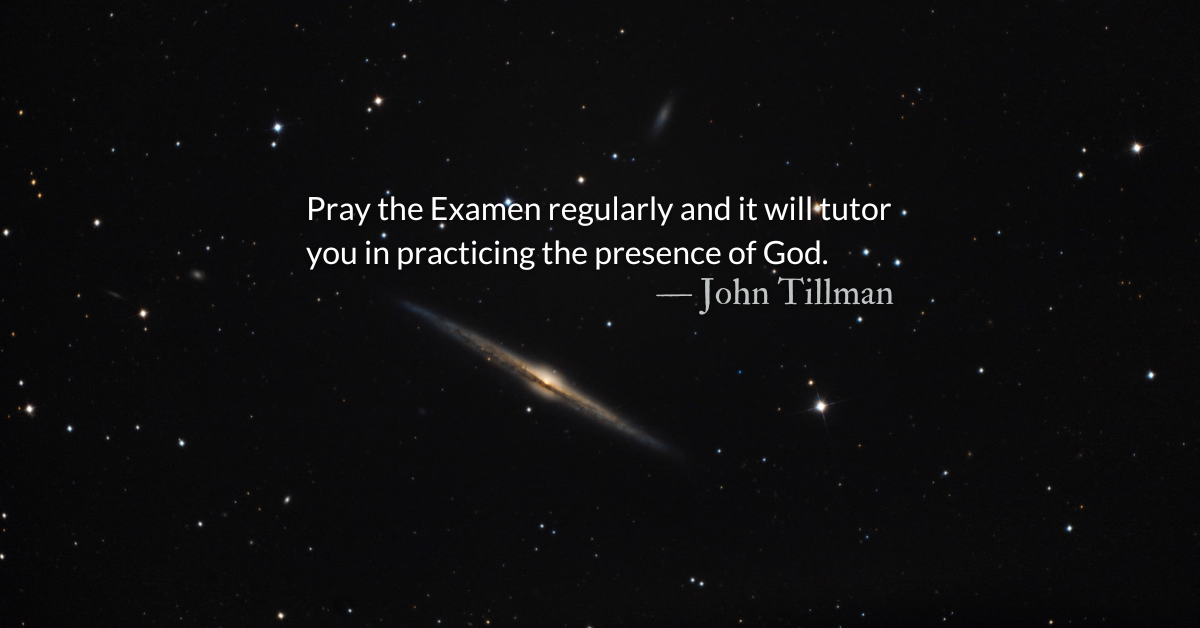
Pray the Examen regularly and it will tutor you in practicing the presence of God. When you are more sensitive to his presence and leading, you can become a reliable source of God’s influence and action, no matter where you go.

For a simple, short version of the Examen, use the following five actions: Awareness, Analysis, Admission, Acceptance, Anticipation.

Awareness: Pause. Relax. Release any concerns your mind is holding. Become aware that you are in God’s presence and have been continually…when you are settled peacefully, thank God for his presence and ask for his grace to be more aware of him, especially in the next few minutes.

Analysis: Review moments from the past day or week in which you sensed God’s presence with you. When and how did you sense him? How did you interact with God or act on God’s prompting or on God’s behalf? … Celebrate moments in which Christ’s grace, love, and righteousness shone through you. Humbly acknowledge that these moments were empowered by the Holy Spirit and not yourself. 

Admission: As you review you will also recall shortcomings and failures. Confess sins with the knowledge that Jesus has forgiven you. Confess not just actions of sin, but motivations behind them. (Not just that you shouted in anger but that you have an unhealthy desire for dominance and control rooted in a failure to trust God…)

Acceptance: Celebrate that, through Jesus, you are forgiven, reinstated, and accepted. This is the good news, the gospel! In addition, celebrate that Christ is at work in and through us for our sanctification and perfection.

Anticipation: Look forward to tomorrow with faith and anticipation of the presence of Christ going before you and being with you. Ask for grace to be more aware of his presence with you going forward, and close with the Lord’s prayer or another prayer chosen from scripture.

The Lord’s Prayer:
Our Father in Heaven, holy is your name.
Your kingdom come and your will be done on earth as it is in heaven.
Give us today our daily bread.
Forgive us our debts as we forgive our debtors.
Lead us not into temptation but deliver us from evil. Amen.

*We will return to prayers from The Divine Hours, next week.

Image Note: In today’s image is NGC 4565, known as the “Needle Galaxy” for its profile. This edge-on spiral galaxy is about 30 to 50 million light-years away. When we practice God’s presence through prayer, we are in the presence of the God who cared about Paul’s chains and who placed this galaxy in the sky for us to find.

Today’s Readings
Ezekiel 21(Listen 5:29)
Colossians 4(Listen 2:21)

This Weekend’s Readings
Ezekiel 22(Listen 4:58)Philemon(Listen 2:52)
Ezekiel 23(Listen 7:48)Ephesians 1(Listen 3:10)

Preview in new tab(opens in a new tab)

Read more about Mustard Seed Prayers
Allow your prayer to be shaped and rewritten by your relationship with God.

Read more about Breathing Prayers
Breath prayers are simply short prayers which can be said “in a breath.” These are often taken from scripture.

The Gospel-Spreading Strategy of Suffering

Scripture Focus: Colossians 1.9-14; 24, 29
9 For this reason, since the day we heard about you, we have not stopped praying for you. We continually ask God to fill you with the knowledge of his will through all the wisdom and understanding that the Spirit gives, 10 so that you may live a life worthy of the Lord and please him in every way: bearing fruit in every good work, growing in the knowledge of God, 11 being strengthened with all power according to his glorious might so that you may have great endurance and patience, 12 and giving joyful thanks to the Father, who has qualified you to share in the inheritance of his holy people in the kingdom of light. 13 For he has rescued us from the dominion of darkness and brought us into the kingdom of the Son he loves, 14 in whom we have redemption, the forgiveness of sins. 

24 Now I rejoice in what I am suffering for you, and I fill up in my flesh what is still lacking in regard to Christ’s afflictions, for the sake of his body, which is the church….29 To this end I strenuously contend with all the energy Christ so powerfully works in me.

Reflection: The Gospel-Spreading Strategy of Suffering
By John Tillman

Colossians, like Philippians, shines with joy, despite being written from confinement. 

Paul challenged the Colossians to live as those belonging to the “kingdom of light” who have been rescued from the “dominion of darkness.” Like Jesus, Paul referred to a kingdom that is not “of this world.” (John 18.36) Paul challenged them to continue spreading the light of the gospel, as Epaphras had spread it to them, but however dark the dominion of Rome was, Paul wasn’t requesting rescue from an earthly empire.

Paul had already been rescued and delivered by God the Father into the kingdom of Jesus from the kingdom of sin. (Colossians 1.13) When Paul, in his own hand, signs this letter, “Remember my chains” (Colossians 4.18), he wasn’t asking for a jailbreak. He’s reminding his readers, including us, what it might take to spread the gospel.

Paul rejoices in his sufferings. He sees them not as something to be freed from but as part of his work on behalf of Christ’s Church. (Colossians 1.24) Today’s church needs this challenge. Especially in the United States, Western Christians know little of suffering for the gospel. We seem to think the gospel depends on our being freed of all constraint, inconvenience, oppression, or mistreatment. How far from Paul’s gospel strategy we have come!

If we are in Christ, we are already in the kingdom. We are ambassadors, not invaders. The kingdom is revealed when we live the life Paul described—one of joy, wisdom, understanding, bearing fruit, doing good works, growing in the knowledge of God, and having power not for conquering but for the patient endurance of suffering. (Colossians 1.11) Like Christ in the garden, we don’t need to be rescued or to conquer by force. (Matthew 26.52-54) Like Christ, and like Paul, our gospel-spreading strategy depends more on what we are willing to suffer than who we are willing to conquer.

Are there freedoms we are fighting for that, if abandoned, would free us to serve the gospel or the church? Are there sufferings we are avoiding that, if accepted and rejoiced in, would show the power of God in us?

Not all sufferings spread the gospel and we certainly shouldn’t seek suffering to gratify our pride or make ourselves feel “righteous.” But let us remember Paul’s chains, and those of fellow Christians around the world, by considering what we are willing to suffer in spreading the gospel.

Divine Hours Prayer: A Reading
Jesus taught us, saying: “I tell you, if anyone openly declares himself for me in the presence of human beings, the Son of man will declare himself for him in the presence of God’s angels. But anyone who disowns me in the presence of human beings will be disowned in the presence of God’s angels.” — Luke 12.8-9

– From The Divine Hours: Prayers for Summertime by Phyllis Tickle.

Today’s Readings
Ezekiel 18(Listen 5:26)
Colossians 1(Listen 4:18)

Read more about Christ’s Supremacy :: A Guided Prayer
We all need repetition in our spiritual lives to reinforce the greatest truths of our faith. One of those truths is the supremacy of Christ.

Read more about Sinless Descendants
They weren’t innocent of their parents’ sins because they were perpetuating them.

Show Buttons
Hide Buttons
Spur a spiritual rhythm of refreshment right in your inbox
By joining this email list you are giving us permission to send you devotional emails each weekday and to communicate occasionally regarding other aspects of the ministry.
100% Privacy. We don't spam.