Never Too Far

Scripture Focus: Jeremiah 18.12
12 But they will reply, ‘It’s no use. We will continue with our own plans; we will all follow the stubbornness of our evil hearts.’”

Reflection: Never Too Far
By Erin Newton

The fate of Israel is like watching a train wreck. 

God calls out to the people through Jeremiah trying to warn them of the coming disaster. It is like the warning signs you see when driving the wrong direction down the road. You bypass the signs telling you not to turn, past the signs that tell you not to enter, and eventually, you’re facing oncoming traffic. But you’ve committed to getting on the highway, so you keep barreling down the road to impending doom.

Is there any time when someone is too deep in sin to repent? Has there been a time in your life where sin had escalated so much so that you gave up trying to change your ways? 

As we saw earlier this week, stubbornness is the hardening of the heart. It is the resolute defiance against change despite consequences or rebukes. There can be a false narrative that we tell ourselves that there is a limit to the grace of God. “I’m too far gone”, we think. Out of shame of possibly sinning “too much” or “too severely,” we assume we cannot return to God. 

On the other hand, perhaps some wish to be out of reach of God. There is no shame for one’s sin in this scenario, only the lust to continue. 

In either case, the truth is that all our sins are seen by God. The psalmist ponders this question, “Where can I go from your Spirit? Where can I flee from your presence? If I go up to the heavens, you are there; if I make my bed in the depths, you are there.” (Psalm 139.7-8) There is nothing that is hidden, nothing out of reach.

As Betsy Ten Boom once said, “There is no pit so deep that God’s love is not deeper still.” The limitlessness of God’s love nullifies the sentiment, “It’s no use.” We cannot let our shame limit the forgiving nature of our God. We must not coddle our sins and limit our free will to change. 

Because our mortal bodies are bound to continue in the realm of time and space, we know that we must continue on each day. For those who have given up on God and themselves, the choice is inevitable disaster. For those who choose to listen to God’s call to return, it is a promise of abundant life.

Divine Hours Prayer: The Small Verse
Let me seek the Lord while he may still be found. I will call upon his name while he is near. 


– From The Divine Hours: Prayers for Summertime by Phyllis Tickle.

Today’s Readings

Jeremiah 18(Listen -3:40)
1 Thessalonians 3(Listen – 1:44)

Read more

Read more about Worth Doing Poorly
No matter how far short we fall, anyone can turn in repentance and take steps with Jesus that make a difference.

Readers’ Choice is Coming!
What posts from the past 12 months helped you? Even if all you have to say is, “It blessed me,” share it with us and we’ll share it with others.

Don’t Hope in Humans

Scripture Focus: Jeremiah 17:5-6
5 This is what the Lord says:
“Cursed is the one who trusts in man,
    who draws strength from mere flesh
    and whose heart turns away from the Lord.
6 That person will be like a bush in the wastelands;
    they will not see prosperity when it comes.
They will dwell in the parched places of the desert,
    in a salt land where no one lives.

Reflection: Don’t Hope in Humans
By Erin Newton

As we read the Old Testament, we often scoff at idolatry. Hmph, how primitive, we think. Most of our world sees God as one of many religious, divine beings but considers all such powers as ultimately nonexistent. By default, trust shifts from the divine to the created order. We are a culture that not only trusts in humanity but takes pride in doing so.

Jeremiah lives among a culture that rarely sees any dichotomy between the natural and supernatural yet speaks of this erroneous way of living that we encounter all the time. The prophet chides the people for trusting in humanity as if nothing could be more foolish. As fools today, our world chides at those who trust in God as if it were all a figment of our imaginations.

Trusting in another human being includes not only trusting another person for security, power, value, identity, and love but also drawing strength from ourselves. The prophet rebukes the mantra to pull oneself up by the bootstraps. He rebukes the idea that a mere mortal could be called upon to fix all of one’s problems. The future of those who trust in humanity will be like those who wander the desert always looking to settle but never finding rest.

We hear politicians speak about promises of a brighter and better future if only we will pick them to lead us. We are confronted with the failures of our religious organizations and are told that if we follow “so-and-so” then everything will be made right. Sometimes we hope that if we can be loved by this one person, then our souls will be filled and our identities complete.

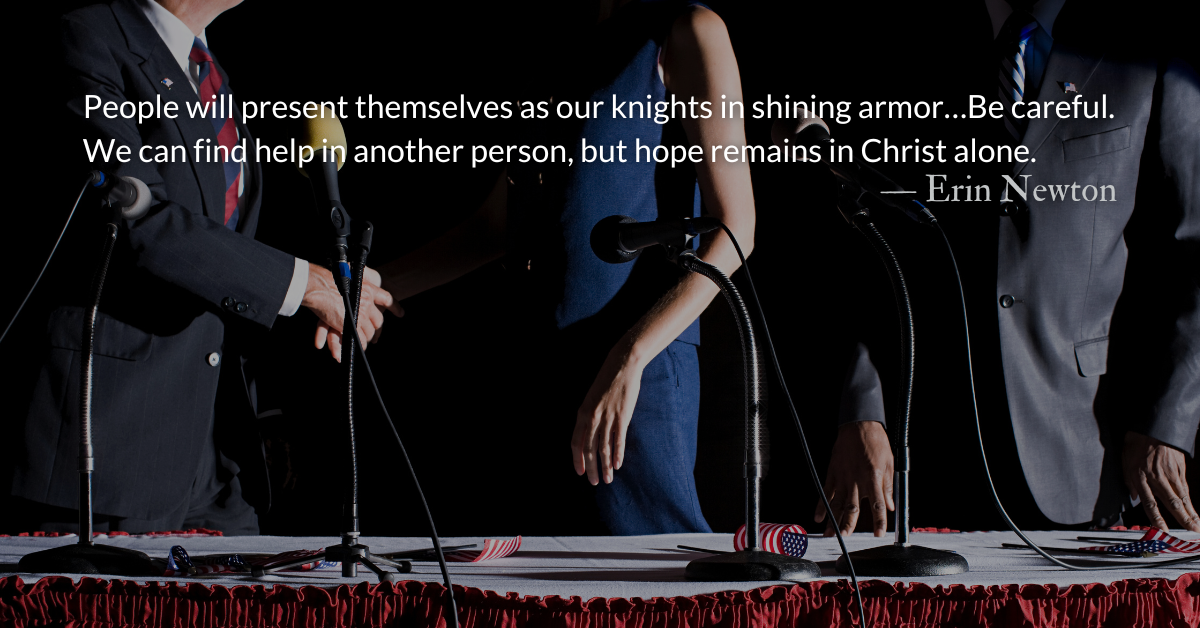
It is a lonely, confusing, and hurting world that we live in. We want something to cling to in times like this. Unsurprisingly, people will present themselves as our knights in shining armor. As we look for hope and answers, let us be careful. We can find help in another person, but hope remains in Christ alone. We cannot call another person our savior or speak about someone as a cure-all for our world.

The only person worthy of our trust is Christ. We can draw strength from our Lord who put on flesh but was fully divine. He is our anchor. God may choose to use men and women to bring peace or prosperity, but wholehearted trust can only be in God. 

Divine Hours Prayer: The Call to Prayer
Come, let us sing to the Lord; let us shout for joy to the Rock of our salvation. — Psalm 95.1


– From The Divine Hours: Prayers for Summertime by Phyllis Tickle.

Today’s Readings
Jeremiah 17 (Listen -4:50)
1 Thessalonians 2 (Listen – 2:53)

Read more about No Princes
How many believers veil their trust in men as trust in God? This can cause problems in two ways.

Readers’ Choice is Coming!
We need to know your favorite posts from the past 12 months. Even if all you have to say is, “It blessed me,” share it with us and we’ll share it with others.

Stubborn Hearts are Hard Hearts

Scripture Focus: Jeremiah 16.11-12
11 Then you will answer them, ‘Because your ancestors abandoned me—this is the Lord’s declaration—and followed other gods, served them, and bowed in worship to them. Indeed, they abandoned me and did not keep my instruction. 12 You did more evil than your ancestors. Look, each one of you was following the stubbornness of his evil heart, not obeying me.


Reflection: Stubborn Hearts are Hard Hearts
By Erin Newton

What can be worse than the worst? There is a sort of irony in this message. Jeremiah’s ancestors had worshiped idols, bowing to the stone and metal they had created. When it comes to high-handedly sinning against God, idolatry is typically the direst example of such sin. Yet, God declares that Jeremiah’s generation is more wicked. What sin can outdo the waywardness of idolatry? Stubbornness. 

The word used for stubbornness is often translated as “hardness of heart.” It is the type of heart that Ezekiel later calls a heart of stone and compares it with a new heart of flesh. It is a self-reliant heart. It is a heart that cannot be corrected, trained, or rebuked. The stubborn person listens only to himself or herself. The stubborn person is confident of oneself and obstinate toward God. 

God was not pleased with the ancestors who had worshiped idols. They broke the first commandment blatantly and without shame. There is within this text the sense that God has always stood by, ready to bestow mercy and forgiveness despite their wayward hearts. We have seen his graciousness over and over in the Old Testament but the tone changes when the people defiantly refuse to change their ways. 

All sins can be enticing in some way or another. The lure of luxury and ease. The seduction of physical pleasure. The appeal of control and power. Stubbornness chooses the pleasure that sin offers over the willingness to cut off one’s hand or pluck out one’s eye for the sake of Christ. (Matthew 5.29)

Beneath the outward expression of stubbornness is a foundation of pride. When we choose pride over humility, we claim to know what is best for ourselves. Pride calcifies the sensitivity of our souls making them callous to conviction. Pride leaves us unable to admit our faults or seek forgiveness. 

How do we prevent stubbornness from taking hold of our hearts? Humility is the answer. We need humility to trust God to deliver us from evil when we are led into temptation. We need humility to accept that we will always fall short. 

Let us ask God to continuously chip away the callous self-reliant edges of our hearts. Let us trust God for what he has done and what he has promised to do. With a heart of flesh, a heart softened to follow Christ, we can live with open hands ready to follow him. 

Divine Hours Prayer: The Request for Presence
Be my strong rock, a castle to keep me safe, for you are my crag and my stronghold; for the sake of your Name, lead me and guide me. — Psalm 31.3

– From The Divine Hours: Prayers for Summertime by Phyllis Tickle.

Today’s Readings
Jeremiah 16(Listen -3:52)
1 Thessalonians 1(Listen – 1:27)

Read more about Choices and Hard Hearts
Hardened hearts happen in stages. Our choices matter. Our hearts are hardened or softened day after day.

Readers’ Choice is Coming!
We need to know your favorite posts from the past 12 months. Even if all you have to say is, “It blessed me,” share it with us and we’ll share it with others.

To Kill a Prophet

Scripture Focus: Jeremiah 11.18-19
18 Because the Lord revealed their plot to me, I knew it, for at that time he showed me what they were doing. 19 I had been like a gentle lamb led to the slaughter; I did not realize that they had plotted against me, saying,
“Let us destroy the tree and its fruit;
    let us cut him off from the land of the living,
    that his name be remembered no more.”

Reflection: To Kill a Prophet
By Erin Newton

There is a risk when you confront bad behavior or rebuke fellow believers. Sin has a way of infecting our hearts so that, as with Frodo or Bilbo Baggins, anyone suggesting we take off the evil ring is met with a darkened, menacing face screaming that friends are out to get us. Jeremiah’s neighbors sought to kill him because he told the people they carried evil around their necks.

What exactly is Jeremiah preaching that causes people to be so upset? There is no new law or new method of worshiping God. He calls them to devote themselves to God alone and to love their neighbors as themselves. This would mean being more benevolent, more gracious, less self-centered, less like the world around them, and more mindful of the covenant to which they were bound.

The language Jeremiah uses to describe the treachery against him is much like Isaiah’s depiction of the suffering servant. Like a gentle lamb, the suffering servant would go quietly to his death. Christ is that servant. Just like Jeremiah, Christ is persecuted for calling the people to live rightly. Some who hear these rebukes clutch at their sins and are poisoned by pride.

When we sit in the pews each Sunday, listen to podcasts about Christian living, or talk with our friends about the current state of Christianity, we will be faced with a call to examine our hearts. We may feel the sting of conviction and the pangs of guilt as the Spirit moves in our souls. When our hearts are darkened to counsel, we may instinctively want to bow up against such preaching. Like Peter in the garden, we might want to pull out a sword and cut the first person in our reach.

Whether we are calling our friends back to truth or hearing the rebuke of a preacher, let us be encouraged by the gentle lamb who walked this way before us.

If in the place of Jeremiah’s friends, angered and resistant to the words of truth, take time with the Spirit to listen. Let the Lord soften our hearts so that we can be shaped to his will. Put away the proverbial swords: the vengeful posts or the angry conversations.

Christ, the gentle lamb, was slaughtered by those who could not stand being corrected. Be quick to listen, slow to speak, and slow to want to kill the prophets. (Matthew 23.29-37)

Divine Hours Prayer: A Reading
Jesus taught us, saying: But I say this to you who are listening: Love your enemies, do good to those who hate you, bless those who curse you, pray for those who treat you badly. To anyone who slaps you on one cheek, present the other cheek as well; to anyone who takes your cloak from you, do not refuse your tunic. Give to everyone who asks you, and do not ask for property back from someone who takes it. Treat others as you would like people to treat you. — Luke 6.27-31

Today’s Readings
Jeremiah 11(Listen -4:09)
Galatians 2(Listen – 3:44)

Read more

Read more about Decorating the Tombs of the Prophets
“Your fathers,” Jesus says, “would not have minded the prophets either, if the prophets were dead.

Readers’ Choice is Coming!
Tell us about your favorite posts from the past 12 months. Even if all you have to say is, “It blessed me,” share it with us and we’ll share it with others.

#ReadersChoice #ReadTheBible

Our Hearts Burn Within

Scripture Focus: Luke 24.31-32
31 Then their eyes were opened and they recognized him, and he disappeared from their sight. 32 They asked each other, “Were not our hearts burning within us while he talked with us on the road and opened the Scriptures to us?”

From John: As we prepare for Student Writers to take us through the book of Acts, we continue through the last three chapters of Luke’s gospel. Don’t forget that, beginning tomorrow, July 15, and continuing through August 10th, approximately 90% of donations to The Park Forum will be directed to scholarships/stipends for these talented students. Give during this time to support our ministry and theirs.

Reflection: Our Hearts Burn Within
By Erin Newton

Rembrandt painted the scene from Luke 24 on two separate occasions. The 1629 version of “The Supper at Emmaus’‘ depicts the reaction of the two men upon the revelation of Jesus’ identity. One man responds in astonishment, face illumined by the divine glow of Jesus. The other has fallen to Jesus’ feet. This version seems to capture the wonderment, “were not our hearts burning within us…?”

After the women had visited the tomb of Jesus on the third day, Luke 24 describes the meeting of Jesus with two other disciples on the road to Emmaus. While traveling, the men had not recognized Jesus and treated him as a stranger. Yet as they talked about the recent crucifixion, this “stranger” began to educate them about the cohesive message of the Old Testament with the recent events.

Once they entered Emmaus and convinced him to stay for dinner, only then were they able to see the man as Jesus himself.

A small miracle had taken place on the road to Emmaus that day. Jesus, truly present in physical form with the signs of the crucifixion scarring his body, could not be recognized. The man these two disciples had spent years following was obscured in their minds.

The journey together likely lasted for hours. The mind-boggling, incomprehensive death of Jesus was now explained as part of the larger story of God’s work in history. All the questions they had were being answered by the man they did not really know.

For many of us, we might hear the words of Christ without seeing him as the divine Savior. We read about Jesus but remain convinced he’s a stranger to our lives. There is a difference between hearing Jesus answer questions about life and seeing Jesus as the answer to questions of life.

When that moment comes, he’s no longer “just a good teacher.” He’s Jesus, our Savior.

When Moses had spent time upon the mountain in the presence of God, his face glowed intensely. The baby in Elizabeth’s womb leapt at the presence of Jesus in the womb of Mary. Like the men on the road, our hearts burn when we are in the presence of God.

Jesus disappeared the moment the men recognized who he was. They would wait for the Spirit to come and dwell within their burning hearts. For us, we recognize Jesus and receive the Helper instantaneously. 

Divine Hours Prayer: The Request for Presence
O God of hosts, show us the light of your countenance, and we shall be saved. — Psalm 80.7

Today’s Readings
Isaiah 42 (Listen -4:11)
Luke 24 (Listen -6:16)

Read more about Jesus Concealed and Revealed
Disciples don’t always seem to recognize the resurrected Jesus. Do we?

Read more about In the Face of Grief
The resurrected Christ seems to have a special preference for appearing to the grieving.

Show Buttons
Hide Buttons
Spur a spiritual rhythm of refreshment right in your inbox
By joining this email list you are giving us permission to send you devotional emails each weekday and to communicate occasionally regarding other aspects of the ministry.
100% Privacy. We don't spam.