Holidays and Death’s Silence

Scripture Focus: Psalm 94:17
17 Unless the Lord had given me help,
    I would soon have dwelt in the silence of death.

Reflection: Holidays and Death’s Silence
By Erin Newton

“What is there really to be thankful for this year?” I sat outside with my dad talking about the upcoming holidays. This is our first major holiday without my mom and there is the painful silence of her absence.

Holidays have all the promises of cheer and merriment as well as the oppressive weight of forced happiness and performative joy. Another friend lamented, “I feel rushed and unable to enjoy the season.” We all feel some sort of pressure from outside circumstances or inward expectations.

Psalm 94 would not be a text you would choose for Thanksgiving and the beginning of Advent. It is a plea for God to enact justice against the wicked. The cry is to God as judge and avenger. But the psalmist’s foot is slipping. Life has become perilous. Anxiety sets in.

In many ways Psalm 94 is a perfect choice for this season. International wars rage around us. Family battles seem no less destructive. Undeserved suffering continues to plague our everyday life.

The Psalmist says, “Unless the Lord had given me help…” The recognition of crises, trauma, grief, pain, hopelessness, and our weakness to remedy it is important. In the same way I have been asked how I manage continuing school or writing or hosting Bible studies in the midst of the never-ending grief. My heart responds, “If it had not been for…,” and I continue with some truth that has anchored me in this turbulent time.

If it had not been for the truth of heaven, I would have dwelt in the silence of death.

If it had not been for the psalms of lament, I would have dwelt in the silence of death.

If it had not been for the hand of Jesus ministering through the hands of a friend who sits quietly next to me as I cry, I would have dwelt in the silence of death.

There are the anchors of faith to buoy us up from the depths of darkness. We remain in the waters, tossing and drifting at sea. But we remain afloat, perhaps just in survival mode as the waves of a busy, social-event-filled month crash over us.

Let us take a moment to consider how God supports us by his unfailing love (v. 18) and gives us joy through his consolation (v. 19). Meditate on how you would finish the phrase, “If it had not been for…”  

Divine Hours Prayer: The Call to Prayer
Search for the Lord and his strength; continually seek his face. — Psalm 105.4

– From The Divine Hours: Prayers for Summertime by Phyllis Tickle.

Today’s Readings
1 Chronicles 19-20 (Listen 5:02)
Psalms 94 (Listen 2:08)

Today’s Readings
1 Chronicles 21 (Listen 5:03Psalms 95-96 (Listen 2:37)
1 Chronicles 22 (Listen 3:25Psalms 97-98 (Listen 2:19)

Read more about Edge of the Abyss
The abyss of despair is like the watery depths of the ocean…The feeling is crushing—helpless, hopeless, vulnerable.

Read more about Supporting Our Work
Our ad-free content is not free to produce. It is supported by donors who help us bring biblical devotionals to inboxes across the world. Consider becoming a donor today.
Edge of the Abyss

Scripture Focus: Psalm 74:9
9 We are given no signs from God;
     no prophets are left,
     and none of us knows how long this will be.

Reflection: Edge of the Abyss
By Erin Newton

Laments are uttered when we come to the end of ourselves. The strong have no need for laments.

We watch as the psalmist lays before God the wretched state of emotions. The sanctuary is ruthlessly destroyed with wave after wave of terror. There is no hope of relief. The psalmist stands and stares into the darkness. Federico Villanueva aptly describes the collective emotion behind Psalm 74, describing the people as “those who are ‘balancing on the edge’ of such an abyss.”

The abyss of despair is like the watery depths of the ocean. It can be a pool of murky water concealed in a dark cave. The feeling is solitary and overwhelming. It can sometimes be the turbulent whirlpools sending all creatures crashing to the ocean floor. The feeling is crushing—helpless, hopeless, vulnerable.

Not many of us will watch someone physically destroy church buildings or burn places of worship. But the psalmist says, “the place where you met with us.” Humanity once walked among the trees with God in Eden. Now, we meet with God in our prayers, in our meditation, in our worship, in our study, and in our fellowship.

Axmen still come and wield their sharpened tools. Someone can come along and destroy these holy meeting places with lies and deception. Organizations can fell the trees of our faith with silence and threats.

When it seems like hope is lost, each breath becomes the song of the lament. Where are you, God? Why are you not here? How long will this last?

The same images of despair become the beacon of hope. The darkness, the waters, the cold, the monsters— these become the message of promise. What God has done in the past gives hope for what he will do in the future.

God harnessed the expanse of the universe, setting boundaries for the sun and the moon. The seasons were set in motion bringing spring to follow winter. Leviathan, chaos incarnate, was crushed and tossed as food to wild animals.

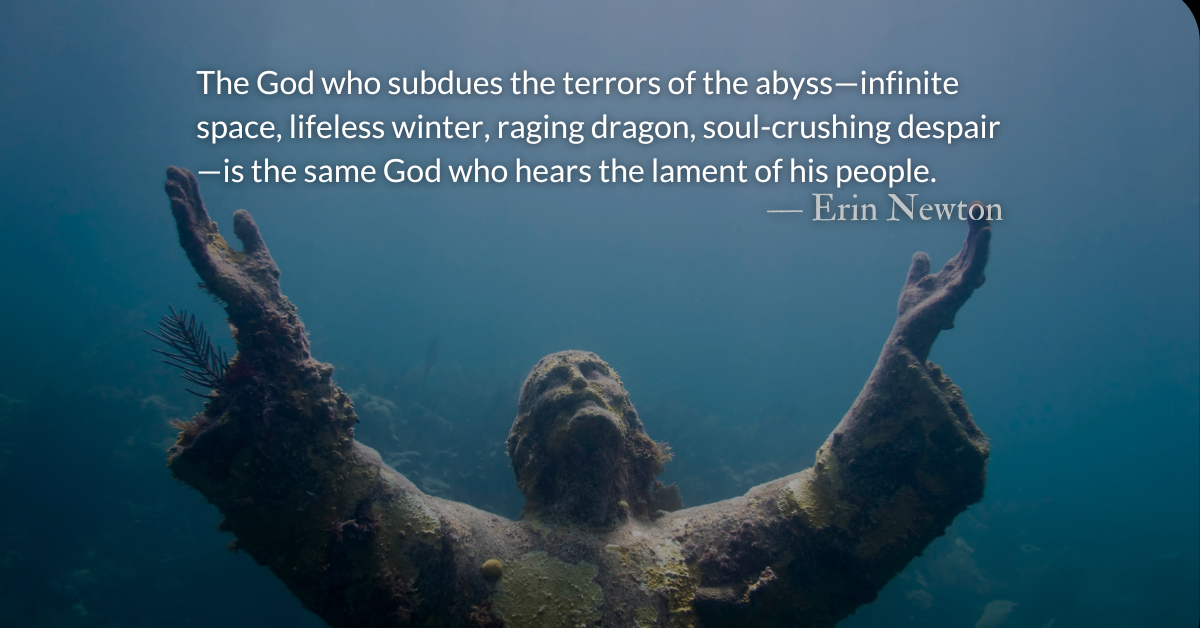
The God who subdues the terrors of the abyss—infinite space, lifeless winter, raging dragon, soul-crushing despair—is the same God who hears the lament of his people.

Let us call upon the God who closes the mouth of the abyss and ask him to remember the vulnerable and the abused. May no person take an ax to the place where God meets with his creation.


Divine Hours Prayer: The Refrain for the Morning Lessons
Send forth your strength, O God; establish, O God, what you have wrought for us. — Psalm 68.28


– From The Divine Hours: Prayers for Summertime by Phyllis Tickle.


Today’s Readings
2 Kings 21 (Listen 4:06
Psalms 74 (Listen 2:34)

Read more about The Struggle against Chaos
One of the thoughts we struggle with is the idea that all the events of life are haphazardly occurring, without meaning, spinning out of control.

Read more about Anxious Nights Between Destruction and Chaos
From the chaos of the sea and the wilderness wind, God brings order and a highway to salvation.

The Plundering of God

Scripture Focus: 2 Kings 14.14
14 He took all the gold and silver and all the articles found in the temple of the Lord and in the treasuries of the royal palace. He also took hostages and returned to Samaria.

Reflection: The Plundering of God
By Erin Newton

Israel and Judah were cousins, descendants of Jacob, and called and bound to the Abrahamic covenant. But down the line, they traded brotherhood for hostility—peace for enmity.

The divided kingdom is a story of the darkest hours for God’s people. Not only were nations attacking Israel and Judah from the outside, but the two nations were attacking each other on the inside.

The king of Judah, Amaziah, went to battle against Jehoash, king of Israel. Amaziah was captured by Jehoash, and his family was taken captive.

This story is not drastically different from many of the conflicts between Israel and Judah in Kings. After capturing the king, they followed the common practice of looting the temple. Gold and silver were removed from the house of the Lord.

Looting the temple of God? The opposing army was their family! Did they not worship the same God? Were those vessels not designated for the God they also vowed to serve?

The movement of temple treasures reveals how common it was for items to be taken. An Egyptian king took treasures, and twice that was given to the king of Syria and the king of Assyria. In the midst of this plundering, the temple was twice repaired.

There was a tree in the center of my town. For decades it served as the community Christmas tree. Each December, the city came together to sing carols, drink wassail, and watch the lights burst forth on the tree during the crescendo of the final carol.

Recently, people began to take leaves off the lower branches. When those were gone, small limbs were snapped away. Slowly the tree was stripped bare. A storm came through one winter, coating everything with ice. The tree didn’t survive.

When I think about the plundering of the temple, I think of this tree.

I remember how it was my own neighbors and friends who slowly stripped bare the tree. I think of Israel stripping the temple of their God.

I think of Christians today, so caught up in fighting one another that the house of God is robbed, desecrated, and laid bare by the hands of those who say they love the God that dwells there. 

Before we tear at each other, trading peace for enmity, may we pause and remember that we are bound by the same covenant and are branches on the same vine.

Divine Hours Prayer: A Reading
Concerning the commandments, Jesus taught us, saying: “This is the first: ‘Listen, Israel, the Lord our God is the One, only Lord, and you must love the Lord your God with all your heart, with all your soul, with all your mind, and with all your strength.’ The second is this: ‘You must love your neighbor as yourself.’ There is no commandment greater than these.” — Mark 123.29-31


– From The Divine Hours: Prayers for Summertime by Phyllis Tickle.

Today’s Readings
2 Kings 14 (Listen 5:06)
Psalms 64-65 (Listen 2:39)

Read more about Conflict’s Aftermath
When did we forget he is the Prince of Peace? Let us ask God to replace the festering anger in our hearts with love.

Read more about Reflecting the Unity of Christ
Prayers for unity and peace from brothers and sisters worshiping in places where violence is as common as bad traffic, are especially to be emulated …

You Matter

Scripture Focus: 2 Kings 6:5-7
5 As one of them was cutting down a tree, the iron axhead fell into the water. “Oh no, my lord!” he cried out. “It was borrowed!”
6 The man of God asked, “Where did it fall?” When he showed him the place, Elisha cut a stick and threw it there, and made the iron float. 7 “Lift it out,” he said. Then the man reached out his hand and took it.

Reflection: You Matter
By Erin Newton

I don’t have anything to pay my taxes. A coin appears in the fish’s mouth.

The wine has run out. Water is transformed.

The tool I borrowed fell into the river. The ax-head floats.

Have you ever started a prayer request with the disclaimer, “I know this is no big deal…” or even avoided sharing a request because it seemed so insignificant in comparison to others?

My brother died. Lazarus walks out of the tomb.

I have bled for a decade. The hem cures a lifetime disease.

They are trying to burn us alive. The three men survive unscathed.

We pray for the big ones—the big needs that seem to warrant prayer because our ability is so evidently outmatched. When we think we are strong, we forget to ask for help. Or maybe we think some things are too small for God.

The story of the floating ax is seven verses long. It is brushed over rather quickly in most commentaries in just one paragraph. It follows a larger miracle—a big one—as Naaman is healed of leprosy. The lack of attention for this physics-defying event reflects our assumption that some things are too small to bother God.

Or maybe it’s just too mundane. Why would God care about a borrowed tool? It was just a tool. Replaceable. Inanimate. Perhaps a little old. Maybe a little dull. Definitely a little broken.

What if the reluctance to ask for help in the little things reflects how we think God looks at us? Do we think God only cares about the big things and the important people?

For all the verses that speak of God’s love for his creation, we sometimes love ourselves very little. We think God only cares about the military commanders with leprosy, not an unnamed prophet cutting down trees.  

The next verses speak of the servant’s miraculous vision of Elisha surrounded by a host of angels, hills covered in horses, and chariots of fire. Nestled among these big miracles is the simple recovery of a borrowed ax.

In our world that promotes grandeur and importance, God still cares about the littlest of things. He sees the faithful person doing a day’s work, nothing grand, nothing glorious, and he cares.
There is no need for a disclaimer on “little” prayers. God’s attentiveness poured out for you comes in the same measure as it is with the highest-ranking officer.

Divine Hours Prayer: The Request for Presence
Love the Lord, all you who worship him; the Lord protects the faithful, but repays to the full those who act haughtily. — Psalm 31.23


Today’s Readings
2 Kings 6 (Listen 5:05)
Psalms 51 (Listen 2:19)

Read more about Don’t Lose Heart: God Hears Your Prayers
God isn’t like us—or the unjust judge. He doesn’t grow weary of our prayers.

Read more about Supporting Our Work
Please consider becoming a donor. Support ad-free content that brings biblical devotionals to inboxes across the world.

The Weakness in Evil’s Armor

Scripture Focus: 1 Kings 22:30, 34
30 The king of Israel said to Jehoshaphat, “I will enter the battle in disguise, but you wear your royal robes.” So the king of Israel disguised himself and went into battle.
34 But someone drew his bow at random and hit the king of Israel between the sections of his armor. The king told his chariot driver, “Wheel around and get me out of the fighting. I’ve been wounded.” 

Reflection: The Weakness in Evil’s Armor
By Erin Newton

No evil act can thwart the providence of God. No person can go unnoticed by the ever-watchful eye of our Lord. Nobody hides from an omnipresent deity.

Ahab ruled over God’s people with an oppressive hand. Confident in his power, he ignored the prophet’s threat and wore a disguise to battle. He tried to control the situation and force a favorable outcome. Then by chance—no, by God’s providence—a stray arrow pierced the king and he died.

Evil leaders seem indestructible. They promote themselves as indestructible. Ahab certainly fit the profile. He was corrupt, deceitful, proud, and merciless. He would rather harm befall his peers. He tried to place the target on his comrade, the king of Judah.

The king shielded his weakness with armor, assuming the protection would be as impenetrable as dragon scales. But even iron-clad monsters are not invincible.

The Hobbit tells a story of Smaug, a dragon who set out to destroy the people of Dale. Cocky and boastful of his armored hide, Smaug taunts the people, “My armor is like ten-fold shields, my teeth are swords, my claws spears…” This prideful spirit is just like Ahab. But a weakness in the armor of king and dragon will be found.

In each story, a single arrow strikes in the smallest gap of the armor. The miraculous “once in a lifetime” shot is an arrow finding its target. For our story, it is an arrow guided by the almighty hand of God. The undefeated Creator of the world can bring down evil leaders with a slender stick and random human efforts.

Such is the providence of God. Scheming evil leaders assume they have power to hide themselves, control the circumstances, and escape judgment. The story of Ahab reminds us of the omnipotence of our God.

But some aspects of his providence are difficult to understand. What about all the prophets harmed by Ahab’s rule and Jezebel’s rage? Why could not that arrow have flown years earlier?

We simply do not know. And this leads us to the place in our faith that we must hold in tension: God’s sovereign rule and the continuance of evil. We know God despises evil and grieves such atrocities. We fill our hearts with pleas for justice and intercession for the weak.

Rest assured, no one escapes the will of God. Not even leaders who think they can hide. 

Divine Hours Prayer: The Greeting
Who is like you, Lord God of hosts? O mighty Lord, your faithfulness is all around you.
Righteousness and justice are the foundations of your throne; love and truth go before your face. — Psalm 89.8

– From The Divine Hours: Prayers for Summertime by Phyllis Tickle.

Today’s Readings
1 Kings 22 (Listen 7:51)
Psalms 44 (Listen 2:44)

Read more about Kings Like Ahab
Ahab gets the most ink in Kings. He’s unquestionably wicked, yet God used and spoke to him frequently. Why?

Read more about Evil, Judgment, or Discipline?
Sometimes bad things happen as part of God’s judgment…as Johnny Cash sang, “…sooner or later, God’ll cut you down.”