

Links for today’s readings:
Jan 14 Read: Job 14 Listen: (2:23) Read: John 14 Listen: (4:13)
Scripture Focus: Job 14:5-10
5 A person’s days are determined;
you have decreed the number of his months
and have set limits he cannot exceed.
6 So look away from him and let him alone,
till he has put in his time like a hired laborer.
7 “At least there is hope for a tree:
If it is cut down, it will sprout again,
and its new shoots will not fail.
8 Its roots may grow old in the ground
and its stump die in the soil,
9 yet at the scent of water it will bud
and put forth shoots like a plant.
10 But a man dies and is laid low;
he breathes his last and is no more
Reflection: Can We Live Again?
By Erin Newton
In case no one has told you, it’s ok to disagree with the Bible. Of course, that comes with the caveat that you need to understand context. Verses in a silo can be misunderstood. Scripture without context is dangerous.
Job’s complaints and his friend’s advice are good examples of a “yes, but” interpretation. Here, Job continues his emotional lament about the status of his life. His perspective is bleak and hopeless.
Even if we, today, can read the Scriptures and see the promises of eternal life from the very beginning of Genesis, Job wasn’t there yet. Life in that time was measured by one’s earthly accomplishments, one’s legacy. This is why Job is so distraught. His legacy cannot continue through his children for they have all died. His legacy cannot continue through his social status for he is now a sore-covered outcast. His legacy cannot continue through his wealth for his livestock all perished.
So we come to Job 14 with a measure of sympathy and contextual understanding. This life, here, is utterly important to him. His life, at this point, is also utterly dreadful. He understands the limits of one’s life. He knows that it is God who ordains a person’s days. We can find hope in that.
I remember when my child was sick and doctors were unable to assure me of his recovery. This truth, from Job’s own mouth, resonated in my soul. God determines the limits of life. We cannot die without God knowing.
Although this is something that we can hold as true, it doesn’t (and didn’t years ago) stop me from pleading with God to keep watch, to intervene, or to extend one’s days.
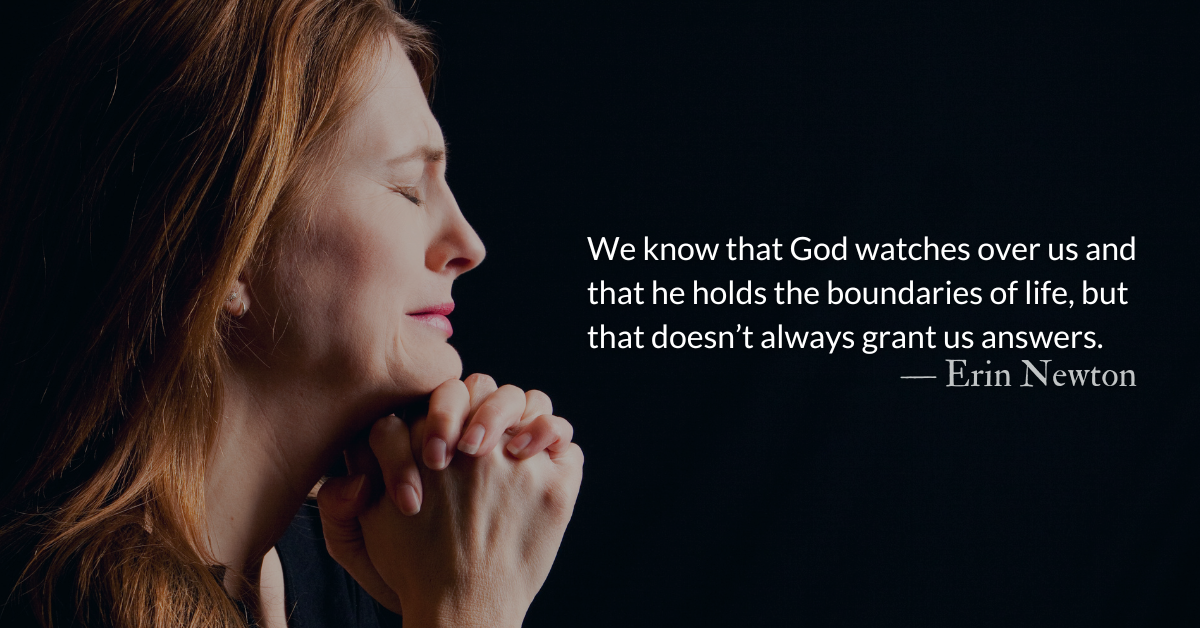
The book of Job is all about tension. We know that God watches over us (“Have you considered my servant Job?”) and that he holds the boundaries of life (“A person’s days are determined”), but that doesn’t always grant us answers.
Job envies the trees that can sprout back to life. When Job finds resolution in his suffering at the end of the book, he reenters the land of living.
We look to the future of eternal life. But in the midst of suffering now, I think God asks us to consider the rejuvenation of trees. We can return to the land of the living—but that means accepting the uncertainty of life and choosing to be present.
Divine Hours Prayer: The Call to Prayer
But I will call upon God, and the Lord will deliver me.
In the evening, in the morning, and at noonday, I will complain and lament,
He will bring me safely back…God, who is enthroned of old, will hear me… — Psalm 55.17
– From The Divine Hours: Prayers for Autumn and Wintertime by Phyllis Tickle.
Read more: Hope In the Tree of the Cross
The idea that God will raise humans to eternal life is a seed in Job…and blooms in the gospels.
Read more: The Arm of Flesh versus the Prince of Peace
How can we tell the difference between Sennacherib’s propaganda and Hezekiah’s true faith?

