
An Imprecatory Psalm for Mass Shootings

Scripture Focus: Galatians 6.7-10
7 Do not be deceived: God cannot be mocked. A man reaps what he sows. 8 Whoever sows to please their flesh, from the flesh will reap destruction; whoever sows to please the Spirit, from the Spirit will reap eternal life. 9 Let us not become weary in doing good, for at the proper time we will reap a harvest if we do not give up. 10 Therefore, as we have opportunity, let us do good to all people, especially to those who belong to the family of believers.

Reflection: An Imprecatory Psalm for Mass Shootings
By John Tillman

In the Dallas-Fort Worth metroplex, when you ask how far away something is, we answer in minutes, not miles. Allen, Texas is about a 40-minute drive from us but this weekend it seemed much closer. As I tried to write today’s devotional the morning after the Allen shooting my thoughts kept returning to it. 

I went to church after writing the 1st draft of this. As normal, I paused to think about what I should do in case of a shooting. Every Sunday, I think about the exits, the likely direction of an attack, and what, if anything, I could do other than help people escape. 

This shouldn’t be normal.

I was a student at Southwestern Baptist Theological Seminary when the shooting at Wedgewood Baptist Church happened on September 15, 1999. I did not know any of the victims personally but one of them was in a class with me. I remember stepping out of the memorial service in SWBTS chapel to get tissues from the bathroom and pass them out to those weeping near me. It wasn’t enough for me to weep with the weeping, or pray without doing something.

Shootings weren’t normal then. Now they are so normal, we do nothing about them except pray.

Someone asked, “What do you pray for when you pray about mass shootings.” My prayers in these situations mirror the imprecatory psalms of scripture. 

Perhaps this prayer is too raw or angry for you to pray. That’s okay. Pray your own prayer. The imprecatory psalms and our angry prayers in crisis are still valuable to God:

An Imprecatory Psalm for Mass Shootings:
Jesus, be with the victims and their families. 
Heal physical, emotional, and spiritual wounds.

God, may swift justice fall on attackers and accomplices.
“Kings” do not bear the sword for nothing.
May that sword swing and find its target.
May evil be punished in this world to the best of our ability.

Holy Spirit, convict those leaders who continue to do nothing in response to these crimes.
Afflict them with lack of sleep and lack of peace.
Do not listen to their prayers!
Turn your face away from them until they establish just laws that:
Prevent these events prior to their happening
Protect victims during these events, and
Prosecute those who contributed to these events afterward.

Throw your covering over us, Lord. Have mercy.
How long, O Lord? How long?

Divine Hours Prayer: The Greeting
To you I lift up my eyes, to you enthroned in the heavens.
As the eyes of servants look to the hand of their masters, and the eyes of a maid to the hand of her mistress,
So our eyes look to the Lord our God, until he shows us his mercy. — Psalm 123.1-3

– From The Divine Hours: Prayers for Springtime by Phyllis Tickle.

Today’s Readings
Numbers 17-18(Listen 6:58)
Galatians 6 (Listen 2:18)

Read more about Justice of God
Sometimes when we find penalties in the Bible harsh, it is because we have been fortunate enough to never suffer serious harm.

Read more about Praise God for the Justice of the Gospel
The psalms were artistic endeavors, not legal documents or court decisions. They are the cries of the victims, not the verdict of the judge.

Bad Yeast and Good Yeast

Scripture Focus: Galatians 5.6-9
6 For in Christ Jesus neither circumcision nor uncircumcision has any value. The only thing that counts is faith expressing itself through love. 

7 You were running a good race. Who cut in on you to keep you from obeying the truth? 8 That kind of persuasion does not come from the one who calls you. 9 “A little yeast works through the whole batch of dough.”

Reflection: Bad Yeast and Good Yeast
By John Tillman

Paul repeats this line, “A little yeast works through the whole batch of dough” in 1 Corinthians. (1 Corinthians 5.6-7) In Corinthians, Paul was concerned that a case of sexual immorality would spread and damage the reputation of the church. Here, Paul was concerned that the Galatians were being misled to follow strict Jewish laws.

So which is it, Paul? Does “yeast” lead to breaking God’s law or to following God’s law? If one law from scripture is binding, Paul, why do you say people don’t have to follow them all?

In the majority of scripture, yeast is treated like a corrupting agent. Nearly every mention is about keeping yeast out of spaces, places, and food that is holy. This goes back to the establishment of Passover. Making bread without yeast in that meal symbolized the haste with which the Israelites were to leave Egypt. (Exodus 12.34-39) All the ceremonial bread used in worshiping the Lord in the Tabernacle was to be made without yeast because it was looking back to that moment.

Yeast was removed from Jewish communities during Passover because just a little could make an entire batch of bread unusable. Even today, on the night before Passover, Jewish families will search through the house for crumbs of leavened bread, hidden by parents for children to find. These will be thrown out or burned.

Paul, and Jesus, were concerned about the yeast of false teaching and sin. They wanted it exposed and thrown out. Jesus warned about this in Mark, Matthew, and Luke. (Mark 8:14-21; Matthew 16.5-12; Luke 12.1-2) In Luke, Jesus specified yeast as the sin of hypocrisy and stressed that hidden things would be exposed. However, Jesus also compared the Kingdom of God to yeast spreading through a large batch of dough. (Luke 13.18-21)

So, there is good yeast which is the gospel the Galatians risked losing. And there is bad yeast, including pride, self-righteousness, hypocrisy, sexual immorality, and other sins.

We need to seek out and throw out bad yeast. This yeast puffs us up with pride which could lead to self-righteous-rule-enforcing or self-righteous-rule-breaking. Sinful yeast makes us unclean and infects everything we touch.  

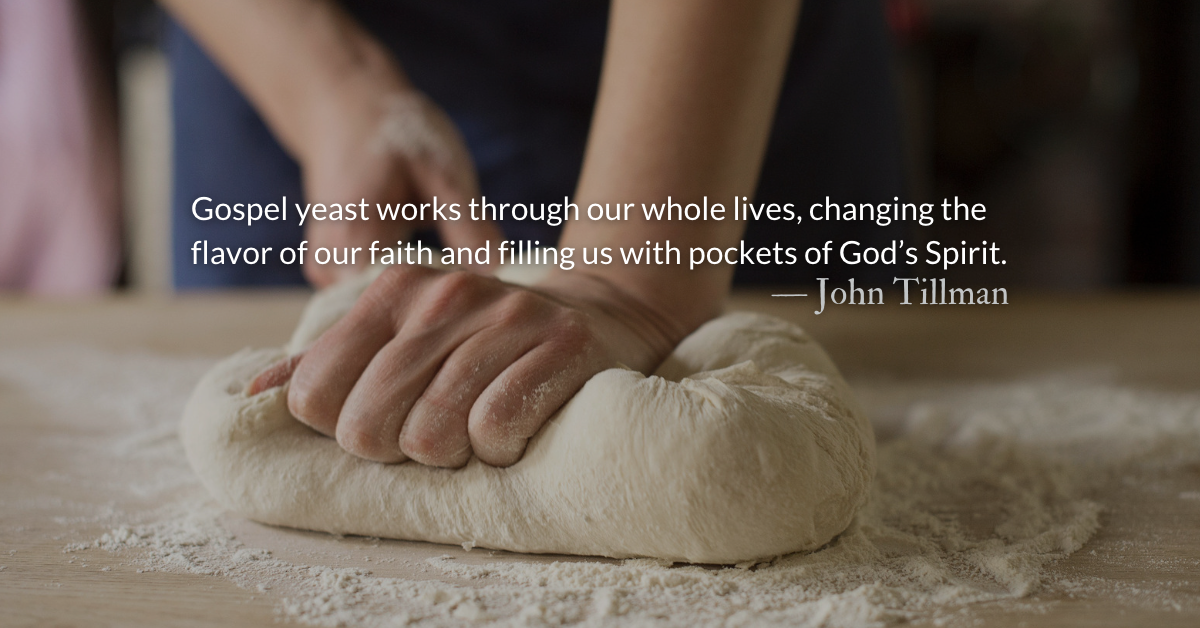
We need gospel yeast. This yeast works through our whole lives, changing the flavor of our faith and filling us with pockets of God’s Spirit. Serve the world with gospel yeast. This yeast is the yeast that counts: “faith expressing itself in love.” (Galatians 5.6)

Share the gospel. It is good yeast.


Divine Hours Prayer: The Call to Prayer
Let my mouth be full of your praise and your glory all the day long. — Psalm 71.8

– From The Divine Hours: Prayers for Springtime by Phyllis Tickle.


Today’s Readings

Numbers 16 (Listen 6:59)
Galatians 5 (Listen 3:22)

Read more about The Law that leads to Grace
Thank you, God, for grace through faith that cannot be downgraded and a Law designed to lead us to grace.

Read more about Of Grace and Thorns
Paul’s thorn in the flesh is one of the great unknowns of scripture.

Downgrading Grace

Scripture Focus: Galatians 2.21
I do not set aside the grace of God, for if righteousness could be gained through the law, Christ died for nothing!

From John: Over the past few years, grace seems to have been downgraded, not just in soteriology, but as a mode of life. Prideful smugness is preferred. Slights and insults are the valued verbal currency. Self-righteous superiority, bluster, boasting, and striving are qualities our culture chases in our leaders. Yet Christ calls to us with simple grace. Come. Be clean. Come. Be with me. Come. Be healed. Come. Be made righteous.

May we confront our graceless culture with grace.

Reflection: Downgrading Grace
By John Tillman

Grace, once gained, can be forgotten and replaced with a smug and damaging form of self-righteousness. We can forget too easily from what Christ saved us and at what cost. This is a dangerous form of amnesia and Paul will not allow the Galatians or even the prominent leaders of the church to fall into it.

Paul shows us a model for biblical confrontation in Galatians. He is direct. He is personal. He seeks restoration.

Galatians may not seem as stridently corrective as some of the passages from the letters to the Corinthians, but Galatians is the only letter of Paul to contain all correction and no praise. Paul gets straight to the point and does not hesitate. He confronts the Galatians head on telling them that he is amazed they are abandoning the gospel of grace through which they were saved. And he relates his story of boldly opposing Peter to call out this downgrade of grace and cheapening of the gospel.

Paul got personal with the Galatians and with Peter. When confronting them about favoritism, Paul quoted Peter’s testimony from Acts 10.34 saying “God shows no favoritism.” When he confronted Peter, he discussed personal practices and details with Peter, telling him exactly what Paul considered to be wrong about what Peter was doing.

Paul never lost sight, even in a corrective mode, of the unity and grace for all found in Christ. Paul’s often-quoted passage about being “crucified with Christ, and I no longer live but Christ lives in me,” demonstrates a shared life in Christ and is a part of his dramatic speech to Peter on his visit to Antioch.

Christ’s sacrifice is at the center of Paul’s argument against any other action being any part of salvation. The sufficiency of faith in Christ cannot be reduced. Paul would not allow the council at Jerusalem or Peter or the Galatians to downgrade grace through faith. When we downgrade grace through faith, we chip away at the cross of Christ, making it an additive to our life rather than the sole source of our life.

Divine Hours Prayer: The Refrain for the Morning Lessons
For God, who commanded the light to shine out of darkness, hath shined in our hearts, to give the light of the knowledge of the glory of God in the face of Jesus Christ. — 2 Corinthians 4.6

– From The Divine Hours: Prayers for Springtime by Phyllis Tickle.

Today’s Readings
Numbers 12-13 (Listen 5:53)
Galatians 2 (Listen 3:44)

This Weekend’s Readings
Numbers 14 (Listen 6:15), Galatians 3 (Listen 4:39)
Numbers 15 (Listen 5:09), Galatians 4 (Listen 4:13)

Read more about On Surrender
What things inside stand as barriers between you and God’s complete possession of all that you are?

Read more about Supporting Our Work
Support our ad-free content that brings biblical devotionals to inboxes across the world. Become a one-time or recurring donor today.

Defender of Grace

Scripture Focus: Galatians 1.9-10, 23-24
9 As we have already said, so now I say again: If anybody is preaching to you a gospel other than what you accepted, let them be under God’s curse! 
10 Am I now trying to win the approval of human beings, or of God? Or am I trying to please people? If I were still trying to please people, I would not be a servant of Christ. 

23 They only heard the report: “The man who formerly persecuted us is now preaching the faith he once tried to destroy.” 24 And they praised God because of me. 

Reflection: Defender of Grace
By John Tillman

Paul was an elite member of one of the most powerful factions of Judaism—a “pharisee of Pharisees.” He had studied under Gamaliel, one of the greatest scholars of his day. He was commissioned by the religious authorities to act on their behalf to defend the law.

It is from this charge that he turns to become the defender of grace. Paul converted from being a disciple of law to an apostle of grace. His conversion stands as one of the repeated touchstones of his teaching, his testimony, and his reasoning.

As much as Paul knew and loved the law, he knew that life did not come from the law—death did. Chares Spurgeon, in a sermon on Galatians, said, “…but while the law is glorious, it is never more misapplied than when it is used as a means of salvation.” Spurgeon continues:

“It was written on stone; as if to teach us that it was a hard, cold, stony law—one which would have no mercy upon us, but which, if we break it, would fall upon us, and dash us into a thousand pieces. O ye who trust in the law for your salvation! Ye have erred from the faith; ye do not understand God’s designs; ye are ignorant of every one of God’s truths.” 

Spurgeon concludes that the law was a tool of God to teach us to receive the better offering of God’s grace:

“It was intended by its thunders to crush every hope of self-righteousness, by its lightning to scathe and demolish every tower of our own works, that we might be brought humbly and simply to accept a finished salvation through the one mighty Mediator who has “finished the law, and made it honorable, and brought in an everlasting righteousness,” whereby we stand, complete before our Maker at last, if we be in Christ.”

We make a mistake when we think of “The Bible” as “the Law” that we must keep. The Law is in the Bible but the Bible is not the Law. The Bible contains the law as a seed. What grows from that seed, through the husbandry of Christ’s sacrifice, is the flower of grace. The Bible is the story of Christ’s flowering, fragrant, and beautiful work of grace.

Divine Hours Prayer: The Greeting
My mouth shall recount your mighty acts and saving deeds all day long; though I cannot know the number of them. — Psalm 71.15

– From The Divine Hours: Prayers for Springtime by Phyllis Tickle.

Today’s Readings
Numbers 11 (Listen 5:22)
Galatians 1 (Listen 3:05)

Read more about Grumbling and Doubt
No matter how deep the hole we are grumbling at the bottom of, God’s arm is not too short to reach us and lift us out.

Read more about Paul’s Stance on Gentleness
May we tear down arguments and strongholds, but never people for whom Christ died.

The Patience of Job

Scripture Focus: James 5.11
11 As you know, we count as blessed those who have persevered. You have heard of Job’s perseverance and have seen what the Lord finally brought about. The Lord is full of compassion and mercy.

Reflection: The Patience of Job
By Erin Newton

Some English versions use the phrase, “the patience of Job.” Really? If you remember the book of Job, patience is typically not the description you had in mind. The Old Testament story of Job reveals a man in the midst of great peril and distress. He lays out his petition before God, pleading for an answer, “Why me? What did I do to deserve such suffering?” Job’s words are tense and angry. He speaks openly through his pain and spares no words.

We can look at the end of Job’s story and see that God restores him once more. We might call that “patience,” but it looks very different than what we would expect.

There is another story of Job that you might not know. The Testament of Job is a Greek version of Job’s story and was not included in the Protestant Canon. This story emphasizes the patient, long-suffering nature of Job and includes a message from Job to his children to be patient, for “patience is better than anything.”

Both stories about Job reveal the essence of patience: keeping the faith. Despite the bitterness of Job’s words in the canonical book, he proclaims, “My ears had heard of you, but now my eyes have seen you.” Patience turns hearsay faith into realized faith.

Patience has been a theme of James 5. Be patient like a farmer waiting for the Lord. Be patient in your interactions with one another. Be patient like the prophets who spoke of promises and days that they would not live to see.

What is patience? Patience is perseverance. Patience is the long and steady endurance of faith. Patience is waiting for God to answer your prayer. Patience is waiting for the healing of the sick. Patience is asking God to show a miracle and waiting years to see it happen.

The trials and struggles of life will test our perseverance. Our patience with ourselves, one another, and God will wear thin. We will speak angry words in our prayers and speak judgments on our neighbors. James understands the reality of the difficulty of patience.

James’ final words are a picture of patience that wanes during trials. When perseverance fails, a person wanders from the faith. James knows the amount of patience required for one to seek out their lost friend. Yet, we consider it a blessing to persevere for Christ and our neighbors.

Divine Hours Prayer: The Small Verse
The people that walked in darkness have seen a great light; on those who live in a land of deep shadow a light has shone. — Isaiah 9.1

– From The Divine Hours: Prayers for Springtime by Phyllis Tickle.

Today’s Readings
Numbers 10 (Listen 4:11)
James 5 (Listen 3:01)

Read more about Job’s Christlikeness
Job is an early “type” or example of Jesus. He demonstrates or proves God’s righteousness through suffering and death.

Read more about Lamenting With Job
Lament is frequent and important in the Bible and should be in our lives as well.