What Prayer Delivers

Scripture: Romans 5.1-2
We have peace with God through our Lord Jesus Christ, through whom we have gained access by faith into this grace in which we now stand.

Reflection: What Prayer Delivers
By John Tillman

We have often written, and discussed in our community that prayer is not a grocery list for God. That’s not what it means for God to be our Deliverer. Those who treat prayer so, will continually be disappointed at what must seem a very poor return on investment.

Some in the church have set prayer up to fail with this kind of teaching—attempting to create a longing for prayer through a materialistic longing for a better job, or positive, tangible outcomes in life. Teaching such as this short-circuits the real and actual longing for prayer that already exists in each person. Roberta C. Bondi discusses this in her essay, The Paradox of Prayer.

There is a deeper reason for our longing for prayer. We are so made that we cannot live fully without it. Prayer is central to the Christian life. It joins us to God, and it leads us to ourselves in God.

Prayer is something far deeper in the human soul than a list of materialistic items. It comes from longings that each person feels—a longing for identity, a longing for connection, a longing for purpose.

In prayer we find things that are more valuable than what a “deliverer god” (lowercase) might pick up at the shop on the way over. We discover who we are, who loves us, and to whom we are to carry that love—for we are God’s delivery system, not the other way around.

Prayer connects us to God, to our true selves, and to our true purpose. Bondi continues:

It is the place where we can be completely ourselves. In prayer we can see ourselves as we are and be truthful about what we see. We can enjoy our own gifts and wonder at all we have been given. We can argue with God about who we are and who we have been. We can acknowledge our mistakes and set them aside. Most important, we can learn to love God, ourselves as belonging to God, and other people as images of God, because we are shaped at our very deepest levels by our prayer.

*Quotes from Roberta C. Bondi’s essay, The Paradox of Prayer, in Communion, Community, Commonweal, edited by John S. Mogabgab.

The Request for Presence
Bow down your ear, O Lord, and answer me… Keep watch over my life, for I am faithful. — Psalm 86.1-2

– From 
The Divine Hours: Prayers for Summertime by Phyllis Tickle.

Full prayer available online and in print.

Today’s Readings
1 Samuel 5-6 (Listen – 5:03)
Romans 5 (Listen – 3:53)

Tempting God :: A Lenten Reflection

If morality was all that Christ desired for the lives of his followers, the cross would be superfluous. Christ’s response, when tempted in the wilderness, wasn’t “that would be immoral,” but, “You shall not put the Lord your God to the test.”

Theologian J.P. Lange explains; “To tempt God is to involve oneself in four contradictions: (1) faith without obedience, (2) prayer without self-surrender, (3) action without warrant from on high, and (4) success without comfort or assurance.”

To tempt God is to give the appearance of spiritual vitality, as Lange points out, but still live unfaithfully. Jesus’ success in temptation shows how broken we are. The Christian experience isn’t just about doing the right things—if we cultivate righteousness under our own power, we still miss relationship with God.

“If the truth of being justified by Christ alone—not by our works—is lost, then all Christian truths are lost,” Martin Luther cautioned. The great reformer believed one of the keys to faithfulness was renewing the gospel—the good news of Christ’s work—in our hearts daily. Luther continues:

Now both these things continue while we live here. We are accused, exercised with temptations, oppressed with heaviness and sorrow, and bruised by the law with its demands of active righteousness. These attacks fall upon our flesh—the part of our heart that still seeks to earn our salvation.

There is no middle ground between Christian righteousness and works-righteousness. There is no other alternative to Christian righteousness but works-righteousness; if you do not build your confidence on the work of Christ you must build your confidence on your own work. On this truth and only on this truth the church is built and has its being.

This distinction is easy to utter in words, but in use and experience it is very hard. For in times of struggle, the devil will seek to terrify us by using against us our past record, the wrath, and law of God. So learn to speak to one’s heart and to the Law. When the law creeps into your conscience, learn to be a cunning logician—learn to use arguments of the gospel against it.
Today’s Reading
Job 11 (Listen – 2:01)
Romans 15 (Listen – 4:32)This Weekend’s Readings
Job 12 (Listen – 2:21)  Romans 16 (Listen – 3:30)
Job 13 (Listen – 2:27)  1 Corinthians 1 (Listen – 4:03)

The Root of Faithfulness

Don’t aim at success—the more you aim at it and make it a target, the more you are going to miss it. For success, like happiness, cannot be pursued; it must ensue, and it only does so as the unintended side-effect of one’s personal dedication to a cause greater than oneself or as the by-product of one’s surrender to a person other than oneself. — Victor Frankl

Every temptation Christ faced was rooted in something which he was within his rights to claim. Jesus was tempted to claim his rights by his own power, on his own timeline, and apart from his Heavenly Father. The temptation account is not a lesson inspiring the faithful to live stronger lives, instead Christ demonstrates what is possible when a person’s identity is firmly rooted in God.

In the sum of his life, Christ’s success was antithetical to worldly success. He restored man’s broken relationship with God, defeated evil, and rose to the right hand of his Father. To accomplish this he became impoverished, homeless, rejected, scorned, beaten, and executed. There are contemporary versions of Christianity that pray for all opposition to be removed—they are effectively praying they fail at following Christ. In Jesus’ own words:

If anyone would come after me, let him deny himself and take up his cross and follow me. For whoever would save his life will lose it, but whoever loses his life for my sake will find it. For what will it profit a man if he gains the whole world and forfeits his soul?

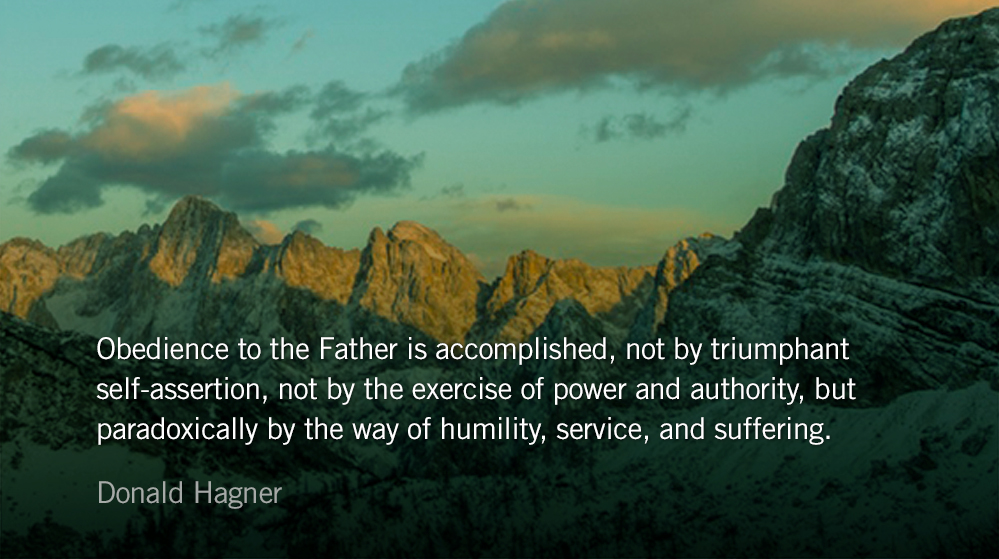
In meditating on the story of Christ’s obedience in temptation, we must focus our attention to how and why he was steadfast. Donald Hagner, a theologian at Fuller in southern California, writes,

The goal of obedience to the Father is accomplished, not by triumphant self-assertion, not by the exercise of power and authority, but paradoxically by the way of humility, service, and suffering. Therein lies true greatness. In fulfilling his commission by obedience to the will of the Father, Jesus demonstrates the rightness of the great commandment as well as his own submission to it.

Today’s Reading
Job 10 (Listen – 2:12)
Romans 14 (Listen – 3:28)

The Heart of Temptation :: Lenten Reflections

The heart of Christianity isn’t morality, so the nature of temptation isn’t a draw toward immorality. As we enter in to the first day of Lent—a season of fasting and servicemindfulness, and community—we take time to reflect on the temptation of Christ. In the brutality of the wilderness we see that the heart of temptation is to convince us that life is better without God.

Divine sonship for Jesus meant far more than the power to do miracles. Jesus’ intimacy with the Father reoriented every aspect of his life. Therefore, when he faced temptation, this holy relationship was hit hardest. It is no different today. Temptation strikes at the core of our identity. N.T. Wright observes:
The first two temptations play on the very strength he has just received. ‘You are my son, my beloved one!’, God had said to him. Very well, whispers the demonic voice; if you really are God’s son, surely he can’t want you to go hungry when you have the power to get food for yourself?

In the wilderness the offer is made: quench your material longings by your own ability. Jesus’ reply? In the end, that wouldn’t satisfy my deepest longings. We have so many appetites—find a way to feed them all on your own and you’ll still be hungry.

Theologian Don Garlington writes,
The impact of Satan’s temptation is that Jesus, like Adam first and Israel later, had a justifiable grievance against God and therefore ought to voice his complaint by ‘murmuring’ (compare Exodus and Numbers) and ought to provide for himself the basic necessity of life, namely, bread.
Satan, in other words, sought to make Jesus groundlessly anxious about his physical needs and thus to provoke him to demand the food he craved.

The invitation of Christ is an invitation to have our deepest needs met in someone whose very nature is love. In the embrace of his mercy and grace we find the resting place for our identity. We experience in Christ’s forgiveness of us the freedom to forgive others. We find in Christ’s power all we need to flourish in the wilderness of our world.

Today’s Reading
Job 9 (Listen – 3:22)
Romans 13 (Listen – 2:35)

The Community of Lent

I appeal to you therefore, brothers, by the mercies of God, to present your bodies as a living sacrifice, holy and acceptable to God, which is your spiritual worship. — Romans 12.1
Lent is the opportunity for Christian communities to integrate personal faith with corporate works. The experience of fasting with a community brings the great commandment to life:
Hear, O Israel: The Lord our God, the Lord is one. You shall love the Lord your God with all your heart and with all your soul and with all your might.
The structure of this commandment is fascinating: a corporate belief—the Lord our God—followed by individual disciplines—you shall. Paul echoes this framework in Romans 12: in light of what we have experienced of God’s mercy, each of you live in this way. In Recovering Biblical Worship, N.T. Wright explains:
Heirs of the Reformation are so drilled in justification by faith that we easily forget that when Paul comes to worship and obedience he delights in declaring that what we do in Christ, on the basis of God’s mercy, is pleasing to God. This is not taking away one jot or tittle from justification by faith; here in Romans itself it is that to which justification by faith leads you.
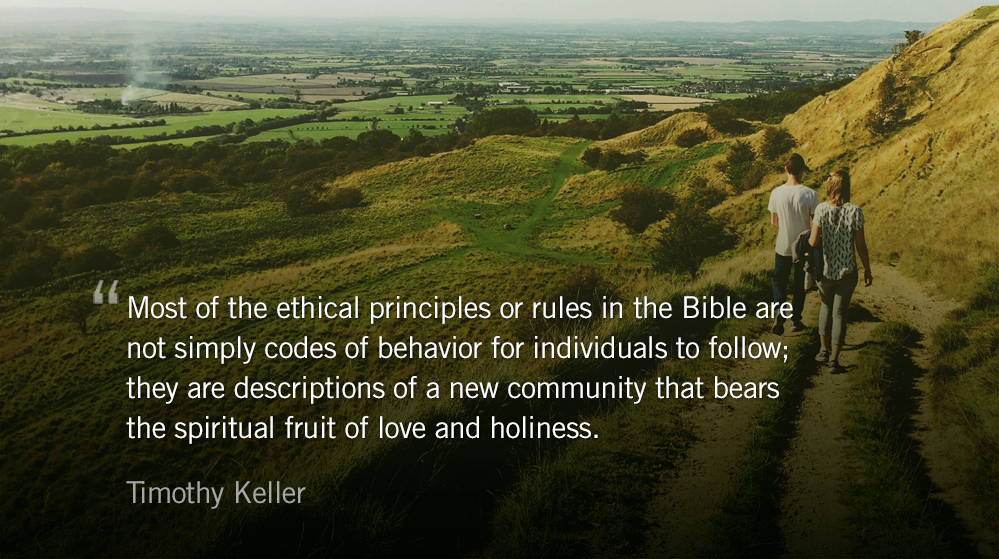
Members of the Church flourish when the fruit of faith is born in and through their community. Timothy Keller writes, “Most of the ethical principles or rules in the Bible are not simply codes of behavior for individuals to follow; they are descriptions of a new community that bears the spiritual fruit of love and holiness.” Dr. Keller continues:
Far more of the Biblical ethical prescriptions is addressed to us as a community than as individuals. The Ten Commandments were given to Israel at Mount Sinai to form them into an alternate society that would be a light to the nations. The call of Romans 12:1-2 to “offer your bodies as living sacrifices” is usually interpreted as a call to individual consecration, but it is actually a demand that we commit ourselves to a corporate body and not live as autonomous individuals any longer.

All of Romans 12, in fact, should be read as a description of this new society. In the same way, Jesus’ call for his followers to be a “city on a hill” means we must read the entire Sermon on the Mount as a description of this new community, not simply as ethical guidelines for individual believers.
Because we have been justified by faith we have the joy of entering into a season of reflection by God’s mercy. Together we fast. Together we engage. Together we serve.

Today’s Reading
Job 8 (Listen – 2:08)
Romans 12 (Listen – 2:58)