Mary, the Called One — Joy of Advent

Links for today’s readings:

Read: Ezra 8 Listen: (5:40)
Read: Revelation 7 Listen: (2:56)

Scripture Focus: Luke 1:26-38

26 In the sixth month of Elizabeth’s pregnancy, God sent the angel Gabriel to Nazareth, a town in Galilee, 27 to a virgin pledged to be married to a man named Joseph, a descendant of David. The virgin’s name was Mary. 28 The angel went to her and said, “Greetings, you who are highly favored! The Lord is with you.”

29 Mary was greatly troubled at his words and wondered what kind of greeting this might be. 30 But the angel said to her, “Do not be afraid, Mary; you have found favor with God. 31 You will conceive and give birth to a son, and you are to call him Jesus. 32 He will be great and will be called the Son of the Most High. The Lord God will give him the throne of his father David, 33 and he will reign over Jacob’s descendants forever; his kingdom will never end.”

34 “How will this be,” Mary asked the angel, “since I am a virgin?”

35 The angel answered, “The Holy Spirit will come on you, and the power of the Most High will overshadow you. So the holy one to be born will be called[a] the Son of God. 36 Even Elizabeth your relative is going to have a child in her old age, and she who was said to be unable to conceive is in her sixth month. 37 For no word from God will ever fail.”

38 “I am the Lord’s servant,” Mary answered. “May your word to me be fulfilled.” Then the angel left her.

Revelation 7:12

“Amen!
Praise and glory
and wisdom and thanks and honor
and power and strength
be to our God for ever and ever.
Amen!”

Reflection: Mary, the Called One — Joy of Advent

By Jon Polk

With the angelic proclamation, “Greetings, you who are highly favored!”, we have our first introduction to Mary in Luke’s Gospel. Because of this lofty declaration, we often think of Mary as the model of obedience, the picture of a perfect follower of God.

Now to be sure, being selected to bear the Son of God is indeed a high honor, but the extraordinary thing about Mary was that she was so ordinary. Living in a small village, not in the religious center of Jerusalem, she was a young girl in a culture that valued age and men. She later refers to herself as poor and lowly.

God chooses Mary because she has nothing. When she asks of the angel, “How will this be?”, it is a practical question. She’s old enough to know how these things work and she knows that there’s a step missing in the process.

Mary discovers a lesson that all Christians must learn. When God calls us, we are not capable in ourselves of accomplishing the task. Only God can provide what we need. Through miraculous intervention, Mary goes from unwed virgin to the mother of the Christ child. God called and God made it happen.

By embracing her calling, Mary becomes a partner with God in literally bringing the Kingdom here on earth. Without God’s intervention, Mary could not become pregnant. Without Mary as a human mother, Jesus could not be born as one of us. This is God’s design, for us to work together with God to give life to the Kingdom here on earth.

God’s call transforms us from people who are incapable on our own to those for whom, with God’s help, nothing is impossible. We, like Mary, have been chosen by God, not because of anything we have or have done, but because God wants to have a relationship with us. Like Mary, we are indeed highly favored children of God.

Let us recognize the gifts God has given us and remember how truly favored we are. Listen closely for your calling from God and be quick to obey, even when you don’t fully understand the whys and the hows. During this season of Advent, may we use what God has given us to breathe life into the Kingdom here on earth, both now and all year long.

Divine Hours Prayer: The Refrain for the Morning Lessons

On this day the Lord has acted; we will rejoice and be flad in it. — Psalm 118.24

– From The Divine Hours: Prayers for Autumn and Wintertime by Phyllis Tickle.

Read more about Mary’s Story — Love of Advent

God can dramatically transform, and God can dramatically indwell. No matter our story, we belong within the love of Jesus.

Support Our Work

Year-end giving provides half of our support through the year. Please consider becoming a donor and getting us off to a great start in the new year.
No Sympathy for Babylon

Scripture Focus: Revelation 19.1-6
1 After this I heard what sounded like the roar of a great multitude in heaven shouting: 

“Hallelujah! 
Salvation and glory and power belong to our God, 
2 for true and just are his judgments. 
He has condemned the great prostitute 
who corrupted the earth by her adulteries. 
He has avenged on her the blood of his servants.” 
3 And again they shouted: 
“Hallelujah! The smoke from her goes up for ever and ever.” 
4 The twenty-four elders and the four living creatures fell down and worshiped God, who was seated on the throne. And they cried: 
“Amen, Hallelujah!” 
5 Then a voice came from the throne, saying: 
“Praise our God, 
all you his servants, 
you who fear him, 
both great and small!” 
6 Then I heard what sounded like a great multitude, like the roar of rushing waters and like loud peals of thunder, shouting: 
“Hallelujah! 
For our Lord God Almighty reigns. 

Reflection: No Sympathy for Babylon
By John Tillman

When nations fall, the world stands in horror. But one day, a nation will fall that has caused so much evil that choruses of praise will break out from all those who suffered under its rule. 

Babylon will fall.

In Revelation 18, John showed us nations and business owners mourning Babylon’s fall. They didn’t care about the lives she’d snuffed out. They lamented the loss of profits she put in their pockets. (Revelation 18.9-18) The Rolling Stones had a hit song entitled, “Sympathy for the Devil.” But in this chapter, John sympathizes with sufferers and shares the voices of Babylon’s victims shouting a three-fold, “Hallelujah” at Babylon’s fate.

In the Bible, Babylon is both literal and metaphorical. Babylon appears on the scene in the story of the Tower of Babel, then echoes through scripture like the peals of a warning bell, telling us, “Beware, beware, beware!” It is a real empire and also a symbol of all empires, cities, leaders, and powers on Earth.

Biblical authors paint other cities and empires with Babylon’s colors. In Revelation she is Rome but throughout scripture Egypt, Assyria, Nineveh, and even Jerusalem and Samaria (the capital of the northern kingdom of Israel) were painted as Babylon. From the biblical authors’ perspective, Babylon hasn’t fully fallen yet. Only stumbled.

Babylon sang shanties on the decks of slave ships in the North Atlantic. It thrived in Hitler’s Germany. It preened in South African Apartheid and in the Jim Crow South. It rode shotgun with rape squads during genocides on every continent.

Babylon is still alive today and we can see its signs. Pride and the abuse of power. Greed and the crushing of the poor. Lust and the dehumanizing industry of smut. Gluttony and the never-ending appetite for more. These are Babylon’s bloody calling cards of evil. We see these bloody cards played from the hands of leaders of nations, political parties, international corporations, and other groups.

It’s easy to point fingers at others. But we need to examine ourselves. God calls us to “come out” of Babylon. (Revelation 18.4) That tells us that we are living there. When Babylon falls, will we sing dirges with the kings and merchants or hallelujahs with her victims?

Babylon woos and confuses. She tempts, taunts, and tricks. Are we seduced? Or maybe just sympathetic? 

The painful question is…How much of our hearts belong to Babylon?

Divine Hours Prayer: The Cry of the Church
O God, come to my assistance! O Lord, make haste to help me!

– From The Divine Hours: Prayers for Summertime by Phyllis Tickle.

Today’s Readings
2 Samuel 11 (Listen 4:25)
Revelation 19 (Listen 3:47)

This Weekend’s Readings
2 Samuel 12 (Listen 5:25Revelation 20 (Listen 2:49)
2 Samuel 13 (Listen 6:39Revelation 21 (Listen 4:34)

Read more about Come Out of Babylon
“Come out of her,” Christ cries. “Don’t look back longingly,” warns the angel of the Lord…Babylon is a test of the heart.

Read more about Come Out of Captivity
Christ’s kingdom of light exposes the darkness of our human kingdoms. We find this not only in Revelation, but throughout the scriptures.

A Time of Peace and Favor — Peace of Advent

Scripture Focus: Revelation 14.6-7
6 Then I saw another angel flying in midair, and he had the eternal gospel to proclaim to those who live on the earth—to every nation, tribe, language and people. 7 He said in a loud voice, “Fear God and give him glory, because the hour of his judgment has come. Worship him who made the heavens, the earth, the sea and the springs of water.”

Acts 17.30-31
30 In the past God overlooked such ignorance, but now he commands all people everywhere to repent. 31 For he has set a day when he will judge the world with justice by the man he has appointed. He has given proof of this to everyone by raising him from the dead.”

2 Corinthians 6.1-2
1 As God’s co-workers we urge you not to receive God’s grace in vain. 2 For he says,

“In the time of my favor I heard you,
    and in the day of salvation I helped you.” (Isaiah 49.8)

I tell you, now is the time of God’s favor, now is the day of salvation.

Reflection: A Time of Peace and Favor — Peace of Advent
By John Tillman

Advent, arguably, is more about Christ’s second advent than his first. His first advent is used by the church to teach us how to anticipate his second. We look back to look forward. He came in meekness but one day will come in power. He lay in a manger but one day he will sit on a throne. He rode in on a donkey, with open hands, but one day he will ride on a horse, wielding a sword. Just as he was unexpected at his first advent, he will be unexpected at his second.

The angel in Revelation flies across the sky with “the eternal gospel.” The hour of judgment is coming but the hour of proclamation precedes the hour of judgment. The hour of salvation precedes the hour of damnation. The hour of invitation precedes the hour of separation.

This is the time in which we live. We are, in a sense, in midair, hanging between Heaven and Earth, poised between proclamation and judgment. 

Christ’s eternal gospel has a time and that time is always and ever now. His gospel is ever-reaching, ever-welcoming, ever-wooing. Now is the time for us to proclaim. Let us proclaim it faithfully.

Now is the Time
Now is the time of favor.
Now is the time of grace.
Now is the time God in Heaven has a baby’s face.

Now is the time of birthing. 
Now is the time of life.
Now is the time when death foresees perishing in strife.

Now the manger holds him
Now the child sleeps
The cross will one day hold him. There he will make peace.

Now is the time of calling. 
Now is the time. Shalom!
Now is the time prodigals find feasts and love at home.

Now is the time of mercy.
Now is the time. Repent.
Now ruffians and scoundrels are forgiven and sent.

Now is the time to witness. 
Now is the time to woo.
Now is the time to expose idols that make us fools.

Now is the time of appeal.
Now is the gospel spread.
Now we must bear witness. Telling what he said.

Now won’t last forever.
Now is just today.
Now is opportunity to choose the narrow way.

Divine Hours Prayer: The Greeting
You are the Lord, most high over all the earth; you are exalted far above all gods. — Psalm 97.9

Today’s Readings
Nehemiah 5 (Listen 3:29
Revelation 14 (Listen 3:51)

This Weekend’s Readings
Nehemiah 6 (Listen 3:19Revelation 15 (Listen 1:29)
Nehemiah 7 (Listen 6:37Revelation 16 (Listen 3:17)

Read more about Supporting Our Work
Please consider becoming a one-time or monthly donor! Support ad-free content that brings biblical devotionals to inboxes across the world.

Read more about Peace from Labor
“What Child is This?” speaks to the unexpected form of our Savior. Good Christians, fear, for sinners here / the silent Word is pleading. His labor of love never ceases.

Peace in the Waiting — Peace of Advent

Scripture Focus: Nehemiah 1.3-43
They said to me, “Those who survived the exile and are back in the province are in great trouble and disgrace. The wall of Jerusalem is broken down, and its gates have been burned with fire.” 4 When I heard these things, I sat down and wept. For some days I mourned and fasted and prayed before the God of heaven.

Revelation 10.6b-7
6b “There will be no more delay! 7 But in the days when the seventh angel is about to sound his trumpet, the mystery of God will be accomplished, just as he announced to his servants the prophets.”

Reflection: Peace in the Waiting — Peace of Advent
By John Tillman

There are so many waiting moments in scripture. We see waiting on God as a consistent theme. In nearly every story about any key figure of faith, there are times of waiting. 

Nehemiah’s generation waited for rescue. As the exile began to come to an end, however, the reports from those returning were not good. Trouble, disgrace, and danger were the norm. After all the waiting in exile, and returning home, all was still not well. Peace was elusive.

John wrote Revelation waiting in exile on the isle of Patmos. The “son of thunder” (Mark 3.17; Luke 9.51-56) had become the disciple of love, the “elder” who cared for God’s children (2 John 1.1-2; 3 John 1.1, 4), and sought peace for God’s church. (Revelation 1.4-6)

There are so many waiting moments in our lives. Usually, what we are waiting for is something we need or want right now. When waiting, we feel stuck. We feel sidelined. We feel behind everyone else. We feel abandoned. In these waiting moments, peace seems impossible.

Advent is an exercise in waiting. It is laid out in the calendar of the church like a lesson to be taught. We mark the weeks and the days. Perhaps we light candles or eat treats from a calendar to mark the march toward Christmas day. As we practice waiting expectantly for a day on the calendar, we learn how to wait for things that are not tied to a date.

Like the returning Jews, we live in quasi-exile. Free but under oppression. Saved but still suffering. Like John, we stand between physical and spiritual realities. We simultaneously languish on an isle of exile and walk with Jesus the living One. We see the Kingdom of God yet suffer the kingdoms of human rulers. Trouble, disgrace, and danger may be the norm. 

Nehemiah shows us the efficacy of prayer and fasting as we wait and how to act when God’s hand moves. John says to the church that he is our “companion in the suffering and kingdom and patient endurance that are ours in Jesus” (Revelation 1.9) and he testifies that there is coming a day when there will be no more delay.

A day is coming when waiting will be no more. Faith will be sight. Peace will be present. The mystery of God will be accomplished. That day, though not yet, is certain. That peace, though beyond understanding, can be ours, even in the waiting.

Divine Hours Prayer: The Refrain for the Morning Lessons
Be strong and let your heart take courage, all you who wait for the Lord. — Psalm 31.24

Today’s Readings
Nehemiah 1 (Listen 2:06)  
Revelation 10 (Listen 1:59)

Read more about Supporting Our Work
Please consider joining our donors, sharing with us a “thank you” to our donors, or both!

Read more about Eating the Book
Eating the Bible may be uncomfortable. It means digesting parts we’d rather not swallow.

In the Bleak Midwinter — Carols of Advent Hope

Scripture Focus: Hebrews 11:1, 39-40
1 Now faith is confidence in what we hope for and assurance about what we do not see.

39 These were all commended for their faith, yet none of them received what had been promised, 40 since God had planned something better for us so that only together with us would they be made perfect.

Revelation 21:1, 3-4
1 Then I saw “a new heaven and a new earth,” for the first heaven and the first earth had passed away, and there was no longer any sea.

3 And I heard a loud voice from the throne saying, “Look! God’s dwelling place is now among the people, and he will dwell with them. They will be his people, and God himself will be with them and be their God. 4 ‘He will wipe every tear from their eyes. There will be no more death’ or mourning or crying or pain, for the old order of things has passed away.”

Reflection: In the Bleak Midwinter — Carols of Advent Hope
By Jon Polk

Despite the lack of any biblical or historical evidence for the actual date of Jesus’ birth, Christmas has been celebrated on December 25th since the 3rd century. However, the mention of shepherds tending flocks in the Nativity story instead suggests a spring date likely for the birth of Jesus.

Nonetheless, Christmas is tightly identified with the winter season, which may explain why the pensive “In the Bleak Midwinter” is one of the most beloved Christmas carols of all time.

In the bleak midwinter, frosty wind made moan, 
Earth stood hard as iron, water like a stone; 
Snow had fallen, snow on snow, snow on snow, 
In the bleak midwinter, long ago.

While the seasonal details may not be entirely accurate, the poetic implications are clear. The world into which Christ was born is cold, harsh, and dreary, beset by sin and indifference. Into that landscape, our hope, the Messiah, was born.

In the bleak midwinter a stable place sufficed 
The Lord God Almighty, Jesus Christ.

The text was written by English poet Christina Rossetti, daughter of Italian parents and member of an artistic family. Her father was a Dante scholar and taught Italian at King’s College. Her brothers were influential in the development of the 19th-century Pre-Raphaelite art movement.

Originally titled, “A Christmas Carol,” Rossetti’s poem was published in the January 1872 edition of the American journal, Scribner’s Monthly. Music was added to the hymn in 1906, twelve years after her death, by composer Gustav Holst.

Christina encountered her share of suffering in her lifetime. As a pre-teen, her father had a serious health breakdown causing him to retire from work. She lived with an autoimmune disorder that affected her thyroid. In 1893, she was diagnosed with breast cancer which took her life a year later.

Unhindered by her own misfortunes, Rossetti was extremely committed to her faith. She spent her time ministering to former prostitutes and using her gift of writing to bring attention to pressing issues of the day, including slavery and the exploitation of young women. 

It is no surprise, then, that the final verse of her solemn Christmas hymn contemplates not what Christ has done for us, but rather, what we can do for him.

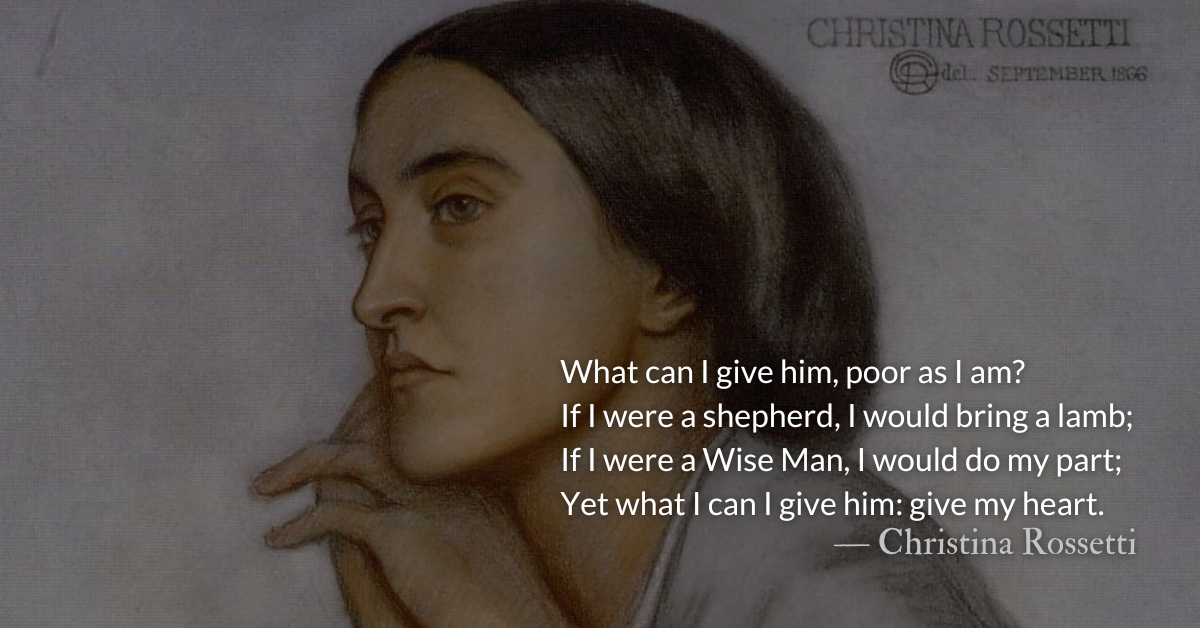
What can I give him, poor as I am? 
If I were a shepherd, I would bring a lamb; 
If I were a Wise Man, I would do my part; 
Yet what I can I give him: give my heart.

If you are weary from living in a dark and cold world, if you are struggling with adversity or hardship, be reminded to hold on to your faith and hope in the Christ who has broken into our lives in the midst of our bleakest midwinters.

Listen: In the Bleak Midwinter by Kevin Max
Read: Lyrics from Hymnary.org

Divine Hours Prayer: The Refrain for the Morning Lessons
With my whole heart I seek you; let me not stray from your commandments. — Psalm 119.10

Today’s Readings
Esther 1 (Listen 4:14)
Hebrews 11 (Listen 6:22)

Read more about Supporting Our Work
Help us provide biblical content for free with no ads and no agendas. Biblical literacy depends heavily on more extensive Bible reading.

Read more about This We Proclaim
The ancient church did not fix the celebration of Advent around the winter solstice because of history, but because of pedagogy.