Biblical Worship Reflects God

Scripture Focus: Psalm 113
1 Praise the Lord.  
Praise the Lord, you his servants; 
praise the name of the Lord. 
2 Let the name of the Lord be praised, 
both now and forevermore. 
3 From the rising of the sun to the place where it sets, 
the name of the Lord is to be praised. 
4 The Lord is exalted over all the nations, 
his glory above the heavens. 
5 Who is like the Lord our God, 
the One who sits enthroned on high, 
6 who stoops down to look 
on the heavens and the earth? 
7 He raises the poor from the dust 
and lifts the needy from the ash heap; 
8 he seats them with princes, 
with the princes of his people. 
9 He settles the childless woman in her home 
as a happy mother of children. 
Praise the Lord. 

Student Writers Month is here: The student writers featured from July 15 to August 9 have received free coaching, ministry training, and seminars by special guests in addition to this publishing opportunity, the ability to re-publish their work elsewhere, and a stipend/scholarship for their work. A portion of all donations during these dates will be applied to the students’ stipends/scholarships. Find out more about the students at this link or give a one-time or recurring gift at this link.

Reflection: Biblical Worship Reflects God 
By Jacque Jordan

There is beauty in structured biblical worship. A psalm with cadence, rhythm, syllabic mirroring, and rich theology not only helps the orator remember the song of praise, but it allows us to be present while remembering who God is, what He does, and who we are in relationship to Him.

Worship is a response to our overwhelming belief in God and it takes many forms. For example, in the Gospels, some kneel before Jesus in worship. In Chronicles, David lies prostrate and dances glorifying the Lord. However, worship does not start with a song or end when you sit down—worship is a heart posture we carry with us.

Psalm 113 walks us through how to biblically worship the Lord beginning with a call for all to praise the Lord forevermore. Verses 4-6 tell us why the Lord is worthy to be praised. He is exalted over all the nations, glorious, eternal, unmatched, and devoted in the pursuit of His creation. Through God’s character and love for us, He restores our identity by raising up the poor, lifting the needy, and giving barren women children.

This Psalm parallels Revelation 4 and 5, where John is lifted up in the Spirit and witnesses heavenly worship. John sees everything and everyone around the throne worshiping the Lord, praising His character. John, suddenly overcome with sorrow, realizes no one is worthy to open the scroll and take on the sins of the world. But then the Lamb that was slain appears and ransoms the world. Every tribe, nation, and tongue proceeds to worship Jesus and God for who they are, what they’ve done, and their relationship to creation.

The Lord is searching for worshipers. God does not need our worship but asks for it. God instills a desire in our hearts to worship Him, knowing that there, at his feet, we will find rest. May we write these truths from Psalm 113 on our hearts and speak them over ourselves during the day. When we are at work, waiting, or in the woes of suffering, we can lean on the words we’ve been given in the Psalms. When our heart’s disposition is to worship the Lord, it gives meaning to all that we do.


Divine Hours Prayer: The Greeting
My mouth shall recount your mighty acts and saving deeds all day long; though I cannot know the number of them. — Psalm 71.15

– From The Divine Hours: Prayers for Summertime by Phyllis Tickle.

​Today’s Readings
Isaiah 45 (Listen 4:39)
Psalms 112-113 (Listen 1:49)

Read more about Supporting Our Work
Donations during Student Writers Month support our ministry and these students. A portion of every donation goes to stipends/scholarships for these students.

Read more about In The Face of Wonder
Mary’s powerful confession, prayer, and prophecy, shows her familiarity with the scriptures and an intimate connection with God

A Psalm for the Stuck

Scripture Focus: Psalm 111:1-10
1 Praise the Lord.
I will extol the Lord with all my heart
    in the council of the upright and in the assembly.
2 Great are the works of the Lord;
    they are pondered by all who delight in them.
3 Glorious and majestic are his deeds,
    and his righteousness endures forever.
4 He has caused his wonders to be remembered;
    the Lord is gracious and compassionate.
5 He provides food for those who fear him;
    he remembers his covenant forever.
6 He has shown his people the power of his works,
    giving them the lands of other nations.
7 The works of his hands are faithful and just;
    all his precepts are trustworthy.
8 They are established for ever and ever,
    enacted in faithfulness and uprightness.
9 He provided redemption for his people;
    he ordained his covenant forever—
    holy and awesome is his name.
10 The fear of the Lord is the beginning of wisdom;
    all who follow his precepts have good understanding.
    To him belongs eternal praise.

Student Writers Month is here: The student writers featured from July 15 to August 9 have received free coaching, ministry training, and seminars by special guests in addition to this publishing opportunity, the ability to re-publish their work elsewhere, and a stipend/scholarship for their work. A portion of all donations during these dates will be applied to the students’ stipends/scholarships. Find out more about the students at this link or give a one-time or recurring gift at this link.

Reflection: A Psalm for the Stuck
By Liz Daye

Lately, I’ve been in a funky season of “stuckness.” My prayerful attempts at thankfulness have felt like a half-hearted lie. It’s like a weird ongoing wrestling match with a constant inquiry: What is God like? More importantly, what is God like for those feeling secretly and utterly stuck? Thankfully, the psalmist’s words in chapter 111 do something interesting. They reveal practical language that aids us in loosening that sticky grip. 

God reveals his message through his methods. So, it matters that God often uses story and poetry to reveal what he’s like. Why? Because God isn’t more interested in providing answers than offering us himself

Psalm 111’s poetic passage is a psalm of thankfulness. The Hebrew acrostic form of the poem serves as a memory tool. By remembering the story of the exodus, the psalmist contextualizes what God is like, while also referencing covenants of old and pondering promises. Remembrance intertwines with worship giving a gentle invitation towards thankfulness. 

And in wondering about the relationship between God’s majesty and glory, and his grace and compassion, it matters that there is no separation between these various qualities. His grace is glorious. His compassion is majestic. And all of these attributes are characterized by faithfulness and justice. (111:7). Faithfulness and justice for whom? For the ones who were wild enough to let God “unstick” them from the pharaoh’s grasp, thanking God all the way out into the wilderness. 

Too often our individualistic conceptualizations of thankfulness aren’t merely incomplete, they leave us stuck. Yet this psalm shows us that thankfulness moves God’s people towards a God who moves toward his people. Direction and purpose are inherent to thankfulness. Thankfulness to God in the psalm isn’t abstract. It’s particular- personal. The interplay of these relational qualities reveals the triune God through the thankfulness of his people. What is God like? God is the deliverer of the “stuck.” Majestic and glorious. Gracious and compassionate. 

Israel’s thankfulness is rooted in the story of their belonging. The psalm is how they remember. How do you remember what God is like? This psalm is a communal reminder to look backward together, so that we can look ahead together. Thankfulness isn’t our arrival point, nor is it a means to an end. Thankfulness frees us so we can move again, together. It’s the beginning, middle, and there is no end. “To Him belongs eternal praise” (111:10)


Divine Hours Prayer: The Request for Presence
Let them know that this is your hand, that you, O Lord, have done it. — Psalm 109.26

– From The Divine Hours: Prayers for Summertime by Phyllis Tickle.

​Today’s Readings
Isaiah 44 (Listen 5:12)
Psalms 110-111 (Listen 1:57)

Read more about Forward-Looking Remembering
Remembering is not “living in the past”… instead it informs our hope for a future that God has for us.

Read more about Supporting Our Work
A portion of every donation during Student Writers Month goes toward stipends/scholarships for these students. Donate today.

Shocking Prayers and Promises

Scripture Focus: Psalm 109.6-8
6 Appoint someone evil to oppose my enemy; let an accuser stand at his right hand. 
7 When he is tried, let him be found guilty, and may his prayers condemn him. 
8 May his days be few; may another take his place of leadership.

Reflection: Shocking Prayers and Promises
By John Tillman

You’ll probably never hear Psalm 109 or other imprecatory psalms read in church. The condemnations are harsh. The cries for violent retribution are unsettling. Is this praying or cursing?

When the suffering cry out, they don’t consider the feelings of those listening. They chuck civility and cordiality out the window. They employ emotional language and evocative metaphors. They abandon the vocabulary of propriety and politeness. They may even go beyond cursing to “cussing.”

Imagine yourself standing in front of someone shouting out the curses and demands of this psalm…

If you are like me, you probably picture yourself giving one of two responses: disengagement or discouragement. You want to get away from them or tell them to calm down.

“Be respectful.” “Ask nicely and I’ll listen.” “I can’t be around you when you are like this.”

God responds differently. God turns his ear to them. God leans closer. God joins them in their suffering. God’s face looks on them with compassion. God’s hands lift them up and punish their oppressors.

We are not God. We are incapable of his level of listening, patience, empathy, and compassion.

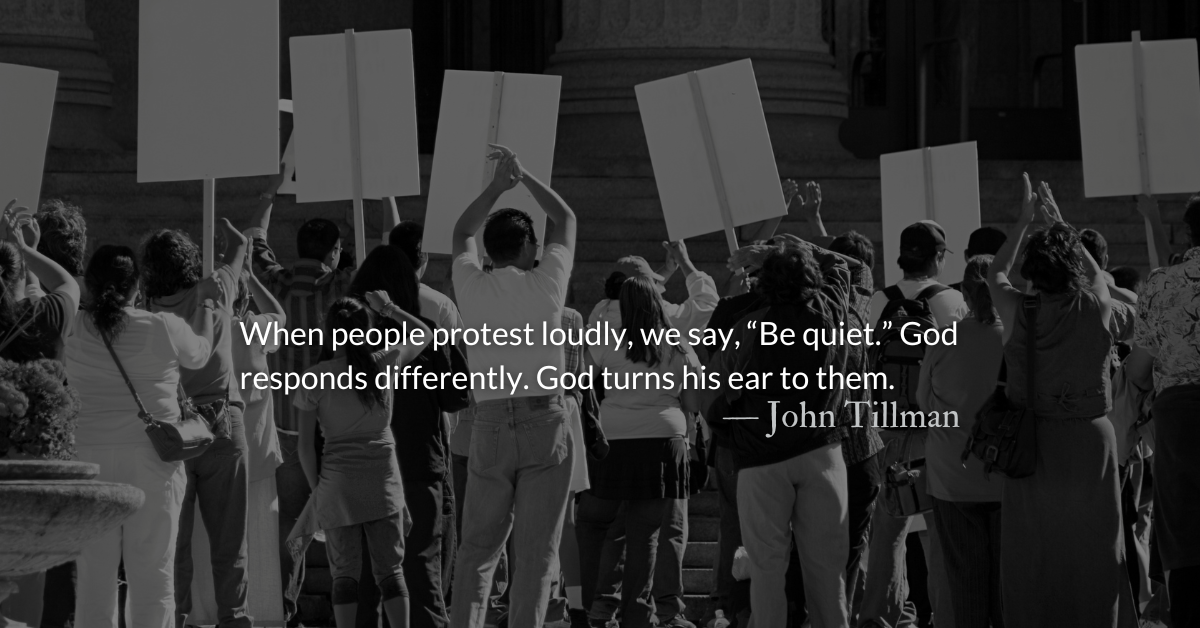
When people protest loudly, we say, “Be quiet.” When they protest at inconvenient times, we say, “Not now.” When they protest in our faces, we say, “Back off.” When they protest in our spaces, we say, “Get out.”

We are also powerless to enact the fullness of God’s justice and righteousness.

There are problems we cannot comprehend. There are oppressors we cannot correct. There are powers we cannot oppose. There are wrongs we cannot make right.

We can, however, lean on the listening, patient, empathetic, compassionate heart of God revealed in scripture. We can work for the problem-solving, corrective, overcoming, good-creating justice and righteousness revealed in scripture. That is what the psalmist is doing.

The psalmist’s cry, “May his children be fatherless and his wife a widow,” (Psalm 109.9) echoes a promise of God from Exodus 22.24 and Jeremiah 18.21. It is God who promised to punish those who harm the vulnerable. We can pray shocking prayers.

Are you hesitant to hear out the hurting?
When the suffering won’t be silent, do you shut your ears?
When the abused are red-faced with anger and shame, do you turn your face away?
When the oppressed open their mouths with curses, do you open the door and leave?


Divine Hours Prayer: The Refrain for the Morning Lessons
Mercy and truth have met together; righteousness and peace have kissed each other. — Psalm 85.10

– From The Divine Hours: Prayers for Summertime by Phyllis Tickle.

​Today’s Readings
Isaiah 10.5-34 (Listen 5:14)
Psalm 106 (Listen 4:52)

​This Weekend’s Readings
Isaiah  11-12 (Listen 3:39), Acts 1 (Listen 3:5802)
Isaiah  13 (Listen 3:11), Acts 2 (Listen 6:35)

Read more about An Imprecatory Psalm for Mass Shootings
I went to church…As normal, I paused to think about what I should do in case of a shooting…This shouldn’t be normal.

Read more about Wartime Prayers
Imprecatory prayers become expressions of trust in God our Father…not only powerful but…just and loving.

God’s Feathers

Scripture Focus: Psalm 91
1 Whoever dwells in the shelter of the Most High 
will rest in the shadow of the Almighty. 
2 I will say of the Lord, “He is my refuge and my fortress, 
my God, in whom I trust.” 
3 Surely he will save you 
from the fowler’s snare 
and from the deadly pestilence. 
4 He will cover you with his feathers, 
and under his wings you will find refuge; 
his faithfulness will be your shield and rampart. 
5 You will not fear the terror of night, 
nor the arrow that flies by day, 
6 nor the pestilence that stalks in the darkness, 
nor the plague that destroys at midday. 
7 A thousand may fall at your side, 
ten thousand at your right hand, 
but it will not come near you. 
8 You will only observe with your eyes 
and see the punishment of the wicked. 
9 If you say, “The Lord is my refuge,” 
and you make the Most High your dwelling, 
10 no harm will overtake you, 
no disaster will come near your tent. 
11 For he will command his angels concerning you 
to guard you in all your ways; 
12 they will lift you up in their hands, 
so that you will not strike your foot against a stone. 
13 You will tread on the lion and the cobra; 
you will trample the great lion and the serpent. 
14 “Because he loves me,” says the Lord, “I will rescue him; 
I will protect him, for he acknowledges my name. 
15 He will call on me, and I will answer him; 
I will be with him in trouble, 
I will deliver him and honor him. 
16 With long life I will satisfy him 
and show him my salvation.” 

Reflection: God’s Feathers
By John Tillman

Even in our relatively comfortable lives today, we have parallels to the dangers the psalmist fears.

We fear snares, traps, scams, and conspiracies. We fear terrors of darkness and unknown enemies and dangers. We fear pestilences, plagues, and illnesses that can strike early or late in life. We know of weapons that fly overhead and are more deadly than arrows. We know of enemies and armies that can swarm around us to harass and attack us both online and in real life.

The psalmist portrays humans as fragile, vulnerable, and defenseless birds. We are easily ensnared by grift, infected by filth, or broken by force. 

Birds are dual symbols in scripture. Many times, they symbolize helplessness, struggle, and chaos. Fluttering flocks are metaphors of panic, terror, and fright in the face of danger. When sheltered in trees or craggy rocks, birds represent the poor and oppressed. Jesus described birds as relying on God and as being cared for despite their low monetary value.

Other times, birds symbolize power, freedom, and protection. God and the living creatures that surround his throne are associated with birds, feathers, and flight. God carries his people on eagle’s wings and empowers them to soar on wings of their own. (Exodus 19.4; Isaiah 40.31) In this psalm, God is a protective bird. We are covered in God’s feathers. God’s wings are our refuge.

In his commentary, Federico Villanueva says, “In Asia and Africa, Psalm 91 has been used as a kind of magic charm…on amulets and inscribed on buildings.” It’s not hard to see why. The psalm makes some of the most explicit claims of protection in the Bible. Who would not want to lay claim to such bold promises?

Scripture is not magic, and it is a snare to think that it is. Satan spoke of Psalm 91 as magical protection to tempt Jesus. But the psalm also promises that Satan, who is the snake, the fowler, and the roaring lion, will be trampled. 

Carving scripture onto an amulet or a building is educational but not protective. However, carving it into our hearts brings change. Through scripture, make God your shelter and dwelling. 

When we dwell in his shelter, fragile as we are, we are shielded in God’s feathers. Powerless as we are, we fly towards God’s purposes. Foolish as we are, God’s wisdom keeps us from the snares of the fowler.


Divine Hours Prayer: The Refrain for the Morning Lessons
Wake up, my spirit; awake, lute and harp: I myself will waken the dawn. — Psalm 108.2


– From The Divine Hours: Prayers for Summertime by Phyllis Tickle.


​Today’s Readings
Malachi 3 (Listen 3:13)
Psalm 91 (Listen 1:39)

Read more about Quotations from the Desert
Satan quotes Ps 91…stops before the verse about him: “You will…trample the…serpent.” He is speaking to the one destined to do the trampling.

Read more about Bearing Reproach
Mary was slandered as a prostitute. We must not be surprised at our mistreatment as the Lord’s messengers

A Broken Rebel’s Prayer

Scripture Focus: Psalm 90
A prayer of Moses the man of God. 
1 Lord, you have been our dwelling place 
throughout all generations. 
2 Before the mountains were born 
or you brought forth the whole world, 
from everlasting to everlasting you are God. 
3 You turn people back to dust, 
saying, “Return to dust, you mortals.” 
4 A thousand years in your sight 
are like a day that has just gone by, 
or like a watch in the night. 
5 Yet you sweep people away in the sleep of death— 
they are like the new grass of the morning: 
6 In the morning it springs up new, 
but by evening it is dry and withered. 
7 We are consumed by your anger 
and terrified by your indignation. 
8 You have set our iniquities before you, 
our secret sins in the light of your presence. 
9 All our days pass away under your wrath; 
we finish our years with a moan. 
10 Our days may come to seventy years, 
or eighty, if our strength endures; 
yet the best of them are but trouble and sorrow, 
for they quickly pass, and we fly away. 
11 If only we knew the power of your anger! 
Your wrath is as great as the fear that is your due. 
12 Teach us to number our days, 
that we may gain a heart of wisdom. 
13 Relent, Lord! How long will it be? 
Have compassion on your servants. 
14 Satisfy us in the morning with your unfailing love, 
that we may sing for joy and be glad all our days. 
15 Make us glad for as many days as you have afflicted us, 
for as many years as we have seen trouble. 
16 May your deeds be shown to your servants, 
your splendor to their children. 
17 May the favor of the Lord our God rest on us; 
establish the work of our hands for us— 
yes, establish the work of our hands.

Reflection: A Broken Rebel’s Prayer
By John Tillman

Psalm 90, the prayer of Moses, is the prayer of a broken rebel, humbled and wise, relying on God.

Moses was a rebel from the beginning. Born illegally, the state condemned him to death from birth. Secreted into the wicked king’s palace as a child, he grew up like a sleeper agent. His family did this for his safety but also must have hoped that their little rebel, like a well-slung stone, might take down the oppressive giant.

Instead, he fails miserably. Commits murder. Gets caught. Flees for his life. Marries foreigners. Has uncircumcised children. He stutters. He hesitates. He hides. Yet, God speaks directly to him and does wonders before his eyes. But, despite the burning bush and the voice of God and all those miracles, Moses still says, “Please send someone else.”

Who better to emulate in prayer than a man this broken, purposeless, ashamed, and fearful? Through prayer, Moses became a different kind of man. He became a man used for God’s purposes, breaking the might of a national superpower. He became a man of humility instead of shame. He became a man who stood his ground in faith rather than fleeing in fear.

A Broken Rebel’s Prayer
Lord, whether in a precariously floating basket, a gleaming palace, or a desert lit by burning bushes, you are the source of our life.

All our strivings are pointless before you.
You are the better dwelling place we long for.
Everything we hope for is in you.
We dwell enslaved to our brokenness, our shame, and our fear.
We return to the dust with you as our only hope.

Lord, you see thousands of years like a day and our lives like a blink of an eye.
Help us live our brief lives wisely, with your righteous wrath and merciful love before our eyes.

Have compassion on us, Lord, weak as we are.
Help us praise you with our faltering voices,
Raise our unworthy hands to see you win what our rebellions never could.

Let us pursue your power for your purposes.
Let us release our shame and stand before you in humility.
Let us stand our ground defending the weak with faith that seas will part and armies will fall without striking a blow against us.

Establish your work through our hands and speak your words through our voices.


Divine Hours Prayer: The Request for Presence
Lord, God of hosts, hear my prayer; hearken, O God of Jacob. — Psalm 84.7


– From The Divine Hours: Prayers for Summertime by Phyllis Tickle.


​Today’s Readings
Malachi 2 (Listen 3:12)
Psalm 90 (Listen 2:03)

Read more about Outward-Focused Rhythms
Instead of focusing mostly on activities that are forms of self-investment, practicing daily rhythms that are rooted in Christ can take us beyond ourselves.

Read more about Offal Leaders
God smeared their faces with offal, but some keep trying to wipe it off and pretend nothing is wrong.