
Prophets We Want, Prophets We Need

Scripture Focus: Micah 2.6, 11
6 “Do not prophesy,” their prophets say. 
“Do not prophesy about these things; 
disgrace will not overtake us.” 
11 If a liar and deceiver comes and says, 
‘I will prophesy for you plenty of wine and beer,’ 
that would be just the prophet for this people!

From John: We look back today on this post from 2020 and the harsh words Micah had for those who objected to the types of issues he prophesied about.

Reflection: Prophets We Want, Prophets We Need
By John Tillman

In his commentary on Micah, James Limburg described the people’s objections to Micah as grounded in “a theology which assured them of the Lord’s perpetual blessing, of his long-suffering and patience, and of his mighty acts on behalf of his people.”

Micah’s opponents had a theological concept that God’s nature and promises trapped him into perpetually improving their circumstances. In other words, God loved them too much for anything bad to happen. This misreading of the scriptures provided a bulletproof feeling of invulnerability. To them, it was scandalous and inappropriate to proclaim guilt or catastrophic consequences. 

Certainly, the Lord’s nature is long-suffering and patient. God’s first description of himself in the Bible is that he is compassionate, gracious, slow to anger, abounding in love and faithfulness. (Exodus 33.19-23, 34.5-7) But God will also have justice. In this same passage, he declares that he will not leave the guilty unpunished. 

Certainly, the Lord made promises regarding Abraham’s descendants. But as John the Baptist later warned, “out of these stones God can raise up children for Abraham.” (Luke 3.7-9) Any person or group thinking God’s plans would be thwarted if they experienced suffering, defeat, imprisonment, or even death is foolish and prideful.

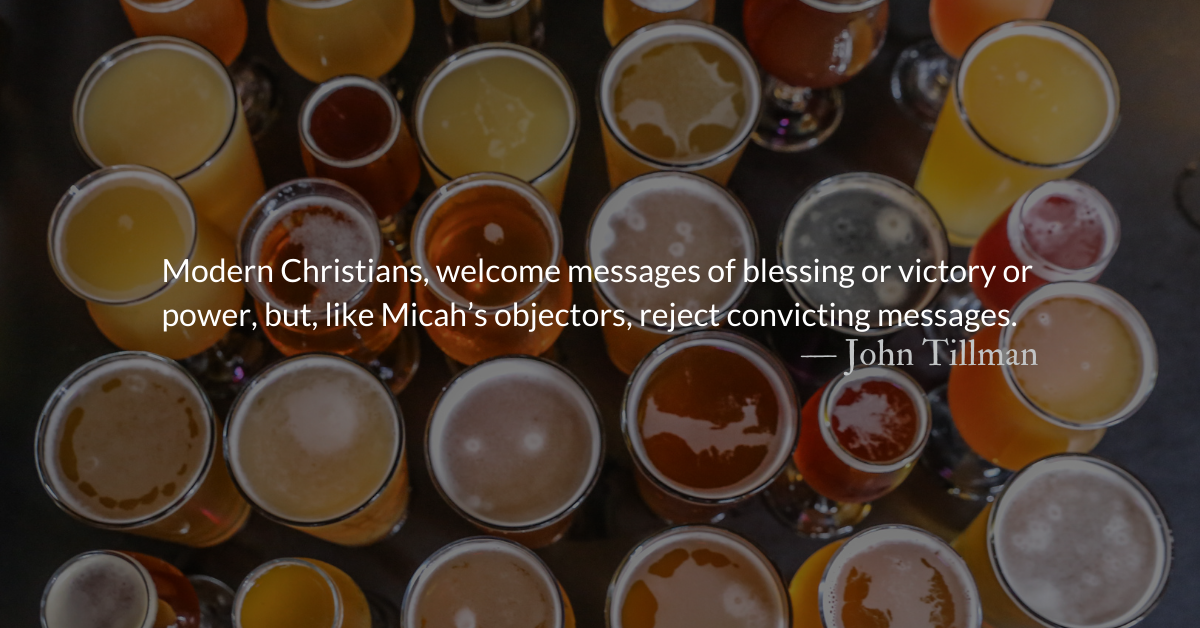
Modern Christians welcome messages of blessing or victory or power but, like Micah’s objectors, reject convicting messages. We are sometimes guilty of falsely claiming biblical promises (such as the Abrahamic promises or promises regarding our righteousness in Christ) as a cloak of invulnerability against suffering or guilt. Many today are scandalized by “prophets” who speak like Micah and Amos, especially if they speak on similar topics. They object:
“Don’t say such things!” 
“Don’t talk about justice.” 
“Don’t hold us responsible for prior generations.” 

*God regularly holds entire nations responsible for the deeds of prior generations. — Amos 1; Joel 3.19; Ezekiel 25, 35)

Pointing out unrighteousness or the need for justice should not be scandalous.

We wrongly interpret God’s promises to us through Christ if we only see them as guarantees of blessings in this life. We are ignoring Christ’s lived example if we do not think it likely suffering, mistreatment, or even death might be part of God’s plan or purpose for our lives.

If the only prophets we listen to promise “plenty of wine and beer,” and the only signs we want from God are blessings for ourselves, we may be in the same boat as Micah’s hearers.

Divine Hours Prayer: The Greeting
Deliver me, O Lord, by your hand from those whose portion in life is this world. — Psalm 17.14

Today’s Readings
Micah 2 (Listen – 2:11)
John 18 (Listen – 5:16)

Read more about The Gospel is an Uprising
The Anastasis—the Uprising—is the great jailbreak of God.

Read more about Unworthy Prophets
These prophets claim to speak for God but, instead, tickle the ears of the powerful…
Prophets We Want, Prophets We Need

Scripture Focus: Micah 2.6, 11
6 “Do not prophesy,” their prophets say. 
“Do not prophesy about these things; 
disgrace will not overtake us.” 

11 If a liar and deceiver comes and says, 
‘I will prophesy for you plenty of wine and beer,’ 
that would be just the prophet for this people! 

Luke 11.29-32
29 As the crowds increased, Jesus said, “This is a wicked generation. It asks for a sign, but none will be given it except the sign of Jonah. 30 For as Jonah was a sign to the Ninevites, so also will the Son of Man be to this generation. 31 The Queen of the South will rise at the judgment with the people of this generation and condemn them, for she came from the ends of the earth to listen to Solomon’s wisdom; and now something greater than Solomon is here. 32 The men of Nineveh will stand up at the judgment with this generation and condemn it, for they repented at the preaching of Jonah; and now something greater than Jonah is here.

Reflection: Prophets We Want, Prophets We Need
By John Tillman

In his commentary on Micah, James Limburg described the people’s objections to Micah as grounded in “a theology which assured them of the Lord’s perpetual blessing, of his long-suffering and patience, and of his mighty acts on behalf of his people.”

Micah’s opponents had a theological concept that God’s nature and promises trapped him into perpetually improving their circumstances. In other words, God loved them too much for anything bad to happen. This misreading of the scriptures provided them a bulletproof feeling of invulnerability. To them, it was scandalous and inappropriate to proclaim guilt or catastrophic consequences. 

Certainly, the Lord’s nature is long-suffering and patient. God’s first description of himself in the Bible is that he is compassionate, gracious, slow to anger, abounding in love and faithfulness. (Exodus 33.19-23, 34.5-7) But God will also have justice. In this same passage, he declares that he will not leave the guilty unpunished. 

Certainly, the Lord made promises regarding Abraham’s descendants. But as John the Baptist later warned, “out of these stones God can raise up children for Abraham.” (Luke 3.7-9) Any person or group thinking God’s plans would be thwarted if they experienced suffering, defeat, imprisonment, or even death is foolish and prideful.

Modern Christians, welcome messages of blessing or victory or power, but, like Micah’s objectors, reject convicting messages. We are sometimes guilty of falsely claiming biblical promises (such as the Abrahamic promises or promises regarding our righteousness in Christ) as a cloak of invulnerability against suffering or guilt. Some today are scandalized by “prophets” who speak like Micah and Amos, especially if they speak on similar topics. 

“Don’t say such things!” 
“Don’t talk about justice.” 
“Don’t hold us responsible for prior generations.” (God regularly holds entire nations responsible for the deeds of prior generations. — Amos 1; Joel 3.19; Ezekiel 25, 35)

Pointing out unrighteousness or the need for justice should not be scandalous.

We wrongly interpret God’s promises to us through Christ if we only see them as guarantees of blessings in this life. We are ignoring Christ’s lived example if we do not think it likely that suffering, mistreatment, or even death might be part of God’s plan or purpose for our lives.

If the only prophets we listen to promise “plenty of wine and beer,” and the “signs” we want from God are all blessings for ourselves, we may be in the same boat as Micah’s hearers.

Divine Hours Prayer: The Greeting
O God, you know my foolishness, and my faults are not hidden from you. — Psalm 69.6– Divine Hours prayers from The Divine Hours: Prayers for Autumn and Wintertime by Phyllis Tickle

Today’s Readings
Micah 2 (Listen – 2:11)
Luke 11 (Listen – 7:33)

This Weekend’s Readings
Micah 3 (Listen – 1:51) Luke 12 (Listen – 7:42)
Micah 4 (Listen – 2:33) Luke 13 (Listen – 5:02)

Read more about God is Faithful, not Indebted
Rather than an indebted God, we serve a faithful God. He does not treat us as we deserve.

Read more about Jesus with Axe and Fire
John the Baptist describes a Christ who stands ready with both axe and fire.

The Gospel is an Uprising

Micah 2.13
The One who breaks open the way will go up before them;
they will break through the gate and go out.
Their King will pass through before them,
the Lord at their head.”

Luke 11.20-22
But if I drive out demons by the finger of God, then the kingdom of God has come upon you. “When a strong man, fully armed, guards his own house, his possessions are safe. But when someone stronger attacks and overpowers him, he takes away the armor in which the man trusted and divides up his plunder.

Reflection: The Gospel is an Uprising
By John Tillman

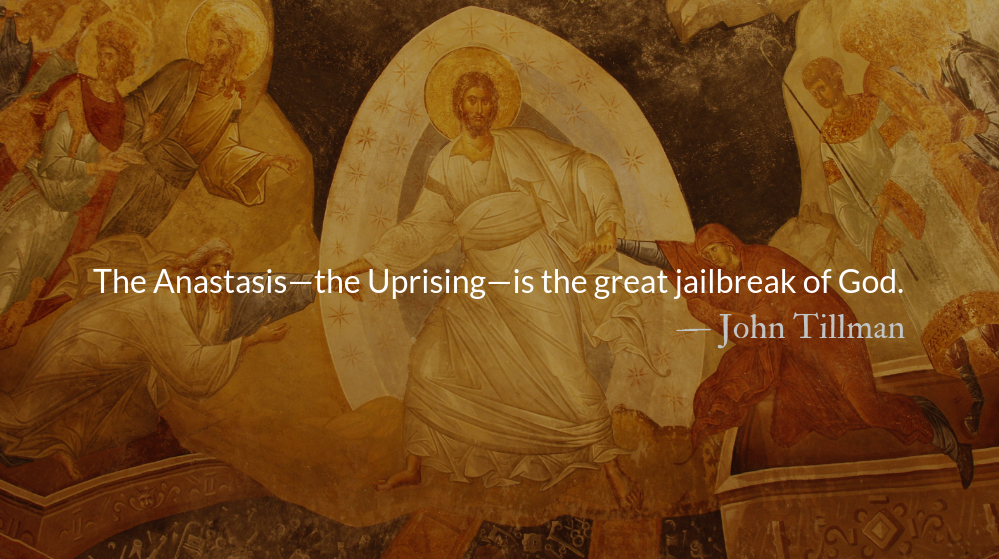
The word translated “resurrection” is anastasis. It is a common term. It is used for individual resurrection events, such as the resurrections of Jairus’s daughter, of Lazarus, and of Jesus himself. It also refers to the ultimate resurrection event to come at the end of time.

The depictions of Christ in today’s readings relate strongly to a traditionally Eastern Christian visualization of this ultimate resurrection that translates anastasis more literally as “Uprising.”

These artworks depicting Christ’s resurrection step outside of time and geography to show Christ exiting the doors of Hell itself, literally breaking open the gates. He is often depicted stepping upon Death, as he leads by the hand Adam, Eve, and others of the faithful dead.

The Anastasis—the Uprising—is the great jailbreak of God.

The Uprising is a visualization of Christ’s resurrection gleaned less from gospel accounts than from multiple sources throughout scripture, including our passage today in Micah, where Christ is “the One who breaks open the way,” gathering captives together and smashing through the gates holding them back, and our passage from Luke, where Christ portrays himself as a violent thief, breaking in to the house of the strong man, Satan, destroying his defenses, and plundering his possessions.

The Anastasis can be interpreted as an Eighth Day occurrence, an event occurring outside of time. But it can also be understood as “already and not yet.” It is both completed in the past, coming in the future, and happening now, in our midst.

Our ultimate freedom may be in the future, but Christ is still the strong man, standing ready to liberate us today as he did the many demoniacs in scripture. We may not suffer in the same way they did but aren’t we still impaired as many of them were?

Aren’t we at times mute when we should speak truth into the lives around us?
Don’t we at times throw ourselves into the fires of judgment rather than accept Christ’s grace?
Don’t we at times harm others and ourselves in our rage?

What sins are you blind to? What cries for help are you deaf to? What injustice leaves you mute, unwilling to speak?

May Jesus, the strong man, the liberator, free us to see, to hear, and to speak.
May he kick open the gates of what paralyzes us and lead us out to do his work in the world.

May we join the Uprising.

Prayer: The Call to Prayer
God has gone up with a shout, the Lord with the sound of the ram’s horn.  — Psalm 47:5

– Prayer from The Divine Hours: Prayers for Autumn and Wintertime by Phyllis Tickle.

Prayers from The Divine Hours available online and in print.

Today’s Readings
Micah 2 (Listen – 2:11)
Luke 11 (Listen – 7:33)

Additional Reading
Read More about The Eighth Day
Peter encourages his readers about Christ’s second coming with thoughts that closely relate to the Jewish concept of the eighth day that was influential on early Christian belief and practice.

Read More about Freedom for Prisoners :: Epiphany
The Gospel is a jailbreak. Jesus is a thief in the night, robbing the possessions of the strong man, Satan—stealing away with captives who foolishly, yet willingly sold themselves to the debtor’s prison of sin.

Support our Work
Each month over 22,000 Park Forum email devotionals are read around the world. Support our readers with a monthly or a one time donation.

*Image By © José Luiz Bernardes Ribeiro /, CC BY-SA 3.0

Show Buttons
Hide Buttons
Spur a spiritual rhythm of refreshment right in your inbox
By joining this email list you are giving us permission to send you devotional emails each weekday and to communicate occasionally regarding other aspects of the ministry.
100% Privacy. We don't spam.