Pass Through the Water and Walk in the Spirit

Links for today’s readings:

Mar 30  Read: Song of Songs 6 Listen: (1:48) Read: Matthew 3 Listen: (2:17)

Scripture Focus: Matthew 3.11, 13

11 “I baptize you with water for repentance. But after me comes one who is more powerful than I, whose sandals I am not worthy to carry. He will baptize you with the Holy Spirit and fire.

13 Then Jesus came from Galilee to the Jordan to be baptized by John. 14 But John tried to deter him, saying, “I need to be baptized by you, and do you come to me?”

Reflection: Pass Through the Water and Walk in the Spirit

By John Tillman

The baptism John wanted did not come how or when he expected.

John was a phenomenon. Crowds came from a wide geographic area to be baptized on the east bank of the Jordan, probably across from Jericho. (John 1.28; 10.40)

The repentant stood in lines to be baptized. Cynical, self-righteous, and unrepentant religious leaders stood in clusters to watch with suspicion and judgment.

No one (especially the religious leaders) could miss the location’s symbolism. One generation of Israelites failed to trust God and cross here and the next generation crossed on dry land to victory. (Numbers 14:29-31; Joshua 3.14-17) Elijah passed the mantle of his calling to Elisha here. They crossed eastward on dry ground together, (2 Kings 2.7-8) Elijah was taken up to heaven, and Elisha crossed back on dry ground. (2 Kings 2.13-14)

John used the Jordan as a symbol of choosing faith. Pass through the water of repentance or die in the desert of your sin? Abandon your way and enter God’s kingdom or go your own way to destruction?

John longed for a greater baptism than he practiced. He prophesied about one coming to baptize with the Holy Spirit and fire. Then, Jesus, the promised one, asked John to baptize him in ordinary Jordan river water just like every repentant sinner standing in line.

To obey his father, as an example to us, and to move toward his battles with sin and death, Jesus had to pass through the water. He experienced the baptism of John to bring the greater baptism John prophesied.

The baptism John wanted came not only after John’s death, but after Jesus’ death, resurrection, and ascension. The baptism John prophesied was poured out on the early church and on every follower of Jesus. (Acts 2.1-3)

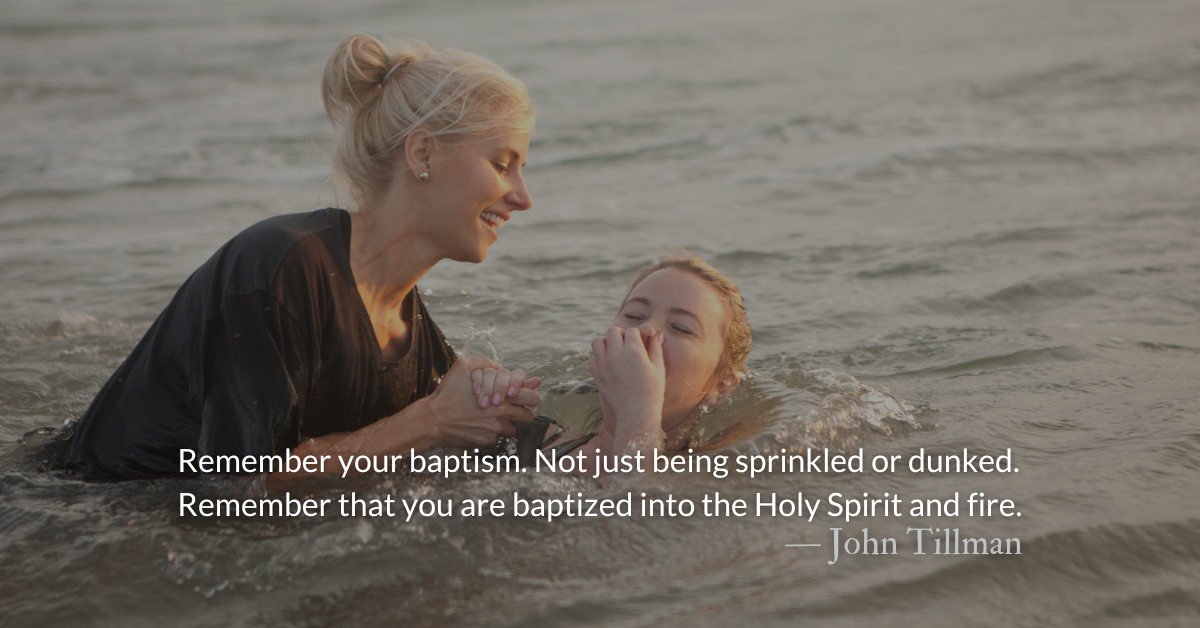
Churches do water baptism differently, but we all recognize the water as a symbol of the Spirit. Remember your baptism. Not just being sprinkled or dunked. Remember that you are baptized into the Holy Spirit and fire.

Like John, our experience of the Holy Spirit might not look, feel, or function as we anticipate and we may have doubts. (Matthew 11.2-3) But don’t take for granted what John died longing for and Jesus died to obtain for us. “Eagerly desire the greater gifts” and walk in “the most excellent way” of love. (1 Corinthians 12.31-13.1)

Take up the mantle passed to us by those who have gone before. If you have passed through the water, walk in the Spirit.

Divine Hours Prayer: The Request for Presence

Give me the joy of your saving help again and sustain me with your bountiful Spirit. — Psalm 51.13

– From The Divine Hours: Prayers for Springtime by Phyllis Tickle.

Read more: Love without Red Flags

“I am for my lover, and my lover is for me.” This literal translation reveals the self-giving attitude of the husband and of the wife. They are for one another.

Read more: Clear the Old Growth 

With sober judgment, let us clear the old growth…cutting down pride, selfishness, hatred, fear, greed, and lusts
The Discrepancy of the Fig Tree

Links for today’s readings:

Mar 2  Read: Proverbs 21 Listen: (3:12) Read: Mark 11 Listen: (3:59)

Scripture Focus: Mark 11.12-22

12 The next day as they were leaving Bethany, Jesus was hungry. 13 Seeing in the distance a fig tree in leaf, he went to find out if it had any fruit. When he reached it, he found nothing but leaves, because it was not the season for figs. 14 Then he said to the tree, “May no one ever eat fruit from you again.” And his disciples heard him say it. 15 On reaching Jerusalem, Jesus entered the temple courts and began driving out those who were buying and selling there. He overturned the tables of the money changers and the benches of those selling doves, 16 and would not allow anyone to carry merchandise through the temple courts. 17 And as he taught them, he said, “Is it not written: ‘My house will be called a house of prayer for all nations’? But you have made it ‘a den of robbers.’” 18 The chief priests and the teachers of the law heard this and began looking for a way to kill him, for they feared him, because the whole crowd was amazed at his teaching. 19 When evening came, Jesus and his disciples went out of the city. 20 In the morning, as they went along, they saw the fig tree withered from the roots. 21 Peter remembered and said to Jesus, “Rabbi, look! The fig tree you cursed has withered!” 22 “Have faith in God,” Jesus answered. 

Matthew 21.18-20

18 Early in the morning, as Jesus was on his way back to the city, he was hungry. 19 Seeing a fig tree by the road, he went up to it but found nothing on it except leaves. Then he said to it, “May you never bear fruit again!” Immediately the tree withered. 20 When the disciples saw this, they were amazed. “How did the fig tree wither so quickly?” they asked.

Reflection: The Discrepancy of the Fig Tree

By John Tillman

Biblical trustworthiness does not mean every scene is like a word-for-word transcript from a video recording.

Mark and Matthew’s accounts of the cursed fig tree differ in chronology. Matthew’s fig tree is cursed the morning following cleansing the temple and Jesus’ teaching about it happens when it withers before the disciples’ eyes. Mark’s fig tree is cursed on the way to cleanse the temple and Peter notices it withered the next morning. Jesus says slightly different things in each account but the main message is the same.

The chronological discrepancy does not threaten the historicity or inerrancy/reliability of the scripture or what it teaches.

First of all, there’s no reason the two can’t be harmonized. Matthew’s “immediately” doesn’t necessarily mean the tree withered all in an instant. There’s no reason it couldn’t have begun visibly withering immediately with the process being completed (and commented on by Peter) the next morning.

Secondly, gospel authors made narrative decisions for reasons of symbolism and structure. They grouped events and teachings for pedagogical purposes. John’s gospel is so thematic and non-chronological (with unique events no one else recorded) we separate it from the “synoptic” gospels. Yet, Mark, Matthew, and Luke also made unique choices about what events and teachings to include and in what order.

These facts of human editorial discretion should not distress us because they did not distress the early church. The early church considered these gospel accounts inspired by the Holy Spirit with the discrepancies. They considered them accurate, trustworthy, and authoritative scripture. We should too.

So what’s the lesson? The fig tree discrepancy that concerns Jesus is the discrepancy between outward posturing and the true fruit of faith. Truly flourishing faith produces deeds.

In both Matthew and Mark the lesson of the fig tree comes the morning after cleansing the temple. The fig tree symbolizes the temple, which symbolizes the spiritual life of the nation and individuals. The temple and the fig tree appear to be flourishing from a distance but Jesus found no fruit. John the Baptizer warned them to “produce fruit in keeping with repentance.” Jesus’ curse is the ax blow John prophesied. (Matthew 3.8-10)

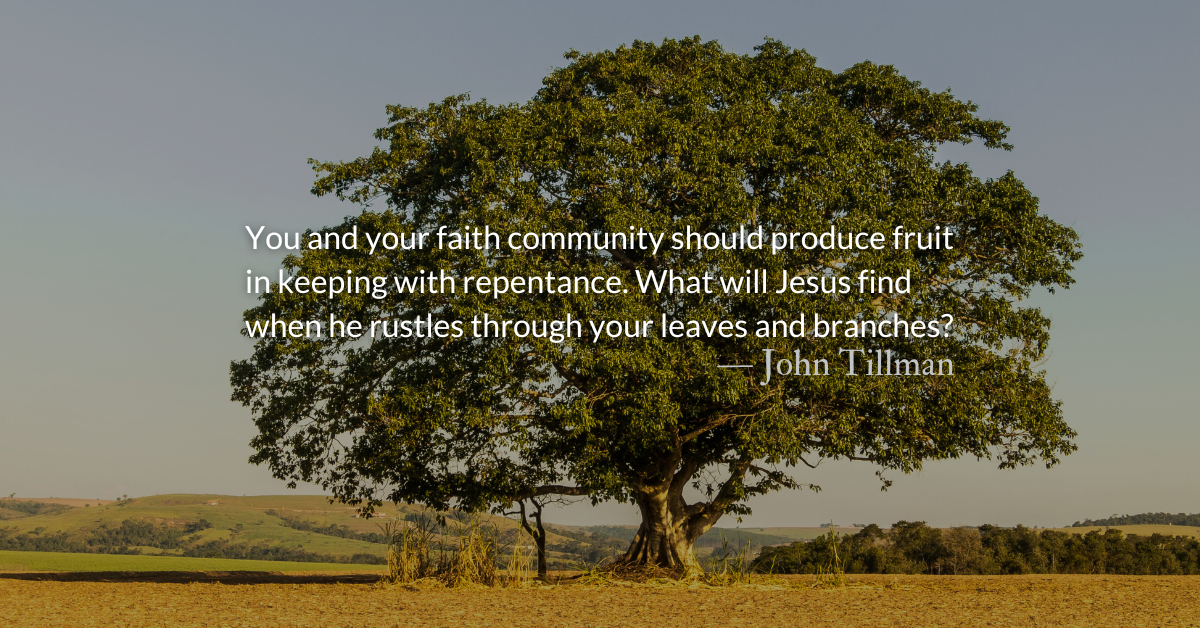
Whether instantly or over time, Jesus will “curse” communities that fail the fruit test, removing his lampstand from them. (Revelation 2.5) You and your faith community should produce fruit in keeping with repentance. What will Jesus find when he rustles through your leaves and branches?

Divine Hours Prayer: The Greeting

Show me your ways, O Lord, and teach me your paths. Lead me in your truth and teach me for you are the God of my salvation; in you have I trusted all the day long. — Psalm 3.8


– From The Divine Hours: Prayers for Springtime by Phyllis Tickle.

Read more:  Figs Out of Season

We may even feel that we are experiencing the chastisement of Christ that the out-of-season fig tree experienced. We may feel withered and diminished.

Read more: Both Parts of Justice

Biblical justice is taking responsibility for the good of others and restoring damage that you cause or fail to prevent.

Call Him by Name — Love of Advent

Links for today’s readings:

Dec 22  Read: 2 Chronicles 26 Listen: (4:00) Read: Psalms 135-136 Listen: (5:03)

Scripture Focus: Psalm 135:13

13 Your name, Lord, endures forever,

    your renown, Lord, through all generations.

14 For the Lord will vindicate his people

    and have compassion on his servants.

Psalm 136:23-26

23 He remembered us in our low estate

    His love endures forever.

24 and freed us from our enemies.

    His love endures forever.

25 He gives food to every creature.

    His love endures forever.

26 Give thanks to the God of heaven.

    His love endures forever.

Matthew 1:20-21

20 But after he had considered this, an angel of the Lord appeared to him in a dream and said, “Joseph son of David, do not be afraid to take Mary home as your wife, because what is conceived in her is from the Holy Spirit. 21 She will give birth to a son, and you are to give him the name Jesus, because he will save his people from their sins.”

Reflection: Call Him by Name — Love of Advent

By Jon Polk

Many of Isaiah’s Messianic prophecies have been enshrined in popular consciousness thanks to the magnificent work of George Frideric Handel. Take, for example, the names of Jesus from Isaiah 9:6 sung by the chorus in “For Unto Us a Child Is Born” from Handel’s Messiah:

…and His name shall be called

Wonderful Counselor, the Mighty God

the Everlasting Father, the Prince of Peace…

Names are significant. The psalmist proclaims that God’s name and great renown will last forever, surpassing all earthly generations (135:13). In ancient Jewish thought, a name was tightly woven with the character of a person, capturing their essence, reputation and authority.

In Matthew’s Nativity account, the angel instructs Joseph to give Mary’s child the name Jesus, “because he will save his people from their sins” (1:21). Jesus is the Greek form of the Hebrew name Joshua, which means “the Lord saves.”

Jesus, literally “the Savior,” is…

Wonderful Counselor. Jesus is a compassionate counselor to his people, healing their afflictions and listening to their broken hearts. Jesus meets our needs, gently guides our steps, and imparts divine wisdom. As the psalmist notes of God, “he remembers us in our low estate” (136:23), walking alongside us in our times of need.

Mighty God. Jesus, while completely human, is also fully God, and being fully God, he is all-powerful. Jesus comes to our rescue, protects us from harm, and in an ultimate act of power and might, lays down his own life for ours. As the psalmist states, “he frees us from our enemies” (136:24), chief of which is our enslavement to sin.

Everlasting Father. Jesus, as God, exists eternally, without restraints due to time. Jesus, as a good father, provides for us, his children, and weeps with us in our anguish and pain. Jesus’ heart beats with a fatherly love for us. As the psalmist declares, “he gives food to every creature” (136:25), demonstrating paternal care.

Prince of Peace. Jesus is heavenly royalty, but not like the brutal warlords of ancient times. Jesus’ rule over the universe brings true, lasting peace, a peace that restores the broken relationship between humanity and God. It is a peace won through the sacrifice of his own life. For this, we echo the psalmist who encourages us to “Give thanks to the God of heaven” (136:26).

Consider which name and characteristic of Jesus you need most this Advent season. Call out to him with that name in confidence. Let your spirit sing along with the jubilant choir, “For unto us a child is born, unto us a Son is given!”

Divine Hours Prayer: The Request for Presence

Be my strong rock, a castle to keep me safe, for you are my crag and my stronghold; for the sake of your Name, lead me and guide me. — Psalm 31.3

– From The Divine Hours: Prayers for Autumn and Wintertime by Phyllis Tickle.

Read more: Silent Night — Carols of Advent Joy

Silent Night was born out of a period of insecurity

Consider Supporting Our Work

We need more donors just like you. Every donation, small or large, supports ad-free content that brings biblical devotionals to inboxes across the world.

Deuteronomy’s Dream for the Poor

Links for today’s readings:

Read: Deuteronomy 15 Listen: (3:20) Read: 2 Corinthians 8 Listen: (3:25)

Scripture Focus: Deuteronomy 15.4-5, 7-11

4 …there need be no poor people among you, for in the land the Lord your God is giving you to possess as your inheritance, he will richly bless you, 5 if only you fully obey the Lord your God…

7 If anyone is poor among your fellow Israelites in any of the towns of the land the Lord your God is giving you, do not be hardhearted or tightfisted toward them. 8 Rather, be openhanded and freely lend them whatever they need. 9 Be careful not to harbor this wicked thought: “The seventh year, the year for canceling debts, is near,” so that you do not show ill will toward the needy among your fellow Israelites and give them nothing. They may then appeal to the Lord against you, and you will be found guilty of sin. 10 Give generously to them and do so without a grudging heart; then because of this the Lord your God will bless you in all your work and in everything you put your hand to. 11 There will always be poor people in the land. Therefore I command you to be openhanded toward your fellow Israelites who are poor and needy in your land.

Matthew 26.11

11 The poor you will always have with you, but you will not always have me.

Reflection: Deuteronomy’s Dream for the Poor

By John Tillman

Matthew 26.11 is just one phrase of many words of Jesus that have been misquoted, taken out of context, or abused in history. People have used this to imply that poverty is intractable and action against it is ineffectual at best and against God’s will at worst. This false teaching is one of the more damaging ones to spread in the history of the church.

Jesus never implied opposing poverty means opposing God’s sovereignty. Instead, Jesus directly referenced Deuteronomy 15.11, including its command to be openhanded toward the poor.

Deuteronomy makes an extraordinary promise that “there need be no poor people among you” (Deuteronomy 15.4) but follows it up with realism, saying, “There will always be poor people…” (Deuteronomy 15.11)

God proclaims the possibilities of generosity while acknowledging the grim reality of greed. Through following God, we can open our hearts and hands, maintaining idealistic visions and actions without losing sight of ugly realities. Christians can look the darkest realities of poverty in the face and confidently say, “It doesn’t have to be this way.”

“If only you fully obey the Lord your God.” (Deuteronomy 15.4)

The dream of Deuteronomy 15.4 was fulfilled (for a short time) in the early church. It was said of them, “God’s grace was so powerfully at work in them all that there were no needy persons among them.” (Acts 4.33-34) These Spirit-filled believers fulfilled Deuteronomy’s proclaimed possibility about the poor.

All systems controlled by humans eventually become corrupted and the Acts 4 church is no exception. Racism slips into the distribution of food and the highest levels of the church leadership must get involved (and get honest) to solve it. Corruption in systems run by humans is inevitable. If the church’s own system faced accusations of inequity, how much more can we expect inequity to be a concern in secular systems? However, these concerns are not a reason that we should abandon our calling in this area.

At the heart level of each individual and at the highest levels of our churches, denominations, and governments, Christians must acknowledge that the poor are our responsibility and are one way that God will judge how well we are helping his will to be done “on Earth as it is in Heaven.” (Matthew 6.9-10)

Divine Hours Prayer: The Morning Psalm

Though high up, You see the lowly;
Though far away, you keep an eye on the proud. — Psalm 138.6

– Divine Hours prayers from The Divine Hours: Prayers for Summer
by Phyllis Tickle

Read more: He Became Poor

The reasons God gives for his just acts of judgment against Israel and Judah…always include offenses related to oppression of the poor.

Consider Supporting Our Work

Our work continues because of donations from people like you. Please consider becoming a donor.

The Shema and The Lord’s Prayer

Links for today’s readings:

Read: Deuteronomy 6 Listen: (3:13)  Read: 1 Corinthians 16 Listen: (2:54)

Scripture Focus: Deuteronomy 6.3-9

3 Hear, Israel, and be careful to obey so that it may go well with you and that you may increase greatly in a land flowing with milk and honey, just as the Lord, the God of your ancestors, promised you.

4 Hear, O Israel: The Lord our God, the Lord is one. 5 Love the Lord your God with all your heart and with all your soul and with all your strength. 6 These commandments that I give you today are to be on your hearts. 7 Impress them on your children. Talk about them when you sit at home and when you walk along the road, when you lie down and when you get up. 8 Tie them as symbols on your hands and bind them on your foreheads. 9 Write them on the doorframes of your houses and on your gates.

Matthew 6.9-13

9 “This, then, is how you should pray:
“ ‘Our Father in heaven,
hallowed be your name,
10 your kingdom come,
your will be done,
on earth as it is in heaven.
11 Give us today our daily bread.
12 And forgive us our debts,
as we also have forgiven our debtors.
13 And lead us not into temptation,
but deliver us from the evil one.’

Reflection: The Shema and The Lord’s Prayer

By John Tillman

Many people today pray daily using The Lord’s Prayer which Jesus taught his disciples in the New Testament. Jesus and his disciples however, already grew up saying a daily prayer. It was a prayer taken from Moses’ speech to the people about to enter the land and was, in Jesus’ day, said twice daily. Jesus answered using this prayer when he was asked what the greatest commandment in the law was. (Mark 12:28-34; Matthew 22.36-40)

This prayer is called, “the Shema.” The Shema takes its name from the first word of the prayer. The Hebrew word shema is sometimes translated to listen or hear. In this prayer, and elsewhere in scripture, hearing and obeying are intrinsically linked in the Hebrew language. Shema implies not just hearing words but carrying them out.

In The Lord’s Prayer, action is also implied. Praying “your will be done on Earth as it is in heaven,” is not intended to be a passive wish with no participation on our part. In both the Shema and The Lord’s Prayer, we are expected to engage in concrete actions once we stop praying.

We will pray today, combining these two prayers from scripture. Before you rise from prayer, ask God to guide your feet and hands to enact his word.

Hear, Listen, Obey

We ask you to hear us, God, but we need to hear you.

You alone are God, our only Father in Heaven

Your name is holy as we are to be holy.
Father, Son, and Spirit are one, as we are to be one.

You alone are the provider of our bread.
You alone are the forgiver of our debts.

In return, Lord, we love you with all our heart, showing your love to others in forgiveness
In return, Lord, we love you with all our soul, opening our inner being to your indwelling
In return, Lord, we love you with all our strength. The strength of our body and mind, we give to you for your service and will.

Tie your Word to us that…
In your strength, may we resist temptation.
In your love, may we rescue the falling.
In your Spirit, may we speak the gospel with our words, carry the gospel with our feet, and enact the gospel with our hands.

Video: (Shema — The Bible Project)

Divine Hours Prayer: The Request for Presence

Lord, God of hosts, hear my prayer; hearken, O God of Jacob. — Psalm 84.7

– Divine Hours prayers from The Divine Hours: Prayers for Summer

 by Phyllis Tickle

Read more: Public, Prayerful, Persistent Protest

Daniel prayed in defiance of an unjust law. He was guilty before the law of the land, but blameless before God.

Consider Supporting Our Work

We pray that you would consider becoming a donor. Support ad-free content that brings biblical devotionals to inboxes across the world.