
Humble, Welcoming Servants—Guided Prayer

Scripture Focus: Mark 9.50
“Salt is good, but if it loses its saltiness, how can you make it salty again? Have salt among yourselves, and be at peace with each other.”

Reflection: Humble, Welcoming Servants—Guided Prayer
By John Tillman

We confess to you, Lord…
When our immaturity demands miracles on our terms
When we struggle to accept the people whom you are calling us to accept
When we take offense
When we are ungrateful for how much you have transformed our lives
That, so many times, it is our own ambitions and selfishness that stand in the way.

Just like the twelve, just like any numbered group, we are concerned about being number one. We argue and attempt to dominate one another.

“He asked them, ‘What were you arguing about on the road?’ But they kept quiet because on the way they had argued about who was the greatest.” — Mark 9.33-34

“Anyone who wants to be first must be the very last, and the servant of all.” — Mark 9.35

Help us to serve all and humbly welcome those whom you place in the center of our gatherings.
He took a little child whom he placed among them. Taking the child in his arms, he said to them 

“Whoever welcomes one of these little children in my name welcomes me; and whoever welcomes me does not welcome me but the one who sent me.” — Mark 9.36-37

Help us to support those outside our groups who are willing to work in Christ’s name.

“‘We told him to stop, because he was not one of us.’
‘Do not stop him,’ Jesus said. ‘For no one who does a miracle in my name can in the next moment say anything bad about me, for whoever is not against us is for us.’” — Mark 9.38-40

Lord, it is not what we see that causes us to stumble, it is our own eyes. It is not what we touch that causes us to stumble, it is our own hands. It is not what we lust for that causes us to stumble. It is our own heart.

“If your eye causes you to stumble, pluck it out. It is better for you to enter the kingdom of God with one eye than to have two eyes and be thrown into hell.” — Mark 9.47

Help us to remove from our lives what causes us to stumble.
Help us to humbly work with those who will work with us.
Help us to be servants to all-comers, not contestants against all-comers.
Help us to remember with thanks the transformative work you have done in our lives.

Divine Hours Prayer: The Call to Prayer
Be joyful in the Lord, all you lands; serve the Lord with gladness and come before his presence with a song. — Psalm 110.1

– Divine Hours prayers from The Divine Hours: Prayers for Summertime by Phyllis Tickle

Today’s Readings
Jeremiah 27 (Listen – 3:52)
Mark 9 (Listen – 6:16)

Read more about Seeking God’s Servant
Blind and hard of hearing as we may be to His ultimate purpose, God leads us and calls us to be His humble servants.

#ReadersChoice is time for you to share favorite Park Forum posts from the year.
What post helped you endure suffering?https://forms.gle/DsYWbj45y9fCDLzi7


Trapped by Being Offended

Scripture Focus: Mark 6.4
A prophet is not without honor except in his own town, among his relatives and in his own home.

Jeremiah 20.1-2
When the priest Pashhur son of Immer, the official in charge of the temple of the Lord, heard Jeremiah prophesying these things, he had Jeremiah the prophet beaten and put in the stocks.

Mark 6.27-28
So he immediately sent an executioner with orders to bring John’s head. The man went, beheaded John in the prison, and brought back his head on a platter.

From John: This repost from 2018 is even more relevant today. When anyone today challenges us, our first instinct has become offense. Any prophet, preacher, politician, scientist, or fellow believer becomes a threat to us if they present evidence contrary to what is comfortable for us to believe. We marginalize them, attack their reputation, redraw our ideological lines to exclude them, and refuse to listen or to judge what they say.

Reflection: Trapped by Being Offended
By John Tillman

Our readings today bring us a theme of three prophets whose offensive messages caused them to be rejected: Jesus, Jeremiah, and John the Baptist.

Nazareth’s residents “took offense” at Jesus. The Greek word translated as “offense” is skandalizó and it implies the idea of a trap that one falls into or is ensnared by.

There’s no gunshot like conviction,
There’s no conscience bulletproof,
There’s no strength like our own weakness,
There’s no insult like the truth. — Charlie Peacock

Stumbling into the trap of offense leads to a pattern that we can learn from. All three of these prophets experienced this pattern in some way. If we find ourselves in one of these steps, we need to prayerfully evaluate our hearts to see if we are trapped by being offended.

Step one: Minimize the prophet’s message based on his or her family background, age, race, gender, or history.
Focus on the prophet and magnify any flaw. Jeremiah was a young, unpatriotic upstart. Jesus was an out-of-wedlock, scandalous, small-town kid from a flyover state from which nothing good could come. John was an extremist and was politically insensitive.

Step two: Publicly censure the prophet, inviting shame, scorn, and sometimes violence.
Jeremiah was held in stocks in the Temple. The purpose of such a punishment is to shame and humble an enemy; to make him or her powerless, allowing verbal and physical attacks. This practice is common today. We still love shaming and stoning people. We just mostly do it digitally through social media.

Step three: Conspire with the powerful to have the prophet silenced.
John’s attack on Herod’s incestuous marriage brought him into political crosshairs and set in motion an illegal conspiracy to have him killed. Jesus also was the victim of conspiracy, leading to his shaming, humiliating death on the cross. Jeremiah was tortured many times. The Bible doesn’t record his death, but according to traditional sources he was eventually stoned.

With the exception of Herodias, all of the people who tortured and killed the three prophets we read of today thought they were doing God’s work—disposing of troublemakers.

This should shock us into inner evaluation of ourselves and our motives. Why are we offended? Can we turn our offense and the offender over to God? We must always be cautious and prayerful when we take offense at a prophet.

Divine Hours Prayer: The Greeting
You are my hope, O Lord God, my confidence since I was young. — Psalm 71.5

– Divine Hours prayers from The Divine Hours: Prayers for Summertime by Phyllis Tickle

Today’s Readings
Jeremiah 20 (Listen – 3:07) 
Mark 6 (Listen – 7:23)

This Weekend’s Readings
Jeremiah 21 (Listen – 2:35) Mark 7 (Listen – 4:28)
Jeremiah 22 (Listen – 5:07) Mark 8 (Listen – 4:29)

Read more about Avoiding Haman’s Petard
Haman’s path to hatred was hatched based on an action which he interpreted as disrespect.

#ReadersChoice is time for you to share favorite Park Forum posts from the year. What post helped you pray more frequently?https://forms.gle/DsYWbj45y9fCDLzi7

From Slavery to Service—Worldwide Prayer

Scripture Focus: Mark 5.18-20
As Jesus was getting into the boat, the man who had been demon-possessed begged to go with him. Jesus did not let him, but said, “Go home to your own people and tell them how much the Lord has done for you, and how he has had mercy on you.” So the man went away and began to tell in the Decapolis how much Jesus had done for him. And all the people were amazed.

Reflection: From Slavery to Service—Worldwide Prayer
By John Tillman

Just as Jesus left the Gerasene man, trusting him to spread the gospel to the Decapolis, he would soon leave the disciples, trusting them to spread the gospel to the world. And now, in our own turn, each generation is entrusted to follow in their footsteps.

May we be as miraculously transformed as the Gerasene man, leaving behind our demons, leaving behind our addictions, leaving behind our places of imprisonment. May we leave behind our slavery and enter his service becoming thankful workers for peace.

We, like the demoniac, are enslaved to our sin and have no strength to escape its pull. Yet, Jesus comes to us to set us free. May we be as radically thankful as the demoniac was, running to our cities and communities with loving action and the life-changing gospel.

Thankful Workers for Peace
A prayer of thanksgiving from Thailand

Dear heavenly Father,
We praise you for your love and mercy to all humankind.
We praise you for your Son, our Savior.
We praise you for this wonderful universe,
for the son, the moon and the stars.
You have placed everything in perfect order so that
we may live in peace and harmony with all that
you have created. You have provided sustenance
for your children.
People everywhere face many difficulties,
they suffer,
they cry,
they are starving,
homeless, and helpless.
Help us to attempt to solve the difficulties they face,
to be active in serving the needy.
And may we be workers for peace.
We pray in the name of Jesus Christ.

*Prayer from Hallowed be Your Name: A collection of prayers from around the world, Dr. Tony Cupit, Editor.

Divine Hours Prayer: The Request for Presence
In you, O Lord, have I taken refuge; let me never be put to shame; deliver me in your righteousness. — Psalm 31.1

– Divine Hours prayers from The Divine Hours: Prayers for Summertime by Phyllis Tickle

Today’s Readings
Jeremiah 19 (Listen – 2:58) 
Mark 5 (Listen – 5:21)

Read more about Freedom for Prisoners
The demoniac of the Gerasenes could not be captured or detained. He could break any chains that were put on him, yet remained captive to the evil inside of him.

#ReadersChoice is time for you to share favorite Park Forum posts from the year.
What post helped you explain the gospel?https://forms.gle/DsYWbj45y9fCDLzi7

Keeping the Sabbath by Action

Scripture Focus: Jeremiah 17.21-23
21 This is what the LORD says: Be careful not to carry a load on the Sabbath day or bring it through the gates of Jerusalem. 22 Do not bring a load out of your houses or do any work on the Sabbath, but keep the Sabbath day holy, as I commanded your ancestors. 23 Yet they did not listen or pay attention; they were stiff-necked and would not listen or respond to discipline.

Mark 3.4-6
4 Then Jesus asked them, “Which is lawful on the Sabbath: to do good or to do evil, to save life or to kill?” But they remained silent. 
5 He looked around at them in anger and, deeply distressed at their stubborn hearts, said to the man, “Stretch out your hand.” He stretched it out, and his hand was completely restored. 6 Then the Pharisees went out and began to plot with the Herodians how they might kill Jesus.

Reflection: Keeping the Sabbath by Action
By John Tillman

There is more than one way to desecrate the Sabbath.

The way of “keeping the Sabbath holy” that we commonly think of is by limiting what we do. We refrain from doing work. We focus on spiritual matters. We prioritize worship. This is the kind of warning that Jeremiah was sent to cry. “Stop the clamour of commerce.” “Stop the wheels of wealth accumulation,” the prophet says. But Jesus defines a second requirement to keep the Sabbath holy. 

To Jesus, keeping the Sabbath holy meant staying in step with God’s Spirit and leaving nothing undone that the Spirit commanded. His stinging question about what is lawful on the Sabbath goes unanswered by the teachers of the law, not because they don’t know the answer, but because they don’t like the answer they would be forced to give.

Jeremiah banned commerce on the Sabbath because the day was intended to be about the worship of God and enriching the community rather than one’s self. Instead, over the centuries, the restrictions of the Sabbath had become excuses for selfish inaction. The experts of the law used their expertise to dodge responsibility rather than shoulder it and to accumulate wealth and power rather than honor God with it.

There’s more than one way to make Jesus angry. 

Inaction in the face of someone who needs help is one way that is very reliable. Jesus burns with anger for their heartlessness, but it’s more than activism—Jesus takes action. When we get angry, we tend to cause harm. When Jesus gets angry, he heals.

Jesus was angry because these teachers were doing what the wealthy of Jerusalem were doing in Jeremiah’s day. They were tying up heavy loads for others to carry, (and on the Sabbath, no less) but would not lift a finger to help them.

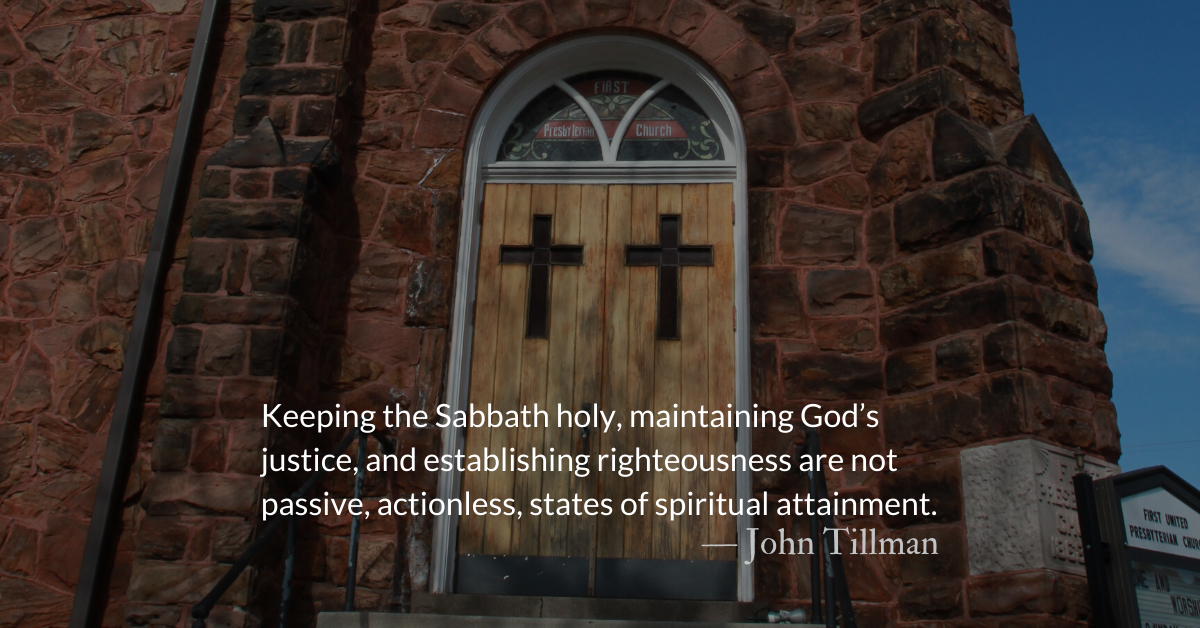
Keeping the Sabbath holy, maintaining God’s justice, and establishing righteousness are not passive, actionless, states of spiritual attainment. God’s holiness moves. God’s righteousness rolls like a river. God’s justice falls on the wicked.

May our holiness surpass that of the religious leaders, as Jesus prayed it would. 
May we not live in prayerlessness during the week and expect God to show up on the weekend.
May we fulfill the Sabbath by worshiping in spirit and truth.
May we not desecrate the Sabbath with inaction in the face of need.

Divine Hours Prayer: The Refrain for the Morning Lessons
He looks at the earth and it trembles; he touches the mountains and they smoke. — Psalm 104.33

– Divine Hours prayers from The Divine Hours: Prayers for Summertime by Phyllis Tickle

Today’s Readings
Jeremiah 17 (Listen – 4:50) 
Mark 3 (Listen – 5:05)

Read more about The Focus of Christ’s Anger
It isn’t too often we see Jesus angry, so it makes sense to pay close attention to when and why it happens.

#ReadersChoice is time for you to share favorite Park Forum posts from the year.
What post helped you pray more passionately?

https://forms.gle/DsYWbj45y9fCDLzi7
Ladies First—Resurrection Appearances

Scripture Focus: Mark 16.9
He appeared first to Mary Magdalene…

Luke 24.22-25
In addition, some of our women amazed us. They went to the tomb early this morning but didn’t find his body. They came and told us that they had seen a vision of angels, who said he was alive. Then some of our companions went to the tomb and found it just as the women had said, but they did not see Jesus.”

He said to them, “How foolish you are, and how slow to believe all that the prophets have spoken!”

John 20.19
On the evening of that first day of the week, when the disciples were together, with the doors locked for fear of the Jewish leaders, Jesus came and stood among them and said, “Peace be with you!”

*This Easter week as we shelter in our homes due to COVID-19, we may feel more like the fearful gathered disciples than we ever have before. We will look this week at the appearances of Jesus, who comes to stand in our troubled midst and say, “Peace be with you.”

Reflection: Ladies First—Resurrection Appearances
By John Tillman

“Firsts” are important in the scriptures. So we cannot imagine that it is a coincidence or a mistake that Jesus appears first to the women. 

One reason Jesus may have done this is that they, along with John, were with him to the end. They were the last faces he saw as he gave up his spirit. It makes sense that he would honor them to be the first to behold his now glorified face, raised by the Spirit’s power.

Jesus did this despite knowing that no one would believe them. A woman’s testimony was considered invalid in court. Today, a woman’s testimony counts according to the technicalities of the law, but still counts for less in the general culture. All these centuries later, we still have problems in our society taking a woman at her word.

If the gospel accounts had been written late, with intentional warping of the facts to make plausible an extraordinary claim, the women’s testimony, which not even Jesus’ closest followers believed, would have been deleted and replaced with that of Nicodemus or someone else with moral standing. (See more on the trustworthiness of the Resurrection accounts here.)

Instead, Jesus not only appeared to women first, but gave his most personal resurrection greeting to a woman shamed by her culture for having been demon-possessed. Mary Magdalene is also (probably falsely) accused by history of having been a prostitute. 

Jesus was intentionally exalting the humbled, by placing the women, and scorned outcasts, at the center of the narrative in an irreplaceable and immovable way.

He also was intentionally confronting the disciples with their cultural blindness and propensity to doubt. This was not to pile shame on them, but to build faith in them. He was weaning them off of faith by sight, knowing that soon they too must believe in him without seeing him.

Faith by sight, is faith limping along on a crutch. Faith by sight dies in the dark. Faith by sight is blind to the Spirit, for it never looks beyond the physical. But the worst thing about faith by sight is that even it still fails.

What is extraordinary about humanity is not that we are capable of believing without seeing. It is that we are capable of seeing, and still refusing to believe.

Like the women, we will be doubted. But let us still run and tell, “I have seen the Lord!”

He is risen! He is risen, indeed!

Divine Hours Prayer: The Cry of the Church
Christ has died. Christ has risen. Christ will come again.

– Divine Hours prayers from The Divine Hours: Prayers for Springtime by Phyllis Tickle.

Today’s Readings
Proverbs 31 (Listen -2:50)
1 Timothy 2 (Listen -1:38)

Read more about Easter—The Happy Beginning
Easter is not a happy ending. It is a happy beginning.

Read more about A New Day :: Worldwide Prayer
May we follow the example of the first witnesses: the women who were more faithful than the betrayers, braver than the soldiers, and the first to believe in and spread the gospel.


Show Buttons
Hide Buttons
Spur a spiritual rhythm of refreshment right in your inbox
By joining this email list you are giving us permission to send you devotional emails each weekday and to communicate occasionally regarding other aspects of the ministry.
100% Privacy. We don't spam.