When Suffering Lingers

Because the schooling of suffering is so dangerous, it is right to say that this school educates for eternity.

― Søren Kierkegaard

Scripture: Exodus 3.5

The angel of the Lord appeared to Moses in a flame of fire out of the midst of a bush. He looked, and behold, the bush was burning, yet it was not consumed.

Reflection: When Suffering Lingers
The Park Forum

The burning bush appeared at the height of Israel’s suffering. Early rabbinic writings understood the bush to be a symbol of ancient Israel—persevering under the flame Egypt’s brutality.

The Greek philosopher Philo expanded the rabbi’s imagery to include all of humanity. “For the burning bramble was a symbol of those who suffered wrong, as the flaming fire of those who did it,“ he explained in his work On the Life of Moses.

Philo was a contemporary of Christ, although the two never would have met (Philo was an aristocrat in Alexandria). The philosopher spent his life exploring the synergy and tension of Jewish scriptural study and Stoicism. His writings reveal through scripture what he could not find in philosophy—meaning in suffering.

“Christianity teaches that, contra fatalism, suffering is overwhelming; contra Buddhism, suffering is real; contra karma, suffering is often unfair; but contra secularism, suffering is meaningful,” writes Timothy Keller In Walking with God through Pain and Suffering. “There is a purpose to it, and if faced rightly, it can drive us like a nail deep into the love of God and into more stability and spiritual power than you can imagine.”

Though we burn, we are not consumed. This is the mere beginning of God’s grace. Endurance is the deposit guaranteeing great reward. God’s promise to those who suffer is not only that the flame will be extinguished, but that all it has burnt will be restored.

The prophets joyfully proclaim God as the one who will return the wasted years. The New Testament crescendos with no more tears, no more death, no more pain—all of it replaced by  new life.

It is the cross that is the enduring symbol of the Christian faith, not the burning bush. The bush reminds us that God always hears the cry of his people. The cross shows us that God stops at nothing—moving heaven and earth, even sacrificing his beloved—to bring them restoration.

Prayer: The Greeting

“Restore us, O God of hosts;* show the light of your countenance, and we shall be saved.”

– From The Divine Hours: Prayers for Springtime by Phyllis Tickle.

Full prayer available online and in print.

Today’s Reading
Exodus 3 (Listen – 3:59)
Luke 6 (Listen – 6:46)

A Vocation Hostile to Faith

There is not a square inch in the whole domain of our human existence over which Christ, who is Sovereign over all, does not cry, Mine!

― Abraham Kuyper

Scripture: Genesis 50.26

So Joseph died at the age of a hundred and ten. And after they embalmed him, he was placed in a coffin in Egypt.

Reflection: A Vocation Hostile to Faith
The Park Forum

The earliest-dated Egyptian mummies happened naturally—their bodies preserved by the relentless heat and arid climate of the ancient Near East. Around 2,600 B.C.E, long before Joseph’s time, Egypt formalized a mummification process.

“The embalmers took out the brains and entrails and washed them in palm wine,” the Greek historian Herodotus explained. “They began to anoint the body with the oil of cedar, myrrh, cinnamon, and cassia.”

Mummification was not simply a medical practice, but a spiritual rite. Archaeologists have unearthed amulets believed to provide blessing, and canopic jars which paired individual organs to gods for protection. Many mummies held a papyrus scroll containing spells from the Book of the Dead.

The Bible made a point to show that Joseph asked for his father to be embalmed by doctors. Priests would have been normative, and Joseph’s maneuver likely exempted Jacob from some of the spiritual murkiness of mummification. But because he had been a ruling official under Pharaoh, Joseph’s body would have had a full Egyptian burial ceremony.

This isn’t the only time in the scriptures where vocation creates tension with faith. When Naaman places his trust in God after Elijah heals him, the Syrian army commander presents a dilemma. Part of his occupation involves escorting his leader into a pagan temple and helping the leader bow before Baal’s idol—a act which caused Naaman to bow as well.

“Go in peace,” the prophet tells Naaman. Shalom he says—may things be exactly as God wills them.

God knows the true resting place of our hearts. God also values a person wholly submitted to him yet embedded in a pagan culture—how else will the nations be reached? How will each vocation be redeemed?

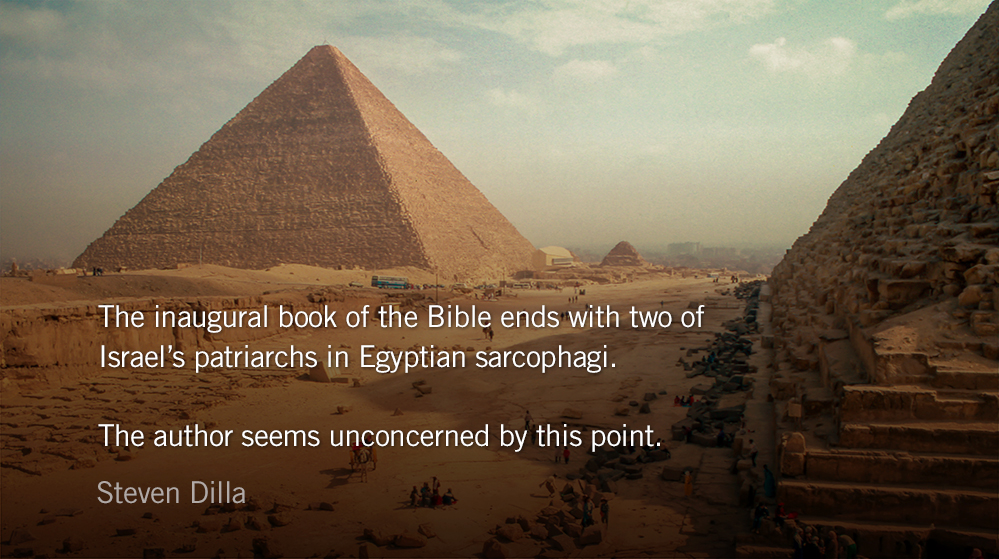
The inaugural book of the Bible ends with two of Israel’s patriarchs in Egyptian sarcophagi. The author seems unconcerned by this point. He knows it’s the end of a book, not the end of the story. More importantly, his faith wasn’t in men for redemption, but in the coming Messiah.

The Call to Prayer 

I will call upon God, and the LORD will deliver me. God, who is enthroned of old, will hear me. — Psalm 55:17, 20

– From The Divine Hours: Prayers for Springtime by Phyllis Tickle.

Full prayer available online and in print.

Today’s Reading
Genesis 50 (Listen – 4:07)
Luke 3 (Listen – 5:24)

This Weekend’s Readings
Exodus 1 (Listen – 2:32) Luke 4 (Listen – 5:27)
Exodus 2 (Listen – 3:18) Luke 5 (Listen – 5:04)

Going Home

It is not the strength of your faith but the object of your faith that actually saves you.

― Timothy Keller

Scripture: Genesis 49.33

When Jacob finished commanding his sons, he drew up his feet into the bed and breathed his last and was gathered to his people.

Reflection: Going Home
The Park Forum

There is a brutal reality to death which cannot be softened. When his father Jacob dies, we read that, “Joseph threw himself on his father and wept over him and kissed him.” Old age may make death more expected, but nothing makes it less heartbreaking.

Joseph had been robbed of his best years with his father—reconnecting only as an adult. When he first heard Jacob was nearing Egypt, Joseph raced out in his chariot to meet him along the way.

Reunions are meant to be joyous occasions. At their best, they are times when loved ones gather to reminisce, laugh, and feast. In this case, the beloved was restored to his family. Jacob and Joseph’s reunion was filled with the triumph of a father and son, once separated by what seemed like forever, now reunited.

The revelation at Jacob’s death, that he, “was gathered to his people” is not simply a Hebrew euphemism. This is one of the first images scripture reveals about the afterlife. Like what Joseph felt when he fell headlong into his father’s arms on the road to Egypt, death, for the faithful, is a reunion of inexpressible joy.

Death may be present reality, but time is not eternity. 2 Corinthians observes that Christians are, “sorrowful, yet always rejoicing.” Now death; soon life.

Even Jesus wept at a funeral—yet death did not get the last word—he called Lazarus from the grave. Resurrection is a fundamentally relational concept in the scriptures. It restores holistic life to body and soul, relationship, and integrity to community once fractured.

No wonder the prophets of the New Testament would rejoice at the image of the resurrection as the great banquet of heaven. Together we shall delight in new life, knowing that whatever joy we experience as we reunite with friends and family will seem infinitesimal in comparison to the triumph of living in harmony with our Father.

Prayer: The Request for Presence 

Gladden the soul of your servant, for to you, O Lord, I lift up my soul. — Psalm 86:4

– From The Divine Hours: Prayers for Springtime by Phyllis Tickle.

Full prayer available online and in print.

Today’s Reading
Genesis 49 (Listen – 4:54)
Luke 2 (Listen – 6:11)

Fresh Focus

We need not say in what precise form or way the blessing shall come: let us leave it in all its breadth of inconceivable benediction.

― Charles Haddon Spurgeon

Scripture: Genesis 48.15

And [Israel] blessed Joseph and said, “The God before whom my fathers Abraham and Isaac walked, the God who has been my shepherd all my life long to this day…”

Reflection: Fresh Focus
By Charles Haddon Spurgeon (1834-1892)

If we want to bless young people, one of the likeliest means of doing so will be our personal testimony to the goodness of God. Young men and women usually feel great interest in their fathers’ life-story—if it be a worthy one—and what they hear from them of their personal experience of the goodness of God will abide with them.

I want you to note, that Jacob, in desiring to bless his grandsons, introduced them to God. He speaks of “God before whom my fathers did walk: God who blessed me all my life long.” This is the great distinction between man and man: there are two races, he that fears God, and he that fears him not.

The religion of this present age, such as it is, has a wrong direction in its course. It seeks after what is called “the enthusiasm of humanity,” but what we want far more is enthusiasm for God. We shall never go right unless God is first, midst, and last. I despair for benevolence when it is not based upon devotion. We shall not long have love to man if we do not first and chiefly cultivate love to God.

Jacob died as one who had been delivered from all evil, ay, even the evil of old age. His eyes were dim; but that did not matter, for his faith was clear. I love to think that we are going where our vision of God will not be through the eye, but through the spiritual perceptions. These were brighter in Jacob in his old age than ever before; his faith and love—which are the earthly forms of those perceptions—were apprehending God in a more forcible manner than ever, and therefore signified little that the eyes which he would need no longer were failing him.

*Abridged and language updated from Charles Haddon Spurgeon’s sermon A Bit of History for Old and Young. 

The Prayer Appointed for the Week

O God, the strength of all who put their trust in you: Mercifully accept my prayers; and because in my weakness I can do nothing good without you, give me the help of your grace, that in keeping your commandments I may please you in both will and deed; through Jesus Christ my Lord, who lives and reigns with you and the Holy Spirit, one God, for ever and ever. Amen.

– From The Divine Hours: Prayers for Springtime by Phyllis Tickle.

Full prayer available online and in print.

Today’s Reading
Genesis 48 (Listen – 3:43)
Luke 1:39-80 (Listen – 9:26)


Risks of Faith

Gallantly, ceaselessly, quietly, man must fight for inner liberty to remain independent of the enslavement of the material world.

― Abraham Joshua Heschel

Scripture: Genesis 47.29-30

[Israel said,] “Do not bury me in Egypt, but let me lie with my fathers. Carry me out of Egypt and bury me in their burying place.”

Reflection: Risks of Faith
The Park Forum

“Imagine, challenges Kierkegaard, “a mighty spirit who promised to a certain people his protection, but upon the condition that they should make their appearance at a definite place where it was dangerous to go.” And here, in just a sentence, we have the story that repeats with every father of the faith. And also the story of our own faith. The philosopher continues:

Suppose that these folks waited to make their appearance, and instead went home to their living rooms and talked to one another in enthusiastic terms about how this spirit had promised them his potent protection. No one would be able to harm them. Is not this ridiculous?

So it is with today’s Christianity. Christ taught something perfectly definite by believing; to believe is to venture out as decisively as it is possible, breaking with everything one naturally loves. But to him who believes, assistance against all danger is also promised.

But today we play at believing, play at being Christians. We remain at home in the old grooves of finitude–and then we go and twaddle with one another, or let the preachers twaddle to us, about all the promises that are found in Christ. Is this not ridiculous?

Israel never saw the promised land. John the Baptist was seized by anxiety when Christ did not usher in the Kingdom of God during his lifetime. “Others suffered mocking and flogging, and even chains and imprisonment,” the book of Hebrews records. “They were stoned, they were sawn in two, they were killed with the sword.”

How we long to experience the fullness of God now. How we overlook the “great cloud of witnesses” who walked in faith before us.

Kierkegaard prays:

Preserve me, Lord, from the deceit of thinking that by being prudent and looking after my own interests I am necessarily using my talents aright. He who takes risks for your sake may appear to lose, but he is accepted by you. He who risks nothing appears to gain by his prudence, but he is rejected by you. But let me not think that by avoiding risk I am better than the other. Grant me to see that this is an illusion, and save me from such a snare.

Prayer: The Request for Presence

Satisfy us by your loving-kindness in the morning; so shall we rejoice and be glad all the days of our life. — Psalm 90:14

– From The Divine Hours: Prayers for Springtime by Phyllis Tickle.

Full prayer available online and in print.

Today’s Reading
Genesis 47 (Listen – 5:03)
Luke 1:1-38 (Listen – 9:26)

Show Buttons
Hide Buttons
Spur a spiritual rhythm of refreshment right in your inbox
By joining this email list you are giving us permission to send you devotional emails each weekday and to communicate occasionally regarding other aspects of the ministry.
100% Privacy. We don't spam.