Carol of the Bells — Carols of Advent Hope

Scripture Focus: Hebrews 13:15-16
15 Through Jesus, therefore, let us continually offer to God a sacrifice of praise—the fruit of lips that openly profess his name. 16 And do not forget to do good and to share with others, for with such sacrifices God is pleased.

Luke 2:10-11
10 But the angel said to them, “Do not be afraid. I bring you good news that will cause great joy for all the people. 11 Today in the town of David a Savior has been born to you; he is the Messiah, the Lord.”

Psalm 150:3-6
3 Praise him with the sounding of the trumpet,
    praise him with the harp and lyre,
4 praise him with timbrel and dancing,
    praise him with the strings and pipe,
5 praise him with the clash of cymbals,
    praise him with resounding cymbals.
6 Let everything that has breath praise the Lord.
Praise the Lord.

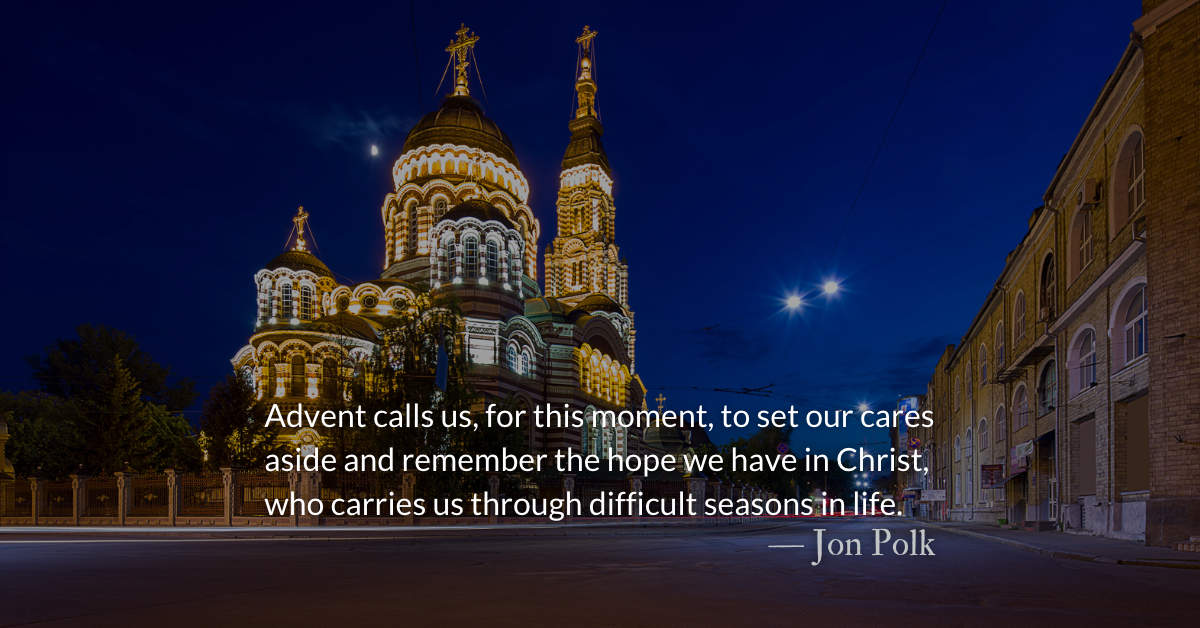
Image: Today’s image is a picture of Blagoveshchensky Cathedral in Kharkiv, Ukraine.

Reflection: Carol of the Bells — Carols of Advent Hope
By Jon Polk

Perhaps recognized less for its lyrics and more for its chime-like melody in three-quarter time, the rhythmic “Carol of the Bells” provides the perfect accompaniment for the holiday season.

Hark how the bells,
sweet silver bells,
all seem to say,
throw cares away
Christmas is here,
bringing good cheer,
to young and old,
meek and the bold.

While now indelibly connected with Christmas, the origins of this carol trace back to a Ukrainian folk song written for New Year celebrations.

The conductor of the Ukrainian Republic Choir commissioned Mykola Leontovych to write a new piece based on traditional folk songs. Leontovych was a composer, conductor and music teacher, but he was also educated as a priest in a Ukrainian seminary and composed the first liturgy in the modern Ukrainian language.

Leontovych wrote “Shchedryk” (“Bountiful Evening”) in 1914 and it was first performed in 1916 by students from Kyiv University. The song, also known by the English title “The Little Swallow,” tells the tale of a swallow who flies into a home, singing a prediction of a bountiful and wonderful year ahead for the family inside.

Bountiful evening, bountiful evening, a New Year’s carol;
A little swallow flew into the household
and started to twitter,
to summon the master:
“Come out, come out, O master,

Your goods [livestock] are great,
you will have a lot of money, by selling them.
If not money, then chaff from all the grain you will harvest
you have a dark-eyebrowed beautiful wife.”

As you can tell, although “Shchedryk” and “Carol of the Bells” may share the same melody, their lyrics are not at all the same.

Leontovych’s song was written during a time of intense political and social turmoil in Ukraine during World War I. In fact, Leontovych himself was killed by a Russian agent in 1921 and he is considered a martyr by the Eastern Orthodox Church in Ukraine. The swallow was a herald of springtime and its presence in the song would have given listeners hope for better days ahead in the New Year. 

When “Shchedryk” was performed by the Ukrainian National Choir in the United States in 1919, American choir conductor Peter Wilhousky, himself of Ukrainian descent, thought the song sounded like handbells ringing. Wilhousky eventually wrote new lyrics and performed his version, focused on Christmas, with the NBC radio orchestra during the Great Depression. Once again, the carol lifted the spirits of listeners during a challenging and difficult time.

Advent calls us, for this moment, to set our cares aside and remember the hope we have in Christ, who carries us through difficult seasons in life. May our hearts be stirred to worship the One who truly brings us hope.

Listen: Carol of the Bells by Fleming & John
Listen: Shchedryk (Ukrainian and English Translation) by Eileen
Read: English Lyrics from LyricsForChristmas.com
Read: Ukrainian Lyrics (with translation) from Wikipedia.org

From John: As the conflict in Ukraine enters its tenth month, please continue to pray. A fellow seminarian Jon and I served with was in Ukraine just before war broke out. Although she is back in the states, the ministry team she served continues their work from Poland, doing what they can to spare and save lives, to provide for refugees, and to spread the gospel as they minister. Pray for their safety as they frequently enter the country to assist those evacuating or to deliver supplies. Pray for the end of the conflict and that people can return to rebuild their lives, cities, and churches.

Divine Hours Prayer: The Request for Presence
Show me your marvelous loving-kindness, O Savior of those who take refuge at your right hand from those who rise up against them.
Keep me as the apple of your eye; hide me under the shadow of your wings. — Psalm 17.7-8

Today’s Readings
Esther 3 (Listen 3:12)
Hebrews 13 (Listen 3:31)

Read more about Supporting Our Work
Give to support biblical literacy, rhythmic Bible reading and prayer, and gospel-centered discipleship.

Read more about Facts and Harsh Realities
The pastors and churches they support in Eastern Ukraine are in real, tangible danger…harsh realities surround them.

Good King Wenceslas—Readers’ Choice

Readers’ Choice Month:
This September, The Park Forum is looking back on readers’ selections of our most meaningful and helpful devotionals from the past 12 months. Thank you for your readership. This month is all about hearing from you. Submit a Readers’ Choice post today.

Today’s post was originally published, on December 8, 2021, based on 3 John 3-6 and Luke 6:38
It was selected by reader, EN: 
“Hymns and carols have always been close to my heart. This was a wonderful reflection.”


Scripture Focus: 3 John 3-6
3 It gave me great joy when some believers came and testified about your faithfulness to the truth, telling how you continue to walk in it. 4 I have no greater joy than to hear that my children are walking in the truth.
5 Dear friend, you are faithful in what you are doing for the brothers and sisters, even though they are strangers to you. 6 They have told the church about your love. Please send them on their way in a manner that honors God.

Luke 6:38
Give, and it will be given to you. A good measure, pressed down, shaken together and running over, will be poured into your lap. For with the measure you use, it will be measured to you.

Reflection: Good King Wenceslas—Readers’ Choice
By Jon Polk

In 921, the Duke of Bohemia (in modern Czech Republic) died when his son Wenceslas was only 13 years old, too young to rule. Wenceslas’ late grandfather converted to Christianity under the influence of Byzantine missionaries and his grandmother had seen to his education, so she was made regent in his stead.

At age 18, Wenceslas was made Duke of Bohemia and his reign was characterized by his Christian heritage. He became known for acts of charity and almsgiving, winning the admiration of his subjects.

Historian Cosmas of Prague wrote about Wenceslas in 1119:

His deeds I think you know better than I could tell you; rising every night from his noble bed, he went around to God’s churches and gave alms generously to widows, orphans, those in prison and afflicted by every difficulty, so much so that he was considered, not a prince, but the father of all the wretched.

Wenceslas’ legacy helped shape the medieval concept of the righteous king, whose power is based on great piety in addition to regal authority.

Written by English hymn writer John Mason Neale in 1853, the carol “Good King Wenceslas” recounts one incident of love and generosity by the good king.

Good King Wenceslas looked out
On the Feast of Stephen
When the snow lay round about
Deep and crisp and even
Brightly shone the moon that night
Though the frost was cruel
When a poor man came in sight
Gathering winter fuel

The king orders his servants to gather food, drink and firewood and summons his page to help him deliver the goods to the poor peasant. 

Page and monarch forth they went
Forth they went together
Through the rude wind’s wild lament
And the bitter weather

As the weather worsens, the page insists he can go no further; the king suggests that the page simply follow boldly in his footsteps. Upon doing so, the page discovers that he is warmed by the sod where snow had melted under his master’s footprints.

The Christmas season often prompts many people to engage in acts of charity and kindness. There are toy drives, meals served in soup kitchens and generous donations made to notable causes, all our expressions of God’s love.

Unfortunately, however, our generosity usually ends on December 26th.

While the carol recounts only one incident at Christmastime, Wenceslas was remembered for a life of generosity and love for those in need.

We follow a Righteous King who lived his whole life as a servant. He invites us to simply walk boldly in his footsteps, serving others not only for a few weeks during the Christmas season, but consistently throughout the year.

Therefore, Christian men, be sure
Wealth or rank possessing
Ye who now will bless the poor
Shall yourselves find blessing

Listen: Good King Wenceslas by Downhere
Read: Lyrics from Hymnary.org

Divine Hours Prayer: The Refrain for the Morning Lessons
Blessed are they which do hunger and thirst after righteousness: for they shall be filled. — Matthew 5.6

– From The Divine Hours: Prayers for Summertime by Phyllis Tickle.

Today’s Readings
Lamentations 4(Listen 3:42)
Romans 2(Listen 4:13)

Readers’ Choice is Here!
Thanks for sharing your recommended posts from the last 12 months. We have loved hearing from you!

Read more about He Became a Servant — Love of Advent
Jesus is our perfect and complete picture of what God is like. He is still among us as one who serves and we are to be like him.

Choices and Hard Hearts—Readers’ Choice

Readers’ Choice Month:
This September, The Park Forum is looking back on readers’ selections of our most meaningful and helpful devotionals from the past 12 months. Thank you for your readership. This month is all about hearing from you. Submit a Readers’ Choice post today.

Today’s post was originally published, on February 24, 2021, based on Exodus 7.1-5 and Luke 10.10-12, 16
It was selected by reader, Wade, from Texas. 

Scripture Focus: Exodus 7.1-5
1I have made you like God to Pharaoh, and your brother Aaron will be your prophet. 2 You are to say everything I command you, and your brother Aaron is to tell Pharaoh to let the Israelites go out of his country. 3 But I will harden Pharaoh’s heart, and though I multiply my signs and wonders in Egypt, 4 he will not listen to you. Then I will lay my hand on Egypt and with mighty acts of judgment I will bring out my divisions, my people the Israelites. 5 And the Egyptians will know that I am the Lord when I stretch out my hand against Egypt and bring the Israelites out of it.”

Luke 10.10-12, 16
10 But when you enter a town and are not welcomed, go into its streets and say, 11 ‘Even the dust of your town we wipe from our feet as a warning to you. Yet be sure of this: The kingdom of God has come near.’ 12 I tell you, it will be more bearable on that day for Sodom than for that town.
16 “Whoever listens to you listens to me; whoever rejects you rejects me; but whoever rejects me rejects him who sent me.”

Reflection: Choices and Hard Hearts—Readers’ Choice
By John Tillman

Pharaoh’s heart is the prototypical story about hardened hearts in the Bible. His story affects how we see the topic and the process of how a heart is hardened. Nearly half of the occurrences of the word “harden” in the NIV text are in reference to Pharaoh or the Egyptians.

We also see hardened hearts and the response of Christ’s messengers to them in our reading from Luke. God used Moses as a stand-in and had Moses use Aaron as a prophet. Jesus sends his 72 followers out as prophets of his message as well. 

“Whoever rejects you rejects me and the one who sent me,” Jesus said. Whoever rejected the apostles or other disciples, rejected Jesus, and rejected God the Father. When Pharoah rejected Aarron, he rejected Moses, and he rejected Yahweh.

In both stories, God’s messengers carried his peace. They performed miracles, healings, and signs. Yet there were those who missed (or denied) the miracles. Jesus knew some would reject his messengers. God knew Pharaoh would reject his messengers. In doing so, these hearers were rejecting God himself and bringing judgment on themselves.

Before we think of ourselves as messengers of God, we first need to consider ourselves with sober judgment.

Are we people of peace (Luke 10.5-6) or Pharaohs relying on violence? (Exodus 5.14-15, 20-21) Are we rejecting God by rejecting his messengers because they don’t look the way or sound the way we think they should? (“In Amaziah’s Shoes: Amos 7.10-17)

The scriptures contrast moments of Pharaoh hardening his own heart and God hardening it. (Exodus 4.21; 7.3; 8.15, 32; 9.12-34; 10.20, 27; 11.10) Even Pharaoh gets multiple chances to do the right thing. When he fails to see the miracles for what they are and refuses to heed God’s messengers, God gives him over to the path of rebellion he chose. 

Hardened hearts happen in stages. Our choices matter. Our hearts are hardened or softened day after day. Do we hear and obey? Our hearts will grow softer, more sensitive, and better able to obey in the future. Do we hear and turn away? Our hearts will grow harder, colder, less able to respond to the loving call of God.

Softening your heart is something that occurs not in one single moment, but rather through a lifelong process. Untended, our hearts harden and lean away from God. Only by continual cultivation will the soil of our hearts remain soft, fertile soil for fruitful expressions of the gospel.

Divine Hours Prayer: The Call to Prayer
Love the Lord, all you who worship him; the Lord protects the faithful, but repays to the full those who act haughtily. — Psalm 31.23

– From The Divine Hours: Prayers for Summertime by Phyllis Tickle.

Today’s Readings
Jeremiah 48 (Listen 7:31)
2 Corinthians 7 (Listen 2:58)

Readers’ Choice is Here!
There’s still room for your recommended posts from the last 12 months. Which one helped you heal?

Read more about For Those Yet Unseeing — Worldwide Prayer
We assume that faith comes easily when we witness miracles. We are wrong.

Daughters of Saul and Sons of Moses—Readers’ Choice

Readers’ Choice Month:
This September, The Park Forum is looking back on readers’ selections of our most meaningful and helpful devotionals from the past 12 months. Thank you for your readership. This month is all about hearing from you. Submit a Readers’ Choice post today.

Today’s post was originally published, on April 11, 2022, based on Psalm 145.1-4, 1 Chronicles 15.29, and Luke 19.39-40
It was selected by reader, MT.


Scripture Focus: Psalm 145.1-4
1 I will exalt you, my God the King; 
I will praise your name for ever and ever. 
2 Every day I will praise you 
and extol your name for ever and ever. 
3 Great is the Lord and most worthy of praise; 
his greatness no one can fathom. 
4 One generation commends your works to another; 
they tell of your mighty acts.

1 Chronicles 15.29
29 As the ark of the covenant of the Lord was entering the City of David, Michal daughter of Saul watched from a window. And when she saw King David dancing and celebrating, she despised him in her heart.

Luke 19.39-40
39 Some of the Pharisees in the crowd said to Jesus, “Teacher, rebuke your disciples!”
40 “I tell you,” he replied, “if they keep quiet, the stones will cry out.”

Reflection: Daughters of Saul and Sons of Moses—Readers’ Choice
By John Tillman

Yesterday, Palm Sunday, we celebrated Jesus’ arrival into Jerusalem and the week leading to the crucifixion and resurrection. (Matthew 21.1–11; Mark 11.1–11; Luke 19.28–44; John 12.12–19)

Like David’s procession of the Ark of the Covenant entering Jerusalem, Jesus’ processional was met by a joyous crowd. In both cases, there were those who wanted to steal the joy of the moment.

Michal, daughter of Saul and wife of David, critiqued the celebration. (1 Chronicles 15.29) She claimed to be concerned about propriety and modesty, but David’s response implied that her moralizing concealed a concern about power. (2 Samuel 6.20-23) The daughter of Saul despised this lowly king.

Likewise, religious leaders objected to crowds singing about Jesus “Hosanna to the Son of David! Blessed is he who comes in the name of the Lord!” (Psalm 118:25,26) They publicly voiced concerns about blasphemy but privately they were concerned about power. They didn’t want to upset Rome. (John 11.48) The sons of Moses despised this lowly teacher.

Psalm 105
is the Psalm listed in Chronicles as one David (or Asaph at David’s direction) sang on the occasion of the Ark’s entry. (1 Chronicles 16.7-11) However, despite Psalm 145 not having a date or event attached, one could certainly imagine its celebratory tone going well with the procession David led or the procession of Jesus the Son of David.

Those traveling up to Jerusalem would sing psalms on their ascent, preparing for and celebrating being in the presence of God. We can pray and sing these psalms with the same sense of anticipation. Jesus comes to us as he came to Jerusalem, humble and lowly. We can welcome him with shouts, cries, and joyous abandon that some will not understand.

Welcome him this week and every week as the only rightful king of our hearts. We must depose our affection for other Saul-like kings. We must abandon vestiges of religion which grasp at power rather than righteousness.

Do not let daughters of Saul or sons of Moses steal your joy in the lowly king, the humble teacher. Let us exalt him with pure praise and abandon. Let us ensure the next generation joins in with us.

“I will exalt you, my God the King; 
I will praise your name for ever and ever. 
Every day I will praise you 
and extol your name for ever and ever. 
Great is the Lord and most worthy of praise; 
his greatness no one can fathom. 
One generation commends your works to another; 
they tell of your mighty acts.”


Divine Hours Prayer: The Call to Prayer
Search for the Lord and his strength; continually seek his face. — Psalm 105.4

– From The Divine Hours: Prayers for Summertime by Phyllis Tickle.

Today’s Readings
Jeremiah 42(Listen 3:44)
2 Corinthians 2 (Listen 2:13)

Today’s Readings
Jeremiah 43(Listen 2:34)2 Corinthians 3 (Listen 1- 2:25)
Jeremiah 44(Listen 6:10)2 Corinthians 4 (Listen 1- 3:02)

Read more

Read more about A Way Back for Strivers
If we wrestle with you God, you will bless…If we will return to you, God, you will heal

Readers’ Choice is Here!
We want to know about your favorite post from the last 12 months! Tell us about it and we will repost it in September.

Our Hearts Burn Within

Scripture Focus: Luke 24.31-32
31 Then their eyes were opened and they recognized him, and he disappeared from their sight. 32 They asked each other, “Were not our hearts burning within us while he talked with us on the road and opened the Scriptures to us?”

From John: As we prepare for Student Writers to take us through the book of Acts, we continue through the last three chapters of Luke’s gospel. Don’t forget that, beginning tomorrow, July 15, and continuing through August 10th, approximately 90% of donations to The Park Forum will be directed to scholarships/stipends for these talented students. Give during this time to support our ministry and theirs.

Reflection: Our Hearts Burn Within
By Erin Newton

Rembrandt painted the scene from Luke 24 on two separate occasions. The 1629 version of “The Supper at Emmaus’‘ depicts the reaction of the two men upon the revelation of Jesus’ identity. One man responds in astonishment, face illumined by the divine glow of Jesus. The other has fallen to Jesus’ feet. This version seems to capture the wonderment, “were not our hearts burning within us…?”

After the women had visited the tomb of Jesus on the third day, Luke 24 describes the meeting of Jesus with two other disciples on the road to Emmaus. While traveling, the men had not recognized Jesus and treated him as a stranger. Yet as they talked about the recent crucifixion, this “stranger” began to educate them about the cohesive message of the Old Testament with the recent events.

Once they entered Emmaus and convinced him to stay for dinner, only then were they able to see the man as Jesus himself.

A small miracle had taken place on the road to Emmaus that day. Jesus, truly present in physical form with the signs of the crucifixion scarring his body, could not be recognized. The man these two disciples had spent years following was obscured in their minds.

The journey together likely lasted for hours. The mind-boggling, incomprehensive death of Jesus was now explained as part of the larger story of God’s work in history. All the questions they had were being answered by the man they did not really know.

For many of us, we might hear the words of Christ without seeing him as the divine Savior. We read about Jesus but remain convinced he’s a stranger to our lives. There is a difference between hearing Jesus answer questions about life and seeing Jesus as the answer to questions of life.

When that moment comes, he’s no longer “just a good teacher.” He’s Jesus, our Savior.

When Moses had spent time upon the mountain in the presence of God, his face glowed intensely. The baby in Elizabeth’s womb leapt at the presence of Jesus in the womb of Mary. Like the men on the road, our hearts burn when we are in the presence of God.

Jesus disappeared the moment the men recognized who he was. They would wait for the Spirit to come and dwell within their burning hearts. For us, we recognize Jesus and receive the Helper instantaneously. 

Divine Hours Prayer: The Request for Presence
O God of hosts, show us the light of your countenance, and we shall be saved. — Psalm 80.7

Today’s Readings
Isaiah 42 (Listen -4:11)
Luke 24 (Listen -6:16)

Read more about Jesus Concealed and Revealed
Disciples don’t always seem to recognize the resurrected Jesus. Do we?

Read more about In the Face of Grief
The resurrected Christ seems to have a special preference for appearing to the grieving.