Can We Live Again?

Links for today’s readings:

Jan 14  Read: Job 14 Listen: (2:23) Read: John 14 Listen: (4:13)

Scripture Focus: Job 14:5-10

5 A person’s days are determined;
    you have decreed the number of his months
    and have set limits he cannot exceed.
6 So look away from him and let him alone,
    till he has put in his time like a hired laborer.

7 “At least there is hope for a tree:
    If it is cut down, it will sprout again,
    and its new shoots will not fail.
8 Its roots may grow old in the ground
    and its stump die in the soil,
9 yet at the scent of water it will bud
    and put forth shoots like a plant.
10 But a man dies and is laid low;
    he breathes his last and is no more

Reflection: Can We Live Again?

By Erin Newton

In case no one has told you, it’s ok to disagree with the Bible. Of course, that comes with the caveat that you need to understand context. Verses in a silo can be misunderstood. Scripture without context is dangerous.

Job’s complaints and his friend’s advice are good examples of a “yes, but” interpretation. Here, Job continues his emotional lament about the status of his life. His perspective is bleak and hopeless.

Even if we, today, can read the Scriptures and see the promises of eternal life from the very beginning of Genesis, Job wasn’t there yet. Life in that time was measured by one’s earthly accomplishments, one’s legacy. This is why Job is so distraught. His legacy cannot continue through his children for they have all died. His legacy cannot continue through his social status for he is now a sore-covered outcast. His legacy cannot continue through his wealth for his livestock all perished.

So we come to Job 14 with a measure of sympathy and contextual understanding. This life, here, is utterly important to him. His life, at this point, is also utterly dreadful. He understands the limits of one’s life. He knows that it is God who ordains a person’s days. We can find hope in that.

I remember when my child was sick and doctors were unable to assure me of his recovery. This truth, from Job’s own mouth, resonated in my soul. God determines the limits of life. We cannot die without God knowing.

Although this is something that we can hold as true, it doesn’t (and didn’t years ago) stop me from pleading with God to keep watch, to intervene, or to extend one’s days.

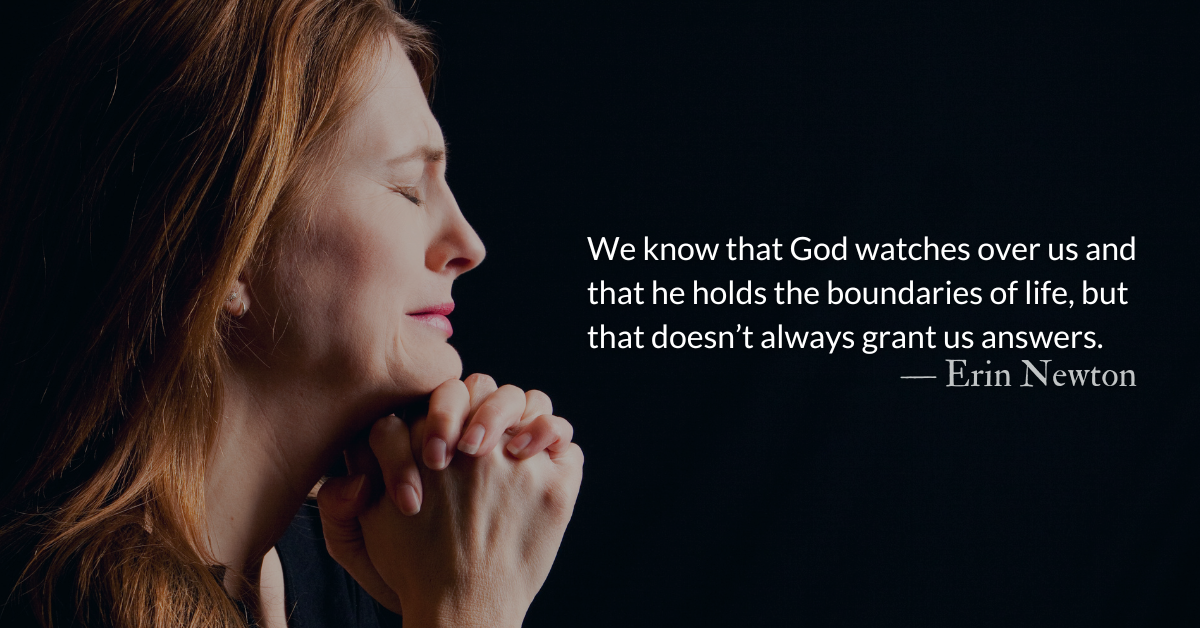
The book of Job is all about tension. We know that God watches over us (“Have you considered my servant Job?”) and that he holds the boundaries of life (“A person’s days are determined”), but that doesn’t always grant us answers.

Job envies the trees that can sprout back to life. When Job finds resolution in his suffering at the end of the book, he reenters the land of living. 


We look to the future of eternal life. But in the midst of suffering now, I think God asks us to consider the rejuvenation of trees. We can return to the land of the living—but that means accepting the uncertainty of life and choosing to be present.

Divine Hours Prayer: The Call to Prayer

But I will call upon God, and the Lord will deliver me.
In the evening, in the morning, and at noonday, I will complain and lament,
He will bring me safely back…God, who is enthroned of old, will hear me… — Psalm 55.17

– From The Divine Hours: Prayers for Autumn and Wintertime by Phyllis Tickle.

Read more: Hope In the Tree of the Cross

The idea that God will raise humans to eternal life is a seed in Job…and blooms in the gospels.

Read more: The Arm of Flesh versus the Prince of Peace

How can we tell the difference between Sennacherib’s propaganda and Hezekiah’s true faith?
Hope In the Tree of the Cross

Scripture Focus: Job 14.7-9, 14-17
7 “At least there is hope for a tree: 
If it is cut down, it will sprout again, 
and its new shoots will not fail. 
8 Its roots may grow old in the ground 
and its stump die in the soil, 
9 yet at the scent of water it will bud 
and put forth shoots like a plant.

14 If someone dies, will they live again? 
All the days of my hard service 
I will wait for my renewal to come. 
15 You will call and I will answer you; 
you will long for the creature your hands have made. 
16 Surely then you will count my steps 
but not keep track of my sin. 
17 My offenses will be sealed up in a bag; 
you will cover over my sin. 

Psalm 22.1, 31
1 My God, my God, why have you forsaken me? 
Why are you so far from saving me, 
so far from my cries of anguish?
 
31 They will proclaim his righteousness, 
declaring to a people yet unborn: 
He has done it! 

Reflection: Hope In the Tree of the Cross
By John Tillman

“At least there is hope for a tree…”

This phrase sparked a memory. I remembered the phrase, “I want to be a tree,” but I didn’t remember its source. When I looked it up I was reminded of the remarkably strange world of 80s British music videos and Tim Pope’s song, “I Want to Be a Tree.” 

I’m sure I heard this song during the early days of MTV (when they used to play music) and the phrase must have stuck in my memory. Pope is most well known for his music videos for David Bowie, The Cure, and others. 

Pope’s song is mostly tongue-in-cheek escapism but buried in the humorous lyrics are the roots of real issues. At first he wants to escape attention and life’s annoyances. He obliquely references the Eden narrative. He then hopes to escape “World War Three.” Today’s crisis-centered culture is fraught with uncertainty about many things but it is hard to explain how inescapable nuclear annihilation seemed to GenXers and how powerless we felt about it. 

Job’s lament is more desperate and is grounded in suffering that is more intense than Pope, or most of us, ever will know. Job’s thoughts also take us deeper into the promises of God. 

Job planted his hopes in God. The idea that God will raise humans to eternal life is a seed in Job. It develops in the Psalms and other scriptures and blooms in the gospels. 

Today we also read Psalm 22, referenced by Jesus from the tree of the cross. It begins, like Job, questioning God’s abandonment, but ends triumphantly, celebrating God’s victory. “He has done it,” Psalm 22’s last line proclaims. “It is finished,” Christ’s last breath from the cross echoes. (John 19.30; Psalm 22.31)

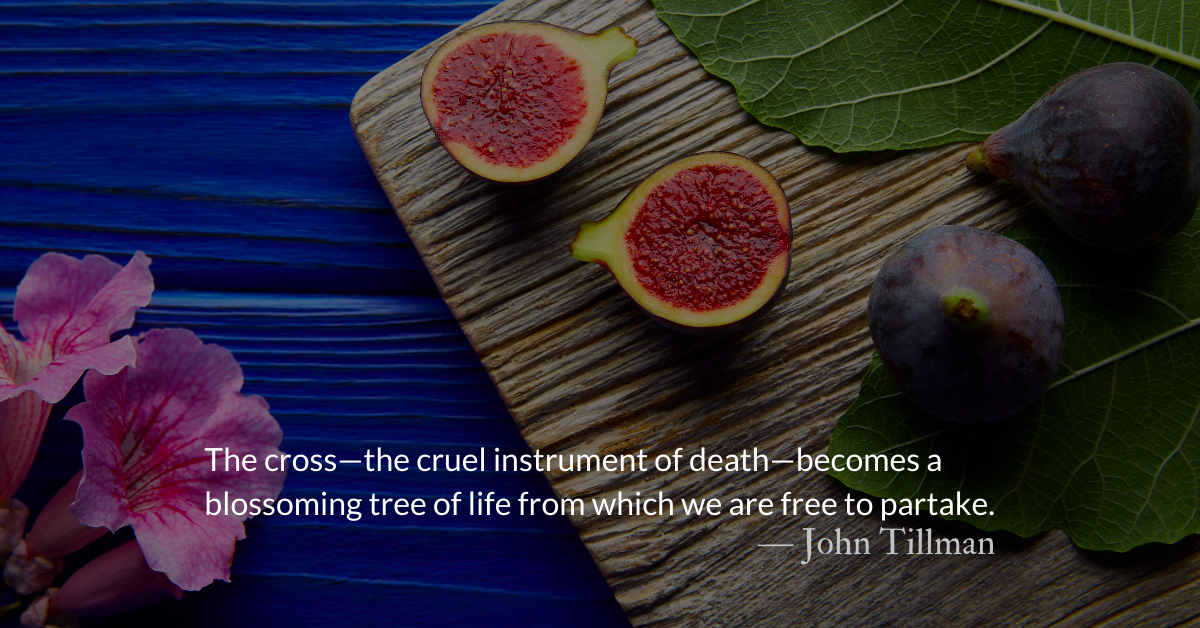
Our hope is found not in becoming a tree but in laying down our lives and being transformed by the cross of Christ. The cross—the cruel instrument of death—becomes a blossoming tree of life from which we are free to partake. (Genesis 2.16; 3.22-24; Proverbs 11.30; Revelation 2.7; 22.1-2, 14

At the roots of the tree of the cross, we find healing, peace, and power. As we follow Christ, we will become like this tree. Grafted into the Root of Jesse, (Romans 11.16-21) we bloom in deserts of suffering. We protect others under our branches and shade. We bless the earth, bringing up water of life and healing for the nations.

When grown to maturity, a Christian is like a tree. (Psalm 1.3)

Further Study: Humans are… Trees? From The Bible Project Podcast

Divine Hours Prayer: The Refrain for the Morning Lessons
Our sins are stronger than we are, but you will blot them out. — Psalm 65.3

– From The Divine Hours: Prayers for Autumn and Wintertime by Phyllis Tickle.


Today’s Readings
Job 14 (Listen – 2:23)
Psalm 22 (Listen – 3:49)

This Weekend’s Readings
Job 15 (Listen – 3:23), Psalm 23-24 (Listen – 2:03)
Job 16-17 (Listen – 3:40), Psalm 25 (Listen – 2:18)

Join us! Walk through the Bible with us…
Share this subscription link with friends, family, or your community of faith. Find joy reflecting on God’s Word!

https://mailchi.mp/theparkforum/m-f-daily-email-devotional

Read more about Praise from a Stump
In Isaiah chapter 11, we see this shamed, humbled tree being miraculously restored.