A Dirge from God

Scripture Focus: Ezekiel 19:9, 14b
9 With hooks they pulled him into a cage
and brought him to the king of Babylon.
They put him in prison,
    so his roar was heard no longer
    on the mountains of Israel…

14  “…This is a lament and is to be used as a lament.”

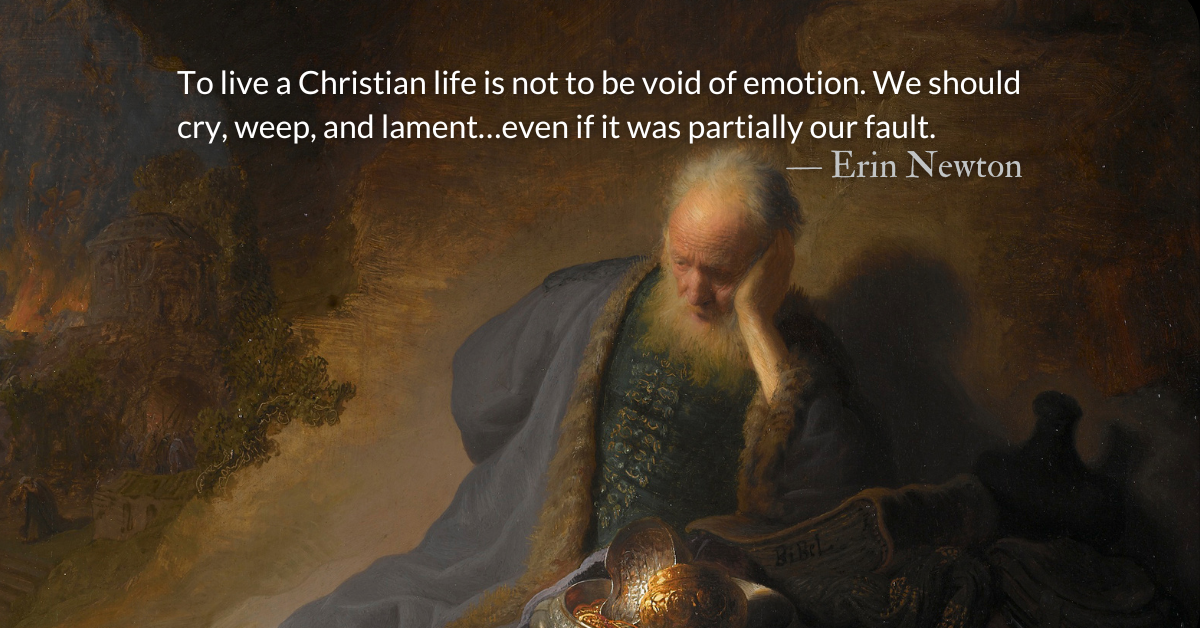
Image Note: Today’s image is taken from Jeremiah Lamenting the Destruction of Jerusalem by Rembrandt. View a high-quality image of the painting at this link.

Reflection: A Dirge from God
By Erin Newton

Jesus wept. When Lazarus died, Jesus grieved. We know Jesus was fully human and he experienced the same feelings as we do. We often think that Jesus’ experiences with grief created the means for God to understand our sadness and sympathize. The incarnation of Christ highlights his experiences with grief. Yet, God has been nurturing and guiding people through their sorrow for centuries before Jesus. He can sympathize with our sorrow, but he has also been anticipating our sorrow and providing guidance on how to process these difficult emotions.

Much of the poetry in the Bible expresses the emotional aspect to our spiritual lives. We often think of Psalms in times of distress, hoping for words that resonate with our souls. Surprisingly, we sometimes find such poetry in the prophets.

God gives Ezekiel words for the nation’s lament. He utilizes the imagery of a mother lion and her cubs. One cub is captured and taken away. The next cub is reared but captured and taken to Babylon. These cubs are the kings of the northern and southern kingdoms. The lament speaks poetically about God’s people being uprooted from the fertile land and cast into the desert. God declares that these verses be used as a lament.

This particular word for lament, qina, specifically indicated a funeral hymn, a dirge. For many chapters, we have read about God’s coming judgment upon the people because of their unfaithfulness. Time after time, we could see that whatever was coming was their fault. But God considers their emotional well-being. Judgment has come but he guides them in their lament.

God speaks to us in our humanity. Life with God is not cold. Other laments and psalms reveal the depths of emotional pain. To live a Christian life is not to be void of emotion. We should cry, weep, and lament…even if it was partially our fault.

There is a temptation to shame people amid their pain. “They deserve it.” In the case of the Israelites, “God warned them.” We scoff, roll our eyes, and mutter, “Well, I don’t feel sorry for them.” But this lament in Ezekiel tells us that no matter who it is, people are free to feel.

It is through the deep wells of emotions that we often meet God. No facades of strength. Just our authentic, emotional selves. In aiming to be strong, we forget the God-given duty to grieve.

Divine Hours Prayer: The Refrain for the Morning Lessons
Those who sowed with tears will reap with songs of joy.
Those who go out weeping, carrying the seed, will come again with joy, shouldering their sheaves. — Psalm 126.6-7

– From The Divine Hours: Prayers for Summertime by Phyllis Tickle.

Today’s Readings
Ezekiel 19 (Listen 2:12) 
Colossians 2 (Listen 3:27)

Read more about Lament the Fall of Leaders (Even Bad Ones)
No matter what we may think of leaders’ foolish decisions or reckless waste, their fall and failure will mean pain and suffering for many.

Read more about Legacy of Failure
We need to be reminded of our humanity and our great need for forgiveness.

What is a False Prophet?

Scripture Focus: Ezekiel 13:6, 10
6 Their visions are false and their divinations a lie. Even though the Lord has not sent them, they say, “The Lord declares,” and expect him to fulfill their words…

10 “‘Because they lead my people astray, saying, “Peace,” when there is no peace.

Reflection: What is a False Prophet?
By Erin Newton

There is no single word in Hebrew to designate a false prophet from a legitimate prophet. In the New Testament, the Greek language provides a word, pseudoprophetes. Quite clearly, we see the two words combined: pseudo + prophet. This is a phony, fake, counterfeit speaker for God.

In the Old Testament, they are referred to generically as “prophets” without a specific qualifying word to denote falsehood. How do we know it is a false prophet?

In Ezekiel, false prophets spoke out of their own imagination but claimed they had the words of God. They spoke about peace when there was none. They created a sense of security, that was merely a façade, a prop. God speaks against these imposters and declares their coming ruin.

There is a good warning here from the lack of a Hebrew word for false prophets. They have the same titles as legitimate pastors, priests, reverends, and leaders. By name, they are just like those who speak the words of God, the words of truth. How will we know if those among us are false prophets?

When every religious leader claims to be speaking truth, declaring the words of God, heralding their interpretation as “gospel,” what will be the litmus test for all these words? The example in Ezekiel reveals two things to look for: ignoring the reality of suffering and avoiding convicting or uncomfortable messages.

False prophets will tickle the ear of their audience with words of false peace. When injustice or abuse are in their midst, a false prophet will ignore these issues and downplay their significance. They speak peace when there is no peace.

False prophets build a sense of security for their audience by erecting walls that are nothing more than paper mâché. This may look like claims of financial or physical blessings as a way to ward off suffering in life. This may be the call to rely on political parties or elected officials to keep evil from encroaching on one’s way of life. They will claim that nothing can harm you as long as you [fill in the blank.]

These messages cannot be supported by the whole of Scripture. Look at Job. Look at Esther. Look at Paul. These were all righteous people who suffered personally or had to walk through the hardship of suffering around them.

False prophets call themselves authentic; we must learn the difference.

Divine Hours Prayer: The Refrain for the Morning Lessons
Let not those who hope in you be put to shame through me, Lord God of hosts; let not those who seek you be disgraced because of me, O God of Israel. — Psalm 69.7

– From The Divine Hours: Prayers for Summertime by Phyllis Tickle.

Today’s Readings
Ezekiel 13 (Listen 4:14)
Romans 16 (Listen 3:30)

Read more about Sufferings and False Prophets
False prophets today may be religious or political…what they have in common is telling us exactly what we want most to hear.

Read more about Cut and Run from False Prophets
Zechariah’s audience knew that lying prophets were deadly. Their lies killed.

Falling on Deaf Ears

Scripture Focus: Ezekiel 12:27-28
27 “Son of man, the Israelites are saying, ‘The vision he sees is for many years from now, and he prophesies about the distant future.’
28 “Therefore say to them, ‘This is what the Sovereign Lord says: None of my words will be delayed any longer; whatever I say will be fulfilled, declares the Sovereign Lord.’”

Reflection: Falling on Deaf Ears
By Erin Newton

They have ears to hear but do not hear. When Jesus spoke parables, he often concluded with, “Whoever has ears to hear, let them hear.” For the most part, everyone has ears and most people with ears can hear. Metaphorically, to have ears is an ability to understand, think critically, and humbly accept teaching that might seem counterintuitive.

God speaks to Ezekiel, “They have eyes to see but do not see and ears to hear but do not hear…” The cause of their metaphorical deafness is their rebellion. It is a self-inflicted spiritual deafness. God has been speaking. In fact, Ezekiel has been using visual performances to relay the message of God. They are not only deaf, but they are also blind.

At moments, it seems that they can hear God, but they refuse to accept it. The prophet’s words are dismissed, brushed aside. They prefer to live in ignorance, assuming that everything will continue as normal. Judgment had been prophesied for years, centuries in fact, but they continued to ignore it as some mythic future.

The prophetic message is not encouraging. The vision of judgment is not comforting. To accept the message is to admit one’s failure. Hearts that cannot accept teaching, blind to the word of God, are proud and rebellious. Calls to repentance are met with a shrug and a wave, “That’s good for thee, but not for me.”

Why is it easy to hear a convicting message and quickly lay it aside? Sometimes we think it is something we might need to deal with later but certainly not now. We detach ourselves from culpability either by calling it a future problem or someone else’s problem.

Like the Israelites, we cannot feign ignorance. God has sent many messengers to preach and to perform. For us, we have the Word of God and the Spirit of God which speaks to us each day.

The Israelites had a proverb, “The days go by and every vision comes to nothing.” It was common knowledge that God had delayed his judgments. But in his delay, which Peter later calls loving patience (2 Peter 3.8-9), they had continued in rebellion. Perhaps they assumed they could clean their lives up for God later but continue in sin now.

We err in our assumption about God’s delay. It is foolish to rely on his mercy to forgive us tomorrow while we pursue sin today.

Divine Hours Prayer: The Refrain for the Morning Lessons
Be still, then, and know that I am God; I will be exalted among the nations; I will be exalted in the earth. — Psalm 46.11

– From The Divine Hours: Prayers for Summertime by Phyllis Tickle.

Today’s Readings
Ezekiel 12(Listen 4:53)
Romans 15(Listen 4:32)

Read more about Puking Prophets of Success
We must open our eyes to see, open our ears to hear, and open our hearts to feel the uncomfortable, the painful, the hurtful truths.

Read more about Turn Out the Lights
God covered false prophets with darkness…If we ignore the light long enough, God will blind us.

When God Leaves the Building

Scripture Focus: Ezekiel 10.18-22
18 Then the glory of the Lord departed from over the threshold of the temple and stopped above the cherubim. 19 While I watched, the cherubim spread their wings and rose from the ground, and as they went, the wheels went with them. They stopped at the entrance of the east gate of the Lord’s house, and the glory of the God of Israel was above them. 
20 These were the living creatures I had seen beneath the God of Israel by the Kebar River, and I realized that they were cherubim. 21 Each had four faces and four wings, and under their wings was what looked like human hands. 22 Their faces had the same appearance as those I had seen by the Kebar River. Each one went straight ahead. 

Reflection: When God Leaves the Building
By John Tillman

Ezekiel’s visions of cherubim and “whirling wheels” are as confusing as they are captivating—as befuddling as they are beautiful.

Many study the details of Ezekiel’s vision. Many paintings, many theories, and many words have come from this imagery. Some think Ezekiel was hallucinating or on drugs. Some think his vision describes an alien spaceship. (Easier to believe in than God, I suppose?) But Ezekiel isn’t some poor, inept, ignorant, ancient fool. His literary skill is beyond ours. It’s better to admit we don’t understand what we are reading than to accuse him of not understanding what he saw.

What Ezekiel saw is less important than what he is telling us. In seeking to define the objects he described, many have missed the object of his argument.

The point of Ezekiel’s vision is not to describe the kind of vehicle God drives. The point is to tell us God is leaving. God is moving out—leaving the house David and generations of followers had worshiped in. The glory is departing from the temple. 

The “car”, if God drove one, is pulling out of the garage. No matter how well appointed the temple may be, without God’s presence, it’s as pointless as an empty garage. Its tools have no meaning. It smells vaguely of gasoline and rubber but there’s no horsepower, no purpose. It’s just an empty room.

God did not leave without reason or without many, many warnings and pleadings with his people. Yet people were surprised at God’s leaving. They missed the warnings. They ignored the pleadings.

If God can leave the Temple Solomon built, he can surely leave our churches, our organizations, and our nations. That’s the scary part. The beautiful part is that God didn’t leave his people. He just left their corrupted places. His people, including Ezekiel, were either already in exile or on their way. God went with them just as he was with them in Egypt. Then he heard their cries and brought them out, repentant and joyful.

Let us never be so prideful, so unheeding, that we are surprised to turn around and find that God has left the building. Let us never be so despairing over God abandoning a building, a country, or an organization that we forget that God remains close to his faithful remnant. Even if everything falls and burns, God can restore, if we will simply be faithful.

Divine Hours Prayer: The Small Verse
Open, Lord, my eyes that I may see.
Open, Lord, my ears that I may hear.
Open, Lord my heart and my mind that I may understand.
So shall I turn to you and be healed.


– From The Divine Hours: Prayers for Summertime by Phyllis Tickle.

Today’s Readings
Ezekiel 10(Listen 3:16)
Romans 13(Listen 2:35)

Read more about Hearts God Moves
In Ezra we will see God’s work to, stone by stone, reconstruct the Temple of Jerusalem to bear his name.

Read more about A Temple for Exiles
God is measuring out a temple of living stones which rest upon the chief cornerstone of Christ.

Apocalypse, How? — Editor’s Choice

Readers’ Choice Month:
In August, The Park Forum looks back on our readers’ selections of our most meaningful and helpful devotionals from the past 12 months. Thank you for your readership. This month is all about hearing from you. Submit a Readers’ Choice post today.

Today’s post is an “Editor’s Choice” originally published, September 8, 2020, based on readings from Ezekiel 11.
It was selected by John Tillman
“Connecting apocalyptic fiction to the true meaning of apocalypse in scripture has long been something I wanted to write about. For decades, I have enjoyed apocalyptic-style fiction and recognized that it revealed things about our culture. We see this by watching the same “monster” come to us dressed in different fears and sins as our culture changes. For example, early zombie stories had supernatural causes and showed our fear of spiritual forces, now zombie stories are connected to fears of genetic manipulation or other types of technology and the “sins” of society or corporations that pursue them. As a society and as individuals, we never stop needing to have our sins and fears revealed to us so that we may confess them to our God. Rather than our greatest fear, ‘apocalypse’ may be our greatest need.”

Scripture Focus: Ezekiel 11.13
Then I fell facedown and cried out in a loud voice, “Alas, Sovereign LORD! Will you completely destroy the remnant of Israel?” 

Reflection: Apocalypse, How? — Editor’s Choice
By John Tillman

Today, we think of an “apocalypse” as a kind of ending event, involving widespread destruction, suffering, and death. 

Apocalypses come in different flavors from zombies to aliens, from resurrected dinosaurs to natural disasters. Some of our apocalyptic tastes can be quite bizarre. Who would have guessed in 2013 that by 2020 there would be five sequels to Sharknado?

The popularity of “apocalypse” in entertainment has even spawned industries supporting “preppers” who stock up on guns, ammo, food, supplies, or whatever they may need for various kinds of apocalyptic scenarios.

We have apocalypses all wrong.

The Greek word, apocalypsis, does not mean destruction or the end of anything, much less “zombies.” Apocalypsis means unveiling or revealing, and it is the Greek title of the book we call “Revelation.” But the book called Apocalypsis or Revelation isn’t the only apocalyptic part of the Bible. There are many books, poems, writings, and stories that are considered “apocalyptic” in nature. Some “apocalypses” are violent, some are not.

Jesus told his disciples that he would “apocalypse” the father to them, meaning that he would reveal to them God the Father. In fact, Jesus’ entire ministry could be described as one long, loving apocalypse, revealing to us what God is like. “Anyone who has seen me has seen the Father…” (John 14.9)

When we read an “apocalyptic” passage in the Bible, we need to remember that something is being revealed or exposed.

In Ezekiel’s vision, the suffering he witnessed caused him to fall to his knees and cry out, fearing that all would be destroyed. This is often our fear as well, which is revealed in our fictional apocalypses. Name your fear and there’s an apocalypse flavor catering to it. We fear the breakdown of society and human nature? Hollywood gives us zombies. We fear destruction caused by irresponsible science or business? Hollywood gives us Jurassic Park. Our “apocalypses” are revealing after all. They reveal things about us.

Ezekiel did not fully understand the depth of Judah’s sin until he saw the horrifying visions he records. Many times, it takes a moment of horror for us to be forced to confront our own sin. Our sin will be “apocalypsed” to us. But how?

What sin have you glossed over or covered that God might “apocalypse” to you?
What spiritual “prepping” have you done that might aid you?
Are you ready for an apocalypse?

Divine Hours Prayer: A Reading
In the due course John the Baptist appeared; he proclaimed this message in the desert of Judea: “Repent, for the kingdom of Heaven is close at hand. “ — Matthew 3.1-2

– Divine Hours prayers from The Divine Hours: Prayers for Springtime by Phyllis Tickle

Today’s Readings
1 Samuel 12 (Listen – 4:19)
Romans 10 (Listen – 3:21)

This Weekend’s Readings
1 Samuel 13 (Listen – 3:54), Romans 11 (Listen – 5:23)
1 Samuel 14 (Listen – 9:01), Romans 12 (Listen – 2:58)

Read More about Readers’ Choice 2021
Have we heard from you yet? Tell us about posts from the past year (September 2020 – July 2021) that have helped you in your faith.

https://forms.gle/ozM13qvW9ouSWhJS7

Read more about Prepare for the End
Whenever and however “the end” comes, we can be soberly prepared, watchfully vigilant, and unwaveringly hopeful.