How the Church Grows


“Keep away from these men and let them alone, for if this plan or this undertaking is of man, it will fail; but if it is of God, you will not be able to overthrow them.” — Gamaliel (Acts 5.38-39)

Christianity’s first followers faced enormous opposition, dozens of competing religions and philosophies in Rome, and lacked the backing of cultural influencers. In a sermon on discipleship Timothy Keller asks how Christianity “not only forced the most powerful state in the history of the world to come to terms with it, but even was able to outlive and survive the complete destruction of the very civilization and government that sought to destroy it?”

Keller explores the work of Yale historian Kenneth Scott Latourette’s seven-volume series, A History of the Expansion of Christianity, to reject the superficial answers often given:

1. Rome was struggling from a loss of absolute truth and Christianity provided it. 

The problem with this theory, according to Latourette, is that every religion offered absolute truth.

2. Christianity was far more inclusive than any competing religion or philosophy. 

No other religion was as gender-inclusive as the first Christians, nor, as Keller points out, “there really had never been anything that brought slave and masters together, the poor and the rich, the simple and the elite.” Yet if inclusivity was enough, Rome’s liberalism would have survived.

3. Intransigence and flexibility.

While Christians denied the syncretism of Eastern religions, they were also enormously flexible in regards to who could come to faith. Converts did not have to leave their culture, change their language, or abandon their vocation—instead they became witnesses inside their communities. But this doesn’t account for the speed and scale at which Christianity spread.

Finally, Latourette concludes:
It is clear that at the very beginning of Christianity, there must have occurred a vast release of energy, unequalled in the history of the race. Without it, the future course of the faith is inexplicable… Something happened to the men who associated with Jesus. That burst of energy was ascribed by the early disciples to the founder of their faith. Why this occurred may lie outside the realms in which historians are supposed to move.

As Christians adjust to a smaller global population we must not look to Acts as a step-by-step model for programs. The first Church grew not by might, nor by power, but by the Spirit of God. Its followers stopped at nothing in their submission to Christ, love for their neighbor, and sacrifice for one another.
Today’s Reading
Ezra 5 (Listen – 3:02)
Acts 5 (Listen – 6:49)

Resolutions that Bring Change

“But you will receive power when the Holy Spirit has come upon you, and you will be my witnesses in Jerusalem and in all Judea and Samaria, and to the end of the earth.” — Jesus (Acts 1.8)

Julius Caesar updated the Roman calendar in 46 B.C.E., moving the beginning of the year and drawing attention to Janus. The ancient deity, who reigns over beginnings and endings, is depicted as having two heads—one facing the future, the other looking back toward the past.

At the same time in history it was a cultural standard in Babylon to make pledges to the gods—particularly around the return of borrowed objects and the repayment of debt.

The desire to be resolute this time of year has deep roots, though we are not as superstitious. Modern New Year’s resolutions are generally not focused on commitments to a deity, but to self. The principle strength for accomplishing goals is our own discipline and power; the primary goal is that our life will be better.

We can discipline ourselves to eat better, work out more, or use our time more wisely. Many will succeed—we are shockingly powerful creations—but accomplishment in these areas still leaves us longing for something greater.

In Acts 1, after making possible the fulfillment of all humanity’s longings, Christ passed his mission to his church. Contrary to the contortions of his message today, he did not challenge them to live perfect lives (legalism), to be their best selves (individualism), or to live a blessed life (prosperity gospel).

Christ told his followers that power would come through his Spirit—the implication is that they would remain weak—their power would be his presence. He gave them a mission that required them to sacrifice their pride, taking his message to the people they liked the least. He invited them to join something larger than themselves: his mission to restore all things.

Gospel-centered resolutions, it would follow, are those that cost our pride and sin the most—and yield the greatest gains for the cause of Christ. They join us to the community of believers and give us cause to rely on prayer and scripture as we lay down our pursuit of self for the glory of Christ. They accomplish, through our lives, the very wonderful things God intends for humanity. Best of all, they will come to fruition because of Christ’s power and presence in our world.

Today’s Reading
Ezra 4 (Listen – 4:27)
Acts 4 (Listen – 5:15)

My Brother’s Keeper :: The Weekend Reading List

If we cause a tree to be chopped down in a forest—but the forest is on the other side of the world, so we won’t necessarily hear it—will we care? This is the cultural way to ask the biblical question: “Am I my brother’s keeper?” Another way yet; are we responsible for the pain inflicted on others because of our emotions and desires?

Up until 1979 the city of Shenzhen, which links Hong Kong to mainland China, was home to 15,000 people. Today it has exploded to a population of 15 million—almost twice the size of New York City. The growth has primarily been driven by its designation as a “Special Economic Zone,” allowing corporations to operate outside of Communist business restrictions.

The now-smog-covered metropolis is home to hundreds of electronic manufacturing companies. Chances are, if you use a smartphone, television, camera, copy machine, or computer on a regular basis you carry with you the fingerprints of the citizens of Shenzhen.

The cause and effect of consumerism is rarely as clear as in Joseph Bernstein’s piece for BuzzFeed on the connection between western consumer whims and the quality of life of Chinese assembly workers in Shenzhen.

The story of manufacturing the ever-changing wishes of westerners is the story of eking out a living. “When we see a demand, we change our business direction; it is about survival.” a general manager at a factory in Shenzhen said. A young saleswoman echoed his sentiment: “Last year the selfie stick was very popular… But we need to change with the market or we’ll die.”

Bernstein examines one of the most popular electronic toys this Christmas: the hoverboard—a two-wheel, self-balancing device made popular by celebrities and social media.

The hoverboard industry that has unfurled (in China) hands us the playthings of social-media-driven seasonal diversion. It is the funhouse mirror reflection of the viral internet, the metal-and-cement consequence of our equally flexible commercial hype machine. It happened before with selfie sticks, and before that with drones. It may soon happen with virtual reality headsets and body-worn police cameras. — Joseph Bernstein

The average assembly worker at Foxconn and Pegatron (who manufacture for Apple, Samsung, Amazon, Dell, HP, Blackberry, and many more) works a 60-hour workweek, lives in a dorm with seven other people, and makes $3,800/year.

BBC undercover report of Apple’s iPhone 6 production uncovered 12-hour work days and documented workers regularly falling asleep on the assembly line. The Hong Kong Free Press also reported a major factory closing on Christmas day: over 2,000 workers lost their jobs last week, all of whom are owed back wages.

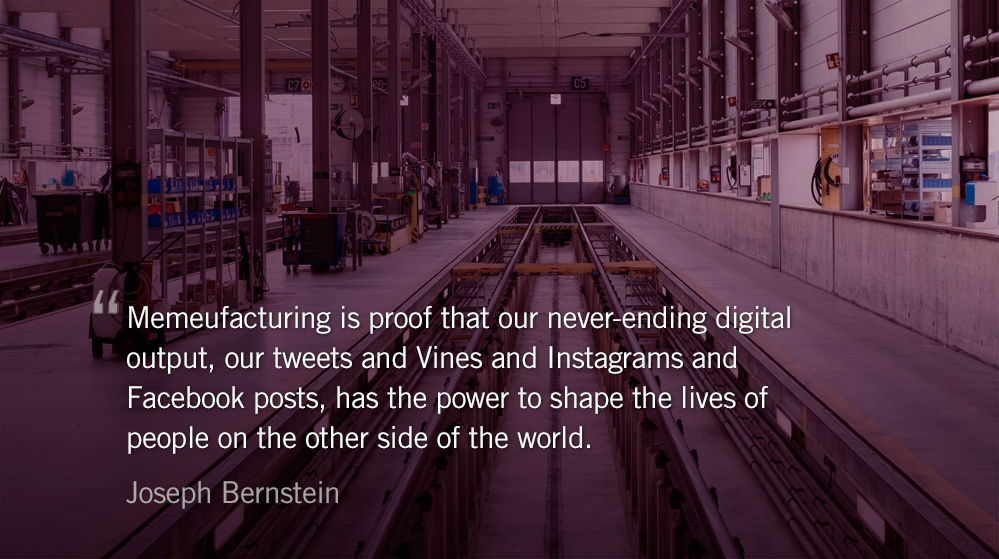
Memeufacturing is proof that our never-ending digital output, our tweets and Vines and Instagrams and Facebook posts, has the power to shape the lives of people on the other side of the world. — Joseph Bernstein

“Memeufacturing,” a term Bernstein coined, is the production of electronics in response to their success online. On the western side of the equation we consume without regard to consequence. “It is understood that hoverboards come from China in the same way it is understood that Spam comes from pigs: vaguely and glibly,” Bernstein quips.

The role of faith in such a world cannot be understated. If we are people who believe prayer has power we would find ourselves interceding for the millions of people marginalized by unfettered consumerism. If we believe part of Christ’s path is sacrifice we would curtail the desires the social web and advertising arouse in our souls. Most importantly, as faith communities, we would work out how to love our global-neighbors as we love ourselves—we would become our brother’s keeper.

Today’s Reading
Ezra 1 (Listen – 2:03)
Acts1 (Listen – 3:58)

This Weekend’s Readings
Ezra 2 (Listen – 5:25) Acts 2 (Listen – 6:35)
Ezra 3 (Listen – 3:01) Acts 3 (Listen – 3:33)

The Weekend Reading List

Saved by Mercy :: Tolkien’s Letters

By J.R.R. Tolkien

If you re-read all the passages dealing with Frodo and the Ring, I think you will see that not only was it quite impossible for him to surrender the Ring, in act or will, especially at its point of maximum power, but that this failure was adumbrated from far back.

He was honored because he had accepted the burden voluntarily, and had then done all that was within his utmost physical and mental strength to do. He (and the Cause) were saved—by Mercy : by the supreme value and efficacy of Pity and forgiveness of injury.

1 Corinthians 10.12-13 may not at first sight seem to fit – unless ‘bearing temptation’ is taken to mean resisting it while still a free agent in normal command of the will. I think rather of the mysterious last petitions of the Lord’s Prayer: Lead us not into temptation, but deliver us from evil. A petition against something that cannot happen is unmeaning.

There exists the possibility of being placed in positions beyond one’s power. In which case (as I believe) salvation from ruin will depend on something apparently unconnected: the general sanctity (and humility and mercy) of the sacrificial person.

I did not ‘arrange’ the deliverance in this case: it again follows the logic of the story. (Gollum had had his chance of repentance, and of returning generosity with love; and had fallen off the knife-edge.)

No, Frodo ‘failed.’ It is possible that once the ring was destroyed he had little recollection of the last scene. But one must face the fact: the power of Evil in the world is not finally resistible by incarnate creatures, however ‘good’; and the Writer of the Story is not one of us.

*Excerpt from the draft of a letter to Miss J. Bum, July, 26 1956. From The Letters of J.R.R. Tolkien (Mariner Books, 2000).

Today’s Reading
2 Chronicles 36 (Listen – 4:26)
Revelation 22 (Listen – 3:59)


Give a Year-End Gift Now.

Your tax-deductible donation can help us increase Scripture engagement in cities around the world. Support our work today.

How to be Married to your Soul Mate :: Tolkien’s Letters

By J.R.R. Tolkien

The essence of a fallen world is that the best cannot be attained by free enjoyment, or by what is called ‘self-realization’ (usually a nice name for self-indulgence, wholly inimical to the realization of other selves); but by denial, by suffering. Faithfulness in Christian marriage entails that: great mortification.

No man, however truly he loved his betrothed and bride as a young man, has lived faithful to her as a wife in mind and body without deliberate conscious exercise of the will, without self-denial. Too few are told that—even those brought up ‘in the Church.’

When the glamour wears off, or merely works a bit thin, they think they have made a mistake, and that the real soul-mate is still to find. The real soul-mate too often proves to be the next sexually attractive person that comes along. And of course they are, as a rule, quite right: they did make a mistake.

Nearly all marriages, even happy ones, are mistakes: in the sense that almost certainly (in a more perfect world, or even with a little more care in this very imperfect one) both partners might have found more suitable mates. But the ‘real soul-mate’ is the one you are actually married to.

Only the rarest good fortune brings together the man and woman who are really as it were ‘destined’ for one another, and capable of a very great and splendid love. The idea still dazzles us, catches us by the throat: poems and stories in multitudes have been written on the theme, more, probably, than the total of such loves in real life.

In such great inevitable love, often love at first sight, we catch a vision, I suppose, of marriage as it should have been in an un-fallen world. In this fallen world we have as our only guides, prudence, wisdom (rare in youth, too late in age), a clean heart, and fidelity of will

Out of the darkness of my life, so much frustrated, I put before you the one great thing to love on earth: the Blessed Sacrament. There you will find romance, glory, honor, fidelity, and the true way of all your loves upon earth.

*Abridged from a letter to Michael Tolkien, March 6-8, 1941. From The Letters of J.R.R. Tolkien (Mariner Books, 2000).

Today’s Reading
2 Chronicles 35 (Listen – 5:25)
Revelation 21 (Listen – 4:34)


Give a Year-End Gift Now.

Your tax-deductible donation can help us increase Scripture engagement in cities around the world. Support our work today.