Wrongly Placed Fear

Scripture Focus: 1 Peter 1.17
Since you call on a Father who judges each person’s work impartially, live out your time as foreigners here in reverent fear.

Reflection: Wrongly Placed Fear
By John Tillman

Christians have been taught that we are “living out our time as foreigners.” But in western culture, that was built on Christianity, it has been too easy to forget and too easy to feel at home right here in the world. But for the first time, some Christians are beginning to feel unwelcome.

This cannot be called persecution. It is at worst a loss of status.

Persecution of Christians around the world is more than murder, rape, and torture. In the countries in which Christians suffer the most, persecution is social and systemic.

It is this type of persecution—a systemic loss of legal rights and status—that scares Christians in the west more than facing down a knife attack, a rampaging truck, or a bullet.

This fear has made American Christians a paranoid and unpredictable group. Liable to believe fake news, liable to vote for candidates and support policies that two decades ago would have been inconceivable, and liable to turn on each other.

Nothing demonstrates our paranoia better than the increasingly divisive nature of religious dialogue. Progressive Christians blame conservative Christians for being dogmatic and mean-spirited. Conservatives blame progressives for abandoning central Christian teachings.

This is how people act when they are living in fear. But this is not the reverent fear of the Lord that Peter speaks of. That reverence is born out of love and leads to loving one another deeply, from the heart.

We live in fear that the Lord will let us suffer rather than rejoicing in that suffering as Peter instructs. We are living in fear that soon we will be considered the extremists—cast out from society.

The believers Peter was writing to were the losers and outcasts. They had literally been scattered from their homeland and cast out to the margins.

Christian thought has always been extremist thought. It is a revolutionary rejection of the world’s power structure. Jesus was crucified for extremist thought. It was Christian extremist thought that brought down slavery.

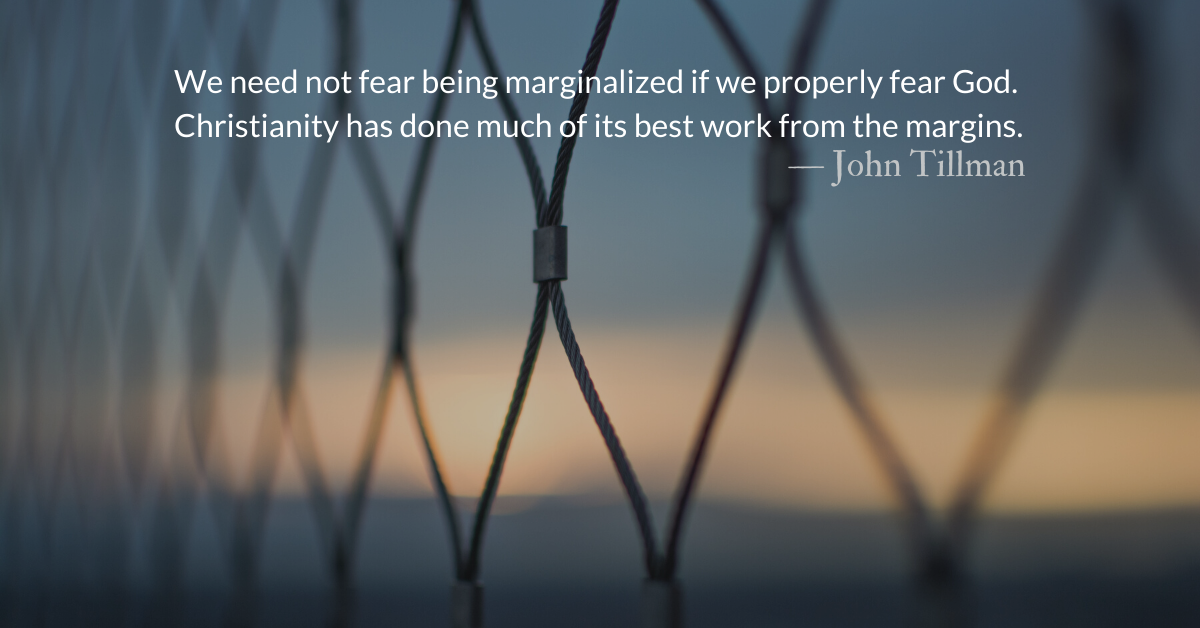
We need not fear being marginalized if we properly fear God. Christianity has done much of its best work from the margins.

It was from the margins that first-century Christians won more than converts, they won the culture. Not by winning court cases or electing the right officials, but by demonstrating the extremity of God’s love that comes from the Gospel.

May God give us grace to follow their example.

– Divine Hours prayers from The Divine Hours: Prayers for Springtime by Phyllis Tickle

Today’s Readings
Isaiah 13 (Listen – 3:11) 
1 Peter 1 (Listen 3:53)

Read more about Where Martyrdom Begins Part 1
We are commanded to take up our cross daily, not finally. It is in the so-called small, everyday sacrifices that we give our lives for each other. 

Read more about The Way of Love Amidst Fear
Fear is natural and one shouldn’t be ashamed of being afraid. However, the response of a Christian must be supernatural.


Praise from a Stump :: A Guided Prayer

Scripture Focus: Isaiah 12.1-3
1 In that day you will say: 
         “I will praise you, LORD. 
         Although you were angry with me, 
         your anger has turned away 
         and you have comforted me. 
      2 Surely God is my salvation; 
         I will trust and not be afraid. 
         The LORD, the LORD himself, is my strength and my defense; 
         he has become my salvation.” 
      3 With joy you will draw water 
         from the wells of salvation. 

Reflection: Praise from a Stump :: A Guided Prayer
By John Tillman

Israel is compared to trees many times in scripture including grapevines, fig trees, and olive trees. Isaiah’s image of the stump goes along with his image of the unfruitful vineyard. It is a purposely destroyed tree. It is not just trimmed or pruned but ground down to a stump. 

In Isaiah chapter 11, we see this shamed, humbled tree being miraculously restored. Instead of being uprooted and completely destroyed, the “shoot from the stump of Jesse” is supernaturally blessed to grow and become fruitful in ways the tree never had been before.

Prophecies are often multi-layered and this one is no different. The shoot has often been compared to Jesus himself. Layered over that meaning, it also represents the nation of Israel as a whole, the church which is Christ’s body, and it pre-envisions the tree of healing that will grow in the city of God.

We, in Christ, can see ourselves in both the unworthy and shamed stump, and in the new supernatural growth of the remnant. Pray this prayer, based partially on Isaiah 12, that offers praise from the remnant to God our salvation who forgives and blesses us to reach the nations.

The Praise of the Remnant
How can we stand on the Day of the Lord?
Our lips are unclean, our hearts are hard.
The weak and outcast suffer from our indifference.
Blood sinks into the ground from our injustices.
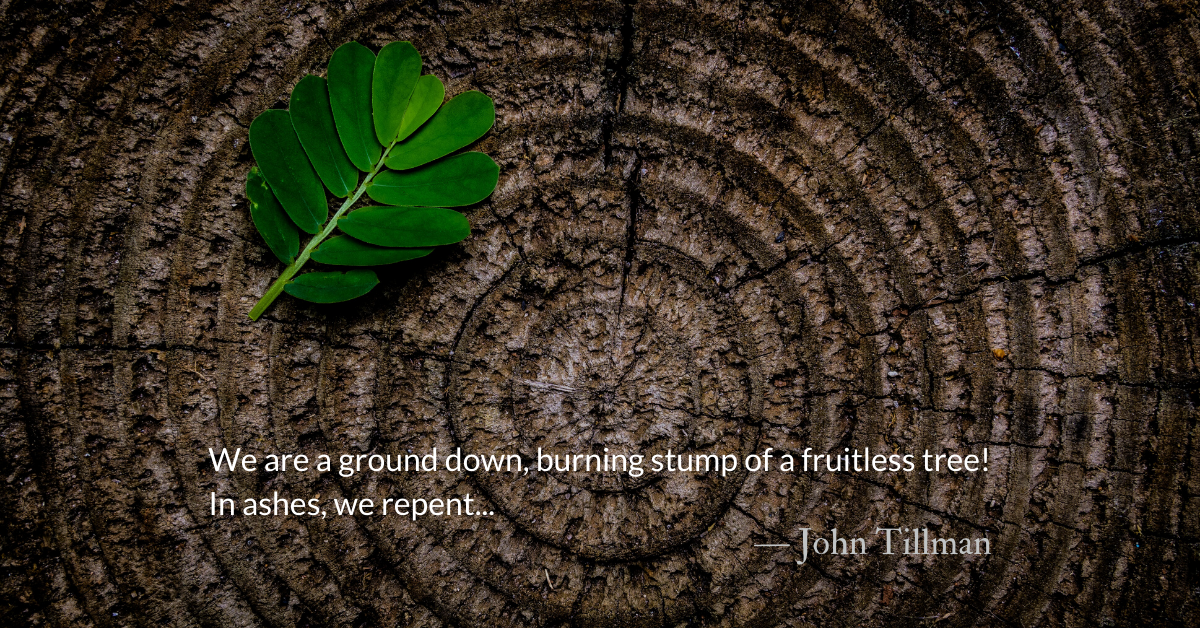
We are a ground down, burning stump of a fruitless tree!

In ashes, we repent.
Burning our idols of self-reliance
In sorrow, we lament.
Trusting your promise and your character
In humility, we place our face 
in the dust to which we will return.
Our longing, Lord, is to see your face.

We will praise you, Lord.
Although you are angry with us,
Turn your anger away
Comfort us and be our salvation.

You, our strength and our defense.
You, our source and our supply
You, our bread of life
You, our living water from the rock

Only you redeem and save, punish and forgive.
Only you make a highway through our desert
Leading your children and the nations to your presence.

We shout aloud praises to you!
We proclaim to the nations your greatness!
We praise your name and your righteousness!

Divine Hours Prayer: The Request for Presence
Gladden the soul of your servant, for to you, O Lord, I lift up my soul. — Psalm 86.4

– Divine Hours prayers from The Divine Hours: Prayers for Springtime by Phyllis Tickle

Today’s Readings
Isaiah 11-12 (Listen – 3:39) 
James 5 (Listen 3:01)

Read more about Family Tree
We can be grafted into the family tree of Christ and bear the same fruit that he wants to bring about in our lives.

Read more about Figs Out of Season
Through the power of the Holy Spirit’s work in our lives we are able to produce fruit in supernatural abundance and beyond our natural abilities.


To Whom We Draw Near

Scripture Focus: 
James 4.7-8
7…Resist the devil, and he will flee from you. 8 Come near to God and he will come near to you…

Reflection: To Whom We Draw Near
By John Tillman

The writing in James is tight, terse, and tense. It is full of short, pithy quotables that, at first glance, seem disconnected from one another. But most of the time (just like in the book of Proverbs it is sometimes compared to) larger thoughts are developing and each thought shines light on the next. 

James copies the style of Proverbs often—writing a balanced statement of a good on one side, contrasted with its opposite. In James 4, his balanced statements help to contrast living as a “friend of the world” rather than a “friend of God.” 

We want to be a friend of God and of the world too but James reminds us that is impossible. We are called to have a single love and to be faithful to God alone, satisfying ourselves in God and clinging to him to the exclusion of all others. If we maintain a polyamorous relationship that includes our worldly, fleshly desires, God, in response, will distance himself from us. 

James calls this being double-minded rather than single-minded. Our conflicts, struggles, anger, and rage come from attempts to achieve our worldly desires—seeking wealth, seeking power, seeking pleasures. We want God’s blessings to spend on devilish pursuits. When we choose this, we are choosing enmity rather than friendship with God, war rather than peace.

We live on Earth which rightfully belongs to God, but  “the world” is the powers, systems, and spiritual forces that usurp God’s rule and authority. We are aliens and strangers in the world, not citizens. God does not acknowledge dual citizenship with a rebellious world. We cannot keep one foot in two kingdoms which are at war. 

James recommends that we choose our enemies carefully, for when we choose our enemies, we are also choosing our friends. Choosing to be near to the world is choosing to be far from God. Resisting the devil will cause him to flee from us. Coming near to God will cause him to come near to us. The distance of the devil and the nearness of God are affected by our responses. 

We must choose whom to resist and whom to draw close to. May we draw close to God and be safely kept in his hand. We need not fear having the world as an enemy when we have God as a friend.

Divine Hours Prayer: The Request for Presence
Show us the light of your countenance, O God, and come to us. — Psalm 67.1

– Divine Hours prayers from The Divine Hours: Prayers for Springtime by Phyllis Tickle

Today’s Readings
Isaiah 10:5-34 (Listen – 5:14) 
James 4 (Listen 2:25)

Read more about Prayer and Faith
Do we feel that God is distant from us? It is we who have moved. Draw near in prayer.

Read more about Seeking after a Seeking God
Wherever and however we draw near to God, he will draw near to us.


Much Demanded

Scripture Focus: Isaiah 9.14-16
14 So the Lord will cut off from Israel both head and tail,
    both palm branch and reed in a single day;
15 the elders and dignitaries are the head,
    the prophets who teach lies are the tail.
16 Those who guide this people mislead them,
    and those who are guided are led astray.

James 3.1
Not many of you should become teachers, my fellow believers, because you know that we who teach will be judged more strictly. 

Reflection: Much Demanded
By John Tillman

There is an often repeated biblical principle—the more you are given, the more will be expected of you. 

We see its implications in Isaiah’s prophecy against the leaders. (Isaiah 9.14-16) James echoes it in his warning to “teachers.” (James 3.1) Christ worded it, “From everyone who has been given much, much will be demanded; and from the one who has been entrusted with much, much more will be asked.” (Luke 12.48)

Part of God’s righteousness, his justice, is not holding those with little accountable for their poverty. Whether a poverty of finances, of knowledge, of access, or of power, God judges those with little lightly and those with much heavily.

This should be sobering to us who are greatly privileged.

We live in an age of unprecedented availability of knowledge. We are more accountable to God for what we say and teach than ever before. We have an unprecedented ability to access the Bible at any time and on any device imaginable. We are more accountable to God for our ignorance of his scriptures than ever before. We have an unprecedented ability to reach around the world (or across the street) to know and befriend people of all races, backgrounds, and beliefs. We are more accountable to God for holding on to racial prejudice, divisions, and resentments than ever before. We are living in the most prosperous time in history with financial resources available to the majority of people that were unimaginable in prior ages of history. We are more accountable to God for abandoning and abusing those in poverty than ever before.

It is to our shame with such wealth that there are starving children.
It is to our shame with such connectedness that we cause divisiveness.
It is to our shame with such availability of the Bible that we do not avail ourselves of reading it.
It is to our shame with such access to expert knowledge that we scrape the basements of the Internet to find conspiracies that we like better than the facts. (Isaiah 8.12-13)

May we confess and repent, before God comes to settle accounts with us.

Much has been given to us. May we praise God in thankfulness for it.
Much has been given to us. May we serve our neighbor in humbleness with it.
Much has been given to us. May we challenge every form of oppression with it.

Divine Hours Prayer: The Greeting
O God, you have taught me since I was young, and to this day I tell of your wonderful works. — Psalm 71.17

– Divine Hours prayers from The Divine Hours: Prayers for Springtime by Phyllis Tickle

Today’s Readings
Isaiah 9:8-10:4 (Listen – 3:36) 
James 3 (Listen 2:38)

Read more about Confession as a Crucible
The crucible of COVID-19 is revealing in our society and ourselves the ugliest most sinful parts of our nature.

Read more about Confession Destroys Denial
We give our lives and bodies as Mary did to be used by you to bring down rulers from their thrones, lift up the humble, and fill the hungry with good things.


Pleasing Sacrifices

Scripture: Hebrews 13:15-16
Through Jesus, therefore, let us continually offer to God a sacrifice of praise—the fruit of lips that openly profess his name. And do not forget to do good and to share with others, for with such sacrifices God is pleased.

Reflection: Pleasing Sacrifices
By Jon Polk

After weaving a rich theological tapestry, the letter to the Hebrews concludes in the same manner as many other New Testament epistles, with the author including a closing postscript of seemingly disconnected behavioral exhortations.

Love each other. Show hospitality. Remember the suffering. Honor marriage. Be content. Imitate your leaders.

The list is followed by one of the many commonly quoted verses from Hebrews, “Jesus Christ is the same yesterday and today and forever.”

There is a thread of continuity in these instructions that connects with Christ’s eternally consistent character.

One final time, the author recalls the high priest imagery that has permeated the book. A reference to the Old Testament sin offerings serves as a reminder that Jesus himself functions both as our high priest and a sacrifice for our sins.

Jesus’ self-sacrifice on the cross is not merely an event that happened to Jesus, it is one of his important character traits. Jesus’ selflessness, demonstrated by his willingness to give up his very life for us, is the same yesterday and today and forever.

So what do all these final charges have in common? Selflessness.

Loving one another in the community of faith involves treating one another as we would members of our own families. There is a reason we refer to each other as sisters and brothers.
Not only should we love those in our community, but we are challenged to love those outside our community as well. Loving the stranger, the “other,” often involves personal risk.

One step even further is serving the outcasts, not simply strangers but those shunned from the community, in prison, mistreated, suffering. Ministry to the outcast involves a sacrifice of our time and resources.

Any married person could tell you that a truly successful marriage is founded on a commitment to serve one another selflessly.

Being content with what we have and guarding our hearts from the love of money may require reevaluation of career goals or personal ambitions. Trusting in God to meet our needs means releasing our selfish desire to control our destiny.

Remembering that God has provided faithful leaders to guide and instruct us is yet another way we practice selfless humility.

Ultimately we have been called to imitate our self-sacrificing savior, Jesus, by giving of ourselves to do good for the benefit of others. George Herbert, 17th-century British priest, poet, and theologian, wrote, “For there is no greater sign of holiness than the procuring and rejoicing in another’s good.”

Divine Hours Prayer: The Refrain for the Morning Lessons
For God, who commanded the light to shine out of darkness, hath shined in our hearts, to give the light of the knowledge of the glory of God in the face of Jesus Christ. — 2 Corinthians 4.6

– Divine Hours prayers from The Divine Hours: Prayers for Springtime by Phyllis TickleToday’s Readings
Isaiah 6 (Listen – 2:24) 
Hebrews 13 (Listen 3:31)

Today’s Readings
Isaiah 7 (Listen – 3:51) James 1 (Listen 3:26)
Isaiah 8:1-9:7 (Listen – 3:26) James 2 (Listen 3:32)

Read More about Finishing Well
We must keep our eyes on the example of Jesus, who ran the race before us and endured great suffering on our behalf.

Read More about Compelled Toward Community
We have been made participants in a New Covenant of grace with God and we are beneficiaries of Christ’s inheritance of forgiveness.

Show Buttons
Hide Buttons
Spur a spiritual rhythm of refreshment right in your inbox
By joining this email list you are giving us permission to send you devotional emails each weekday and to communicate occasionally regarding other aspects of the ministry.
100% Privacy. We don't spam.