The King We Want

Scripture Focus: John 19.15
15 But they shouted, “Take him away! Take him away! Crucify him!” “Shall I crucify your king?” Pilate asked. “We have no king but Caesar,” the chief priests answered.

Zechariah 9.9
9 Rejoice greatly, Daughter Zion! 
Shout, Daughter Jerusalem! 
See, your king comes to you, 
righteous and victorious, 
lowly and riding on a donkey, 
on a colt, the foal of a donkey. 

1 Samuel 8.6-7
6 But when they said, “Give us a king to lead us,” this displeased Samuel; so he prayed to the Lord. 7 And the Lord told him: “Listen to all that the people are saying to you; it is not you they have rejected, but they have rejected me as their king.


Reflection: The King We Want
By John Tillman

All the gospel writers include the detail from Zechariah’s vision of a coming king riding on a donkey. John and Matthew quote Zechariah 9.9 to point out Jesus’ fulfillment of this prophecy. However, this humble king wasn’t what many wanted. Many rejected Jesus then. And many still reject him now.

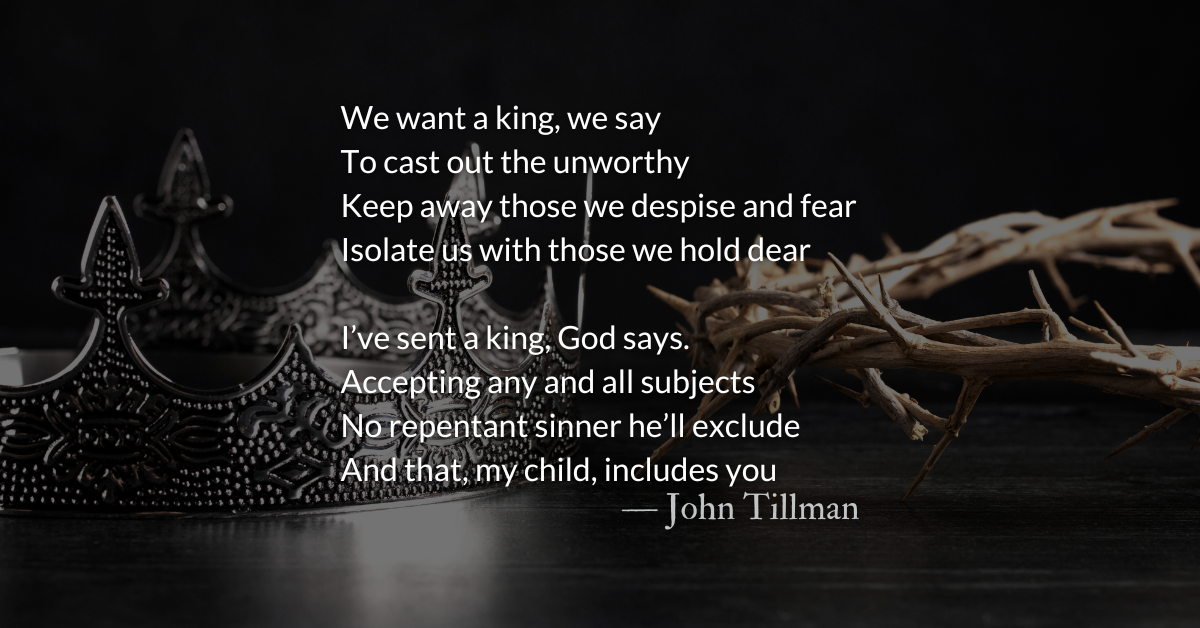
The King We Want
We want a king, we say
A king like other nations
With Solomon’s glitz and glamor
With Goliath’s sword and armor

I’ve sent a king, God says
Unlike any you’ve seen
Son of the Giant Killer
Yet, rejected as your ruler

We want a king, we say
Exalted and victorious
We’ll hear his saber rattle
We’ll follow him to battle

I’ve sent a king, God says
A king not of this realm
Your lust for worldly power
Shows you mistake the hour

We want a king, we say
To make our city great
To make for ourselves a name
To not be scattered from this plain

I’ve sent a king, God says
You had no eyes to see him
He wept over your city
That the outcasts gained no pity

We want a king, we say
We’ll even take a bad one
Let him speak like a serpent coiled
Long as we can share the spoils

I’ve sent a king, God says
You had no ears to hear him
Of sin’s sting you must repent
Then my King will crush the serpent

We want a king, we say
A conqueror, triumphant
Crush our enemies who slight us
Crush the governments above us

I’ve sent a king, God says
He rode in on a donkey
My servants prophesied him
You rebels crucified him

We want a king, we say
To cast out the unworthy
Keep away those we despise and fear
Isolate us with those we hold dear

I’ve sent a king, God says.
Accepting any and all subjects
No repentant sinner he’ll exclude
And that, my child, includes you


Divine Hours Prayer: The Refrain for the Morning Lessons
Righteousness shall go before him, and peace shall be a pathway for his feet. — Psalm 85.13

– From The Divine Hours: Prayers for Summertime by Phyllis Tickle.


Today’s Readings
Job 20 (Listen 2:52
John 19 (Listen 6:23)

This Weekend’s Readings
Job 21 (Listen 3:05), John 20 (Listen 4:17)
Job 22 (Listen 2:54), John 21 (Listen 3:58)

Read more about Ecce Homo
Pilate presents Jesus as king and he is rejected. Not just by the Jews. By the world. This moment is the essence of all sin.

Read more about Pause To Read
Check out today’s new podcast episode: Defining Moment. How many have you listened to? Let us know what you think. Share and rate the episodes to spread the word.

Our Redeemer Lives

Scripture Focus: Job 19.23-27
23 “Oh, that my words were recorded, 
that they were written on a scroll, 
24 that they were inscribed with an iron tool on lead, 
or engraved in rock forever! 
25 I know that my redeemer lives, 
and that in the end he will stand on the earth. 
26 And after my skin has been destroyed, 
yet in my flesh I will see God; 
27 I myself will see him 
with my own eyes—I, and not another. 
How my heart yearns within me! 

Reflection: Our Redeemer Lives
By John Tillman

Job lived before Moses and before Abraham. The Law had not yet been written. However, the concept of a redeemer has many expressions within the Law. A redeemer was typically a family member who would save or redeem a victim from a hopeless situation. 

Commentator Carl Schultz notes different types of redeemers. The redeemer could take vengeance for the victim’s unjust death. (Deuteronomy 19.1–12; 2 Samuel 3.26-27; 2 Samuel 14.11) The redeemer could reclaim the victim from slavery. (Leviticus 25.47-49) The redeemer could reclaim family property. (Leviticus 25.25-27) The redeemer could marry the victim’s widow, continuing the family line and maintaining property for the widow and her children. (Ruth 4.1-16)Job could have been thinking of a relative who might come to his aid, but what human relative could redeem all Job lost? What human relative could vindicate him? Pronounce him innocent? Restore his dignity? Restore his health? Restore his life?

Job’s words about a redeemer may have an earthly meaning, but no earthly redeemer could accomplish all that Job longed for.

Job was not asking for a loan or financial support. He did not want to muster an army to pursue human raiders. (Job 1.17) He did not appeal for legal representation. Job looked for a redeemer beyond the physical, yet Job declared he would see this redeemer in the flesh.

We share Job’s situation. Job’s difficulties are greater in severity than ours but similar in nature. Have we not lost loved ones? Have we not been cheated? Have we not lost or lacked finances? Have we not been estranged from loved ones? Have we not experienced injustice?

Do we not also need the redemptions described in the Law? By Satan’s deceit, Adam and Eve died, and we are slain with them. By sin’s shackles, we are enslaved to a wicked master. By death’s power, we are evicted from our true home with God. By all of this, we live under Satan’s kingdom—in his household.

We share Job’s hopeless situation. We also share Job’s Redeemer.

Jesus fulfills all the roles of the redeemer in the Law. He is the strong man, breaking into Satan’s home to steal us back and crushing the head of the serpent. He is our brother, restoring our rightful home and preparing a place for us. He is our liberator, breaking the shackles of sin. He is our new Adam and, united to him, as he suffered, died, and rose, so shall we.

Praise God, our Redeemer lives!


Divine Hours Prayer: The Greeting
The Lord lives! Blessed is my Rock! Exalted is the God of my salvation! — Psalm 18.46

– From The Divine Hours: Prayers for Summertime by Phyllis Tickle.


Today’s Readings
Job 19 (Listen 2:48
John 18 (Listen 5:16)

Read more about Mystery in the Ashes
Who demonstrates the height, depth, width, and length of the love of God? Jesus. Who shows us the Father? Jesus.

Read more about Pause To Read
Another full podcast episode is out tomorrow. How many have you listened to? Let us know what you think. Share and rate the episodes to spread the word.
Tense Conversations

Scripture Focus: Job 18:1-2
1  Then Bildad the Shuhite replied:
2 “When will you end these speeches?
     Be sensible, and then we can talk.

Reflection: Tense Conversations
By Erin Newton

“Tension” is a good word for the dialogues between Job and his friends. Their relationship is strained. The friends accuse Job of evil despite his pleas to the contrary and our privileged view from the prologue. There is anxiety as the friends (and reader) wait to see if Job really will curse God. Tension abounds.

The greatest tension in the book is the conflict between how each person views the world. The friends, Bildad especially, see the universe operating within a system of divine retribution. God punishes the wicked. This is true. Job, however, knows his innocence. God hears the pleas of the righteous. This is also true.

The discomforting questions remain: Why is Job suffering if he is not evil? Why is God silent if Job is innocent?

As the dialogue is tossed back and forth, Bildad’s reply sounds like someone who is frustrated. I imagine a little huffing and rolling of eyes. The Message translates the verse in similar manner, “How monotonous these word games are getting! Get serious! We need to get down to business.” The New Living translation echoes this sentiment, “How long before you stop talking? Speak sense if you want us to answer!”

Bildad requires some level of sensibility (NIV, NLT) or seriousness (MSG) before the conversation can continue. He asks for a solution to the tension of worldviews. “Agree with me,” captures the sense of his words.

We are quick to criticize Bildad for demanding Job to come to some mental, emotional, or spiritual sensibility. We scoff at his lack of empathy and blindness to Job’s pain. He should be sensitive and give good counsel.

The tension sets in—he’s not wrong in his view of retribution, but we know this is not the right situation for it.

Are we so different from Bildad? We often want someone to grasp this great truth about God so their pain can be eased. We hope some baptized platitudes will ease the burden our friends are carrying. Suffering is not so simple.

Tension marks Job’s painful dialogue with friends. Tension describes the reality that God will punish evil and that the innocent do endure suffering.

Tension resides in our inward struggle to understand the mystery of pain. Tension must be confronted when we sit with our friends in their senseless grief. To live our lives according to Job is to sit within the tension of suffering and justice.


Divine Hours Prayer: The Request for Presence
Save me, O God, by your Name; in your might, defend my cause.
Hear my prayer, O God; give ear to the words of my mouth. — Psalm 54.1-2

– From The Divine Hours: Prayers for Summertime by Phyllis Tickle.


Today’s Readings
Job 18 (Listen 1:54
John 17 (Listen 3:40)

Read more about Principles, Promises, and Presence
The problem with Job’s friends is not the content but the application…the wisdom is misapplied to try to “fix” Job through shame and blame.

Read more about Supporting Our Work
Our work is free to read but costs time and money to make. Please consider becoming a donor. Help bring biblical devotionals to inboxes across the world.

Christ, Our Undeserved Friend — Guided Prayer

Scripture Focus: Job 16.19-21
19 Even now my witness is in heaven; 
my advocate is on high. 
20 My intercessor is my friend  
as my eyes pour out tears to God; 
21 on behalf of a man he pleads with God 
as one pleads for a friend.

Reflection: Christ, Our Undeserved Friend — Guided Prayer
By John Tillman

The earliest dates for Job’s writing are around 2,000 years before Christ, and the antiquity of the events may be far earlier than that date. Both Ezekiel and James (Ezekiel 14.14-20; James 5.10-11) discuss Job among lists of historical persons, implying that they believe him to be more than merely a story or parable. So, Job’s words give us the earliest written prophetic vision of Christ. In Job, Christ is our un-named and undeserved heavenly representative, who takes our case and acts as a true friend, even as Job’s earthly friends berate and badger him.

This week, pray this poetic prayer of thanks to Christ, our advocate, redeemer, and friend. This poem incorporates prayers of Job and other scriptures.

Christ, Our Undeserved Friend:
In this life,
When gripped by strife,
I know above
Of one who loves.

When I’m amidst a storm that swirls
Hiding from accusations hurled,
Immobilized in sin and guilt,
Collapsing consequence I built,

Rotten inward and outward too,
My sins are yeast worked through and through.
Condemned, inner and outer self
Have no appeal, no chance of health.

I cannot speak, for if I do
My words turn each fault into two.
My speech reflects my inward sin.
My thoughts bring outward sins within.

I hope in nothing I can reach
But he who in this darkness seeks.
The darkness is not dark to him.
He sees me clearly, sees my sin.

Though my sins and weakness he sees,
My case before the Father, pleads.
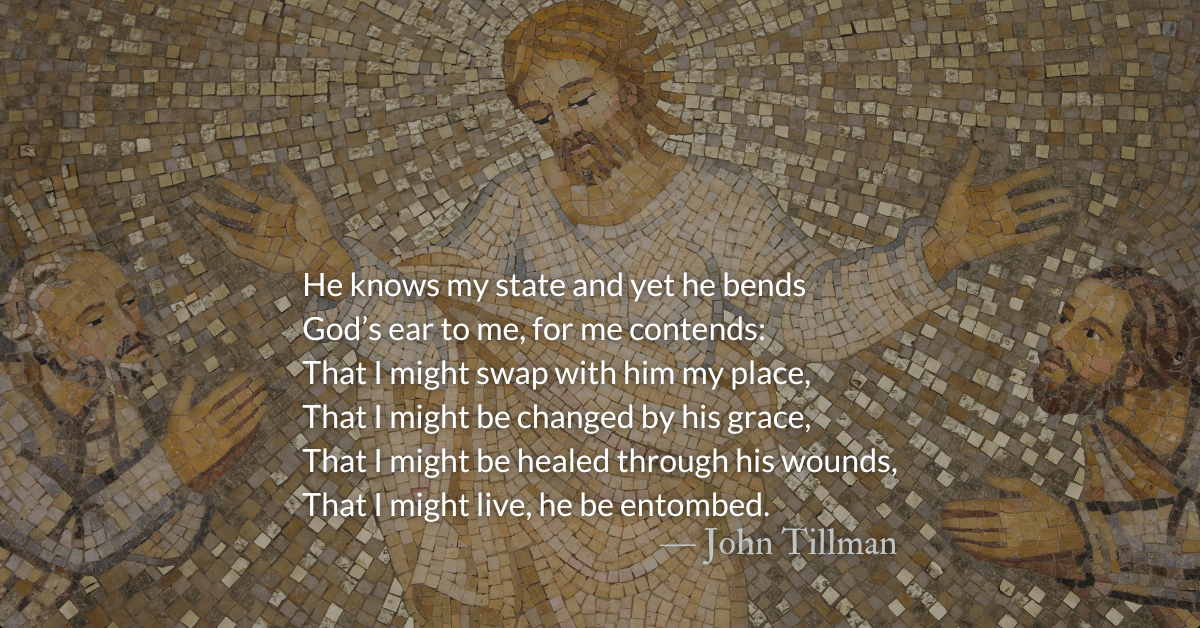
He knows my state and yet he bends
God’s ear to me, for me contends:

That I might swap with him my place,
That I might be changed by his grace,
That I might be healed through his wounds,
That I might live, he be entombed.

The Father consented.
The son he descended.
He purloined my guilt.
His dear blood was spilt.

My sin he grasped with nail-pierced grip
Dragged sin to hell, and there left it.
My sorrow sees his body riven.
My joy to know his body risen.

With death defeated, he grasped me,
That I should live eternally.
His work in me, begins to show,
As obeying his Word, I go.

Serving my world in thanks to Him,
Shunning pride, a humble pilgrim
To read, ponder, walk in, live in
The Word, and Holy Spirit given.

I walk with my redeemer, friend,
Holding my hand, until the end.
In this world there will sufferings be,
Tolerable only when with thee.

Give my mouth a tongue which will speak
Of your love and, though I am weak,
Unfailing faith to stand in grace
And steps to finish out this race.

Christ, he our undeserved friend,
Is with me yet, until the end.


Divine Hours Prayer: The Call to Prayer
Love the Lord, all you who worship him; the Lord protects the faithful, but repays to the full those who act haughtily. — Psalm 31.23


– From The Divine Hours: Prayers for Summertime by Phyllis Tickle.


Today’s Readings

Job 16-17 (Listen 2:09
John 16 (Listen 4:14)

Read more about Lamenting With Job :: Guided Prayer
Lament is frequent and important in the Bible and should be in our lives as well.

Read The Bible With Us
It’s never too late to join our continuous Bible reading plan. Ask a friend to join you in reading the Bible with us at a sustainable, two-year pace.

https://mailchi.mp/theparkforum/m-f-daily-email-devotional

Not Getting It

Scripture Focus: John 12.16
16 At first his disciples did not understand all this. Only after Jesus was glorified did they realize that these things had been written about him and that these things had been done to him. 

Reflection: Not Getting It
By John Tillman

John tells us that nearly everything Jesus said and did, and what was done to him was written about in the scriptures. Yet, it still surprised everyone. They did not get it.

Jesus said to the Samaritan woman, “You worship what you do not know,” and in some ways that is true of all generations before Jesus.

In the stories of every patriarch, prophet, priest, or king, we see moments God surprised them. There were twists and turns in the biblical narrative when God’s unsuspected, and sometimes counterintuitive, plans and purposes were revealed.

Jesus’ enemies, disciples, and followers had been waiting for the Messiah to come. The religious leaders studied the scriptures diligently, searching for him. (John 5.39-40) The Samaritans, hated by the Jews, still believed in the Messiah and waited for him. (John 4.19-26) The Magi traveled from distant lands looking for him. (Matthew 2.1-2) They all had expectations that came from scripture and prophecy.

Some things nearly everyone got right, starting with the place of his birth, Bethlehem. Herod’s scholars knew exactly where to send the searching Magi. (Matthew 2.4-8) When Phillip told Nathanael that he thought Jesus of Nazareth was the Messiah, Nathanael scoffed that nothing good could come from Nazareth. (John 1.45-46) Later, opponents of Jesus also considered Nazareth, in Galilee, a location that disqualified Jesus from being taken seriously. (John 7.52)

Jesus said to Thomas, “Because you have seen me, you have believed; blessed are those who have not seen and yet have believed.” (John 20.29) The disciples saw and touched Jesus, but in some ways, we see more of Jesus through the written gospels and the rest of the New Testament than they did at that time. There was more to be revealed.

“We did not get it,” John says. (John 12.16)  “We did not understand what Jesus was doing or saying. We did not understand what was happening because we did not understand what had been written.”

If the learned religious leaders who opposed Jesus and the earnest disciples who were so close to him could make errors, we can too. To take God seriously is to follow him humbly. To be surprised by God is to know him better than we did before.

If God surprised men and women all through the scriptures, he will surprise us. God has surprises in store for you this year. Humbly examine your assumptions and look for the unexpected.

Divine Hours Prayer: The Call to Prayer
Search for the Lord and his strength; continually seek his face. — Psalm 105.4

– From The Divine Hours: Prayers for Summertime by Phyllis Tickle.

Today’s Readings
Job 12 (Listen 2:21
John 12 (Listen 6:26)

This Weekend’s Readings
Job 13 (Listen 2:27John 13 (Listen 5:06)
Job 14 (Listen 2:23John 14 (Listen 4:13)

Monday’s Readings
Job 15 (Listen 3:23John 15 (Listen 3:20)

New Pause To Read Episode Today!
The 3rd full podcast episode is out! Listen and share it with someone. Rate and review the podcast to spread the word.

Read more about Mary and Judas
Mary did the theological math. She gave her offering knowing Jesus was about to give his life. Judas did some math as well. He realized that he didn’t want to follow