Time Tested Devotion

Scripture Focus: Colossians 4.2-6
2 Devote yourselves to prayer, being watchful and thankful. 3 And pray for us, too, that God may open a door for our message, so that we may proclaim the mystery of Christ, for which I am in chains. 4 Pray that I may proclaim it clearly, as I should. 5 Be wise in the way you act toward outsiders; make the most of every opportunity. 6 Let your conversation be always full of grace, seasoned with salt, so that you may know how to answer everyone.

Reflection: Time Tested Devotion
By John Tillman

One time-tested way of devoting oneself to prayer is the prayer of Examen. First published in 1548 in the Spiritual Exercises, by Saint Ignatius, this prayer has been used throughout the Church, by both clergy and laypersons.

There are many versions of the Examen, including the version at this link. The Examen is adaptable and customizable. As you implement it and get it into your memory, you can use the prayer at any time.

Pray the Examen regularly and it will tutor you in practicing the presence of God. When you are more sensitive to his presence and leading, you can become a reliable source of God’s influence and action, no matter where you go.

For a simple, short version of the Examen, use the following five actions: Awareness, Analysis, Admission, Acceptance, Anticipation.

Awareness: Pause. Relax. Release any concerns your mind is holding. Become aware that you are in God’s presence and have been continually…when you are settled peacefully, thank God for his presence and ask for his grace to be more aware of him, especially in the next few minutes.

Analysis: Review moments from the past day or week in which you sensed God’s presence with you. When and how did you sense him? How did you interact with God or act on God’s prompting or on God’s behalf? … Celebrate moments in which Christ’s grace, love, and righteousness shone through you. Humbly acknowledge that these moments were empowered by the Holy Spirit and not yourself. 

Admission: As you review you will also recall shortcomings and failures. Confess sins with the knowledge that Jesus has forgiven you. Confess not just actions of sin, but motivations behind them. (Not just that you shouted in anger but that you have an unhealthy desire for dominance and control rooted in a failure to trust God…)

Acceptance: Celebrate that, through Jesus, you are forgiven, reinstated, and accepted. This is the good news, the gospel! In addition, celebrate that Christ is at work in and through us for our sanctification and perfection.

Anticipation: Look forward to tomorrow with faith and anticipation of the presence of Christ going before you and being with you. Ask for grace to be more aware of his presence with you going forward, and close with the Lord’s prayer or another prayer chosen from scripture.

The Lord’s Prayer:
Our Father in Heaven, holy is your name.
Your kingdom come and your will be done on earth as it is in heaven.
Give us today our daily bread.
Forgive us our debts as we forgive our debtors.
Lead us not into temptation but deliver us from evil. Amen.

*We will return to prayers from The Divine Hours, next week.

Image Note: In today’s image is NGC 4565, known as the “Needle Galaxy” for its profile. This edge-on spiral galaxy is about 30 to 50 million light-years away. When we practice God’s presence through prayer, we are in the presence of the God who cared about Paul’s chains and who placed this galaxy in the sky for us to find.

Today’s Readings
Ezekiel 21(Listen 5:29)
Colossians 4(Listen 2:21)

This Weekend’s Readings
Ezekiel 22(Listen 4:58)Philemon(Listen 2:52)
Ezekiel 23(Listen 7:48)Ephesians 1(Listen 3:10)

Preview in new tab(opens in a new tab)

Read more about Mustard Seed Prayers
Allow your prayer to be shaped and rewritten by your relationship with God.

Read more about Breathing Prayers
Breath prayers are simply short prayers which can be said “in a breath.” These are often taken from scripture.
For Better or For Worse

Scripture Focus: Ezekiel 20:32-33, 37
32 “‘You say, “We want to be like the nations, like the peoples of the world, who serve wood and stone.” But what you have in mind will never happen. 33 As surely as I live, declares the Sovereign Lord, I will reign over you with a mighty hand and an outstretched arm and with outpoured wrath…
 37 I will take note of you as you pass under my rod, and I will bring you into the bond of the covenant.

Reflection: For Better or For Worse
By Erin Newton

Israel was bound to God and God to them in covenant. It was a relationship in which God is glorified and the people receive his blessing. It was bound by the immutable word of God himself.

Despite the infidelity of Israel, her idolatry and oppression of the weak, God never released them from that covenant. They chose other gods to worship and corrupted the whole concept of monotheism. Yet through it all, nothing could separate them from God.

In Ezekiel 20, God reminds the people of this bond. The people have openly rejected him and declared their intention to worship something else. They want to punt the faith. “What you have in mind will never happen.”

Can you reject God and flee from his presence? In our minds we think it’s possible. Psalm 139:7-10 echoes the impossibility of departing from God.

7 Where can I go from your Spirit?
    Where can I flee from your presence?
8 If I go up to the heavens, you are there;
    if I make my bed in the depths, you are there.
9 If I rise on the wings of the dawn,
    if I settle on the far side of the sea,
10 even there your hand will guide me,
    your right hand will hold me fast.

Like Israel, we have been covenanted with God. It is the new covenant, sealed by the Spirit, sealed upon our hearts. There is much talk about deconstruction with some defining the term as the rejection of the faith entirely. Yet we see in Ezekiel that when God has given himself in a covenant, it is unmovable.

For Israel, the people needed to deconstruct the way they had been practicing religion. Their so-called worship of God was corrupt and manipulated. Priests and leaders had allowed faith to turn into idolatry.

Israel wanted to move on to some other form of worship not realizing their God had been with them all along. Return to him. That is the message for Israel. God would say the same to us today.

Is our deconstruction leading us to different idols or are we searching for true, undefiled worship? Can we see how God will be with us in our wandering? Through pain, the Israelites will return to the Lord. Refining our faith can be painful. This is a call for us to examine what exactly we are trying to reject.

Divine Hours Prayer: The Cry of the Church
In the evening, in the morning, and at noonday, I will complain and lament, and he will hear my voice. — Psalm 55.18

– From The Divine Hours: Prayers for Summertime by Phyllis Tickle.

Today’s Readings
Ezekiel 20(Listen 9:25)
Colossians 3(Listen 3:09)

Read more about Denying Our Exile
Israel thought it was God’s nation…They confronted anyone who questioned their narrative as unpatriotic.

Read more about Presence is Precious
The presence of God is a gift of grace made available to those who seek it, recognizing it as the precious thing that it is.

A Dirge from God

Scripture Focus: Ezekiel 19:9, 14b
9 With hooks they pulled him into a cage
and brought him to the king of Babylon.
They put him in prison,
    so his roar was heard no longer
    on the mountains of Israel…

14  “…This is a lament and is to be used as a lament.”

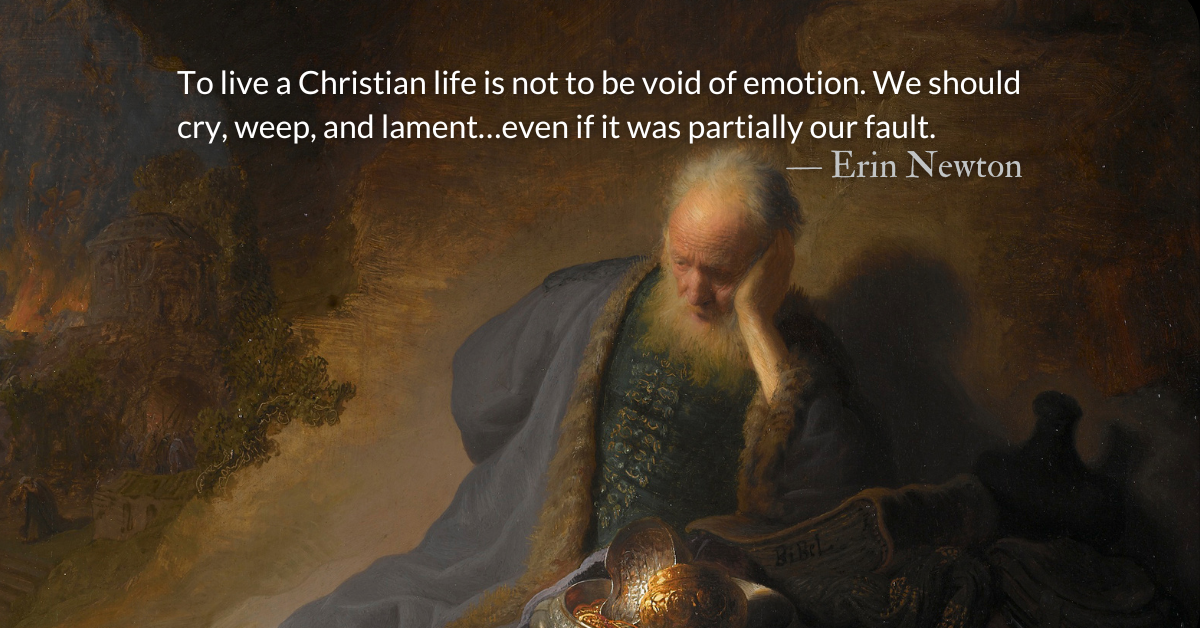
Image Note: Today’s image is taken from Jeremiah Lamenting the Destruction of Jerusalem by Rembrandt. View a high-quality image of the painting at this link.

Reflection: A Dirge from God
By Erin Newton

Jesus wept. When Lazarus died, Jesus grieved. We know Jesus was fully human and he experienced the same feelings as we do. We often think that Jesus’ experiences with grief created the means for God to understand our sadness and sympathize. The incarnation of Christ highlights his experiences with grief. Yet, God has been nurturing and guiding people through their sorrow for centuries before Jesus. He can sympathize with our sorrow, but he has also been anticipating our sorrow and providing guidance on how to process these difficult emotions.

Much of the poetry in the Bible expresses the emotional aspect to our spiritual lives. We often think of Psalms in times of distress, hoping for words that resonate with our souls. Surprisingly, we sometimes find such poetry in the prophets.

God gives Ezekiel words for the nation’s lament. He utilizes the imagery of a mother lion and her cubs. One cub is captured and taken away. The next cub is reared but captured and taken to Babylon. These cubs are the kings of the northern and southern kingdoms. The lament speaks poetically about God’s people being uprooted from the fertile land and cast into the desert. God declares that these verses be used as a lament.

This particular word for lament, qina, specifically indicated a funeral hymn, a dirge. For many chapters, we have read about God’s coming judgment upon the people because of their unfaithfulness. Time after time, we could see that whatever was coming was their fault. But God considers their emotional well-being. Judgment has come but he guides them in their lament.

God speaks to us in our humanity. Life with God is not cold. Other laments and psalms reveal the depths of emotional pain. To live a Christian life is not to be void of emotion. We should cry, weep, and lament…even if it was partially our fault.

There is a temptation to shame people amid their pain. “They deserve it.” In the case of the Israelites, “God warned them.” We scoff, roll our eyes, and mutter, “Well, I don’t feel sorry for them.” But this lament in Ezekiel tells us that no matter who it is, people are free to feel.

It is through the deep wells of emotions that we often meet God. No facades of strength. Just our authentic, emotional selves. In aiming to be strong, we forget the God-given duty to grieve.

Divine Hours Prayer: The Refrain for the Morning Lessons
Those who sowed with tears will reap with songs of joy.
Those who go out weeping, carrying the seed, will come again with joy, shouldering their sheaves. — Psalm 126.6-7

– From The Divine Hours: Prayers for Summertime by Phyllis Tickle.

Today’s Readings
Ezekiel 19 (Listen 2:12) 
Colossians 2 (Listen 3:27)

Read more about Lament the Fall of Leaders (Even Bad Ones)
No matter what we may think of leaders’ foolish decisions or reckless waste, their fall and failure will mean pain and suffering for many.

Read more about Legacy of Failure
We need to be reminded of our humanity and our great need for forgiveness.

The Gospel-Spreading Strategy of Suffering

Scripture Focus: Colossians 1.9-14; 24, 29
9 For this reason, since the day we heard about you, we have not stopped praying for you. We continually ask God to fill you with the knowledge of his will through all the wisdom and understanding that the Spirit gives, 10 so that you may live a life worthy of the Lord and please him in every way: bearing fruit in every good work, growing in the knowledge of God, 11 being strengthened with all power according to his glorious might so that you may have great endurance and patience, 12 and giving joyful thanks to the Father, who has qualified you to share in the inheritance of his holy people in the kingdom of light. 13 For he has rescued us from the dominion of darkness and brought us into the kingdom of the Son he loves, 14 in whom we have redemption, the forgiveness of sins. 

24 Now I rejoice in what I am suffering for you, and I fill up in my flesh what is still lacking in regard to Christ’s afflictions, for the sake of his body, which is the church….29 To this end I strenuously contend with all the energy Christ so powerfully works in me.

Reflection: The Gospel-Spreading Strategy of Suffering
By John Tillman

Colossians, like Philippians, shines with joy, despite being written from confinement. 

Paul challenged the Colossians to live as those belonging to the “kingdom of light” who have been rescued from the “dominion of darkness.” Like Jesus, Paul referred to a kingdom that is not “of this world.” (John 18.36) Paul challenged them to continue spreading the light of the gospel, as Epaphras had spread it to them, but however dark the dominion of Rome was, Paul wasn’t requesting rescue from an earthly empire.

Paul had already been rescued and delivered by God the Father into the kingdom of Jesus from the kingdom of sin. (Colossians 1.13) When Paul, in his own hand, signs this letter, “Remember my chains” (Colossians 4.18), he wasn’t asking for a jailbreak. He’s reminding his readers, including us, what it might take to spread the gospel.

Paul rejoices in his sufferings. He sees them not as something to be freed from but as part of his work on behalf of Christ’s Church. (Colossians 1.24) Today’s church needs this challenge. Especially in the United States, Western Christians know little of suffering for the gospel. We seem to think the gospel depends on our being freed of all constraint, inconvenience, oppression, or mistreatment. How far from Paul’s gospel strategy we have come!

If we are in Christ, we are already in the kingdom. We are ambassadors, not invaders. The kingdom is revealed when we live the life Paul described—one of joy, wisdom, understanding, bearing fruit, doing good works, growing in the knowledge of God, and having power not for conquering but for the patient endurance of suffering. (Colossians 1.11) Like Christ in the garden, we don’t need to be rescued or to conquer by force. (Matthew 26.52-54) Like Christ, and like Paul, our gospel-spreading strategy depends more on what we are willing to suffer than who we are willing to conquer.

Are there freedoms we are fighting for that, if abandoned, would free us to serve the gospel or the church? Are there sufferings we are avoiding that, if accepted and rejoiced in, would show the power of God in us?

Not all sufferings spread the gospel and we certainly shouldn’t seek suffering to gratify our pride or make ourselves feel “righteous.” But let us remember Paul’s chains, and those of fellow Christians around the world, by considering what we are willing to suffer in spreading the gospel.

Divine Hours Prayer: A Reading
Jesus taught us, saying: “I tell you, if anyone openly declares himself for me in the presence of human beings, the Son of man will declare himself for him in the presence of God’s angels. But anyone who disowns me in the presence of human beings will be disowned in the presence of God’s angels.” — Luke 12.8-9

– From The Divine Hours: Prayers for Summertime by Phyllis Tickle.

Today’s Readings
Ezekiel 18(Listen 5:26)
Colossians 1(Listen 4:18)

Read more about Christ’s Supremacy :: A Guided Prayer
We all need repetition in our spiritual lives to reinforce the greatest truths of our faith. One of those truths is the supremacy of Christ.

Read more about Sinless Descendants
They weren’t innocent of their parents’ sins because they were perpetuating them.

Mysterious Plea, Mysterious Peace

Scripture Focus: Philippians 4.2-7
2 I plead with Euodia and I plead with Syntyche to be of the same mind in the Lord. 3 Yes, and I ask you, my true companion, help these women since they have contended at my side in the cause of the gospel, along with Clement and the rest of my co-workers.

4 Rejoice in the Lord always. I will say it again: Rejoice! 5 Let your gentleness be evident to all. The Lord is near. 6 Do not be anxious about anything, but in every situation, by prayer and petition, with thanksgiving, present your requests to God. 7 And the peace of God, which transcends all understanding, will guard your hearts and your minds in Christ Jesus.

Reflection: Mysterious Plea, Mysterious Peace
By John Tillman

The church at Philippi was one with which Paul had a special relationship. The letter to them is joyous, intimate, and loving. At Philippi, Paul started the first church on the European continent. Lydia hosted this congregation and was its founding and leading member. The Philippian jailer and his family worshiped here. The former demon-possessed slave girl certainly would have been found there as well.

As Philippians enters its closing chapter, Paul and Timothy make a plea for unity to two feuding leaders. Who are these people, so influential that their disagreement is consequential enough, influential enough, that Paul and Timothy would call them out by name? Euodia and Syntyche—two co-workers who contended for the gospel at Paul’s side, now were contending against each other.

Many theorize about the nature of the conflict, but if Paul did not think it worth inclusion, we shouldn’t waste too much time theorizing. (Even if nerding out about those things can be entertaining…) If we trust God’s word, and we do, we trust that its omissions are not errors any more than its inclusions are.

What do we learn from this mysterious plea for unity?

1- Those who care passionately about the gospel can still disagree.
2- Disagreements don’t mean one’s salvation is in doubt.
3- Disagreements can be healthy, as “iron sharpens iron.” (Proverbs 27.17) We may learn better why we believe what we believe when we are challenged by differing interpretations.
4- Disagreements can become damaging internally (inside the church) and externally (in the wider world).

Wielded carelessly, iron breaks iron rather than sharpening it, and unhealthy disagreements flavor the gospel with strife rather than peace.

We certainly could use some unity in Christian circles today. Factions of evangelicalism seem constantly to be at one another’s throats rather than “greeting with a holy kiss.” (Romans 16.16) Some misuse scripture to normalize cruel words, mockery, and threats as “Jesus-like.” Our social media-driven world thrives on conflict but the gospel brings peace.

Rather than pursue conflict shaped by the world’s methods, let us keep reading Paul’s path to peace. Paul’s next words after issuing his challenge for unity are about rejoicing, gentleness, and overcoming anxiety through prayer. The result of this process will be peace, and not just between Euodia and Syntyche, but for us as well. The gospel provides mysterious peace for you and me that surpasses understanding.

Divine Hours Prayer: The Greeting
Show me your ways, O Lord, and teach me your paths.
Lead me in your truth and teach me, for you are the God of my salvation; in you have I trusted all the day long. — Psalm 25.34

– From The Divine Hours: Prayers for Summertime by Phyllis Tickle.

Today’s Readings
Ezekiel 17 (Listen 4:26) 
Philippians 4 (Listen 3:20)

Read more about The Thriving Tree
Jesus, the king planted by God upon Zion, is the tree that will thrive, bringing all the birds to his shade.

Read more about The Step After Surrender
A life that has been poured forth to Him must find its crown, its completion, in being poured forth for man

Show Buttons
Hide Buttons
Spur a spiritual rhythm of refreshment right in your inbox
By joining this email list you are giving us permission to send you devotional emails each weekday and to communicate occasionally regarding other aspects of the ministry.
100% Privacy. We don't spam.