Everyone Is Doing It

Links for today’s readings:

Nov 4  Read: 2 Kings 17 Listen: (7:19) Read: Psalms 69 Listen: (4:04)

Scripture Focus: 2 Kings 17.22-23, 26-29, 33, 40-41

22 The Israelites persisted in all the sins of Jeroboam and did not turn away from them 23 until the Lord removed them from his presence, as he had warned through all his servants the prophets. So the people of Israel were taken from their homeland into exile in Assyria…

26 It was reported to the king of Assyria: “The people you deported and resettled in the towns of Samaria do not know what the god of that country requires. He has sent lions among them, which are killing them off, because the people do not know what he requires.” 27 Then the king of Assyria gave this order: “Have one of the priests you took captive from Samaria go back to live there and teach the people what the god of the land requires.” 28 So one of the priests who had been exiled from Samaria came to live in Bethel and taught them how to worship the Lord. 

29 Nevertheless, each national group made its own gods…

33 They worshiped the Lord, but they also served their own gods in accordance with the customs of the nations from which they had been brought. 

40 They would not listen, however, but persisted in their former practices. 41 Even while these people were worshiping the Lord, they were serving their idols. To this day their children and grandchildren continue to do as their ancestors did.

Reflection: Everyone Is Doing It

By John Tillman

Israel failed to bless the nations by teaching them to follow Yahweh, following their gods instead. After Israel’s exile, we see the nations literally brought into the promised land and taught, by imperial decree, to worship him.

The non-Israelite settlers were being killed by lions due to not worshiping Yahweh. So Assyria sent back an exiled priest tasked with teaching the people “what the god of the land requires.” This priest was only partially successful. “Even to this day,” the author says, the people continued mixing the worship of God with that of idols. 

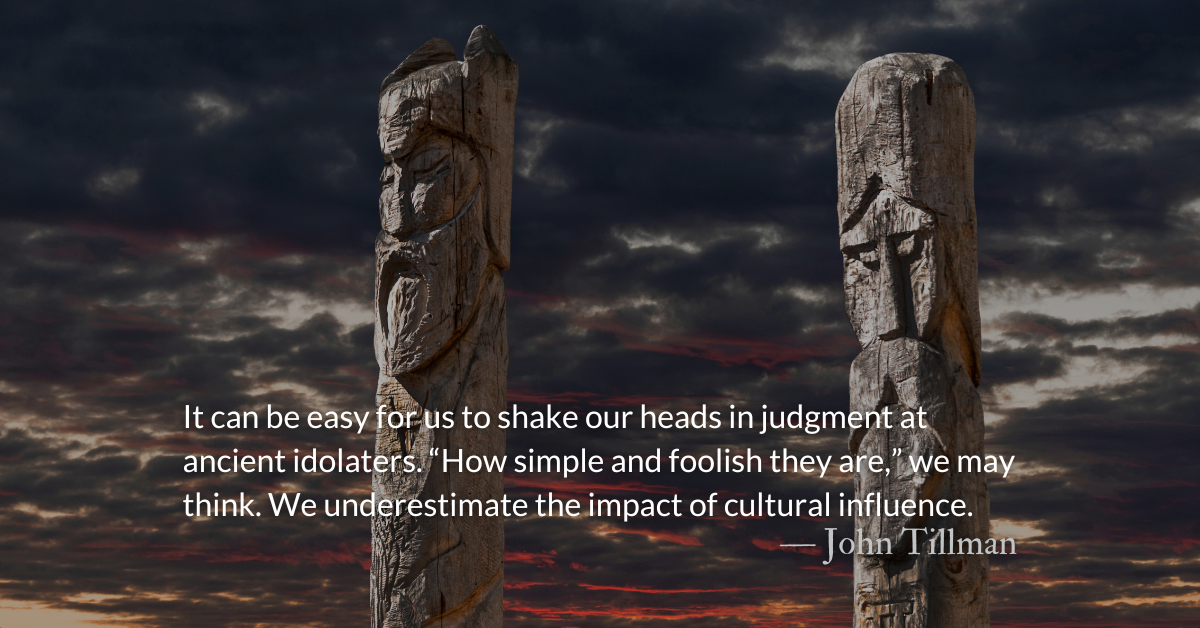
It can be easy for us to shake our heads in judgment at ancient idolaters. “How simple and foolish they are,” we may think. We underestimate the impact of cultural influence.

”Everyone is doing it” only seems lame when you don’t have to live among the “everyone.” Children say “everyone is doing it” to their parents. Parents don’t live among their children’s “everyone” and so dismiss it as foolish. When children challenge their parents about adult behaviors, parents respond with the same answer, “everyone is doing it.”

We find it easy to not worship a fertility god who guarantees good crops because we aren’t farmers living in a culture in which everyone around us is doing it. (Instead, we live in a culture that believes “knowledge is power” and we are all addicted to streams of content, articles, feeds, news channels… “Everyone is doing it.”)

We underestimate the cultural influence that we are under. Some who are baked in the culture of western Christianity THINK they operate from neutral theological and cultural ground but our culture’s yeast is worked all through our dough. Culture can greatly influence our theology and the way we live out our faith. It is hubris to think otherwise. 

Why do we worship God? So that we may not fall prey to lions? So that our kings may not be conquered? So that we can dwell in the land in peace? Selfishness and power can’t grow faith.

Assyria conquered the land but couldn’t enforce worship. We also will fail to force others to faith. Faith cannot be crushed, no matter how powerful the government, but it can’t be forced either. It must grow on its own. All we can do is plant seeds like the priest and pray that God will make them grow.

Divine Hours Prayer: The Greeting

With my whole heart I seek you; let me not stray from your commandments. — Psalm 119.113


– From The Divine Hours: Prayers for Autumn and Wintertime by Phyllis Tickle.

Read more: Come Out of Captivity

We are not beyond hope. His arm is not too short to save. Come out of captivity to cultural idols and into the light.

Consider Supporting Our Work

Donors keep our ad-free biblical devotionals flowing to inboxes across the world. Help us do more by becoming a donor today.

Vassals Become Vessels

Links for today’s readings:

Nov 3  Read: 2 Kings 16 Listen: (3:46) Read: Psalms 68 Listen: (4:26)

Scripture Focus: 2 Kings 16.14-18

14 As for the bronze altar that stood before the Lord, he brought it from the front of the temple—from between the new altar and the temple of the Lord—and put it on the north side of the new altar. 15 King Ahaz then gave these orders to Uriah the priest: “On the large new altar, offer the morning burnt offering and the evening grain offering, the king’s burnt offering and his grain offering, and the burnt offering of all the people of the land, and their grain offering and their drink offering. Splash against this altar the blood of all the burnt offerings and sacrifices. But I will use the bronze altar for seeking guidance.” 16 And Uriah the priest did just as King Ahaz had ordered. 17 King Ahaz cut off the side panels and removed the basins from the movable stands. He removed the Sea from the bronze bulls that supported it and set it on a stone base. 18 He took away the Sabbath canopy that had been built at the temple and removed the royal entryway outside the temple of the Lord, in deference to the king of Assyria.

Reflection: Vassals Become Vessels

By John Tillman

Assyria, the world’s first superpowered empire, was growing.

Judah’s neighbors, Israel and Aram, pressured Judah’s king, Ahaz, to join them in resisting Assyria. When he would not, they conspired to replace him as king and attacked him. As Isaiah promised Ahaz, the coup collapsed. (Isaiah 7.2-7) However, Ahaz failed to follow Isaiah’s advice and stand firm in his faith.

Rather than resist Assyria, Ahaz chose appeasement. Forsaking God’s promise through Isaiah, Ahaz forged an alliance with Assyria to protect himself from his neighbors. To pay Assyria for this protection, Ahaz stripped the temple of gold, silver, and bronze. When visiting Tiglath-Pileser as his newest vassal, Ahaz saw an Assyrian altar and had a copy of it built for the temple in Jerusalem. As a vassal of Assyria, Judah became a vessel for Assyrian ways, worship, and corruption.

First, Ahaz placed the Assyrian altar in front of the altar of God, between it and the temple’s entrance. Then Ahaz moved God’s altar to one side, out of its place. Ahaz instructed the priest to offer sacrifices on the new Assyrian altar, but kept God’s altar for “seeking guidance.” Ahaz not only sidelined Yahweh’s altar, he also worshiped Assyrian gods and sacrificed his son to them. Ahaz distorted and corrupted the temple “in deference to” the Assyrian king. He eventually shuttered the temple and filled the city with altars to many gods. (2 Chronicles 28.24-25) Ahaz’s kingdom and temple became indistinguishable from Assyria.

We are not kings like Ahaz, and the powers of the world rarely threaten us like an empire. Sometimes they woo us like algorithms, seduce us like sins, numb us like drugs, deceive us like politicians, or corrupt us like wicked or reckless friends.

When such powers of the world approach us, it is dangerous for us to choose appeasement. Appeasement soon becomes approval, and approval soon becomes adoption.

Have we become vassals of worldly powers (cultural or political) and vessels of their ways? Have we sidelined part of our theology to center the priorities of powerful allies? Does our deference to powerful forces erase the difference between us and them?

We must not be conformed to or discipled by worldly powers or leaders. (Romans 12.2) Rather than showing deference, we must demonstrate our difference. 

Let us stand firm in our faith, using winsome persuasion, determined persistence, and uncompromising principles to distinguish ourselves and defend our neighbors from the world’s powers.

Divine Hours Prayer: The Request for Presence

“New Day”, by David Adam

This new day you give to me

From your great eternity

This new day now enfold

Me in your loving hold

You are the star of the morn

You are the day newly born

You are the light of our night

You are the savior by your might

God be in me this day

God ever with me stay

God be in the night

Keep us by thy light

God be in my heart

God abide, never depart

– From The Divine Hours: Prayers for Autumn and Wintertime by Phyllis Tickle.

Read more: Kingdoms Breaking Bad

As Israel fractures, each dynasty hopes to be the answer. But each one, especially in the northern kingdom, “breaks bad.”

Consider Supporting Our Work

Our work needs more support from people just like you. Please consider becoming a donor.

Anticipated Surprises — Readers’ Choice


Readers’ Choice is here: Over two-thirds of our devotionals get emailed responses from readers like you. Hearing that what we have written is meaningful to you is meaningful to us. That’s why we love sharing some of your comments and messages. Thank you, readers. We do what we do to serve you. There’s still time to tell us about your favorite, most meaningful posts of the year. If you shared it with someone, or it helped you, let us know via email, direct message, or by filling out the linked form.

Links for today’s readings:

Oct 31  Read: 2 Kings 13 Listen: (4:33) Read: Psalms 62-63 Listen: (2:44)

Links for this weekend’s readings:

Nov 1   Read: 2 Kings 14 Listen: (5:06) Read: Psalms 64-65 Listen: (2:39)
Nov 2   Read: 2 Kings 15 Listen: (6:21) Read: Psalms 66-67 Listen: (2:42)

Readers’ Choice posts are selected by our readers:

Brian, DC — Thanks for this reflection. I love beautiful surprises sent by The Almighty to me and my family…Thanks again for this wonderful reminder of how God works among us.

Like last year, we will repost all Christmas-themed Readers’ Choice posts together in one week. We pray our hearts are prepared to make room for Christ this coming Advent season. This post was originally published on December 4, 2024, based on readings from Esther 5.5-9 and Luke 1.45.

Scripture Focus: Esther 5.5-9

5 “Bring Haman at once,” the king said, “so that we may do what Esther asks.” 

So the king and Haman went to the banquet Esther had prepared. 6 As they were drinking wine, the king again asked Esther, “Now what is your petition? It will be given you. And what is your request? Even up to half the kingdom, it will be granted.” 

7 Esther replied, “My petition and my request is this: 8 If the king regards me with favor and if it pleases the king to grant my petition and fulfill my request, let the king and Haman come tomorrow to the banquet I will prepare for them. Then I will answer the king’s question.” 

9 Haman went out that day happy and in high spirits. But when he saw Mordecai at the king’s gate and observed that he neither rose nor showed fear in his presence, he was filled with rage against Mordecai

Luke 1.45

45 Blessed is she who has believed that the Lord would fulfill his promises to her!

Reflection: Anticipated Surprises — Readers’ Choice

By John Tillman

Esther and Mary know about anticipation. What are you anticipating?

There’s a lot of anticipatory tension in Esther’s story. After Xerxes’s edict, the Jews anticipated a day of destruction decreed a year in the future. After prayer and fasting, Esther entered the king’s presence uninvited and waited, anticipating his decision to spare or take her life. “If I perish, I perish.” (Esther 4.16)

When spared, Esther did not pour out her request immediately, but made Xerxes wait. He anticipated her request at two banquets she invited him and Haman to attend. 

It’s unclear why Esther delayed. It could have been fear or hesitation, but it seems more likely to be strategic. Xerxes appears rash (Esther 1.12), forgetful (Esther 6.3), negligent (Esther 4.11), and easily manipulated throughout the story. It is likely that Esther knew this and used anticipation to allow him to remember her charms and renew his affection for her.

Meanwhile, Haman also anticipated. Haman’s mind spun with selfish visions as he bragged about his growing power and closeness to Xerxes and the queen. But he was not content to anticipate good things for himself, Haman relished thoughts of torturing Mordecai, who he viewed as an enemy.

Haman had good reasons to anticipate his victories. Esther had good reasons to fear her defeat. We are not wrong to anticipate that the powerful will continue to abuse power and that violence will continue to be wielded against the weak. We are not wrong to expect the world to be wicked and our lot to include suffering but we are also not wrong to anticipate with hope the unlikely victories that God’s providence arranges.

Every wicked thing Haman anticipated was reversed and he became the victim of every device of torture he set up. Every wicked thing Esther feared was reversed and she became the victor over every scheme set against her. Our enemy anticipates our defeat but God loves turning anticipated losses into unanticipated victories.

God loves a surprise ending, like Esther’s. God also loves a surprise beginning, like Mary’s. Mary didn’t anticipate unwed pregnancy, uninvited shepherds and magi, or fleeing to exile in Egypt. There were many surprises of Jesus’ life in which anticipated doom was overcome by unanticipated hope.

God has unanticipated goodness ready to overturn anticipated failures, hurts, and sorrows. Anticipate surprises. Resurrection is the ultimate surprise ending God has promised. Set your hope on both the sure promises and the unanticipated blessings of God.

The Lord’s Prayer:

We will take a break from The Divine Hours prayers for the month of October and instead pray Dallas Willard’s paraphrase of The Lord’s Prayer:

Dear Father, always near us, may your name be treasured and loved, may your rule be completed in us—may your will be done here on earth in just the way it is done in heaven.

Give us today the things we need today, and forgive us our sins and impositions on you as we are forgiving all who in any way offend us.

Please don’t put us through trials, but deliver us from everything bad. Because you are the one in charge, and you have all the power, and the glory too is all yours-forever-which is just the way we want it!

Read more about Supporting Our Work

Please consider a monthly gift to support our ad-free biblical content. We can’t do what we do without what our donors give.

Read more about Scandalous Surprise of Hope — The Hope of Advent

Who are we to have such hope as advent promises? That Christ would come to us is baffling, surprising, and to some, scandalous.

Wholeness for the Holidays — Readers’ Choice


Readers’ Choice is here: Over two-thirds of our devotionals get emailed responses from readers like you. Hearing that what we have written is meaningful to you is meaningful to us. That’s why we love sharing some of your comments and messages. Thank you, readers. We do what we do to serve you. There’s still time to tell us about your favorite, most meaningful posts of the year. If you shared it with someone, or it helped you, let us know via email, direct message, or by filling out the linked form.

Links for today’s readings:

Oct 30  Read: 2 Kings 11-12 Listen: (7:38) Read: Psalms 60-61 Listen: (2:27)

Readers’ Choice posts are selected by our readers:

Brian, DC — Thanks for this reflection. I learned about kintsugi from Mako Fujimura when he gave me a tour of his studio years ago. I love the theology of this practice. I agree that looking at something that was broken but is being used again is beautiful. But the practice of kintsugi showcases the brokenness and then renders each crack as a new work of beauty. Such grace, joy, creativity, and redemption.

Like last year, we will repost all Christmas-themed Readers’ Choice posts together in one week. We pray our hearts are prepared to make room for Christ this coming Advent season. This post was originally published on December 9, 2024, based on readings from Isaiah 9.2, 6.

Scripture Focus: Isaiah 9.2, 6

2 The people walking in darkness
    have seen a great light;
on those living in the land of deep darkness
    a light has dawned.

6 For to us a child is born,
    to us a son is given,
    and the government will be on his shoulders.
And he will be called
    Wonderful Counselor, Mighty God,
    Everlasting Father, Prince of Peace.

Reflection: Wholeness for the Holidays — Readers’ Choice

By Erin Newton

The thing about Advent is that it is just a waiting game. We know to wait with hope for Jesus’s birth. We know that we will receive love through him. We know that joy will follow this grand event. But what does the peace of Advent offer us?

What are we hoping to find in peace? The feeling of hopelessness, that’s familiar. The heartache of being unloved, we know what that’s like. The weight of sadness and lack of joy is a regular routine. What is life without peace? It is chaotic, broken, raging, tumultuous, scary, fear-driven, uncertain.

Peace is a noun and, within the original Hebrew context, it came from a verb meaning “wholeness” or “complete.” Peace also carries other connotations such as calmness or freedom from conflict. But in the most basic essence of the term—peace is that which fills all voids.

So when Isaiah proclaims the coming child who is a counselor, deity, and father—he is also a prince of wholeness.

The gift of the season is Someone who makes things whole. He mends tears. He binds wounds. He fills chasms. He makes all that is insufficient sufficient.

There is a Japanese technique for mending broken pottery—kintsugi. Many have seen the beautiful pieces that were formerly broken shards of bowls or plates, delicately repaired using golden lacquer. The gold seams not only repair that which was broken but reinvent the beauty of the vessel. The bowl, albeit beautiful as it was before it was broken, becomes an exquisite piece of artistry in kintsugi.

The peace of Advent is like these mended pots. The peace of God is a promise of mending, repairing, and completing all that was broken or lacking. But it is more than just taking the pieces of our lives and putting them back into working order. The peace of God is reinventing our lives, binding the pieces that make us who we are and then shining the golden rays of Himself amongst the pieces.

Isaiah speaks of the people walking in the darkness, living in deep darkness. But the light breaks through. The radiance of Christ, an infant born in a lowly place, illuminates all that they could not see. It is the wholeness of life and light that overcomes the darkness here.

With the Holy Spirit, we no longer lack anything. The pieces have been spiritually mended. The golden seams are already there.

The Lord’s Prayer:

We will take a break from The Divine Hours prayers for the month of October and instead pray Dallas Willard’s paraphrase of The Lord’s Prayer:

Dear Father, always near us, may your name be treasured and loved, may your rule be completed in us—may your will be done here on earth in just the way it is done in heaven.

Give us today the things we need today, and forgive us our sins and impositions on you as we are forgiving all who in any way offend us.

Please don’t put us through trials, but deliver us from everything bad. Because you are the one in charge, and you have all the power, and the glory too is all yours-forever-which is just the way we want it!

Support Our Work

Many times at the end of the year, funds are low and end-of-year giving is vital to fund the coming year. Donate today to help us in 2026.

https://theparkforum.org/support/

Read more about Truth and Love — Love of Advent

The love we receive and the truth we believe, are to be passed on. John testifies that joy comes from walking in love and truth in this way.

Conflict-Free Holidays — Readers’ Choice

Readers’ Choice is here: Over two-thirds of our devotionals get emailed responses from readers like you. Hearing that what we have written is meaningful to you is meaningful to us. That’s why we love sharing some of your comments and messages. Thank you, readers. We do what we do to serve you. There’s still time to tell us about your favorite, most meaningful posts of the year. If you shared it with someone, or it helped you, let us know via email, direct message, or by filling out the linked form.

Links for today’s readings:

Oct 29  Read:  2 Kings 10  Listen: (6:30) Read: Psalms 58-59 Listen: (3:32)

Readers’ Choice posts are selected by our readers:

Brian, DC — Thanks for this reflection. My father would agree…What a great way for the King of Kings to enter the world.

Like last year, we will repost all Christmas-themed Readers’ Choice posts together in one week. We pray our hearts are prepared to make room for Christ this coming Advent season. This post was originally published on December 10, 2024, based on readings from John 14.26-27.

Scripture Focus: John 14.26-27

26 But the Advocate, the Holy Spirit, whom the Father will send in my name, will teach you all things and will remind you of everything I have said to you. 27 Peace I leave with you; my peace I give you. I do not give to you as the world gives. Do not let your hearts be troubled and do not be afraid.

Reflection: Conflict-Free Holidays — Readers’ Choice

By Erin Newton

Jesus was born during the Pax Romana—the peace of Rome. It was a period between wars and a time of relative prosperity. Peace is nearly always thought of as the antithesis to conflict or war. And the Bible refers to peace as the future hope during the midst of pain and suffering.

When we think about God coming to dwell among us, the peace of Advent usually includes the vision of a conflict-free eternity. It is this Prince of Peace who brings the promise to eliminate combat and end all struggles.

We long for the days without strife and without war. It is an age-old plea. The psalmist cries out, “Too long have I lived among those who hate peace. I am for peace; but when I speak, they are for war” (Ps. 120.6-7).  

Not only does peace bring us wholeness, it is meant to bring us freedom from conflict. But that is far from reality. We enter this Advent season with wars raging across the oceans, conflicts brewing among friends and family, war and strife growing between neighbors—we are a far cry from peace it seems.

The baby lying in a manger would become a man who warned that peace would not always be reality. The cost of following Christ may mean division among friends, families, and neighbors. It is the sword that He warned was coming to disrupt so-called peace. Sometimes the conflict we face is because we have chosen to follow Christ, and the so-called peace of our world was simply a dishonest harmony.

So how do we wait this week meditating on the peace of Advent? I think we look to Christ’s birth as the inauguration of the future peace. It is the “already but not yet” peace we are promised. The gears are set in motion even when the grinding clamor of war reverberates worldwide. The first peace to be won was that within our souls. And it continues to win the war of souls.

And then we see the peace he has left with us. The peace he promised would be with us is a non-earthly peace, peace mediated through the Holy Spirit. Yes, national wars and domestic battles continue today. But peace is possible through the power of the Holy Spirit. It is by His power we can seek peace, and sometimes, win peace. Let us seek peace and wait expectantly.

The Lord’s Prayer:

We will take a break from The Divine Hours prayers for the month of October and instead pray Dallas Willard’s paraphrase of The Lord’s Prayer:

Dear Father, always near us, may your name be treasured and loved, may your rule be completed in us—may your will be done here on earth in just the way it is done in heaven.

Give us today the things we need today, and forgive us our sins and impositions on you as we are forgiving all who in any way offend us.

Please don’t put us through trials, but deliver us from everything bad. Because you are the one in charge, and you have all the power, and the glory too is all yours-forever-which is just the way we want it!

Read more about The Arm of Flesh versus the Prince of Peace

How can we tell the difference between Sennacherib’s propaganda and Hezekiah’s true faith?

Support Our Work

Without our donors, our work could not continue as it does today. Please consider becoming a donor and supporting our ad-free content.