Rats in the Cellar :: A Lenten Reflection

By C.S. Lewis (1898-1963)

We begin to notice, besides our particular sinful acts, our sinfulness; begin to be alarmed not only about what we do, but about what we are. This may sound rather difficult, so I will try to make it clear from my own case.

When I come to my evening prayers and try to reckon up the sins of the day, nine times out of ten the most obvious one is some sin against charity; I have sulked or snapped or sneered or snubbed or stormed.

And the excuse that immediately springs to my mind is that the provocation was so sudden and unexpected; I was caught off my guard, I had not time to collect myself. Now that may be an extenuating circumstance as regards those particular acts: they would obviously be worse if they had been deliberate and premeditated.

On the other hand, surely what a man does when he is taken off his guard is the best evidence for what sort of a man he is. Surely what pops out before the man has time to put on a disguise is the truth. If there are rats in a cellar you are most likely to see them if you go in very suddenly. But the suddenness does not create the rats: it only prevents them from hiding. Apparently the rats of resentment and vindictiveness are always there in the cellar of my soul.

Now that cellar is out of reach of my conscious will. I can to some extent control my acts: I have no direct control over my temperament. And if what we are matters even more than what we do—if, indeed, what we do matters chiefly as evidence of what we are—then it follows that the change which I most need to undergo is a change that my own direct, voluntary efforts cannot bring about.

And this applies to my good actions too. How many of them were done for the right motive? How many for fear of public opinion, or a desire to show off? How many from a sort of obstinacy or sense of superiority which, in different circumstances, might equally have led to some very bad act?

But I cannot, by direct moral effort, give myself new motives. After the first few steps in the Christian life we realize that everything which really needs to be done in our souls can be done only by God.

*Abridged from C.S. Lewis’, Mere Christianity.


Today’s Reading
Job 34  (Listen – 3:26)
2 Corinthians 4 (Listen – 3:02)
Christ’s Passion :: A Lenten Reflection

The depth of Christ’s humiliation is astonishing. His life was marked by radical marginalization and poverty; he was born a political refugee, grew up a subsistence-level worker, and died homeless and possessionless.

If we believe Christ suffered because he wants us to emulate his example, our lives will be known for their striving and either frustration (for failing) or pride (for succeeding on our own power). Fortunately the New Testament paints a different picture.

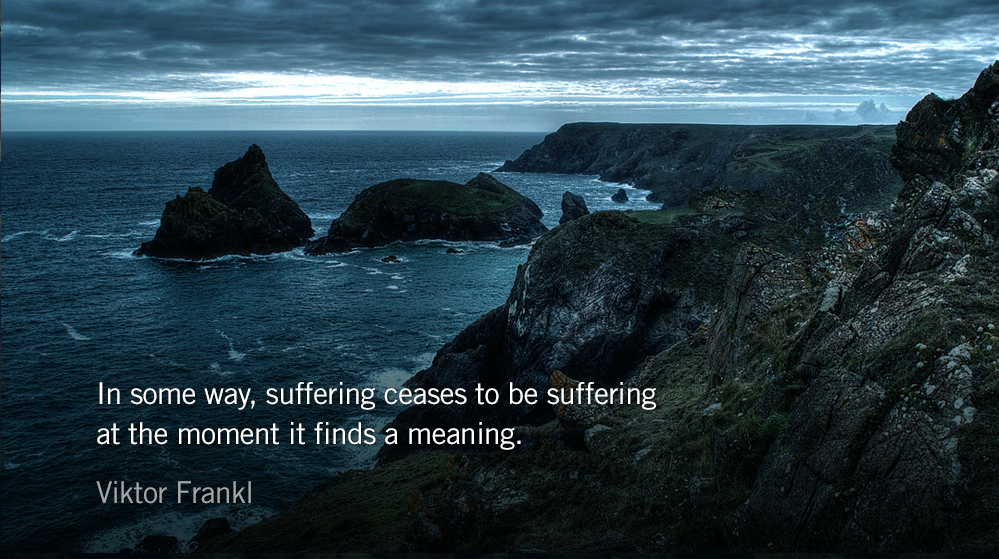
Viktor Frankl observed, “In some way, suffering ceases to be suffering at the moment it finds a meaning.” No stranger to suffering, Dr. Frankl was a psychotherapist who willingly stayed in Austria and endured the holocaust. Of his time in the concentration camp, he wrote, “There was no need to be ashamed of tears, for tears bore witness that a man had the greatest of courage, the courage to suffer.”

This way of understanding suffering demonstrates why Christians have, for centuries, referred to Christ’s suffering as his passion. In modern culture passion is defined as powerful feelings or interest. The historic word comes from the Latin, pati: to suffer.

Following a true passion is a journey of suffering defined not by the intensity of positive emotion, but the willingness to endure for a greater reality. Most people do not miss out on their passions because they have been held back from expressing emotion or desire, but because they were unwilling to courageously place their faith outside of themselves.

It is only through dying to ourselves and placing our passion in Christ that we truly live. It is Christ’s love born in us that gives us hope and a future—never more than in suffering. “Love is the ultimate and the highest goal to which man can aspire,” reflected Dr. Frankl. Reflecting on his time in the concentration camp, he concludes:

The salvation of man is through love and in love. I understood how a man who has nothing left in this world still may know bliss, be it only for a brief moment, in the contemplation of his beloved. In a position of utter desolation, when man cannot express himself in positive action, when his only achievement may consist in enduring his sufferings in the right way—an honorable way—in such a position man can, through loving contemplation of the image he carries of his beloved, achieve fulfillment. For the first time in my life I was able to understand the meaning of the words, ‘The angels are lost in perpetual contemplation of an infinite glory.’


Today’s Reading
Job 33 (Listen – 3:00)
2 Corinthians 3 (Listen – 2:25)

Christ’s Humiliation :: A Lenten Reflection

“Christ was subject to great humiliation in his private life at Nazareth,” writes Jonathan Edwards. While many of us can appreciate a great high priest who can “sympathize with our weaknesses,” the grittiness of this reality can escape us.

Edwards, the great theologian, writes of the daily toil of Christ’s vocation in Nazareth:

He there led a servile, obscure life, in a mean, laborious occupation; for he is called not only the carpenter’s son, but the carpenter. By hard labor he earned his bread before he ate it, and so suffered that curse which God pronounced on Adam; “By the sweat of your face you shall eat bread.”

Let us consider how great a degree of humiliation the glorious Son of God, the Creator of heaven and earth, was subject to in this—that for about thirty years he should live a private obscure life among laboring men, and all this while be overlooked, not taken notice of in the world, more than other common laborers.

Christ’s humiliation in some respects was greater in private life than in the time of his public ministry. The first thirty years of his life he spent among ordinary men, as it were in silence. There was not any thing to make him to be taken notice of more than any ordinary mechanic.

In fasting we forego a luxury in order to better understand our desires and better experience the only one who can truly satisfy. The sacrifice of fasting is our way of entering into the footsteps of Christ who, “though he was rich, yet for your sake he became poor.” Edwards reflects on the fulfillment of Christ’s love, even as he was subjected to the pangs of earthly brokenness:

He suffered great poverty, so that he had no where to lay his head. So that what was spoken of Christ, “My head is filled with dew, and my locks with the drops of the night,” was literally fulfilled. And through his poverty he was doubtless when tried with hunger, thirst, and cold.

Christ had no land of his own, though he was possessor of heaven and earth; and therefore was buried by Joseph of Arimathea’s charity, and in his tomb, which Joseph had prepared for himself.

Christ being thus brought under the power of death, continued under it till the morning of next day but one. Then was finished that great work, the purchase of our redemption, for which such great preparation had been made from the beginning of the world.


Today's Reading
Job 32 (Listen – 2:12)  
2 Corinthians 2 (Listen – 2:13)

Shattering Selfishness :: A Lenten Reflection

At some point we become seduced into believing our life, dreams, and work are the most significant and complex things going in the world. Though we would never admit such things, it’s only a matter of time before this belief yields a near-overwhelming concern that God cannot handle things so complicated without our guidance.

Soon our prayers are dominated by a grasping for control and longing for success. With each circumstance beyond our control we resolve ourselves to refocus—not realizing this only deepens our commitment to ourselves. Kierkegaard warns:
It is the Spirit who gives life. The life-giving Spirit is not a direct heightening of our natural powers—what blas­phemy! How horrible to understand the Spirit in this way!

Christianity teaches that you must die. Your power must be dismantled. The life-giving Spirit—that is the invitation. Who would not willingly take hold of it? But die first—there’s the rub!
Each of us can go along, dedicating our lives to pursuing our dreams or fleeing our failures—both will catch up and crush us. The invitation of Christ is to abandon ourselves—to dispense with our successes and aspirations as well as our failures and shortcomings—for the transcendent love and grace of God. Kierkegaard concludes:
You must first die to every earthly hope, to every merely hu­man confidence. You must die to your selfishness, and to the world, because it is only through your selfishness that the world has power over you.

What, exactly, does it mean to die to yourself? It is more than not seeing your wish fulfilled or to be deprived of the one that is dearest to you. True, this is painful enough, and selfishness is wounded. But it does not follow that you are dying. No, but personally to shatter your own fulfilled desire, personally to de­prive yourself of the dearly desired one who is now your own: this is what it means to wound selfishness at the root.

Christianity is not what we are all too eager to make it. Christianity waits before it applies its remedy. This is Christianity’s severity. It demands a great sacrifice, one which we often despair of making and can only later see why it was necessary to hold out and wait.

Today’s Reading
Job 31 (Listen – 4:16)
2 Corinthians 1 (Listen – 3:52)

Take and Eat :: A Lenten Reflection

The image of Scripture as food is never more vivid than in the season Lent. “Man shall not live by bread alone, but by every word that comes from the mouth of God,” said Jesus. The offer had been extended to Christ: quench your material longings by your own ability. Jesus’ reply?In the end, that wouldn’t satisfy my deepest longings.

But how are we satisfied by the word of God? The basic metaphor of Scripture as nourishment demonstrates Christ’s expectation that we would not simply intake his word, but digest it. It is through daily meditation that we carry the word of God with us—breaking down the whole into discrete parts which can be processed into our thinking and habits.

Philosopher Søren Kierkegaard wrote that this action—carrying and integrating the word of God—is what separates real faith from false religion:

Genuine faith is never satisfied with the religious way of doing things – Sabbath worship or an hour or a half-hour of each day. Christianity is nothing else but faith right in the middle of actual life and weekdays. But we have reduced it to quiet hours, thereby indirectly admitting that we are not really being Christians. That we should have quiet times to think about God – this seems so elevated and beautiful, so solemn. It is so hypocritical, because in this way we exempt daily life from the authentic worship of God.

Yet this process activates our heart’s defense mechanisms. Kierkegaard confronts our refined ways of avoiding this tension:

The matter is quite simple. The Bible is very easy to under­stand. But we Christians are a bunch of scheming swindlers. We pretend to be unable to understand it because we know very well that the minute we understand we are obliged to act accord­ingly. Take any words in the New Testament and forget every­thing except pledging yourself to act accordingly. My God, you will say, if I do that my whole life will be ruined. How would I ever get on in the world?

Nourishment is incomplete until food is converted to energy—faith to action. Truly our lives are transformed through the food of God’s word; our potential for flourishing is unlocked through its nourishment. It is our desire to maintain control over our lives, Kierkegaard warns, that keeps us from living by every word from the mouth of God; “Dreadful it is to fall into the hands of the living God. Yes, it is even dreadful to be alone with the New Testament.”

Today’s Reading
Job 30 (Listen – 3:14)
1 Corinthians 16 (Listen – 2:54)

Show Buttons
Hide Buttons
Spur a spiritual rhythm of refreshment right in your inbox
By joining this email list you are giving us permission to send you devotional emails each weekday and to communicate occasionally regarding other aspects of the ministry.
100% Privacy. We don't spam.