
Anticipating His Advent

From John:
As we move into the season of Advent (the first Sunday of Advent is this weekend) we prepare our hearts with this devotional from our latest guest writer, Dena Dyer. You can connect with Dena and find out more about her writing at her Facebook page. Dena also has a prayer journal available for Christmas, called The Colors of Christmas—a prayer journal.

Reflection: Anticipating His Advent
By Dena Dyer

The people of Israel had not heard from their prophets in over 400 years. In the midst of cruel taxation laws and heavy religious burdens, the long-awaited Messiah became a distant hope, a flicker of promise almost extinguished by doubt and fatigue.

Then a star appeared over a smelly manger in Bethlehem, and rumors began to surface about a child-king who’d been born to a poor man from Nazareth and his young bride. Angels sang to sweaty shepherds, who bowed in worship at a trough housing a promise kept. Some Jews—such as Anna, Simeon, and Elizabeth–worshipped; others stayed mired in confusion.

Thirty long years passed before Jesus began his public ministry. He healed the infirm, emptied graves, and forgave sins. And still, doubts persisted. After a very public trial, crucifixion, and resurrection, thousands of skeptics believed.

Even so, many people still await the Messiah.

Because we as humans are temporal beings in an ever-decaying world, we have a hard time waiting. We have an even more difficult time believing in promises.

My youngest son has prayed like this for years: “God, I hope that Dad has a good day at work. I hope I can go to Morgan’s this weekend. I hope Uncle Marty’s cancer gets better.”

I wondered whether I should correct him when he said “hope,” because I was only familiar with the Webster’s Dictionary definition: “to want something to happen or be true and think that it could happen or be true.”

Then I learned the biblical definition of hope. In the Old Testament, hope is often translated from the Hebrew word yachal meaning “trust.” In the New Testament, the word hope is used for elpis, which can be translated “to expect or anticipate with pleasure.”

Therefore, hope–in the biblical sense–equals trust and faith. Paul wrote in Romans 8:24-25, “In this hope we were saved. Now hope that is seen is not hope. For who hopes for what he sees? But if we hope for what we do not see, we wait for it with patience.”

As our world groans from injustice, terrorism, and catastrophe; as we slog through financial and familial stress, job changes, and health crises; as our children face temptations we could have never imagined—let’s not forget that we trust in what we do not see.

Let’s wait for Jesus with patience, encouraging one another to expect and anticipate with pleasure his second Advent, when he will set all things right.

Let’s wait in peace.

Do you find waiting difficult? Why or why not?
Have you ever lost hope in a certain situation?
Has God given you scripture or people to encourage you to expect and anticipate the fulfillment of God’s promises? Spend some time thanking him.

PRAYER:
My spirit grows weak at the thought of my children inheriting a world that we haven’t stewarded well…a faith that we haven’t lived out the way we should. Father, you’re our hope and peace. You can comfort us with your presence and your word. Let us not neglect it, or you, when we are afraid, but instead run to you with open minds and hearts. And Jesus? Thank you for your ridiculous love. Give me assurance that you are still at work in this world

*This devotional was originally posted as a part of The High Calling devotional series.

Prayer: The Call to Prayer
Search for the Lord and his strength; continually seek his face.— Psalm 105:4

– Prayer from The Divine Hours: Prayers for Autumn and Wintertime by Phyllis Tickle.

Prayers from The Divine Hours available online and in print.

Today’s Readings
Micah 5 (Listen – 2:21)
Luke 14 (Listen – 4:36)

This Weekend’s Readings
Micah 6 (Listen – 2:28) Luke 15 (Listen – 4:19)
Micah 7 (Listen – 3:36) Luke 16 (Listen – 4:27)

Additional Reading
Read More from Dena on Under His Covering
The wise men gave three presents to the baby Jesus, but God also gave three presents to Mary. He gave her the Messiah, but he also granted her joy and peace.

Read More from Origen on Prayer from the Belly of the Beast
Souls that have long been barren but have become conscious of their intellects’ sterility and the barrenness of their mind, through persevering prayer have conceived of the Holy Spirit and given birth to thoughts and words of salvation full of contemplated truth.  — Origen

Support our Work
Each month over 22,000 Park Forum email devotionals are read around the world. Support our readers with a monthly or a one time donation. 

The Losers Who Write History

Jeremiah 26.16-19 (quoting Micah 3.12)
Then the officials and all the people said to the priests and the prophets, “This man should not be sentenced to death! He has spoken to us in the name of the Lord our God.”

Some of the elders of the land stepped forward and said to the entire assembly of people, “Micah of Moresheth prophesied in the days of Hezekiah king of Judah. He told all the people of Judah, ‘This is what the Lord Almighty says:

“‘Zion will be plowed like a field,
Jerusalem will become a heap of rubble,
the temple hill a mound overgrown with thickets.’

“Did Hezekiah king of Judah or anyone else in Judah put him to death? Did not Hezekiah fear the Lord and seek his favor? And did not the Lord relent, so that he did not bring the disaster he pronounced against them? We are about to bring a terrible disaster on ourselves!”

Reflection: The Losers Who Write History
By John Tillman

In our passage today we read a prophecy from Micah that was quoted as precedent in defense of the prophet Jeremiah at least 80 years later.

Micah prophesied during the time of Hezekiah, one of the few kings of Judah who obeyed God and lived righteously. Yet even under a “good” king Micah spoke of the leaders of Judah when he said, “Therefore because of you, Zion will be plowed like a field, Jerusalem will become a heap of rubble, the temple hill a mound overgrown with thickets.”

Micah, it seems, lived in a time when dissent was not considered unpatriotic disloyalty. Hezekiah, listened, repented, and the prophesied disaster was, seemingly, averted. In reality it was only delayed, like Hezekiah’s prophesied death.

Jeremiah, by contrast, lived during the last gasps of a failing kingdom, amidst an evil generation and a corrupt government. There were still some who stood up to prevent the silencing of dissenting voices. But eventually, Jeremiah was killed in exile for his continued “unpatriotic” messages.

It has been said that winners write history books, but in the case of the Bible, that is decidedly not true. Scripture, especially when it comes to the prophets, passes the microphone to the losers of history.

There were prophets other than the ones in the canon of scripture. Micah mentions them in his writing. They sided with powerful kings, predicted good things to get a financial benefit, and spread the king’s vision of the country’s future instead of God’s.

From the standpoint of the time, these powerful, wealthy prophets were the winners. Yet, not one of those glowingly positive, king-praising prophets’ writings are in our Bible. Instead we have the writings of the losers. The cries of the oppressed. The letters from those imprisoned in the Concord jails, and Birmingham jails of Judah and Israel and often letters from those killed.

The same Jesus who wept over “Jerusalem, who kills the prophets” was also not afraid to utilize biting sarcasm on the topic, saying, “surely no prophet can die outside Jerusalem!”

Jesus also condemned the religious leaders who decorated the prophet’s tombs. He recognized that when we venerate prophets, we are often just venerating ourselves by proxy—envisioning ourselves in their role.

May we learn to listen to “losers” and learn what God may say through them.
May we learn to recognize ourselves as the audience of the prophets, not the prophets themselves.
May we learn from dissenting voices, testing every “prophecy” against scripture

Prayer: The Refrain for the Morning Lessons
I will bear witness that the Lord is righteous; I will praise the Name of the Lord Most High  — Psalm 7:18

– Prayer from The Divine Hours: Prayers for Autumn and Wintertime by Phyllis Tickle.

Prayers from The Divine Hours available online and in print.

Today’s Readings
Micah 3 (Listen – 1:51)
Luke 12 (Listen – 7:42)

Additional Reading
Read More about How to Read Prophetic Judgment :: Readers’ Choice
The best way to read prophecy is to imagine yourself not as the speaker, but as the spoken to.

Read More about Decorating the Tombs of the Prophets
The most difficult thing about following a risen and reigning prophet, priest, and king, is that he will not leave us alone. He will keep bugging us.

Support our Work
Each month over 22,000 Park Forum email devotionals are read around the world. Support our readers with a monthly or a one time donation. 

The Gospel is an Uprising

Micah 2.13
The One who breaks open the way will go up before them;
they will break through the gate and go out.
Their King will pass through before them,
the Lord at their head.”

Luke 11.20-22
But if I drive out demons by the finger of God, then the kingdom of God has come upon you. “When a strong man, fully armed, guards his own house, his possessions are safe. But when someone stronger attacks and overpowers him, he takes away the armor in which the man trusted and divides up his plunder.

Reflection: The Gospel is an Uprising
By John Tillman

The word translated “resurrection” is anastasis. It is a common term. It is used for individual resurrection events, such as the resurrections of Jairus’s daughter, of Lazarus, and of Jesus himself. It also refers to the ultimate resurrection event to come at the end of time.

The depictions of Christ in today’s readings relate strongly to a traditionally Eastern Christian visualization of this ultimate resurrection that translates anastasis more literally as “Uprising.”

These artworks depicting Christ’s resurrection step outside of time and geography to show Christ exiting the doors of Hell itself, literally breaking open the gates. He is often depicted stepping upon Death, as he leads by the hand Adam, Eve, and others of the faithful dead.

The Anastasis—the Uprising—is the great jailbreak of God.

The Uprising is a visualization of Christ’s resurrection gleaned less from gospel accounts than from multiple sources throughout scripture, including our passage today in Micah, where Christ is “the One who breaks open the way,” gathering captives together and smashing through the gates holding them back, and our passage from Luke, where Christ portrays himself as a violent thief, breaking in to the house of the strong man, Satan, destroying his defenses, and plundering his possessions.

The Anastasis can be interpreted as an Eighth Day occurrence, an event occurring outside of time. But it can also be understood as “already and not yet.” It is both completed in the past, coming in the future, and happening now, in our midst.

Our ultimate freedom may be in the future, but Christ is still the strong man, standing ready to liberate us today as he did the many demoniacs in scripture. We may not suffer in the same way they did but aren’t we still impaired as many of them were?

Aren’t we at times mute when we should speak truth into the lives around us?
Don’t we at times throw ourselves into the fires of judgment rather than accept Christ’s grace?
Don’t we at times harm others and ourselves in our rage?

What sins are you blind to? What cries for help are you deaf to? What injustice leaves you mute, unwilling to speak?

May Jesus, the strong man, the liberator, free us to see, to hear, and to speak.
May he kick open the gates of what paralyzes us and lead us out to do his work in the world.

May we join the Uprising.

Prayer: The Call to Prayer
God has gone up with a shout, the Lord with the sound of the ram’s horn.  — Psalm 47:5

– Prayer from The Divine Hours: Prayers for Autumn and Wintertime by Phyllis Tickle.

Prayers from The Divine Hours available online and in print.

Today’s Readings
Micah 2 (Listen – 2:11)
Luke 11 (Listen – 7:33)

Additional Reading
Read More about The Eighth Day
Peter encourages his readers about Christ’s second coming with thoughts that closely relate to the Jewish concept of the eighth day that was influential on early Christian belief and practice.

Read More about Freedom for Prisoners :: Epiphany
The Gospel is a jailbreak. Jesus is a thief in the night, robbing the possessions of the strong man, Satan—stealing away with captives who foolishly, yet willingly sold themselves to the debtor’s prison of sin.

Support our Work
Each month over 22,000 Park Forum email devotionals are read around the world. Support our readers with a monthly or a one time donation.

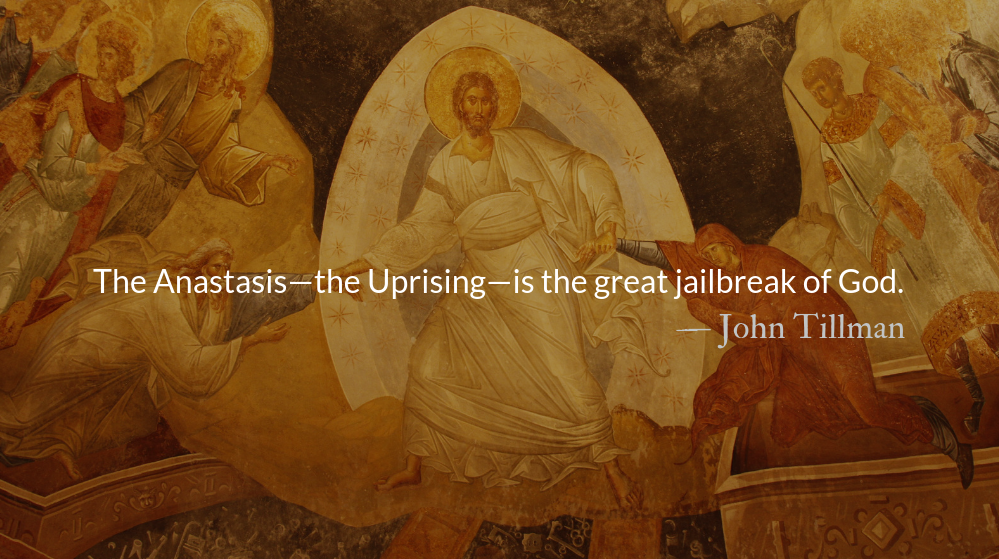
*Image By © José Luiz Bernardes Ribeiro /, CC BY-SA 3.0

One Thing Needed

Luke 10.42
Few things are needed—or indeed only one.

Everybody I know says they need just one thing. Really what they mean is they need just one thing more. — Rich Mullins

Reflection: One Thing Needed
By John Tillman

The Church’s anticipatory season of Advent doesn’t officially begin until December 2nd this year, but our cultural and commercial anticipation of Christmas is in full swing. Parties are being planned. Trees are going up. Lights are being strung.

Christmas is coming.

For some, Christmas seems more ominous than celebratory—like a massive to-do list with an inflexible deadline. With all of the cultural expectations of Christmas, it’s no wonder people push “starting Christmas” earlier and earlier in the year.

If Christmas is about having the perfect meal, with the perfect side-dishes, the perfect guests, the perfect gifts, the perfect decor, the perfect tree, and the perfect decorations, increasing the production timeline makes a lot of sense. But even starting in October, as some do, that’s a lot of perfection for imperfect people to manage in a broken world. It’s a perfect mix for holiday depression and anxiety rather than the peace, comfort, and joy that should be experienced at Christmas.

Martha, the detail oriented disciple, often gets a hard time from preachers who focus on jokes about how uptight she is. We often preach on Martha’s scolding of Jesus about her sister and too rarely preach about Martha’s open declaration that Jesus was the Messiah.

If Martha, in today’s passage is scattered and distracted, the Martha who greets Jesus after her brother’s death is focused with clarity on the “one thing” needed. Martha’s declaration was no trivial thing. Nearby were those who were already plotting Christ’s death and would next be plotting the death of her soon-to-be resurrected brother. Her confession was at the risk of her life.

The one thing that is needed, the better portion that Mary chose and Martha learned to choose under pain of death, is to place ourselves at all costs in the presence of Jesus, our Lord.

Mary and Martha aren’t stereotypes for us to sort ourselves into and excuse our tendencies. We can’t say, “Well, I’m a Mary,” and ignore details. We can’t say, “Well, I’m a Martha,” and ignore relationships. To do so is to dehumanize these women into parables to make us feel better about ourselves.

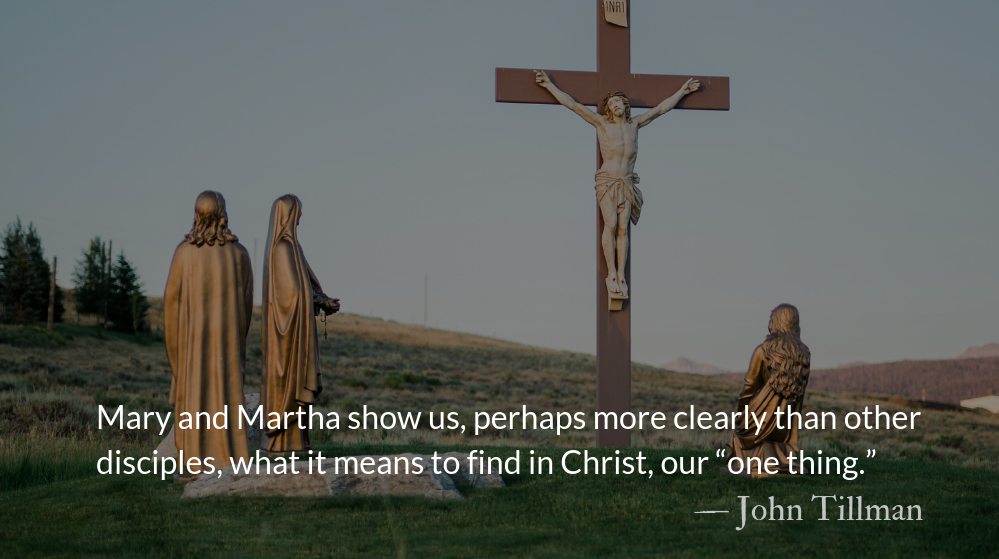
These female disciples each are immature in their own way when we first meet them. But in their final appearances in scripture, they abandon all for Christ, risking financial security, risking reputation, risking their lives to honor him. They show us, perhaps more clearly than other disciples, what it means to find in Christ, our “one thing.”

Prayer: Request for Presence
Protect me, O God for I take refuge in you. I have said to the Lord, “You are my Lord, my good above all other,”  — Psalm 16:1

– Prayer from The Divine Hours: Prayers for Autumn and Wintertime by Phyllis Tickle.

Prayers from The Divine Hours available online and in print.

Today’s Readings
Micah 1 (Listen – 2:46)
Luke 10 (Listen – 8:05)

Additional Reading
Read More about Confessing Christ, Full Grown
It is more difficult to stand before a man who, by inaction, allowed your brother to die and call that man the Messiah, as Martha did.

Read More about The Fragrance of Faith :: Readers’ Choice
Mary of Bethany’s anointing of Christ on his last trip to Jerusalem is intimately connected to the gospel—Christ said that it would be.

Support our Work
Each month over 22,000 Park Forum email devotionals are read around the world. Support our readers with a monthly or a one time donation.
Prayer from the Belly of the Beast

Jonah 2.7-9
“When my life was ebbing away,
I remembered you, Lord,
and my prayer rose to you,
to your holy temple.
“Those who cling to worthless idols
turn away from God’s love for them.
But I, with shouts of grateful praise,
will sacrifice to you.
What I have vowed I will make good.
I will say, ‘Salvation comes from the Lord.

Reflection: Prayer from the Belly of the Beast
By John Tillman

Prayer and thankfulness seem natural around a table of friends and family. But prayer can be even more powerful in the dark places of our lives.

Origen, writing of prayer, speaks of Jonah’s faith that, even though swallowed, as it were, by death, he could be heard by God:

Jonah, because he did not despair of being heard from the belly of the monster that had swallowed him, was able to quit the monster’s belly and complete his interrupted prophet’s mission to the Ninevites. How many things could each of us recount should he choose to recall with gratitude the benefits conferred upon him and to offer praise to God for them!

Let him, moreover, who has learned by experience what manner of monster that which swallowed Jonah typified, if he should ever come to be in the belly of the monster, pray in penitence.

Analogies to the prophet aside, we may not be in the beast’s belly because of wrongdoing, but because our world is filled with beasts. But regardless of how we came to be there, our prayer may be sharpened, amplified, and have greater effect on our hearts. Origen continues:

We know that often fugitives from God’s commands who have been swallowed by death, which at the first prevailed against them, have been saved by reason of repentance from so great an evil, because they did not despair of being able to be saved though already overpowered in the belly of death: for death prevailed and swallowed, and again God took away every tear from every face.

If you have not been there yet, sooner or later we all experience the belly of the beast—sinking in the darkest hole of our lives, in deepest, grave-like depression. In the belly of the beast and in the grip of death, we can, as Jonah did, find in prayer what we could not find with our feet on solid ground.

As Origen says, “Souls that have long been barren but have become conscious of their intellects’ sterility and the barrenness of their mind, through persevering prayer have conceived of the Holy Spirit and given birth to thoughts and words of salvation full of contemplated truth.”

May we find God’s love. May we find courage. May we find purpose. May we find God, waiting there for us. Ready to wipe our tears and carry us onward.

Prayer: Request for Presence
I have said to the Lord, “You are my God;” listen, O Lord, to my supplication  — Psalm 97:9

– Prayer from The Divine Hours: Prayers for Autumn and Wintertime by Phyllis Tickle.

Prayers from The Divine Hours available online and in print.

Today’s Readings
Jonah 2 (Listen – 1:20)
Luke 7 (Listen – 7:14)

This Weekend’s Readings
Jonah 3 (Listen – 1:31) Luke 8 (Listen – 8:09)
Jonah 4 (Listen – 1:56) Luke 9 (Listen – 8:05)

Additional Reading
Read More about Praise in the Midst of Trouble :: A Guided Prayer
A common note ringing from scripture is praise—most particularly praise from those in the midst of, and not yet rescued from trouble.

Read More about about Prayer for Those who Suffer
Bonhoeffer, who suffered for years in Nazi prisons, is both comforted and sobered by this reality: “Only God can help. But then, all our questions must also again and again storm directly against God.”

Support our Work
Each month over 22,000 Park Forum email devotionals are read around the world. Support our readers with a monthly or a one time donation.

Show Buttons
Hide Buttons
Spur a spiritual rhythm of refreshment right in your inbox
By joining this email list you are giving us permission to send you devotional emails each weekday and to communicate occasionally regarding other aspects of the ministry.
100% Privacy. We don't spam.