
Praying for Repentance :: A Guided Prayer

Scripture Focus: 2 Timothy 4.3-4
For the time will come when people will not put up with sound doctrine. Instead, to suit their own desires, they will gather around them a great number of teachers to say what their itching ears want to hear. They will turn their ears away from the truth and turn aside to myths.

Reflection: Praying for Repentance :: A Guided Prayer
By John Tillman

Paul says that the “time will come,” when people will not put up with sound doctrine. He sounds like he is speaking of the future, but it certainly seems as if there were a lot of Paul’s past experiences in Acts that might be described as people not putting up with sound doctrine.

Being stoned, being beaten, being imprisoned, and being run out of town by mobs doesn’t exactly sound like acceptance or tolerance. Doctrinal diligence is needed in every age of the church. Defending correct doctrine is the task Paul is quite seriously commanding Timothy to prepare for. We need to prepare for it too.

But as we think of these people Paul writes of, who will gather teachers to suit their own desires, we need to think about our desires. As we pray for people who turn their ears away from the truth, we need to think about how often we turn away from facts that don’t fit our paradigms. Let us remember that people are not our enemies, only sin.

Let us pray for our culture and ourselves this weekend, a prayer of repentance. Our prayer today is based on yesterday’s readings from chapter 3, verses 2-5 and Paul’s description of sinful, self-interested people who are lovers of themselves. 

A Prayer for Repentance
Lord we remember your prophecy from yesterday’s reading about how sinful people would become. Empower us to confess and repent of these sins, reversing them in our lives to bless others. 

May we pray this passage not as an accusative attack against our culture, but as a lament for the condition of our own hearts and the heart of Christ’s church.

Lord rather then become like the people Paul warned Timothy of, 
May we be found by you and seen by the world as we are:
Showing love to outsiders
Shunning the allure of money and wealth
Praising others not ourselves
Being humble
Healing others in words and deed
Honoring our elders and parents
Living in gratitude
Being made holy by the Holy Spirit
Indwelt by love beyond ourselves
Forgiving
Truth telling and affirming
Calming
Tender and caring
Loving the good
Showing loyalty,
Sharing wisdom,
Shunning the spotlight
And sacrificing our pleasure to serve others.

May our repentance bring glory to Christ and not to ourselves and may Jesus’ name be praised.

Divine Hours Prayer: The Request for Presence
Our God will come and will not keep silence; before him there is a consuming flame and round about him a raging storm. — Psalm 50.3

– From The Divine Hours: Prayers for Autumn and Wintertime by Phyllis Tickle.

Today’s Readings
2 Kings 14 (Listen – 5:06)
2 Timothy 4 (Listen -2:48)

This Weekend’s Readings
2 Kings 15 (Listen – 6:21), Titus 1 (Listen -2:24)
2 Kings 16 (Listen – 3:46), Titus 2 (Listen -2:01)

Thank You!
Thank you to our donors who support our readers by making it possible to continue The Park Forum devotionals. This year, The Park Forum audiences opened 200,000 emails with free, and ad-free, devotional content. Follow this link to join our donors with a one-time or a monthly gift.

Read more about Confessing, Instead of Weaponizing PropheRather than weaponize Paul’s words to attack our culture with an accusing cry, we should instead cry for forgiveness and mercy as we recognize that these faults are also in us.

#WeaponizingTheBible #ConfessingSin #KingdomOfPriests #Repentance

https://theparkforum.org/843-acres/confessing-instead-of-weaponizing-prophecy/

Read more about Praying as Priests
As followers of God today, a part of our identity is as carriers of the blessings of God that are intended for the world.

Confessing, Instead of Weaponizing Prophecy

Scripture Focus: 2 Timothy 3.2-5
People will be lovers of themselves, lovers of money, boastful, proud, abusive, disobedient to their parents, ungrateful, unholy, without love, unforgiving, slanderous, without self-control, brutal, not lovers of the good, treacherous, rash, conceited, lovers of pleasure rather than lovers of God—having a form of godliness but denying its power.

Reflection: Confessing, Instead of Weaponizing Prophecy
By John Tillman

When we read Paul’s word to Timothy about people being “lovers of themselves, lovers of money, boastful, proud, abusive, etc…,” does it not just sound like another normal Thursday on Twitter?

Some days we might find all of these descriptions in the trending topics alone, much less digging down into the @ replies of avowed trolls.

I suppose that every teacher of the Bible, in every age of the church has looked at these words of Paul and thought it a prophecy of his or her own time. It isn’t hard to imagine Paul, in a prophetic vision glancing over our collective shoulders at our social feeds and shaking his head. Calvin, Trotter, Lewis, and Corrie Ten Boom must have imagined Paul reading their news in like manner.

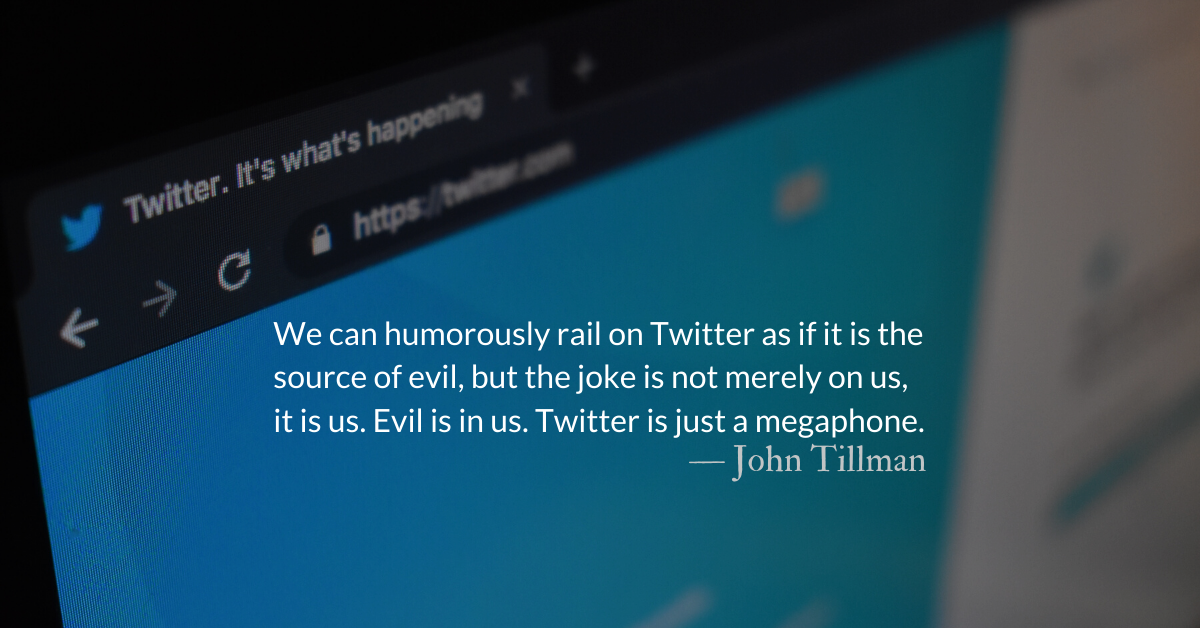
We can humorously rail on Twitter (and other social media and technology) as if it is the source of evil, but the joke is not merely on us, it is us. Evil is in us. Twitter is just a megaphone, amplifying the words of our hearts have always been spouting. Or to think of it another way, Twitter is a microscope allowing us to see deep into the heart of humanity and be shocked at the diseased and horrid condition of our souls.

It is helpful to remember also that Paul was not speaking to Timothy of dangers from outside the church. He was not speaking of governmental, or political, or cultural oppression and sin. He was speaking of sins and false teachings within the church.

We have written before that the best way to read Old Testament prophecy is to imagine yourself not as the noble, righteous prophet or the helpless faithful the prophet stands with, but as the target of the prophet’s message and the ones in need of repentance. New Testament prophecy is no different. Rather than weaponize Paul’s words to attack our culture with an accusing cry, we should instead cry for forgiveness and mercy as we recognize that these faults are also in us.

May we take a priestly stance, confessing the sins of our age. Through the power of the Holy Spirit may we repent each of the items in this prophecy, turning our lives into the antithesis of Paul’s vision and affecting our churches and communities around us with the overflow of God’s Holy Spirit.

Divine Hours Prayer: The Call the Prayer
The Lord is King; let the people tremble; he is enthroned upon the cherubim; let the earth shake. — Psalm 99.1

– From The Divine Hours: Prayers for Autumn and Wintertime by Phyllis Tickle.

Today’s Readings
2 Kings 13 (Listen – 4:33)
2 Timothy 3 (Listen -2:21)

Thank You!
Thank you to our donors who support our readers by making it possible to continue The Park Forum devotionals. This year, The Park Forum audiences opened 200,000 emails with free, and ad-free, devotional content. Follow this link to join our donors with a one-time or a monthly gift.

Read more about How to Read Prophetic Judgment :: Readers’ Choice
We miss the point of prophecy entirely when we weaponize it to attack others.

Read more about Christian Pagans and Disasters
Attributing disasters to angry gods has more in common with the theology of the 1990 movie #JoeVersustheVolcano than it does the God of the Bible.

Choosing Gentleness Over Violence

Scripture Focus: 2 Timothy 2.24-25
The Lord’s servant must not be quarrelsome but must be kind to everyone, able to teach, not resentful. Opponents must be gently instructed, in the hope that God will grant them repentance leading them to a knowledge of the truth.

From John:

Sadly this devotional from 2017 begs to be repeated. The world’s online language has gotten more, instead of less, brutal in two years. But worse and more shocking, the language of many Christians and prominent Christian pastors has followed, growing combative, disrespectful, and even violent, disqualifying themselves, according to Paul from being “the Lord’s servant…” May we repent and call our leaders to follow suit.

Reflection: Choosing Gentleness Over Violence

By John Tillman

When we discuss differences online, the overheated rhetoric of partisan headlines can become a part of our own speech as we share articles or videos that describe our opponents—not their arguments or political positions—as being destroyed, ripped, blasted, shredded. The more violent and dehumanizing the verb, the better.

This isn’t just verbal hyperbole. It is being borne out in actions as more and more people are physically assaulted following online interactions that lead to violence or threats of violence. These types of actions can be extreme and political, such as the attempted assassinations of Representative Gabrielle Giffords in 2011 or of Republican Congressional members in 2017. They can also be smaller in spectacle, and fly below the news radar.

Gamergate
was the name given to attacks on women critiquing the portrayal of female characters in video games. Though it started years ago, many of these attacks—threats, vandalism, hacking, and doxxing attacks—are still going on today. Women are also often attacked using these methods after reporting sexual abuse by powerful men.

We should resist the urge to shrug off these events with denial. Christians believe that God’s Word became flesh, yet somehow we are reluctant to admit the power of our own words to become physicalized into actions. What we say and how we say it matters because, as Jesus taught, the words of our mouths come from our hearts and reveal our inward sinfulness. Sticks and stones start as words and words start in our sinful hearts. This is true not only of the words we speak or type ourselves but the words we lend our digital voices to. By posting, liking, and retweeting articles about our ideological rivals being “destroyed” we are revealing not our ideological righteousness, but our theological sinfulness.

In Paul’s exhortation to Timothy, he encourages faithfulness to the Gospel, and fidelity to right teaching, but Paul specifically instructs Timothy not to be resentful or quarrelsome and to instruct opponents with gentleness. This was no low-stakes conflict that Paul was advising Timothy in. The very heart of what it meant to be a Christian and the definition of salvation through Christ was at stake. It was much, much more important than who misinterpreted whose tweet this week. Yet, still Paul’s charge was to teach gently.

We cannot continue posting and liking things that are resentful, quarrelsome, and the opposite of gentle, yet expect to represent Christ and the Gospel in the world. If we refuse to choose one or the other, we risk showing the world a resentful, quarrelsome, violent Christ.

Divine Hours Prayer: The Call to Prayer

Love the Lord, all you who worship him; the Lord protects the faithful, but repays to the full those who act haughtily. — Psalm 31.23

– From The Divine Hours: Prayers for Autumn and Wintertime by Phyllis Tickle.

Today’s Readings
2 Kings 11-12 (Listen – 7:38)
2 Timothy 2 (Listen -3:17)

Thank You!
Thank you to our donors who support our readers by making it possible to continue The Park Forum devotionals. This year, The Park Forum audiences opened 200,000 emails with free, and ad-free, devotional content. Follow this link to join our donors with a one-time or a monthly gift.

Read more about Abandoning Human Vengeance
As Christians, we have an opportunity to differentiate ourselves from culture every time vitriol spews.

Read more about Praise God for the Justice of the Gospel
Only Christ can stand, simultaneously offering forgiveness to all who seek it, destruction of evil itself, and restoration of all that is broken and lost.

Calloused Hands and Softened Hearts

Scripture Focus: 2 Timothy 1.12
That is why I am suffering as I am. Yet this is no cause for shame, because I know whom I have believed, and am convinced that he is able to guard what I have entrusted to him until that day.

Reflection: Calloused Hands and Softened Hearts
By John Tillman

In suffering for the gospel, Paul carried with him a joy and purpose that he worked to pass on to Timothy and to us.

Paul, when writing this second letter to Timothy, knew that his life was coming to an end. Reading between the lines, one can hear the certainty with which Paul feels his death approaching. 

Paul does not encourage Timothy with any false hope of things improving for Christians or for Timothy. In fact, by his prayers and what he writes, he seems certain of problems and crises for Timothy rather than ease and comfort. He invites Timothy to, “not be ashamed of the testimony about our Lord or of me his prisoner. Rather, join with me in suffering for the gospel, by the power of God.”

Some interpretations of the Christian faith have, from time to time, trended toward pie-in-the-sky, escapist fantasy—as if the great purpose of the gospel was only to leave this world behind. 

Gospel Christianity, fully embraced, realistically addresses the now and spiritually embraces the future. Few religions do both. The Bible shows us a Christ—with dirty, workman’s hands—fixing, healing, and working in the muddy, bloody now of the New Testament. His heart is soft for those far from God and for those hurt and damaged by this world. Following Christ, our hands will grow calloused and our hearts will be softened as we work to meet needs and change the world now.

The Bible also shows us a Christ wielding axe, fire, and wrath. This Christ will end the diseased and broken version of creation we live in and bring about a restoration. This Christ also comes individually to us to end our inner world that is equally diseased and broken, restoring us to our potential.

There is suffering coming to our lives.
There is death coming to our lives.
There is destruction on its way.
We may still be encouraged. This is true not because our suffering will be ended by Christ, but because Christ suffers with us.

There is coming a day on which the world will be no more. But this does not mean that our earthly efforts are wasted. We, like Paul and Timothy, are working alongside Christ. 

We, too, may know in whom we have placed our faith and trust. 

Walking with Christ, we will be:
Shameless in suffering
Personally assured in belief
Convinced of Christ’s ability, not our own
Guarded by Christ Jesus

“I know whom I have believed, and am convinced that he is able to guard what I have entrusted to him until that day.” — 2 Timothy 1:12

Divine Hours Prayer: The Request for Presence
Early in the morning I cry out to you, for in your word is my trust. — Psalm 119.147

– From The Divine Hours: Prayers for Autumn and Wintertime by Phyllis Tickle.

Today’s Readings
2 Kings 10 (Listen – 6:30)
2 Timothy 1 (Listen -2:37)

Thank You!
Thank you to our donors who support our readers by making it possible to continue The Park Forum devotionals. This year, The Park Forum audiences opened 200,000 emails with free, and ad-free, devotional content. Follow this link to join our donors with a one-time or a monthly gift.

Read more about Jesus with Axe and Fire
To burn out of our souls our preoccupation with ourselves we require a different kind of axe and a different kind of fire. Thankfully, Jesus stands ready to supply both.

Read more about Resurrecting Goodness :: Readers’ Choice
It is a uniquely Christian claim that God is invested in our present, not just our future.

The Identical Nature of Greed and Lust

Scripture Focus: 1 Timothy 6.17-18
Command those who are rich in this present world not to be arrogant nor to put their hope in wealth, which is so uncertain, but to put their hope in God, who richly provides us with everything for our enjoyment. Command them to do good, to be rich in good deeds, and to be generous and willing to share.

Reflection: The Identical Nature of Greed and Lust
By John Tillman

As he brings his letter to Timothy to a close, Paul has just lifted heart, mind, and spirit in a glorious and artful prayer, comparing Timothy’s testimony to that of Christ before Pilate and describing God living in unapproachable light. He ends this passage on an uplifting note with a well deserved “Amen.”… But after closing out the letter so beautifully and with a definite note of finality, Paul seems to think of one more thing.

In his commentary, John Wesley notes that verses 17-21 of 1 Timothy seem to be a kind of postscript. It is as if the letter was ready to go and then, perhaps, delayed long enough that Paul had time to think of one more paragraph he found necessary to add. 

So, what was so important that Paul felt the need to add more about it? Wealth and greed.

Paul earlier addressed ministers who think “godliness is a means to financial gain.” This shows us that the prosperity gospel is not a 20th-century invention. It is as old and as dangerous as any other heresy. Paul then turns his attention sharply in verse 17 from ministers to wealthy church members who were at risk of becoming ensnared by greed.

If Paul considers wealth a distraction worthy of a second look and warning, so should we. Paul has already taught that wealth is powerful enough to corrupt those called as ministers of the gospel and instructed Timothy to “flee” from its influence. Paul takes the danger of greed seriously.

Paul uses the word “command” when speaking to the rich about their responsibility to be humble and generous. It is the same level of authoritative language he uses to speak of sexual sins. 

Financial sins of greed and sexual sins of lust are two sides of the same coin. It was no mistake that when the prophet Nathan needed an analogy for lust, he chose a parable about a rich man stealing material goods from the poor. Lust and greed are the exact same sin. One is concerned with material goods and one with flesh.

We must take a second look at our hearts for the twin sins of lust and greed, inviting the Holy Spirit to illuminate every dark corner. Greed or lust may be the downfall of a minister, as Paul warned Timothy, but, as Paul warned, they may also destroy a community.

Divine Hours Prayer: The Request for Presence
O Lord, watch over us and save us from this generation forever. — Psalm 12.7

– From The Divine Hours: Prayers for Autumn and Wintertime by Phyllis Tickle.

Today’s Readings
2 Kings 9 (Listen – 6:32)
1 Timothy 6 (Listen -3:16)

Thank You!
Thank you to our donors who support our readers by making it possible to continue The Park Forum devotionals. This year, The Park Forum audiences opened 200,000 emails with free, and ad-free, devotional content. Follow this link to join our donors with a one-time or a monthly gift.

Read more about God Shivering on Concrete
God’s love is evident in the disaster God promises a nation that ignores responsibilities to the poor and to the foreigner. Our God humbles nations addicted to greed—including His own.

Read more about Greed and Envy
The trap for the wealthy is to think that we are not that wealthy, or that the poor are not that worthy.

Show Buttons
Hide Buttons
Spur a spiritual rhythm of refreshment right in your inbox
By joining this email list you are giving us permission to send you devotional emails each weekday and to communicate occasionally regarding other aspects of the ministry.
100% Privacy. We don't spam.