Unhealthy Patterns of Insurrection

Scripture Focus: 2 Kings 15.8-12
8 In the thirty-eighth year of Azariah king of Judah, Zechariah son of Jeroboam became king of Israel in Samaria, and he reigned six months. 9 He did evil in the eyes of the Lord, as his predecessors had done. He did not turn away from the sins of Jeroboam son of Nebat, which he had caused Israel to commit. 
10 Shallum son of Jabesh conspired against Zechariah. He attacked him in front of the people, assassinated him and succeeded him as king. 11 The other events of Zechariah’s reign are written in the book of the annals of the kings of Israel. 12 So the word of the Lord spoken to Jehu was fulfilled: “Your descendants will sit on the throne of Israel to the fourth generation.” 

Reflection: Unhealthy Patterns of Insurrection
By John Tillman

As promised, Jehu’s dynasty was the longest in Israel’s history but Zechariah, the fifth in the line, only lasted six months. Stability was not the norm in Israel. Previously, the dynasty of Omri (Ahab’s father) was the longest, lasting three generations. (There were four kings in Omri’s line but the last two were both sons of Ahab.)

Zechariah’s death kicked off a period of political instability and growing threats both inside and outside Israel. Six different kings ruled Israel during this time. Four of them were assassinated by their successors. Only one passed the throne on to his son.

Israel repeatedly resorted to rebellion—perhaps rebellion against David’s sons set a pattern. Insurrection was normalized. Assassination, rather than inauguration, was common.

Recently, speaking at Hutchmoot Homebound on “Faith, Fiction, and Christian Nationalism,” Dr. Russell Moore quoted Wendell Berry’s essay “Discipline and Hope,” published in 1972. Berry said, “The most destructive of ideas is that extraordinary times justify extraordinary measures.”

Many rebels think themselves just and their targets wicked. Many in power think themselves righteous and any resistance or critique equivalent to wickedness. Such moral relativism is not new to politics. What is new is how completely it has overtaken some Christians.

Many people today have come to believe that the times are extraordinary enough that any measures are justified, even civil war. When convinced that situations are dire enough, any measure, any abuse, any violence, any tactic seems justified. 

For Christians, it is always right to defend the weak. It is always right to rescue those crushed by the powerful. However, there is never a time when a just end justifies a sinful means to attain it. If the means are unjust, the ends are tainted.

God redeems evil acts after the fact but he doesn’t preemptively give “hall passes” for evil as long as something good happens. Christians shouldn’t either. Good intentions don’t lead to hell, but good intentions pursued by wicked means do.

God’s purposes for our lives do not require a “Christian” government. In fact, arguably greater kingdom work is more often done by global majority Christians living outside the cushy environment and soft-bodied sloth of the Western church.

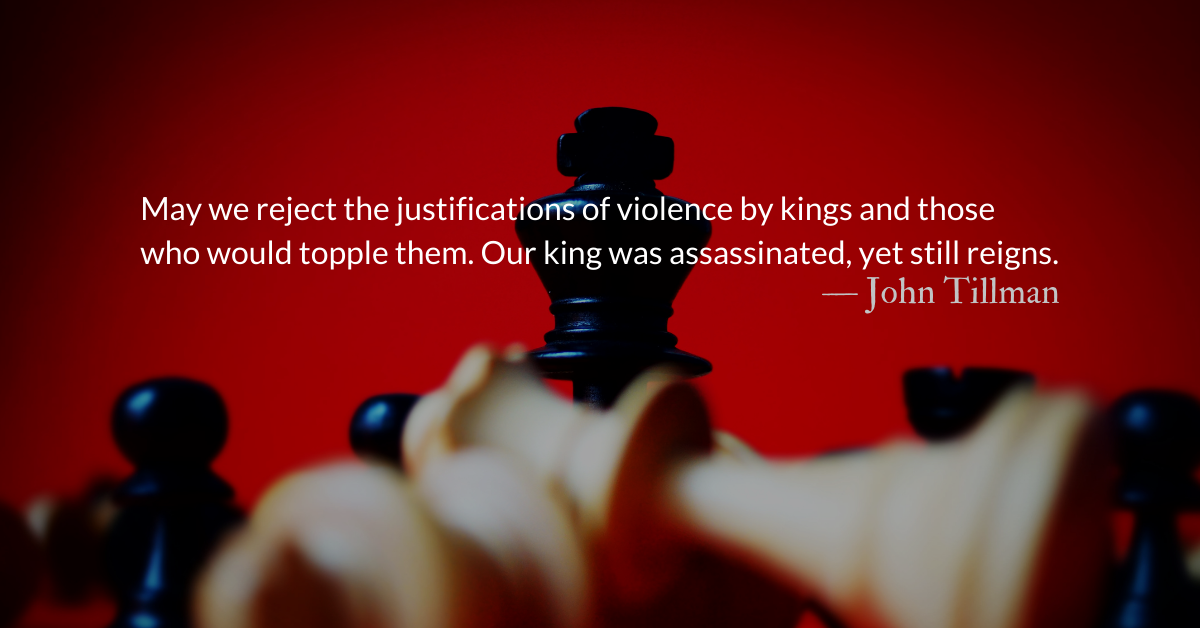
May we pray and pursue peace. May we reject the justifications of violence by kings and those who would topple them. Our king was assassinated, yet still reigns. May he be the only king to whom we give allegiance.

Divine Hours Prayer: A Reading
Jesus taught us, saying: “Be on your guard, stay awake because you never know when the time will come. It is like a man traveling abroad: he has gone from his home, and left his servants in charge, each with his own work to do; and he has told the doorkeeper to stay awake. So stay awake, because you do not know when the master of the house is coming, evening, midnight, cockcrow of dawn; if he comes unexpectedly, he must not find you asleep. And what I am saying to you I say to all: Stay awake!” — Mark 13.33-37

– From The Divine Hours: Prayers for Summertime by Phyllis Tickle.

Today’s Readings
2 Kings 15 (Listen – 6:21)
Titus 1 (Listen – 2:24)

Read more about The Hero We Need Isn’t Jehu
Jehu was an incomplete savior who delivered an incomplete and unsatisfying justice.

Read more about Tribalism and Insurrection
It is difficult to make peace with insurrectionists. They aren’t interested. In a world fluent in violence, when we speak of peace, it is “an unknown tongue.

When God Has Mercy…Will We?

Scripture Focus: 2 Kings 14.23-25
23 In the fifteenth year of Amaziah son of Joash king of Judah, Jeroboam son of Jehoash king of Israel became king in Samaria, and he reigned forty-one years. 24 He did evil in the eyes of the Lord and did not turn away from any of the sins of Jeroboam son of Nebat, which he had caused Israel to commit. 25 He was the one who restored the boundaries of Israel from Lebo Hamath to the Dead Sea, in accordance with the word of the Lord, the God of Israel, spoken through his servant Jonah son of Amittai, the prophet from Gath Hepher. 
26 The Lord had seen how bitterly everyone in Israel, whether slave or free, was suffering; there was no one to help them. 27 And since the Lord had not said he would blot out the name of Israel from under heaven, he saved them by the hand of Jeroboam son of Jehoash. 

Reflection: When God Has Mercy…Will We?
By John Tillman

Jeroboam II became one of the most powerful and prosperous kings of Israel despite his unworthiness. Although he shared no familial line with the first Jeroboam, he shared his sin and wickedness.

The Lord’s compassion for the people, not the righteousness of their leader brought prosperity to Israel. However, that prosperity did not extend to all levels of society. Condemnations in Hosea and Amos record the extreme wealth of Israel’s leaders and the extreme suffering of the poor.

Another prophet serving during this time was Jonah son of Amittai. Chronologically, it is his first appearance. Jonah delivered the good news of God’s mercy to the wicked king of his own country. He carried God’s word to Jeroboam II that God would expand their borders and power. Later, when God wanted to send a message of mercy to Jonah’s political enemies in Nineveh, Jonah refused. His partiality led to his encounter with the fish, but his desire for vengeance remained undigested by the fish’s innards.

Jonah seemed to believe mercy should be limited to his own tribe and country while everyone else burned. How many of us are like him? 

Do we desire mercy for ourselves but not our enemies?
Mercy for our leaders, our tribe, our institutions but not those who oppose us?
Would we say with the sons of Zebedee, “Let us call down fire on them!”? 
Would we say with Jonah, “I didn’t want you to forgive them!”?

Do we mistakenly think we deserve God’s mercy while others don’t? Our leaders are no more deserving, our tribes are no more righteous, our institutions are no more worth saving.

God chooses to have mercy on whom he will. We can be channels of that mercy, like Abram interceding for Sodom, Moses interceding for the people, or dozens of other biblical examples. 
However, standing in the way of God’s mercy to block it is unwise. God’s mercy may overwhelm us like it did Jonah, or it may destroy us like the officer trampled by the crowds running out to the spoils announced by the four lepers.

Jonah held his bitterness so deeply that the depths of the sea couldn’t wash it away and the sun couldn’t burn it away. How deeply will we hold on to ours?
One thing is certain, God keeps his merciful promises, even when we are unworthy vessels and unworthy recipients. 

Divine Hours Prayer: The Call to Prayer
Worship the Lord in the beauty of holiness; let the whole earth tremble before him. — Psalm 96.9

– From The Divine Hours: Prayers for Summertime by Phyllis Tickle.

Today’s Readings
2 Kings 14 (Listen – 5:06)
2 Timothy 4 (Listen – 2:48)

Read more about To Wicked Kings, Foreign and Domestic
We must abandon Jonah’s sinful wish to weaponize God’s wrath.

Read more about Beyond Selfish Thankfulness
A God who does not treat us as we deserve is also a God who often does not treat our enemies as we might feel they deserve.

Worth Doing Poorly

Scripture Focus: 2 Kings 10.25-31
25 As soon as Jehu had finished making the burnt offering, he ordered the guards and officers: “Go in and kill them; let no one escape.” So they cut them down with the sword. The guards and officers threw the bodies out and then entered the inner shrine of the temple of Baal. 26 They brought the sacred stone out of the temple of Baal and burned it. 27 They demolished the sacred stone of Baal and tore down the temple of Baal, and people have used it for a latrine to this day. 
28 So Jehu destroyed Baal worship in Israel. 29 However, he did not turn away from the sins of Jeroboam son of Nebat, which he had caused Israel to commit—the worship of the golden calves at Bethel and Dan. 
30 The Lord said to Jehu, “Because you have done well in accomplishing what is right in my eyes and have done to the house of Ahab all I had in mind to do, your descendants will sit on the throne of Israel to the fourth generation.” 31 Yet Jehu was not careful to keep the law of the Lord, the God of Israel, with all his heart. He did not turn away from the sins of Jeroboam, which he had caused Israel to commit. 

Reflection: Worth Doing Poorly
By John Tillman

There’s an aphorism that says anything worth doing is worth doing right. There is also a counterargument which says that anything worth doing is worth doing poorly. The traditional aphorism discourages shoddiness and sloth and the non-traditional mirror-version discourages despair and apathy.

People may feel they don’t have the resources to “do something right” and so do nothing. Whether one feels a lack of emotional strength, or physical strength, or other resources, the idea that one cannot complete something can be paralyzing.

It is easy to apply this to tangible things. If you are too tired to brush and floss, just brushing makes a difference. If you can’t afford healthy food for every meal, changing one meal a day is an improvement. If you can’t run a 5K, walking around your block is still worthwhile.

But when it comes to serving the Lord, is partial obedience worth anything? How does God view our futile attempts at perfection? 

God seemed pleased with Jehu’s partial obedience. Jehu eliminated the worship of Baal and carried out God’s prophecy against Ahab. Based on this, God made a promise to Jehu that his line of kings would last four generations.

Partial or incomplete obedience matters when it comes to earthly consequences and outcomes but it is not salvific. All the repeated failures of kings and saviors in the Old Testament point to our need for the true savior and true king to come. 

The Christian faith acknowledges, with more honesty than most faith systems, that humans are incapable of complete righteousness and justice. This harsh realism is not a fatalistic surrender to human nature. We cannot gain salvation by legalism but this does not mean abandoning self-control. On the contrary, Paul (the Bible’s most strident anti-legalist) encourages us to make our bodies slaves to God’s will and to press onward to a higher calling.

Christians do not believe in capitulating to sin, but in following the one who has defeated it. It is Christ’s complete righteousness that we cling to and claim, not our own. 

No matter how “good” we are, we can’t save ourselves. But no matter how far short we fall, anyone can turn in repentance and take steps with Jesus that make a difference. Pressing onward to follow Jesus is more important than how many times we fall or fail.

Following Jesus is worth it, even if you fail frequently.

Divine Hours Prayer: The Greeting
For you Name’s sake, O Lord, forgive my sin, for it is great. — Psalm 109.25

– From The Divine Hours: Prayers for Summertime by Phyllis Tickle.

Today’s Readings
2 Kings 10 (Listen – 6:30)
2Timothy 1 (Listen – 2:37)

This Weekend’s Readings
2 Kings 11-12 (Listen – 7:38),  2 Timothy 2 (Listen – 3:17)
2 Kings 13 (Listen – 4:33), 2 Timothy 3 (Listen – 2:21)

Read more about Praising Christ’s Righteousness
God specifically tells Ezekiel that not even the greatest, most righteous men he might trust in would be able to save the nation.

Read more about Kiss of Righteousness and Peace—Guided Prayer
May we bring righteousness and peace together in our lives and communities.

20201002

The Hero We Need Isn’t Jehu

Scripture Focus: 2 Kings 9.22-26
22 When Joram saw Jehu he asked, “Have you come in peace, Jehu?” 
“How can there be peace,” Jehu replied, “as long as all the idolatry and witchcraft of your mother Jezebel abound?” 
23 Joram turned about and fled, calling out to Ahaziah, “Treachery, Ahaziah!” 
24 Then Jehu drew his bow and shot Joram between the shoulders. The arrow pierced his heart and he slumped down in his chariot. 25 Jehu said to Bidkar, his chariot officer, “Pick him up and throw him on the field that belonged to Naboth the Jezreelite. Remember how you and I were riding together in chariots behind Ahab his father when the LORD spoke this prophecy against him: 26 ‘Yesterday I saw the blood of Naboth and the blood of his sons, declares the LORD, and I will surely make you pay for it on this plot of ground, declares the LORD.’ Now then, pick him up and throw him on that plot, in accordance with the word of the LORD.” 

Reflection: The Hero We Need Isn’t Jehu
By John Tillman

Joram’s death completes a prophecy against Ahab. Ahab was so evil that the writer of 2 Kings made a special mention (twice) that there never was anyone like Ahab, who chased after Baal and declared God and God’s prophets to be his enemies. If not for the actions of a few who resisted Ahab, all the prophets of the Lord and those faithful to Yaweh could have been wiped out. 

After the murder of Naboth, God promised to wipe out Ahab’s family, then later delayed the judgment. After Ahab’s death, time was up. Justice rode into Samaria at the heels of Jehu. Like Jehu’s arrow that pierced Joram’s fleeing back, God launched Jehu, into the heart of Israel’s idolatry, targeting those responsible for violence and injustice.

Comparatively speaking, Jehu is probably the closest Israel ever came to having a righteous king who sought the Lord. However, that’s kind of like saying he was the best smelling dumpster fire in the alley. 

Jehu’s brand of justice was blood for blood, deception for deception, and slaughter for slaughter. 
Most of the time those who are used by God to carry out violent justice are then brought down in violence by God. Live by the sword, die by it. They aren’t good role models and we shouldn’t long to emulate them. Jehu wasn’t the hero Israel needed. He’s not the one we need either. 

One thing Jehu got right was that we cannot have peace with God while serving other gods. Jehu was an incomplete savior who delivered an incomplete and unsatisfying justice. He failed to pierce the idolatry and injustice in his own heart. He destroyed the worship of one of Israel’s idols but left other corrupt worship practices in place.

We might like to picture ourselves as a Jehu. We may feel heroic riding to attack and destroy the idols of others. But what idols do we leave standing? What false gods are we at peace with? Before you launch an arrow at another, target your own heart with the help of God’s Spirit. How can there be peace, when our idolatry lives?

Jesus is the hero, the savior, we need. One day, Jesus will ride like Jehu, bringing final justice to evil. But now is the time of salvation when we can make peace with God through Christ. Now, Jesus extends his hands, offering forgiveness. Make peace with him today.

Divine Hours Prayer: The Call to Prayer
The Lord is King; let the people tremble; he is enthroned upon the cherubim; let the earth shake. — Psalm 99.1

– From The Divine Hours: Prayers for Summertime by Phyllis Tickle.

Today’s Readings
2 Kings 9 (Listen – 6:32)
1 Timothy 6 (Listen – 3:16)

Read more about Ahab and David
Ahab’s murder of Naboth has some interesting parallels to David and the murder of Uriah.

Read more about Muscle Memory
Ahaziah adopted the sinful behavior of his father and suffered the same tragic death.

Eating With Enemies

Scripture Focus: 2 Kings 6.17-18, 20-23
16 “Don’t be afraid,” the prophet answered. “Those who are with us are more than those who are with them.” 
17 And Elisha prayed, “Open his eyes, Lord, so that he may see.” Then the Lord opened the servant’s eyes, and he looked and saw the hills full of horses and chariots of fire all around Elisha. 
18 As the enemy came down toward him, Elisha prayed to the Lord, “Strike this army with blindness.” So he struck them with blindness, as Elisha had asked. 

20 After they entered the city, Elisha said, “Lord, open the eyes of these men so they can see.” Then the Lord opened their eyes and they looked, and there they were, inside Samaria. 
21 When the king of Israel saw them, he asked Elisha, “Shall I kill them, my father? Shall I kill them?” 
22 “Do not kill them,” he answered. “Would you kill those you have captured with your own sword or bow? Set food and water before them so that they may eat and drink and then go back to their master.” 23 So he prepared a great feast for them, and after they had finished eating and drinking, he sent them away, and they returned to their master. So the bands from Aram stopped raiding Israel’s territory. 

Matthew 26.52-54
52 “Put your sword back in its place,” Jesus said to him, “for all who draw the sword will die by the sword. 53 Do you think I cannot call on my Father, and he will at once put at my disposal more than twelve legions of angels? 54 But how then would the Scriptures be fulfilled that say it must happen in this way?” 

Psalm 23.5
5 You prepare a table before me
    in the presence of my enemies.
You anoint my head with oil;
   my cup overflows.

Reflection: Eating With Enemies
By John Tillman

Elisha was, perhaps, never more Christ-like than when he led an army of his political enemies into the citadel of his spiritual enemies and then directed everyone to sit and eat a meal together.

This wasn’t a kumbaya moment where everyone held hands and decided to get along. It was a power play. Elisha demonstrated that God alone was king—not Joram, not the king of Aram, Yahweh. Elisha, through God’s power, prepared a table in the presence of his enemies and made them eat together. (Psalm 23.5)

However, no demonstration of God’s power is sufficient to prevent human rebellion. After a short peace in which Aram avoided Israel’s territory, hostilities resumed. After calling Elisha, “Father,” and being obedient during a crisis, Joram and Israel’s kings returned to their idolatry.

No miracle or display of power can sustain faith. The Bible proves over and over that miraculous signs and wonders will not convince us to abandon our idols for long.

Sin is too ingrained in us to be sanded off, like a minor imperfection. Sin is too bold to be frightened away. It crouches at our door. It seeks to master us. It asks to sift us. It hovers over us like a mighty predator. It surrounds us like an army.

Yet, we are not without hope. Like Elisha’s servant, we need our eyes opened to realize those with us are greater than those with them. He that is within us is greater than he that is in the world. (1 John 4.4) The sin that stalks us, has been defeated by the one who walks with us. (Psalm 23.4) The sin that crouches at our door has been nailed to Christ’s cross. (Genesis 4.7) Sin intends to sift us, but Christ has prayed for us. (Luke 22.32)

Like Peter, we will deny Christ, draw our swords, and sin. But we can turn back and strengthen others. Walking with Christ, we will be led to eat with our enemies rather than destroy them.

When Christ leads us into the heavenly city, we will find ourselves dining and worshiping with people we harmed or who harmed us. Christ’s love will cover all, Christ’s justice will restore our hurts and harms, and we will feast together.

However, we shouldn’t wait for eternity. Let us call on God’s power for peace, not destruction. Let us love our enemies today. Through Christ, enemies can eat together in peace.

Divine Hours Prayer: The Call to Prayer
Be strong and let your heart take courage, all you who wait for the Lord. — Psalm 31.24

– From The Divine Hours: Prayers for Summertime by Phyllis Tickle.

Today’s Readings
2 Kings 6 (Listen – 5:05)
1 Timothy 3 (Listen – 2:10)

Read more about Christless Forgiveness is the Absence of Justice
Forgiveness is unjust if forgiveness is simply letting evil succeed…if victims are never heard and no one ever answers for their pain.

Read more about The Undeserved Banquet of the Gospel
God sets his table for scoundrels, shaking hands with undeserved trust.

Show Buttons
Hide Buttons
Spur a spiritual rhythm of refreshment right in your inbox
By joining this email list you are giving us permission to send you devotional emails each weekday and to communicate occasionally regarding other aspects of the ministry.
100% Privacy. We don't spam.