Speak to Philemon

Scripture Focus: Philemon 8-11
8 Therefore, although in Christ I could be bold and order you to do what you ought to do, 9 yet I prefer to appeal to you on the basis of love. It is as none other than Paul—an old man and now also a prisoner of Christ Jesus— 10 that I appeal to you for my son Onesimus, who became my son while I was in chains. 11 Formerly he was useless to you, but now he has become useful both to you and to me.

Reflection: Speak to Philemon
By John Tillman

Our aversion to slavery is historically atypical. Excepting the last 200 years or so, the prevailing thought of the world’s elite philosophers and rulers was that slavery was not just acceptable, but a moral good.

Slavery aligned well with most religious and political systems. Slavery supported the despotic theology and ideology of authoritarianism and social stratification. Gods and emperors were on top, then the wealthy and powerful, then ordinary men, then women, then slaves at the bottom.

Even if we transported ourselves and our belief that slavery is evil back in time to Paul’s day, what could we do? If we went to the market, slaves would be sold there. If we bought property, it would be built and maintained by slaves. Slavery touched every part of life. It was woven into political and financial systems. Slavery was unavoidable. Yet, we find Paul and others resisting and subverting the practice. 

Slavery is not culturally acceptable anymore, but many ideologies that enslave both bodies and minds are. We live among cultural assumptions that shape our media, our economy, our schools, and our politics. Many are wicked, unjust, and unavoidable.

How do we live within unjust systems and during an unjust time? 

Paul’s letters, especially Philemon, show us one way. Paul never led a slave revolt and his words have been twisted to support slavery, but his careful, thoughtful logic and loving, inclusive actions eroded the philosophical foundations of slavery.

Despite the fact that many Christians, past and present, defend slavery, the idea that slavery is evil comes exclusively from Christian theology. Local slave rebellions or individual rulers partially freeing some slaves occurred in ancient history. But nowhere in any culture does a consistent cry arise to abolish slavery for all people everywhere, except among the followers of Jesus. However, it is not to our glory that abolitionism arose from Christianity. It is to our shame that it took so long.

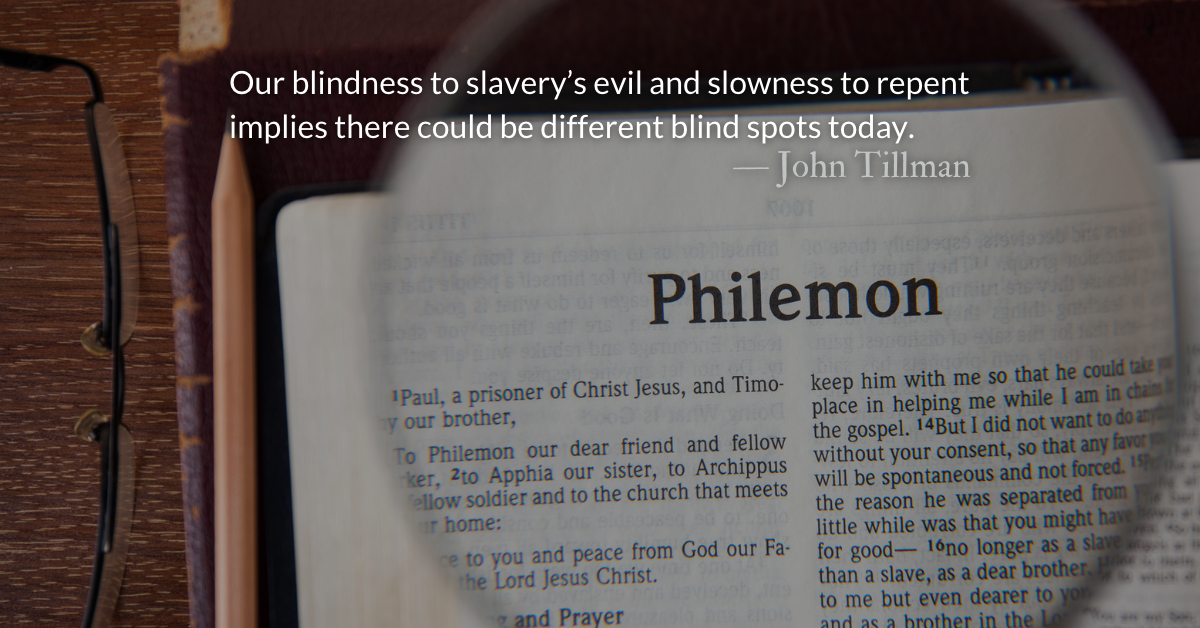
Somehow, through all the pressure of cultural ideology, Paul pushed back against slavery. But it took us too long to see it. Our blindness to slavery’s evil and slowness to repent implies there could be different blind spots today. What is culture telling us today that we accept without question? Speak to your “Philemon.” How can you, gently and with love, erode the philosophical foundations of oppressive ideologies? How can you, in love, set people free through the gospel?

Divine Hours Prayer: The Small Verse
My soul thirsts for the strong, living God and all that is within me cries out to him.

– From The Divine Hours: Prayers for Summertime by Phyllis Tickle.

Today’s Readings
Joshua 8 (Listen 5:55)
Philemon (Listen  2:52)

Read more about Philemon’s Speck and Our Log
Our existence is supported by the labor of people who directly or indirectly serve us, just as Onesimus served Philemon.

Read more about Slavery, Racism, and a Lone Christian Voice
In the late fourth century a lone Christian voice spoke out against the oppressive institution of slavery in a way that none had before.
From Survival to Cultivation

Scripture Focus: Joshua 5.10-12
10 On the evening of the fourteenth day of the month, while camped at Gilgal on the plains of Jericho, the Israelites celebrated the Passover. 11 The day after the Passover, that very day, they ate some of the produce of the land: unleavened bread and roasted grain. 12 The manna stopped the day after they ate this food from the land; there was no longer any manna for the Israelites, but that year they ate the produce of Canaan. 

Reflection: From Survival to Cultivation
By John Tillman

Migrants carry their world through the world. Everything precious to their lives and future is strapped to them in a backpack or a duffel bag. They often carry large amounts of cash or precious items to use for bribes and to survive on the way. I barely trust plastic grocery bags to make it from the store to my car, but migrants travel thousands of miles carrying water, food, and necessities in these bags.

After the first Passover, Israel left Egypt with considerably more than backpacks, duffle bags, and plastic grocery sacks. They had flocks and herds and wealth. Their encampment was carefully organized with strict cleanliness and purity rules. They built the Tabernacle, a magnificent mobile garden of Eden that moved around the desert with them like a mirage.

But no matter how organized or clean a migrant camp is, it is still a migrant camp. There is no planting or harvesting. There is no cultivation. There is only surviving.

At their first Passover in the promised land the people ate food from the land. They tasted the fruit of the promise. They had previously been sustained by manna, the miraculous provision of Heaven. Now they would rely on a different miracle—cultivation. They began the process of going from survival mode to cultivation mode.

Cultivation is just as miraculous as manna. We plant and water, but it is still the Lord who makes things grow. The one in whom we trust is the same one who provided manna in the wilderness.

Cultivation has a different responsibility. Manna could not be saved or shared. They gathered only for themselves. In survival mode, nothing lasts until tomorrow.

Shifting from survival to cultivation, we both save and share. Cultivation creates bounty and resources intended to bless the community and invest in the future.

There is no shame in being migrants. The Lord sustains them—often through us. (Deuteronomy 10.18-19; 24.14, 17; 27.19) But God’s calling and promise are to cultivation. (Micah 4.4) It is through cultivation of faith that we have plenty to share with those in survival mode.

Are you in survival mode or cultivation mode? 

Do you pray only in crisis? Or do you plant prayers, allowing them to grow roots and sprout?
Do you forge scriptures into weapons to fight others? Or do you form scripture into a plowshare, dragging its blades through the soil of your heart, casting out stones and weeds?

Divine Hours Prayer: The Refrain for the Morning Lessons
“Because the needy are oppressed, and the poor cry out in misery, I will rise up,” says the Lord, “And give them the help they long for.” — Psalm 12.5


– From The Divine Hours: Prayers for Summertime by Phyllis Tickle.

Today’s Readings
Joshua 5-6.5 (Listen 7:25) 
Colossians 2 (Listen  3:27)

Tuesday’s Readings
Joshua 6.6-6.27 (Listen 4:47), Colossians 3 (Listen  3:09)

Read more about Jericho’s Wall
God isn’t interested in destroying people we call our enemies

Read more about Over Jordan
When we cross over the Jordan with Christ, the land has no enemies to be defeated.

Success

Scripture Focus: Joshua 1.7-8
Be strong and very courageous. Be careful to obey all the law my servant Moses gave you; do not turn from it to the right or to the left, that you may be successful wherever you go. Keep this Book of the Law always on your lips; meditate on it day and night, so that you may be careful to do everything written in it. Then you will be prosperous and successful.

Reflection: Success 
By Kelsey Hope Stookey

We all have an idea of what success looks like. Maybe for some, it is a promotion, a new car, or thousands of followers on our social media platform. But what if these forms of success do not happen? Does that mean that we are not successful?

Here, Joshua is called to lead God’s people as Moses’ successor. During his ministry, Moses led the nation of Israel and achieved what most would call a successful life and ministry. Moses was not perfect. But even today, he stands as an icon of a successful leader. After Moses’ death Joshua was called to lead. Joshua’s idea of success was almost certainly colored by the life and ministry of his predecessor. Here in verses 7 and 8, God reminds Joshua of how true success is attained. Who defines success and how do we achieve it? God is the one who shapes our vision of success and it hinges upon a relationship with him.

Success is not obtained by replicating the ministry of others. Instead, it is achieved by being faithful to obey God’s Word. When the Old Testament uses this Hebrew word for success which is transliterated as sakal, there is a common theme. A common Hebrew interpretation is to be prosperous or triumphant. Success though is not obtained by a person, but provided by the Lord.

Joshua is not given a list of people to compare his life to measure his success. God did not tell Joshua specifically how he would succeed. He also doesn’t promise Joshua social standing or a military conquest. Instead, he calls him to remember the words of the Lord, to meditate on them, and to be careful to obey. Then, he was promised success and prosperity on God’s terms.

Success in God’s eyes often looks different then how we would picture it. God’s definition of success for our life may not look like a promotion or a new car. It may look like being faithful in the same job for a long period of time because God has us there to minister to others. As we meditate on his word, success changes from the next big thing to daily obedience. No matter what our current situation is, let God define a successful life and not allow others to determine it for us.


Divine Hours Prayer: The Call to Prayer
The Lord is King; let the people tremble; he is enthroned upon the cherubim; let the earth shake. — Psalm 99.1

– From The Divine Hours: Prayers for Summertime by Phyllis Tickle.

Today’s Readings
Joshua 1 (Listen 3:11)
Romans 14 (Listen  3:28)

Read more about A Better Joshua
When changing leaders there is sometimes the fear that the new leader will not live up to the last one.

Read The Bible With Us
Our reading plan immerses you in the Bible at a sustainable, two-year pace. Join us.

https://mailchi.mp/theparkforum/m-f-daily-email-devotional

Stewards of Our Faith

Scripture Focus: Deuteronomy 24.16
16 Parents are not to be put to death for their children, nor children put to death for their parents; each will die for their own sin.

Reflection: Stewards of Our Faith
By Jacque Jordan

In Deuteronomy 24.16, Moses dictates the law to the Israelites who are learning how to live as a chosen people set apart by God. This law addresses Exodus 20.5, “For I, the Lord your God, am a jealous God, punishing the children for the sin of the parents to the third and fourth generation to those who hate me.”

The last phrase, “…to those who hate me,” suggests iniquity is passed down to the third and fourth generations by choice. The Israelites blamed their current exile on the previous generations while continuing to commit the same sins. The Lord was not punishing them on behalf of their parent’s decisions, but judging their present immorality that was shared by their parents.

The Lord gives each person the gift of free will and assurance that he will judge the world in righteousness. We have a human desire to make sense of suffering by assigning blame to others’ sins. We also desire to make exceptions for our own sinful behavior. Jeremiah 31 and Ezekiel 18  teach individual responsibility for sin. So does Jesus. When his disciples asked him, “Rabbi, who sinned, this man or his parents that he was born blind?” Jesus responded, “Neither this man nor his parents sinned…” (John 9.2-3) The Lord does not hold His children accountable for any sins other than their own.

We live in a fallen world; sin patterns and the effects of sin are all around us, permeating our culture, family, and workplace. Certain circumstances and interactions are outside of our control and a part of life. The Lord, however, does not judge us by the criteria of the world.

A relationship with the Lord is true freedom. It is not defined by our parents, where we live, or what we look like. We are not responsible for what happens to us. We are accountable for how we pursue God in the midst of generational sin, confusion, cultural pressures, and the suffering of day-to-day life.

The freedom of being judged individually comes with individual responsibility. May we be good stewards of our faith, and have courage to follow the Lord even if we stand alone.

Divine Hours Prayer: The Call to Prayer
Let my mouth be full of your praise and your glory all the day long.
Do not cast me off in my old age; forsake me not when my strength fails. — Psalm 71.8-9

– From The Divine Hours: Prayers for Summertime by Phyllis Tickle.

Today’s Readings
Deuteronomy 24 (Listen 3:21)
Romans 4 (Listen 4:08)

Read more about A Generational Lament
The inspiring victories of the previous generation have faded. In their world there is no prosperity, little security…they experience only danger and disappointment.

Read more about Cultivation Must Be Learned
Spiritual wisdom and knowledge, like agricultural knowledge, must be passed on, with its seeds, from one generation to the next.

Love Great or Terrible

Scripture Focus: 1 Corinthians 13.1-3
1 If I speak in the tongues of men or of angels, but do not have love, I am only a resounding gong or a clanging cymbal. 2 If I have the gift of prophecy and can fathom all mysteries and all knowledge, and if I have a faith that can move mountains, but do not have love, I am nothing. 3 If I give all I possess to the poor and give over my body to hardship that I may boast, but do not have love, I gain nothing

“Truth without love is harshness; it gives us information but in such a way that we cannot really hear it. Love without truth is sentimentality; it supports and affirms us but keeps us in denial about our flaws.” — Tim Keller

Reflection: Love Great or Terrible
By John Tillman

People get poetic talking about love. In “love songs,” love is either great or terrible.

All you need is love.
What’s love got to do with it?
Love makes the world go ‘round.
Love me tender.
You’re gonna love me.
Sometimes love don’t feel like it should.
At last, my love has come along.
Can anybody find me somebody to love?
I just want to use your love tonight.
I don’t know where to put my love.
I want to know what love is.
Love hurts.
Love bites.
Love stinks.

Paul’s poem on love comes after discussing the gifts of the Spirit. The Corinthians used gifts in powerful, chaotic, and competitive ways that harmed the church. Paul determined to show them a better way—the way of love. (1 Corinthians 12.31)

Jesus named love (of God and neighbor) as the greatest commandment. Paul names love the greatest gift of the Spirit.

A saying around the church I attend is that we follow the words of Jesus and the way of Jesus. It’s one way of saying we speak truth in love. (Ephesians 4.15) The Corinthian church had the “gifts” of Jesus but they weren’t following the “way” of Jesus.

Truth, without love, does harm.
Love, without truth, does harm.

It doesn’t matter how true your words are if they wound people. Some have been wounded so badly by “truth-tellers,” they can’t distinguish the truth from the wound. If you use truth to put people in this condition, what use is your “truth?”

It doesn’t matter how much you love if you never speak truth. Some people mistake unconditional love for unconditional endorsement. Without the truth, people will continue in lies that destroy their bodies, minds, and souls. If you allow this to happen, what use is your “love?”

In the songs quoted above, the difference in love being great or terrible is usually the character of the lover. Let us love in a way that shows the character of Jesus. Don’t let the truth you speak be a resounding gong of nothingness that drives people from salvation, rather than calling them to it.

Love and truth, together, lift others. They don’t push them down.
Love and truth, together, enlighten others. They don’t blind them.
Love and truth, together, save others. They don’t terrorize them.
Love and truth, together, show the character of Jesus, the true lover of our souls.

Divine Hours Prayer: The Greeting
I will thank you, O Lord my God, with all my heart, and glorify your Name forevermore. — Psalm 86.12

– From The Divine Hours: Prayers for Springtime by Phyllis Tickle.

Today’s Readings
Deuteronomy 3 (Listen 4:33)
1 Corinthians 13 (Listen 2:23)

Read more about Another Love Chapter
If asked about the Bible’s “Love Chapter”, most think 1 Corinthians 13. But there is another love chapter. 1 John 4…

Read more about Freedom For, Not From
Let us think about our freedom in the way Paul did, not as a way to benefit ourselves but as a way to benefit others and spread the gospel.

Show Buttons
Hide Buttons
Spur a spiritual rhythm of refreshment right in your inbox
By joining this email list you are giving us permission to send you devotional emails each weekday and to communicate occasionally regarding other aspects of the ministry.
100% Privacy. We don't spam.