Hypocrites, Conspirators, and Old Wives Tales

Scripture Focus: 1 Timothy 4.2-11
2 Such teachings come through hypocritical liars, whose consciences have been seared as with a hot iron. 3 They forbid people to marry and order them to abstain from certain foods, which God created to be received with thanksgiving by those who believe and who know the truth. 4 For everything God created is good, and nothing is to be rejected if it is received with thanksgiving, 5 because it is consecrated by the word of God and prayer. 

6 If you point these things out to the brothers and sisters, you will be a good minister of Christ Jesus, nourished on the truths of the faith and of the good teaching that you have followed. 7 Have nothing to do with godless myths and old wives’ tales; rather, train yourself to be godly. 8 For physical training is of some value, but godliness has value for all things, holding promise for both the present life and the life to come. 9 This is a trustworthy saying that deserves full acceptance. 10 That is why we labor and strive, because we have put our hope in the living God, who is the Savior of all people, and especially of those who believe. 

11 Command and teach these things.

Reflection: Hypocrites, Conspirators, and Old Wives Tales
By John Tillman

Paul and Timothy addressed rumors that Jesus had returned and the final resurrection had already occurred. These Gnostic, dualistic, conspiracists forbade the continuation of normal life and demanded the end of marriages, work, and other norms. 

We might think anyone would be silly to believe such nonsense until we look around at our own era. Wild rumors, old wives tales, conspiracy theories, and extremism are as rampant now as then.

Some conspiracy theories are political, talking about secret corruption and why you can only trust particular sources. Some are economic, talking about who is profiting, who is losing, and who is really to blame! Some involve justice, talking about statistically rare crime as rampant or statistically frequent crimes as unimportant. Some are religious, talking about who’s secretly a heretic, a Fascist, a Marxist, or a liberal. (Yes, theological conversations are constantly invaded by politicization.) 

Conspiracies conveniently prevent questioning their assertions. “If you question it, you must be part of it! You are one of them!” Empathy is banned. Nuance is forbidden. Outrage is applauded. Extreme action is justified. The commonality to every conspiracy theory is this: Fear all others. Trust only us.

When people we know or admire slide into cultish conspiratorial thought, it’s painful. In a very real way, we lose them. They are consumed, eaten up, by their cultish obsession.

Paul challenges Timothy to continue to point out the truth, even in the face of shameless, unconscionable lies. This is for the sake of the church and for the sake of the brothers and sisters in his community.

We should warn people against and help people escape cultish conspiracies. Even when “flesh and blood” oppose us, our struggle is not with them. (Ephesians 6.12) There are spiritual forces that we can only oppose with the gospel and prayer. 

Godless myths float about looking for someone to devour. (1 Peter 5.8) Deceiving spirits crouch by our doorways and devices hungering to master us. (Genesis 4.7) Hypocritical liars spin every “fact” to benefit them. (1 Timothy 4.2) They forbid us from good things painted as bad and bid us adopt wicked things painted as good.

“Train yourself to be godly,” Paul says. Without this training, not only can we not help others, we are susceptible. The escape from conspiratorial cults begins with this: Fear no human. Trust in Jesus. Continue pointing to truth, no matter how many point in the other direction.

Divine Hours Prayer: The Request for Presence
In you, O Lord, have I taken refuge; let me never be put to shame; deliver me in your righteousness. — Psalm 31.1

– From The Divine Hours: Prayers for Summertime by Phyllis Tickle.

Today’s Readings
Judges 3  (Listen 4:30)
1 Timothy 4 (Listen 2:05)

Read more about Facing Wolves
In hunting for “wolves” we can injure a lot of sheep. People who hunt wolves often become wolf-like themselves.

Submit a Readers’ Choice post!
#ReadersChoice is a time for you to share your favorite Park Forum posts from the year.
What post helped you grieve?


Our Merciless Culture

Scripture Focus: 1 Timothy 1.13-14
13 Even though I was once a blasphemer and a persecutor and a violent man, I was shown mercy because I acted in ignorance and unbelief. 14 The grace of our Lord was poured out on me abundantly, along with the faith and love that are in Christ Jesus.

Reflection: Our Merciless Culture
By John Tillman

The mercy and forgiveness offered to Paul is staggering, scandalous, and in our own time, practically impossible.

One of the least Christian things about American culture today is how we feel about forgiveness and mercy. We frown at forgiveness in general, but to forgive someone who harmed you or to forgive someone outside one’s tribe or group, is anathema. If you want to be an outcast, forgive someone outside your political party, your race, or your gender.

Every culture is a bit cynical about mercy and repentance. Reasonable skepticism is justifiable. Even the apostles didn’t accept Paul until Barnabas spoke up for him. The type of mercy extended to Paul and many others in scripture would never be tolerated or allowed today. 

Our culture has become anti-mercy, going past skepticism and walking into the wilderness of hatred and retributive violence. In recent years, when people have offered public forgiveness to individuals that everyone agreed did not deserve it, our world wouldn’t tolerate it. We are opposed to forgiveness. We go beyond refusing to forgive—we label forgiveness and mercy, not just foolish, but evil.

A culture that is invested in and glorifies hatred, retribution, payback, and vengeance cannot allow an act of mercy to stand as a simple act of mercy. It must be critiqued and spun. Media and pundits immediately will attempt to twist it, politicize it, and discount it.

Our world is desperate to explain away Christian forgiveness as something else. It must be enabling evil. It must be the result of racism. It must be a naive and foolish gesture. It must be anything other than Christian, gospel forgiveness. Never that.

Otherwise, we might be forced to set down our weapons of vengeance. Otherwise, we might be forced to question our treasured value of total war against our ideological enemies. Otherwise, we might have to abandon our “ends justify the means” political machinations. Otherwise, we might be forced to admit we need mercy ourselves.

Our world would like to pretend that it hates mercy because it cares for victims. But it requires it’s victims to stay victims, suffering eternally. Healing or restoration doesn’t fuel hatred, only pain does. Our culture’s interest in victims is mostly as fuel for hatred. Our world hates mercy because it loves hate.

As Christians, we must defeat hate by truly caring for victims and by forgiving in shocking and scandalous ways.

*Forgiveness and mercy do not mean abandoning the pursuit of justice through the law. It also does not mean asking victims to be quiet or to stop sharing their pain and their stories. For a short brush-up on the tension between forgiveness and justice, see this Veritas Forum video with Rachael Denhollander.


Divine Hours Prayer: The Refrain for the Morning Lessons
It is not the healthy who need the doctor, but the sick…and indeed I did not come to call the the virtuous, but the sinners. — Matthew 9.12-13

– From The Divine Hours: Prayers for Summertime by Phyllis Tickle.

Today’s Readings
Joshua 24 (Listen 5:49)
1 Timothy 1 (Listen  2:59)

Read more about When God Has Mercy…Will We?
Jonah held his bitterness so deeply that the depths of the sea couldn’t wash it away and the sun couldn’t burn it away. How deeply will we hold on to ours?

Share a Readers’ Choice post!

#ReadersChoice is the time for you to share your favorite Park Forum posts from the year.
What post helped you better understand scripture?
https://forms.gle/dfa88nayaEEqiy9X7

Transformed by Koinonia

Scripture Focus: Philippians 1.4-6
4 In all my prayers for all of you, I always pray with joy 5 because of your partnership in the gospel from the first day until now, 6 being confident of this, that he who began a good work in you will carry it on to completion until the day of Christ Jesus.

Reflection: Transformed by Koinonia
By John Tillman

The word Paul uses to describe the partnership that he feels with the Philippian church is koinonia. Like many Greek words, it has multiple shades of meaning. The word in English primarily refers to the “fellowship” of the church as a community. This meaning is not incorrect, but another interpretation is of being a business partner or having a “share” or investment together in a business. 

Paul knows what it is to have partners in business, having supported himself at times through the skilled trade of tentmaking which he had in common with Priscilla and Aquila. However, the business to which Paul is referring, that we all have a share in, is the gospel.

The business of the gospel is the “putting right” of everything in the cosmos. And the means by which we do so is by “fellowship” or “partnership” with Christ Jesus, whose work continues until “the day of Christ Jesus.” There is no koinonia with Christ without change.

In this phrase, Paul is redefining the ancient Jewish concept of the “Day of the Lord.” This is the “last day” to which Martha refers when discussing her brother Lazarus’s future resurrection and is sometimes called the “eighth day” to symbolize that God is both ending and renewing creation.

This is a day when all will be put right. The day of Lord will be a day of leveling. It will mean tearing down those who have built themselves up and lifting up those who have been crushed.  Earth will be transformed into another place—a place in keeping with all that God desires for us, but we are too foolish to ask for or seek.

Christ’s correction of the cosmos is not limited to all that is without us but includes all that is within us. It is not just Earth that will be transformed but Earthlings. We, each of us, have an inner cosmos that must succumb to a “Day of the Lord” transformation. Within us are exalted idols and habits that must be torn down. Within us are fruits of the spirit that we have trampled under selfish feet.

As we submit to him, Jesus will, with axe and fire, tear down in us what must burn, and with tender nourishing care will tend and cultivate the fruit that he always designed to grow in us. Christ is our partner and our koinonia with him means every trial, suffering, isolation, loss, and sadness, shall work together for our betterment, strengthening, and righteousness.


Divine Hours Prayer: A Reading
Jesus taught us, saying: “I am the true vine, and my Father is the vinedresser. Every branch in me that bears no fruit he cuts away, and every branch that does bear fruit he prunes to make it bear even more. You are pruned already, by means of the word that I have spoken to you.” — John 15.1-3

– From The Divine Hours: Prayers for Summertime by Phyllis Tickle.

Today’s Readings
Joshua 18-19 (Listen 9:59)
Philippians 1 (Listen  4:03)

Read more about Jesus with Axe and Fire
May we ask him regularly to cut down our idols. May he burn out of our souls impurity and selfish desires.

Read more about A Rebellion of Repentance
The repentance John describes is a rebellion more radical than violent insurrection.

Beyond “Plain Reading”

Scripture Focus: Ephesians 5.21-25
21 Submit to one another out of reverence for Christ. 
22 Wives, submit yourselves to your own husbands as you do to the Lord. 23 For the husband is the head of the wife as Christ is the head of the church, his body, of which he is the Savior. 24 Now as the church submits to Christ, so also wives should submit to their husbands in everything. 
25 Husbands, love your wives, just as Christ loved the church and gave himself up for her.

Reflection: Beyond “Plain Reading”
By John Tillman

We often describe the Bible as a park in the midst of the city — a place of restoration and peace amidst the concrete-coated, steel-and-glass struggles of life.

Some Bible passages, however, are less like peaceful parks and more like battlegrounds. When passages have been weaponized and abused, how can we stop hearing them as weapons but as God’s word?

Today’s passage and other Pauline passages about women are such cases. One chapter of Confronting Christianity is “Doesn’t Christianity Denigrate Women?” In it, Rebecca McLaughlin mentions that Ephesians 5.22 repulsed her at first. It seemed hierarchical and prime for abuse.

One reason many think such passages are abusive is how some Christian voices interpret them. Using a “plain reading” they say Paul tells women to sit down. To shut up. To go home. Are they right?

We need to go beyond “plain reading” because the Bible is not plainly written. Peter points out that the difficulty of interpreting Paul leads to destruction. (2 Peter 3.15-17) Treating the Bible as clear-cut instructions which need no interpretation is foolish. Treating our interpretations as infallible is arrogant.

“Plain reading” conveniently lets us carry our prejudices and culture into scripture rather than reading the text in the context and culture of the writer. We better understand Paul’s words in the context of his actions. Are men to be lifted up and women to be pushed down? Did Paul intend that? Did Paul believe it? Did Paul enact it?

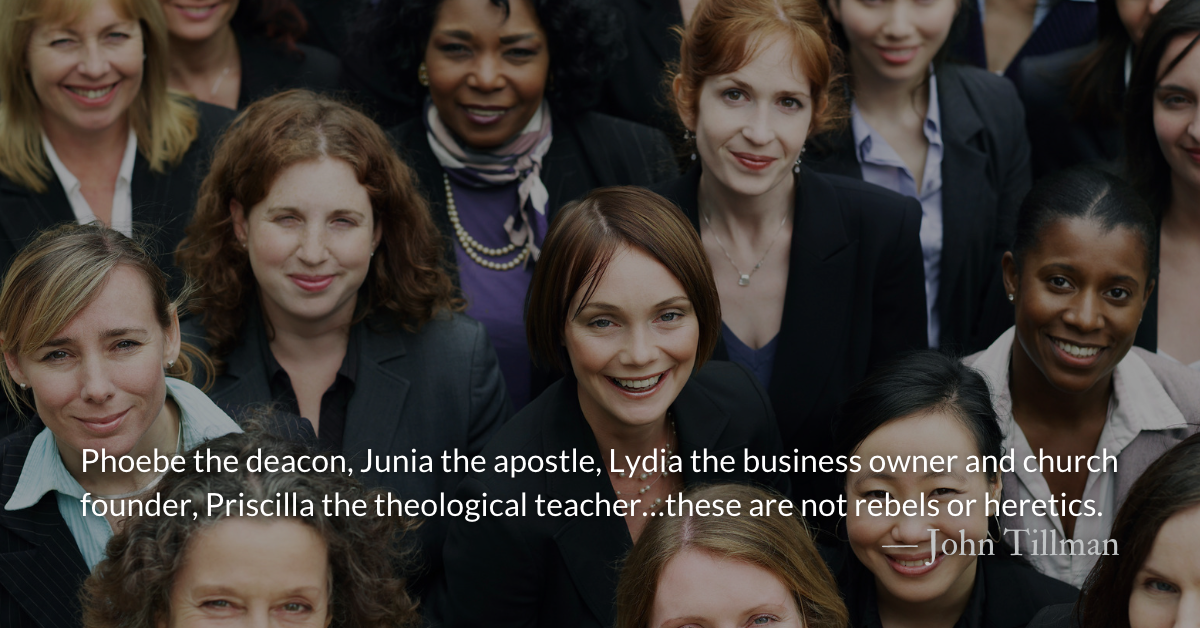
Paul’s treatment of women interprets his words about women. What women did in Paul’s ministry tells us how “submissive” women behave and what they do. Phoebe the deacon, Junia the apostle, Lydia the business owner and church founder, Priscilla the theological teacher…these are not rebels or heretics. They are women following Paul’s words, obeying his intent.

We need to read scripture humbly, contextually, and repeatedly. Don’t give up on passages that have been abused or argued over. The Bible has pearls of great price, treasures hidden in fields, and riches of wisdom to be mined. You’ll rarely strike gold with the first turn of a shovel or solve thorny theological problems with the first turn of a page. (Or 400 words of a devotional.)

We’ll find what Paul means by walking in the steps of Paul and of Jesus. With humility and patience, battlefields can once again become peaceful parks.

From John: To go more in depth on this issue and other challenging topics, I recommend McLaughlin’s book, Confronting Christianity. I am, through my church, helping lead a book club of atheists, agnostics, and deconstructed people discussing the book and it is an excellent place to start for those exploring challenging questions about Christianity.


Divine Hours Prayer: A Reading
Jesus taught us, saying: “The kingdom of heaven is like treasure hidden in a field which someone has found; he hides it again, goes off in his joy, sells everything he owns and buys the field. Again, the kingdom of heaven is like a merchant looking for fine pearls; when he finds one of great value he goes and sells everything he owns and buys it.”  — Matthew 13.44-45

– From The Divine Hours: Prayers for Summertime by Phyllis Tickle.

Today’s Readings
Joshua 14-15 (Listen 9:20)
Ephesians 5 (Listen  3:42)

Read more about None Excluded or Excused
For Paul, ministry was collaborative. Paul’s ministry team included all races, men and women, young people and elders, slaves and free, rich and poor.

Read more about No Asterisks
Deborah’s judgeship doesn’t deserve an asterisk…God did not “settle” for Deborah. He chose her.

Ask and Keep Asking

Scripture Focus: Ephesians 1.17-21
17 I keep asking that the God of our Lord Jesus Christ, the glorious Father, may give you the Spirit of wisdom and revelation, so that you may know him better. 18 I pray that the eyes of your heart may be enlightened in order that you may know the hope to which he has called you, the riches of his glorious inheritance in his holy people, 19 and his incomparably great power for us who believe. That power is the same as the mighty strength 20 he exerted when he raised Christ from the dead and seated him at his right hand in the heavenly realms, 21 far above all rule and authority, power and dominion, and every name that is invoked, not only in the present age but also in the one to come.

Reflection: Ask and Keep Asking
By John Tillman

Writing Ephesians, Paul is “an old man” (Philemon 9). He is in chains. Execution and death lie ahead. Yet, in many of his letters from this time, Paul sounds enduringly hopeful.

Paul’s eyes are not set on his current circumstances or on the current state of the church. They are set on the heavenly realm. He speaks little of earthly sufferings, focusing attention on spiritual blessings.

By the sovereignty of Rome, Paul was predestined for trial, suffering, and, eventually, execution. But by the sovereignty of God, Paul was predestined to adoption to sonship through Jesus, to redemption and forgiveness, and to bringing Gentiles into the family of God. By the Holy Spirit’s prompting, Paul’s speaking, and the Ephesians’ hearing, they believed and were included in Christ as heirs to his promises.

There are different types of sovereignty at work in our lives. We live under the sovereignty of governments and employers. There are penalties and benefits predestined by their laws and policies. When we work according to our employment policies, we receive promised wages. Whether we believe in paying our taxes or not, if we don’t pay them, we are predestined for trouble.

By God’s sovereignty, not only the Ephesians but we are included in Christ by hearing and believing the gospel of salvation. (Ephesians 1.13) Like them, we who believe are marked, sealed, and predestined for the glory that is to come.

And like the Ephesians, we also have farther to go. Paul thanked God for their faith but prayed that through the Holy Spirit they would know God better.

Pray this prayer based on Paul’s:
Lord, help us to ask and keep asking that through the Holy Spirit you would grant us greater wisdom, greater enlightenment, greater hope, and greater power.
In this world that seeks to do us harm, these are our daily bread. We cannot survive without them.
Whatever the world has destined for us, Lord, work out everything in conformity with the purpose of your will.
Your Holy Spirit guarantees that we are your possession. We do not belong to the world.
Through whatever suffering, whether loss of life or comfort, let no harsh treatment make our speech harsh or our hearts hard.
Let your resurrection power not only resurrect our bodies should we die, but resurrect our compassion, our love, our goodness, our humility, and our generosity while we live.

Divine Hours Prayer: The Refrain for the Morning Lessons
Help me, O Lord my God; save me for your mercy’s sake. — Psalm 109.25

– From The Divine Hours: Prayers for Summertime by Phyllis Tickle.

Today’s Readings
Joshua 9 (Listen 3:46)
Ephesians 1 (Listen  3:10)

Today’s Readings
Joshua 10 (Listen 7:23) Ephesians 2 (Listen  3:04)
Joshua 11 (Listen 3:52) Ephesians 3 (Listen  2:41)

Read more about The Consequence of Carelessness
There are times when the monotony of life creates an apathy toward caution.

Read The Bible With Us
There is joy to be found in the scriptures. Read the Bible with us at a sustainable, two-year pace.

https://mailchi.mp/theparkforum/m-f-daily-email-devotional

Show Buttons
Hide Buttons
Spur a spiritual rhythm of refreshment right in your inbox
By joining this email list you are giving us permission to send you devotional emails each weekday and to communicate occasionally regarding other aspects of the ministry.
100% Privacy. We don't spam.