

Links for today’s readings:
Apr 20 Read: Amos 4 Listen: (2:21) Read: Matthew 24 Listen: (5:59)
Scripture Focus: Amos 4.1-3
1 Hear this word, you cows of Bashan on Mount Samaria,
you women who oppress the poor and crush the needy
and say to your husbands, “Bring us some drinks!”
2 The Sovereign Lord has sworn by his holiness:
“The time will surely come
when you will be taken away with hooks,
the last of you with fishhooks.
3 You will each go straight out
through breaches in the wall,
and you will be cast out toward Harmon,”
declares the Lord.
Reflection: Fat Cows and Fat Cats
By John Tillman
Amos called Samaria’s women “cows of Bashan.” He wasn’t body shaming, but he was drawing attention to shameful things.
Just as the poet of Song of Songs was not insulting the bride by saying her hair was like a flock of goats (Song of Songs 4.1; 6.5), Amos was not insulting the physical appearance of these women by comparing them to prize cattle.
The region of Bashan was a symbol of wealth and power. Bashan had rugged mountains and terrain (Psalm 68.15-16), towering forests of strong trees (Ezekiel 27.6; Isaiah 2:12-14; Zechariah 11.2), and strong, well-fed cattle of all kinds. These fattened animals were desirable for eating (Ezekiel 39.18) and for sacrifices.
In agrarian societies, cattle are a symbol of culture and wealth. This is why Pharaoh saw fat and skinny cows in his warning dream about the famine. (Genesis 41.1-4) Amos’s “fat cow” metaphor is less instinctive to our finance-driven society, but “fat cats,” which is similarly unrelated to physical appearance, still resonates today. 1920s journalists coined “fat cats” to shame ultrawealthy industrialists and robber-barons who had outsized influence on political campaigns and public policy. Their influence contributed to increasing poverty and the Great Depression.
Amos shamed the wanton appetites and greed of Samaria’s society that contributed to the oppression of the poor. Their hearts, not their bodies, were misshapen and we can find the same “heart” in our society. Amos would not have to look far today to find “cows of Bashan” and “fat cats” and we don’t either.
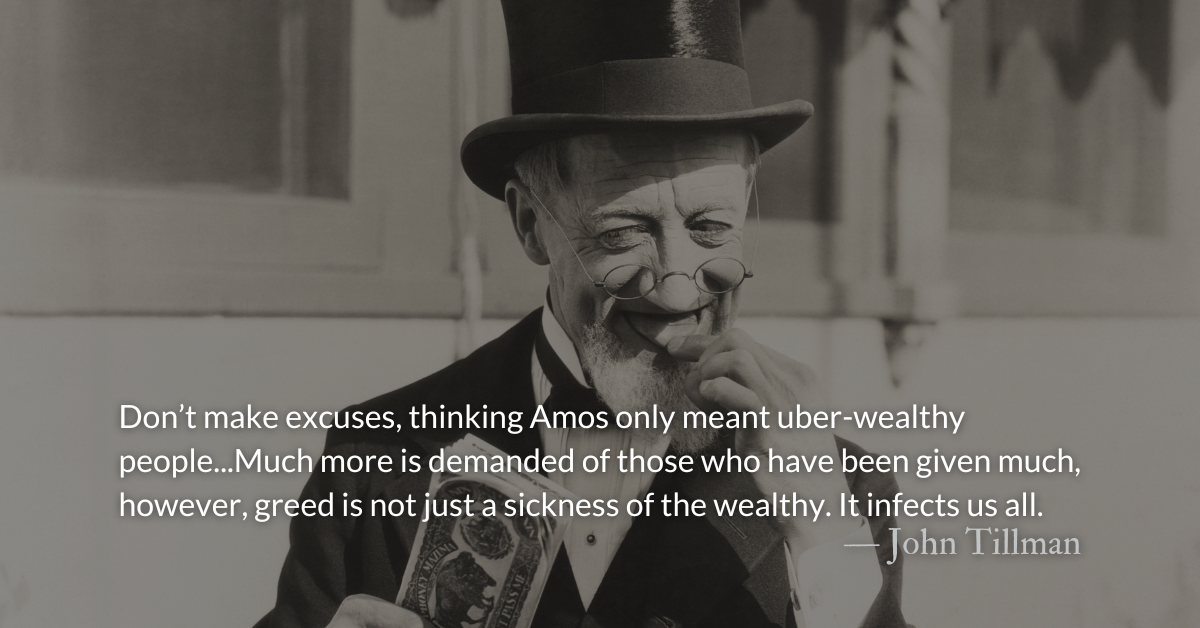
Don’t make excuses, thinking Amos only meant uber-wealthy people. His condemnation is broader. Amos wasn’t just talking about rich women—he included everyone. Take the log from your eye first. (Luke 6.41-42) Much more is demanded of those who have been given much (Luke 12.48), however, greed is not just a sickness of the wealthy. It infects us all.
Our society promotes and celebrates unfettered appetites of greed and pleasure. If you want it, you need it. If you need it, you take it. Or, better yet, force someone to give it to you. We cannot sit in this river passively—we’ll be swept away to destruction. We must constantly resist the current by paddling toward mercy, benevolence, and equal justice and anchoring ourselves to the generosity of Christ.
Like God, look at the heart, not outward appearance. (1 Samuel 16.7) It is shameful for those blessed by the generosity of Jesus to find our hearts shaped by greed. Continually confess and repent this cultural influence of greed and power.
Divine Hours Prayer: The Request for Presence
For the sake of your Name, lead and guide me. — Psalm 31.3
– From The Divine Hours: Prayers for Springtime by Phyllis Tickle
Read more: Prepared to Meet God
Through the mediation of Jesus, we can prepare to meet God with confidence.
Read more: Cherishing Chaff
Many things the disciples prized, Jesus recognized as poison. Many things they cherished Jesus called chaff in the wind.

