
Waiting at the Beautiful Gate — Readers’ Choice

Scripture Focus: Acts 3.6-8
6 Then Peter said, “Silver or gold I do not have, but what I do have I give you. In the name of Jesus Christ of Nazareth, walk.” 7 Taking him by the right hand, he helped him up, and instantly the man’s feet and ankles became strong. 8 He jumped to his feet and began to walk. Then he went with them into the temple courts, walking and jumping, and praising God. 

Originally published on April 3, 2023, based on readings from Acts 3.

Readers’ Choice posts are selected by our readers:
Marisa, Phoenix, Arizona — I love the encouragement that we, the church need to respond and act. That people are waiting on us to be His hands and feet. And this quote in particular- “Jesus did not ‘miss’ this man. He left him for Peter and John. This man was waiting to be healed, not by Christ, but by his disciples—by his church.”

Reflection: Waiting at the Beautiful Gate — Readers’ Choice
By John Tillman

The man Peter and John heal in this passage is a man who waited. 

We do not know the full extent of his deformity, only that he was lame from birth and that its severity was such that he had to be carried to the Temple. We know that he was over forty years old and was such a fixture at the Temple that everyone recognized him. It seems likely that he had been there for most of his life

It is possible this man was present, begging outside the Temple, during Jesus’ first visit when Christ, as a twelve-year-old stunned the teachers with his questions and answers. Not that the man would have heard the debate, being excluded from entering or worshiping at the Temple.

Doubtless, Peter and John had walked by this lame man before in the presence of Jesus. Perhaps they had not noticed the man then. Maybe they were engrossed in theological debate or maybe looking in wonder at the massive stones of the Temple that Jesus then prophesied would soon be thrown down.

Living in Jerusalem, this man certainly knew about Jesus. He may have even seen Jesus. But Jesus had passed him by.

Jesus did not “miss” this man. He left him for Peter and John. This man was waiting to be healed, not by Christ, but by his disciples—by his church.

Jesus has left his church work to do in this world. There are people left out of the kingdom. There are people injured and hurt by the religious and by the irreligious. There are men and women lamed and abandoned by the world. There are unwanted masses that yearn to be free.

They are waiting for us at the Beautiful Gate. We are their miracle. 

The suffering children? They are waiting for us.
The unwanted refugees? They are waiting for us.
The diseased and uneducated? They are waiting for us.
The condemned and shunned? They are waiting for us.

Not for the Democrats. Not for the Republicans. For the church.

Jesus didn’t give us the Holy Spirit for warm, fuzzy feelings in our sanctuaries. The Holy Spirit is given to us to heal those too scarred, scared, deformed, and broken to dare enter the sanctuary. 

When we act in healing ways through the Spirit’s power, the formerly broken will leap, run, and skip into God’s presence as the lame man leaped through the gates of the Temple, praising the name of God.


Divine Hours Prayer: The Request for Presence
Hide not your face from your servant; be swift and answer me…Draw near and redeem me… — Psalm 69.19-20

– From The Divine Hours: Prayers for Summertime by Phyllis Tickle.

Today’s Readings
1 Samuel 9 (Listen 4:42)
2 Peter 1 (Listen 3:06)

Read more about Jesus, our Restorer
Even in the intensity of his own suffering, Christ healed those Peter attacked and forgave those Peter cursed at.

Read The Bible With Us
It’s never too late to join our Bible reading plan. Find joy in the Bible with us at a sustainable, two-year pace.

https://mailchi.mp/theparkforum/m-f-daily-email-devotional

Spiritual Twins — Readers’ Choice

Scripture Focus: Genesis 33:3-4
3 He himself went on ahead and bowed down to the ground seven times as he approached his brother.
4 But Esau ran to meet Jacob and embraced him; he threw his arms around his neck and kissed him. And they wept. 

Originally published on February 1, 2023, based on readings from Genesis 33.

Readers’ Choice posts are selected by our readers:
Peter, Los Angeles — Thank you so much for this reminder to focus on our common bond (rather than on the less significant differences). May we, as God’s children, show humility and forgiveness to our estranged siblings!

Russell, Japan — This is so good! Thank you!

Barbara, Tennessee — Merciful healing posture, yes!

Reflection: Spiritual Twins — Readers’ Choice
By Erin Newton

Before 2016, when I read the story of Jacob and Esau, I thought the note about their twin birth was a random fact. After having twins of my own, I’ve had a front-row seat to their unique relationship. Like brothers, they are the best of friends and, sometimes, the worst of friends. Despite the quarrels, they are closer than any other.

Jacob and Esau are usually thought of as enemies. One loved, one unloved. Israel versus Edom. Jacob was the trickster and Esau was impulsive. In the New Testament, Esau is always labeled for his quickness to sell his birthright for a meal. A poor choice, to say the least, but he did something more memorable.

Esau was angry enough to kill Jacob. But time had passed. Jacob had been the victim of someone else’s trickery. God allowed Jacob to learn his lesson from Laban’s hand, instead of vengeance from Esau.

Forget the birthright-stew debacle. Remember when Esau showed unmerited forgiveness. He loved his brother. He ran to him. He hugged him. He wept. The reunion of Jacob and Esau is a picture of brotherly love. 

Both brothers humbled themselves. Esau laid aside his grudge. Jacob laid aside his pride. Time healed some of the wounds, but humility brought peace. 

When Esau saw the face of Jacob and Jacob looked at the face of Esau, they saw themselves. Twins. Sure, Esau’s a bit hairier than Jacob but they share the same genes. Both were sons of Isaac and probably looked like their father.

My twins are identical, but you’d never know it. There was a problem in the womb, and now the scars and diagnoses create a visible distinction. But technically, each twin is a perfect donor match to the other. They can heal one another if needed. A better “eye for an eye.”

The Bible calls believers “brothers and sisters” in Christ. We are a kind of identical, spiritual twins. We have different scars, our environment shaped us differently, but we’re bonded together. We see each other and see ourselves, as children of the Father.

Look into the faces of those around you. Your friends and your neighbors, the barista and the doctor, a child with disabilities, and an octogenarian with a walker—these people reflect the image of your Father.

Grudges and pride must die. Run. Hug. Weep. These people are your brothers (and sisters). One God, Father of all (Ephesians 4.2-6).


Divine Hours Prayer: The Request for Presence
Save us, O Lord our God, and gather us from among the nations, that we may give thanks to your holy Name and glory in your praise. — Psalm 106.47


– From The Divine Hours: Prayers for Summertime by Phyllis Tickle.

Today’s Readings
1 Samuel 7-8 (Listen 5:34)
2 Timothy 4 (Listen 2:48)

Read more about Running to Forgive
A prodigal son approaches home…limping…fearful of rejection…the wronged party embraces him and kisses him. It’s Esau running to meet Jacob.

Read more about Supporting Our Work
This ministry relies on support from readers like you. Consider joining our donors and supporting ad-free content that brings biblical devotionals to inboxes across the world.

An Accepting Father — Readers’ Choice

Scripture Focus: Matthew 1.24-25
24 When Joseph woke up, he did what the angel of the Lord had commanded him and took Mary home as his wife. 25 But he did not consummate their marriage until she gave birth to a son. And he gave him the name Jesus.

Originally published on February 7, 2023, based on readings from Matthew 1.
Readers’ Choice posts are selected by our readers:

Janice, Louisiana — This was such a relevant devotion today. We covered Matthew 1 in our Inductive Bible Study last night and spent quite a bit of time on Joseph’s actions after learning of Mary’s conception. I’ve instinctively known how that Joseph’s actions were not typical of that time and that he acted in faith but the discussion last night really drove home the significance of his actions.

Lucy, Texas — Put this down as one of my favorites this year.
Reflection: An Accepting Father — Readers’ Choice
By John Tillman

Headings in scripture are not part of the original texts. There are no hard or fast guidelines on what sections should get a heading and which should not. Though these headings are not part of the Inspired Word of God, they are inspired by the Word. They are inserted by the scholars, editors, and publishers of the particular printings of the Bibles we choose. Their function is merely to help readers visually scan or skim for the section we are looking for.

Between verses 17 and 18 of the first chapter of Matthew, many English Bibles include a heading. The simplest heading is in The Message, which says, “The Birth of Jesus.” The NLT gets theological, saying, “The Birth of Jesus the Messiah.” The ESV inserts the Greek title for Messiah, saying, “The Birth of Jesus Christ.” The NKJV mentions Mary, saying, “Christ born of Mary.” The HCSB uses a fancier word for birth, saying, “The Nativity of the Messiah.” The NASB adds the Holy Spirit’s role, saying, “The Conception and Birth of Jesus.” The KJV and WEB leave this section of scripture unadorned, saying nothing at all.

But the NIV adds a radically different heading, with an emphasis on relationships and story: “Joseph Accepts Jesus as His Son.” It’s like a mini-devotional all laid out in six words.

Most of what we know about Joseph comes from Matthew. No author recorded his words, but Matthew recorded his heart and motivations. Joseph was faithful to the law—a righteous man. Yet despite what it seemed that Mary had done, he was merciful, not demanding the law’s punishment. He was a cautious man and obedient to God’s will. 

As with his ancestor, Joseph, (Genesis 37.5-7; 40.8) God spoke to Joseph of Nazareth in dreams. (Numbers 12.6; Matthew 1.20; 2.13) Joseph understood the implications of Isaiah, of the name, “Immanuel” and the name, “Jesus.” As surely as Mary welcomed Jesus, Joseph did as well. This dreamer, Joseph, was willing to take in this mysterious son who was not his son.

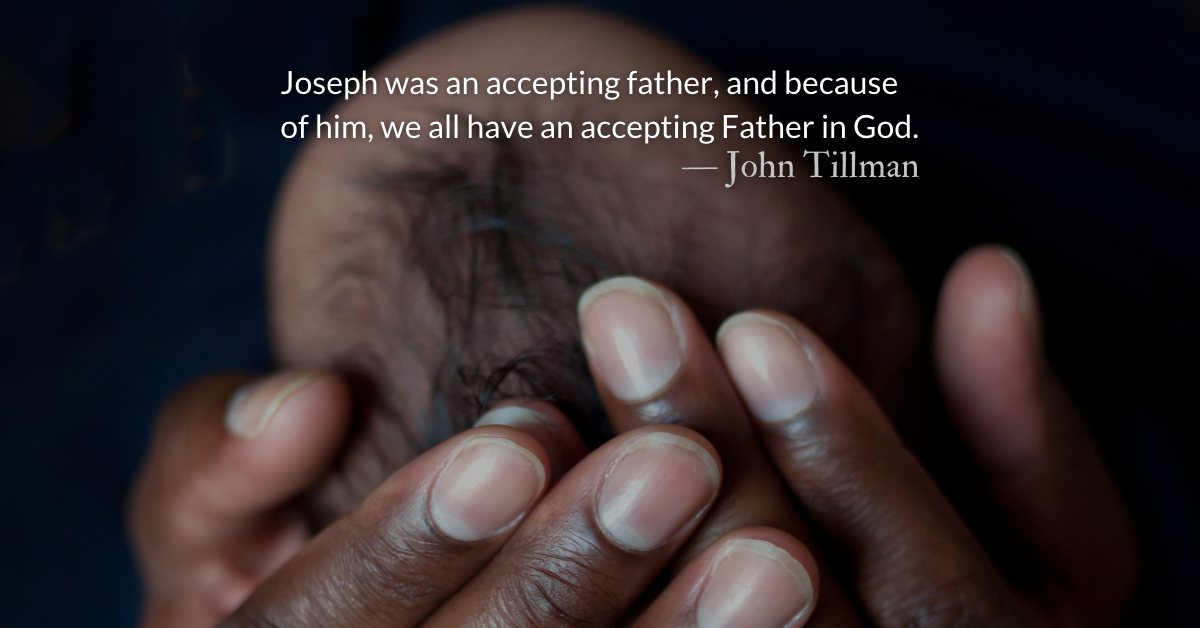
The “son of David,” Joseph, accepted The Son of David, Jesus, as his son. Because of this, we can be accepted by Jesus the Son of David as sons and daughters of God. Joseph was an accepting father, and because of his obedience, we all have an accepting Father in God. Despite what we have done, God is merciful, accepting us as his children.


Divine Hours Prayer: The Refrain for the Morning Lessons
I have made a covenant with my chosen one; I have sworn an oath to David my servant:
“I will establish your line forever, and preserve your throne for all generations.” — Psalm 89.3-4

– From The Divine Hours: Prayers for Summertime by Phyllis Tickle.


Today’s Readings
1 Samuel 5-6 (Listen 6:03)
2 Timothy 3 (Listen 2:21)

Read more about Dream Like Joseph
May we pray and dream as Joseph did. For only with a spiritual connection can we do what we must as a part of our calling.

Read more about Supporting Our Work
The Park Forum strives to provide short, smart, engaging, biblical content to people across the world for free with no ads. Please consider supporting our work.

Better Unborn — Readers’ Choice

Scripture Focus: Jeremiah 20:7, 14, 18
7 You deceived me, Lord, and I was deceived;
    you overpowered me and prevailed.
I am ridiculed all day long;
    everyone mocks me.
14 Cursed be the day I was born!
    May the day my mother bore me not be blessed!
18 Why did I ever come out of the womb
    to see trouble and sorrow
    and to end my days in shame?

Originally published on August 26, 2022, based on readings from Jeremiah 20.

Readers’ Choice posts are selected by our readers:
Barbara, Tennessee — Thank you!

Reflection: Better Unborn — Readers’ Choice
By Erin Newton

Thank God for raw emotions in the Bible. Jeremiah has suffered greatly because of the message to his fellow people. He has called out their sin and they have sought his life in return. He curses his own birth.

Jeremiah’s complaints are sprinkled with positive exaltations of God. He calls God a mighty warrior who thwarts the plans of the wicked. He raises the exhortation to praise God and sing to him. But within the next few words, the prophet returns to wishing he had never been born.

Job also declares that people “are of few days and full of trouble” and asks God to look away and leave them alone (Job 14.1-6). Ecclesiastes states that the dead are better off than the living (Ecclesiastes 4.1-3).We often think that being a Christian means we are constantly at peace with how God works in our lives or that we have some sort of impervious happiness. Neither of these things are true.

Psalm 42 provides another insight into the emotional ups and downs in suffering. The psalmist declares that “tears have been my food.” Then he remembers the joy of festivals. But the depressive thoughts continue, “Why, my soul, are you downcast?” The psalmist tries to counsel himself, searching for the cause of the sadness and trying to cheer himself with thoughts of God.

Neither Jeremiah nor the psalmist ends with a convincingly cheerful attitude. The psalmist repeats the searching question of his downcast soul and affirms that he will continue to hope in God. Jeremiah, too, ends with wishing he had never been born yet admits that even if he tried to withhold God’s message, he would not be able to contain it.

We will face times of pain, grief, and sorrow. It is a lie to think that we shouldn’t wrestle with the pain or disappointment of how our lives are going. It is normal to feel ready to give up, regret answering God’s call, and wish we could go where no one can reach us.

However, we see their example of perseverance. They are sad but they continue. The psalmist vows to keep hoping. Jeremiah continues to share God’s message. No one suffers alone. We are called to bear one another’s burdens. We all feel like Jeremiah at one point or another. Reach out to your friends. Help one another remember the Lord and cling to hope.

Divine Hours Prayer: The Cry of the Church
O God, come to my assistance! O Lord, make haste to help me!


– From The Divine Hours: Prayers for Summertime by Phyllis Tickle.

Today’s Readings
1 Samuel 4 (Listen 3:56)
2 Timothy 2 (Listen 3:17)

Read more about From the Belly of the Beast
Sooner or later we all experience the belly of the beast—sinking in the darkest hole of our lives…

Read more about Supporting Our Work
Please consider becoming a donor. Without the support of our donors, we could not continue publishing ad-free biblical devotionals to inboxes across the world.

Transformed by Koinonia  — Readers’ Choice

Scripture Focus: Philippians 1.4-6
4 In all my prayers for all of you, I always pray with joy 5 because of your partnership in the gospel from the first day until now, 6 being confident of this, that he who began a good work in you will carry it on to completion until the day of Christ Jesus.

Originally published on July 13, 2023, based on readings from Philippians 1.

Readers’ Choice posts are selected by our readers:
Gloria, Texas — I work with missionaries who serve all over the world and this makes me think of their work, their fellowship with other believers (even if far from them), and their connection to the Lord that gives them strength to keep serving…they are working to see more people transformed by koinonia.

Reflection: Transformed by Koinonia  — Readers’ Choice
By John Tillman

The word Paul uses to describe the partnership that he feels with the Philippian church is koinonia. Like many Greek words, it has multiple shades of meaning. The word in English primarily refers to the “fellowship” of the church as a community. This meaning is not incorrect, but another interpretation is of being a business partner or having a “share” or investment together in a business. 

Paul knows what it is to have partners in business, having supported himself at times through the skilled trade of tentmaking which he had in common with Priscilla and Aquila. However, the business to which Paul is referring, that we all have a share in, is the gospel.

The business of the gospel is the “putting right” of everything in the cosmos. And the means by which we do so is by “fellowship” or “partnership” with Christ Jesus, whose work continues until “the day of Christ Jesus.” There is no koinonia with Christ without change.

In this phrase, Paul is redefining the ancient Jewish concept of the “Day of the Lord.” This is the “last day” to which Martha refers when discussing her brother Lazarus’s future resurrection and is sometimes called the “eighth day” to symbolize that God is both ending and renewing creation.

This is a day when all will be put right. The day of Lord will be a day of leveling. It will mean tearing down those who have built themselves up and lifting up those who have been crushed.  Earth will be transformed into another place—a place in keeping with all that God desires for us, but we are too foolish to ask for or seek.

Christ’s correction of the cosmos is not limited to all that is without us but includes all that is within us. It is not just Earth that will be transformed but Earthlings. We, each of us, have an inner cosmos that must succumb to a “Day of the Lord” transformation. Within us are exalted idols and habits that must be torn down. Within us are fruits of the spirit that we have trampled under selfish feet.

As we submit to him, Jesus will, with axe and fire, tear down in us what must burn, and with tender nourishing care will tend and cultivate the fruit that he always designed to grow in us. Christ is our partner and our koinonia with him means every trial, suffering, isolation, loss, and sadness, shall work together for our betterment, strengthening, and righteousness.


Divine Hours Prayer: The Refrain for the Morning Lessons
One thing have I asked of the Lord; one thing I seek; that I may dwell in the house of the Lord all the days of my life… — Psalm 27.5


– From The Divine Hours: Prayers for Summertime by Phyllis Tickle.

Today’s Readings
1 Samuel 1 (Listen 4:13)
Hebrews 12 (Listen 4:36)

This Weekend’s Readings
1 Samuel 2 (Listen 6:09)Hebrews 13 (Listen 3:31)
1 Samuel 3 (Listen 3:03), 2 Timothy 1 (Listen 2:37)

Read more about A Rebellion of Repentance
The repentance John describes is a rebellion more radical than violent insurrection.

Read The Bible With Us
You can join our Bible reading plan at any time and reflect on the whole Bible with us at a sustainable, two-year pace.

https://mailchi.mp/theparkforum/m-f-daily-email-devotional