Mary’s Story — Love of Advent

Scripture Focus: Matthew 1.1, 16
1 This is the genealogy of Jesus the Messiah the son of David, the son of Abraham:
16 and Jacob the father of Joseph, the husband of Mary, and Mary was the mother of Jesus who is called the Messiah.

Luke 1.28
28 The angel went to her and said, “Greetings, you who are highly favored! The Lord is with you.”

Reflection: Mary’s Story — Love of Advent
By Erin Newton

These are the matriarchs of Jesus: Tamar, Rahab, Ruth, Bathsheba, and Mary. This is Mary’s story.

Unlike the other matriarchs of Jesus’s lineage, Mary is the focus of a multitude of hymns and prayers. She is the feature of paintings with token blue robes and a golden halo. As the mother of Jesus, she adorns nearly every nativity scene and features prominently in Advent messages.

The angel calls her “highly favored” and Elizabeth heralds her as “blessed among women.” Mary is well-known, famous to be precise. She is the foremost saint in the Catholic church. We know her story well.

Mary is the easiest character to place in the genealogy. Her story doesn’t center around abuse or widowhood. Yet we know she suffered for the task placed upon her. Her husband was not evil like Er, or sickly like Mahlon or Kilion, or murdered like Uriah. But Joseph was tempted to leave her child fatherless.

Her status as an unwed, pregnant young woman was met with skepticism and doubts. She was outcast in some ways—like Ruth, Rahab, Tamar, and Bathsheba. But Joseph stayed by her side, more like a Boaz than a David. No hand was laid upon her body, more loving than Judah or the men of Jericho.

Mary was a Jew. She did not have to struggle with a foreign culture. She could stay among family and provide safe haven for the Messiah inside.

Mary’s greatest asset to the world was her faithfulness. As men had chosen women before for their bodies; Mary was divinely chosen for her faith. Advent paints a rare and shockingly different picture of love.

Her story is unique, being the only divine conception that ever existed. But in some ways, she’s rather typical and expected. Her past is not powerfully redeemed. Her heritage was not amazingly rewritten.

She is well-known and respected. Her presence demands honor and dignity. Her burdens, disadvantages, and crises are seen as a badge of honor for the one who carries God in her womb.

She is the mother of Jesus. Mary, a woman of faith is chosen and honored as one of five women named in Jesus’s family.

In the love of Jesus belong the ordinarily faithful.

God can dramatically transform, and God can dramatically indwell. No matter our story, we belong within the love of Jesus. Advent invites us to a place of belonging.

Divine Hours Prayer: The Request for Presence
Lead me, O Lord, in your righteousness,… make your way straight before me. — Psalm 5.8

– From The Divine Hours: Prayers for Summertime by Phyllis Tickle.

Today’s Readings
2 Chronicles 17  (Listen 2:48)
Psalms 119.121-144 (Listen 15:14)

This Weekend’s Readings
2 Chronicles 18  (Listen 5:51Psalms 119.145-176 (Listen 15:14)
2 Chronicles 19-20  (Listen 8:09Psalms 120-122 (Listen 2:12)

Read more about Pause To Read
On Pause to Read, a podcast by The Park Forum, we read a devotional from the past year and encourage listeners to pause to read the scripture before continuing to listen to the devotional.

Read more about Supporting Our Work
We could not continue, much less expand our work, without our donors. Please consider joining them to support ad-free biblical devotional content to readers and listeners across the world.

Zealous Correction and Healing — Hope of Advent

Scripture Focus: 2 Chronicles 7.11-16
11 When Solomon had finished the temple of the Lord and the royal palace, and had succeeded in carrying out all he had in mind to do in the temple of the Lord and in his own palace, 12 the Lord appeared to him at night and said: 
“I have heard your prayer and have chosen this place for myself as a temple for sacrifices. 
13 “When I shut up the heavens so that there is no rain, or command locusts to devour the land or send a plague among my people, 14 if my people, who are called by my name, will humble themselves and pray and seek my face and turn from their wicked ways, then I will hear from heaven, and I will forgive their sin and will heal their land. 15 Now my eyes will be open and my ears attentive to the prayers offered in this place. 16 I have chosen and consecrated this temple so that my Name may be there forever. My eyes and my heart will always be there. 

Luke 2.45-49
45 When they did not find him, they went back to Jerusalem to look for him. 46 After three days they found him in the temple courts, sitting among the teachers, listening to them and asking them questions. 47 Everyone who heard him was amazed at his understanding and his answers. 48 When his parents saw him, they were astonished. His mother said to him, “Son, why have you treated us like this? Your father and I have been anxiously searching for you.” 
49 “Why were you searching for me?” he asked. “Didn’t you know I had to be in my Father’s house?”

Reflection: Zealous Correction and Healing — Hope of Advent
By John Tillman

God promised Solomon that his eyes, ears, and heart would always be in the Temple and attentive to those who sought him there. But, God warned that if they turned away and abandoned him, he would reject Solomon’s Temple, destroy it, and exile his people away from the Temple and his presence. The slide into idolatry began quickly. Soon, Solomon built other temples for false gods and joined in worshiping there.

By the time Jesus visited Jerusalem, Solomon’s Temple had been destroyed and burnt with fire. Jesus entered a rebuilt version. However, Jesus’ eyes, ears, and heart still longed to be there, engaging in his father’s business.

One of the humorous mysteries of the incarnation is imagining adults teaching young Jesus about the world he created and the scriptures he inspired. Imagine him, who filled the hearts of psalmists until they burst with poetry, learning to sing words he shaped. Imagine him, who spoke through Isaiah and other prophets about the minute details of his life, ministry, and death, sitting in Nazareth’s Hebrew school listening to a teacher interpret Isaiah’s words without realizing they are about him. Imagine Jesus, who “knew what was in each person” (John 2.24-25), learning ethics from a pharisee who will “devour widows’ houses and for a show make lengthy prayers.” (Mark 12.40)

For Jesus, God’s house was the Temple, flawed as it was. Like today, corruption in religious circles was rampant, and religious leaders were more concerned about political power than truth or justice. Jesus showed us an example of maintaining zeal for God’s house in his life, but that zeal didn’t mean warm, fuzzy nostalgia or not rocking the boat. Every time Jesus came to the Temple, there was something to confront. In the Temple, Jesus deconstructed hypocrisy, repaired the foundations of faith, healed broken bodies, mended broken hearts, and corrected crooked teaching. Don’t we hope for that today?

For us, God’s house is the church, flawed as it is. Advent tells us Jesus is coming. To our churches. To our cities. To us. His eyes, ears, and heart are in his church today. What might Jesus see, hear, and feel in our churches? Will he long to stay? Will he find us doing his father’s business?

Thank God, Jesus is zealous for imperfect people and places! May his Advent bring zealous correction for our errors and healing for our weaknesses.


Divine Hours Prayer: The Refrain for the Morning Lessons
Blessed is he who comes in the name of the lord; we bless you from the house of the Lord. — Psalm 118.26 

– From The Divine Hours: Prayers for Summertime by Phyllis Tickle.


Today’s Readings
2 Chronicles 7  (Listen 4:07)
Psalms 114-115 (Listen 2:18)

Read more about Better Temples
Jesus’ life stands, like the Temple, as a miraculous work of God. He is the promised one who fulfills all of God’s promises.

Read more about Supporting Our Work
Please consider becoming a donor. Your support is needed for us to continue our work.

Exclusive Claims, Inclusive Hope — Hope of Advent

Scripture Focus: 2 Chronicles 6.18-21
​​18 “But will God really dwell on earth with humans? The heavens, even the highest heavens, cannot contain you. How much less this temple I have built! 19 Yet, Lord my God, give attention to your servant’s prayer and his plea for mercy. Hear the cry and the prayer that your servant is praying in your presence. 20 May your eyes be open toward this temple day and night, this place of which you said you would put your Name there. May you hear the prayer your servant prays toward this place. 21 Hear the supplications of your servant and of your people Israel when they pray toward this place. Hear from heaven, your dwelling place; and when you hear, forgive.

Luke 2.28-38
28 Simeon took him in his arms and praised God, saying: 
29 “Sovereign Lord, as you have promised, 
you may now dismiss your servant in peace. 
30 For my eyes have seen your salvation, 
31 which you have prepared in the sight of all nations: 
32 a light for revelation to the Gentiles, 
and the glory of your people Israel.” 

36 There was also a prophet, Anna, the daughter of Penuel, of the tribe of Asher. She was very old; she had lived with her husband seven years after her marriage, 37 and then was a widow until she was eighty-four. She never left the temple but worshiped night and day, fasting and praying. 38 Coming up to them at that very moment, she gave thanks to God and spoke about the child to all who were looking forward to the redemption of Jerusalem.

Reflection: Exclusive Claims, Inclusive Hope — Hope of Advent
By John Tillman

It was a common belief in the ancient world that gods were territorial.

When Assyria conquered the northern kingdom of Israel they exiled much of the population and imported captured peoples from other regions to take their place. When animal attacks became a problem, the Assyrians reasoned that the imported non-Israelites were not properly worshiping “the god of that country,” so they sent back an Israelite priest to train the foreigners in worshiping Yahweh. (2 Kings 17.26-28)

Jews did not worship Yahweh as a regional god. Yahweh was God in Israel, Judah, Egypt, Assyria, Babylon, and everywhere else. Yet, they still struggled to comprehend God’s presence. Solomon marveled that God’s presence would enter the Temple when even the highest heavens failed to contain him. Solomon pondered how this everywhere-god could “dwell on earth with humans.”

God’s enormity does not limit his intimacy, and Solomon’s Temple is not the smallest or humblest place God will enter.

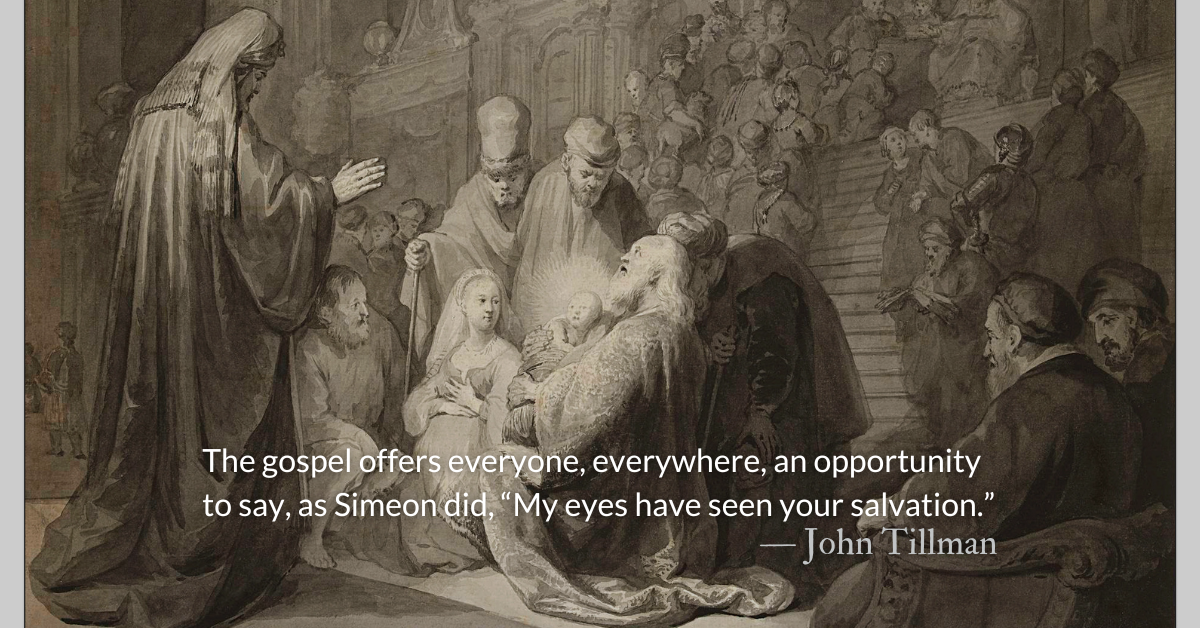
Centuries later, standing in a reconstructed Temple, Simeon held in his arms the same presence that filled Solomon’s Temple. The prophetess Anna, who never left God’s presence in the Temple, recognized it in Jesus and proclaimed about him to Jerusalem.

How astounded Solomon would be at Simeon standing in the Temple holding Jesus in his arms! How astounded we should still be!

Yahweh is God, and Jesus is Lord everywhere, at all times, all at once. This exclusive claim was odd to some and offensive to others. “Who is the Lord that I should obey him?” (Exodus 5.2) “Bow down before this statue I have made!” (Daniel 3.15) “Great is Artemis of the Ephesians!” (Acts 19.34)

Exclusive claims are no less odd or insulting today. Christians face versions of these same objections now. “Why should I obey God?” “You must assent to and support my belief!” “My belief is greater than yours!”

God’s exclusivity is not a bragging point or an insult. Our hope is exclusively in God yet inclusively welcomes all people. Jesus is the light of the world, not the light of our region, race, or nation. His existence is exclusive—He is the only God. His invitation is inclusive—He will be anyone’s God.

The gospel offers everyone, everywhere, an opportunity to say, as Simeon did, “My eyes have seen your salvation.” God is their God, too. Jesus loves them, too. He longs for them and desires to come closer to them than Solomon, Simeon, or Anna could imagine.


Divine Hours Prayer: The Refrain for the Morning Lessons
With my whole heart I seek you; let me not stray from your commandments. — Psalm 119.10

– From The Divine Hours: Prayers for Summertime by Phyllis Tickle.


Today’s Readings
2 Chronicles 6.11-42  (Listen 7:17)
Psalms 112-113 (Listen 1:49)

Read more about He Stoops to Raise
The equally interesting, intimate glory of God is how infinitely small he is willing to shrink in order to meet us, save us, and lift us up.

Read more about Supporting Our Work
Will you help support ad-free content that brings biblical devotionals to inboxes across the world? Join our donors with a one-time or recurring donation.

Mercy Seat and Manger — Hope of Advent

Scripture Focus: 2 Chronicles 3.1
1 Then Solomon began to build the temple of the Lord in Jerusalem on Mount Moriah, where the Lord had appeared to his father David. It was on the threshing floor of Araunah the Jebusite, the place provided by David.

Luke 1.34-38
34 “How will this be,” Mary asked the angel, “since I am a virgin?”

35 The angel answered, “The Holy Spirit will come on you, and the power of the Most High will overshadow you. So the holy one to be born will be called the Son of God. 36 Even Elizabeth your relative is going to have a child in her old age, and she who was said to be unable to conceive is in her sixth month. 37 For no word from God will ever fail.”

38 “I am the Lord’s servant,” Mary answered. “May your word to me be fulfilled.” Then the angel left her.

Reflection: Mercy Seat and Manger — Hope of Advent
By John Tillman

Temples intend to overlap the mundane and the mystical, allowing humans to interact with gods. The holiest place in the Temple was “the mercy seat,” where human guilt was confronted by God’s righteousness and mercy. The Temple site on Mount Moriah was a place of confrontation and sacrifice long before the Temple was built. 

David purchased Araunah’s threshing floor as a place of sacrifice for his own sin. (1 Chronicles 21) David chose plague as punishment, but God stayed the sword of the death angel on the threshing floor. Then David said, “I, the shepherd, have sinned…These are but sheep…let your hand fall on me…do not let this plague remain on your people.”

Abraham was sent to this mountain to offer Isaac as a sacrifice, but God stayed his knife, providing a ram in Isaac’s place and fulfilling Abraham’s promise to Isaac as they traveled, “God himself will provide the lamb.” (Genesis 22.8)

John the Baptizer calls Jesus “the lamb of God” (John 1.29, 36) but also describes him as coming “to clear his threshing floor…gather the wheat into his barn, but…burn up the chaff with unquenchable fire.” (Luke 3.17)

Threshing separates grain from chaff and produces seed and food from grass that would otherwise fade away. It brings life from death. The place where Araunah threshed wheat was a place where the Lord threshed human hearts. It is a place where the holy confronts the unholy. (Isaiah 6.5) In that holiest place, we find mercy and hope.

John says Jesus “tabernacled” among us. (John 1.14) Jesus is where human space overlaps divine space—a Temple that comes to us. Jesus is our mercy seat, the holy one in whom we hope. The mercy seat and the manger represent God’s throne. In the gold-covered room, we glimpse his glory and worth. In the humble manger, he shows us ours.

David met an angel, made a sacrifice, and prepared a place to welcome God’s presence. Generations later, David’s daughter, Mary, did the same to welcome Jesus.

David and Solomon built God a house with rooms covered in gold. Through Mary, Jesus chose to house himself in a poverty-stricken womb.

David, the shepherd, sinned, bringing punishment on his sheep. Jesus, the shepherd, is sinless, taking punishment for his sheep. 

Jesus stays the sword of judgment and knife of sacrifice, providing himself as the lamb.

Jesus threshes life out of death.


Divine Hours Prayer: The Refrain for the Morning Lessons
This is the Lord’s doing, and it is marvelous in our eyes. — Psalm 118.23

– From The Divine Hours: Prayers for Summertime by Phyllis Tickle.


Today’s Readings
2 Chronicles 3-4   (Listen 5:42)
Psalms 108-109 (Listen 4:28)

Read more about Unto Us, He Comes — Hope of Advent
The movements of the heavens tell a story in which Christ comes in at our darkest point to turn the world back to the light.

Read more about Supporting Our Work
Our ad-free content is not free to produce. Join our donors and help bring biblical devotionals to inboxes across the world.
Save Yourself (And Us)

Scripture Focus: Luke 23.35-39
35 The people stood watching, and the rulers even sneered at him. They said, “He saved others; let him save himself if he is God’s Messiah, the Chosen One.”
36 The soldiers also came up and mocked him. They offered him wine vinegar 37 and said, “If you are the king of the Jews, save yourself.”
38 There was a written notice above him, which read: THIS IS THE KING OF THE JEWS.
39 One of the criminals who hung there hurled insults at him: “Aren’t you the Messiah? Save yourself and us!” 

Reflection: Save Yourself (And Us)
By John Tillman

“Save yourself!”
“Save yourself, Jesus!”
“Save yourself and us!”

“Save yourself,” echoed around Jesus with every step toward Jerusalem and the cross. Satan said it. Peter said it. Pilate said it. The religious leaders said it. The crowd said it. The soldiers said it. Even one of the criminals crucified with him said it.

The gospel writers make clear that the cross was not a tragedy or error in judgment. Jesus claimed the religious leaders couldn’t take his life, but that he would lay it down. He claimed angels would defend him if needed, and commanded Peter to abandon the sword. He claimed Pilate had no power over him, yet made no defense. He forgave the shouting crowd, the mocking religious leaders, and the violent soldiers, saying they didn’t comprehend their actions.

Jesus went to Jerusalem, the city that kills the prophets, on purpose. He challenged the powerful. He knew the outcome. Jesus chose the cross. The question we can’t escape is…why?

We live in a “save yourself” culture. We are expected to put ourselves first and save ourselves from everything. We must “bootstrap” our way to success. This is one reason Jesus is foolish (1 Corinthians 1.18) to our culture. He could have saved himself. Instead, he chose to save us.

There is a reason Paul preached, “Christ, and him crucified.” (1 Corinthians 1.22-23; 2.1-3) At the cross, something happened that changed everything. 

“Something … happened on the cross itself, something of earth-shattering meaning and implication, something as a result of which the world was now a different place. A revolution had been launched.” — NT Wright (The Day the Revolution Began)

The second criminal chastised his co-conspirator, saying, “Don’t you fear God?” He understood that Jesus was not being executed by an empire but was inaugurating a kingdom. “Remember me,” the criminal said. He was probably a rebel against Rome but joined a better rebellion through Jesus. 

Like the criminal, we are already condemned. This world is already taking our life. But no matter where you are today or what sins you are condemned for, the cross means you can be saved.

Jesus makes the offer to all. His offer is effectual and real. Like the criminals immobilized on the cross, we can’t do anything to earn what Christ offers. We simply accept or reject his revolutionary kingdom. You can’t save yourself but Jesus saves all those who respond.

Divine Hours Prayer: The Small Verse
Today if you shall hear His voice, harden not your heart.

– From The Divine Hours: Prayers for Springtime by Phyllis Tickle.

Today’s Reading
Leviticus 1(Listen 2:37)
Luke 23(Listen 6:39)

Read More about The Ram and the Cornerstone
Jesus entered Jerusalem like Isaac’s ram on the mountaintop. He rammed his head into the thorns to ensure there would be no escape.

Read More about Demands of Faith
The rebel’s “salvation prayer” is special because it shows us how deep the grace of Jesus reaches.