The Wexford Carol — Carols of Advent Joy

Scripture Focus: John 7.37-28
37 On the last and greatest day of the festival, Jesus stood and said in a loud voice, “Let anyone who is thirsty come to me and drink. 38 Whoever believes in me, as Scripture has said, rivers of living water will flow from within them.”

Luke 1.46-50
46 And Mary said: “My soul glorifies the Lord
47 and my spirit rejoices in God my Savior,
48 for he has been mindful
   of the humble state of his servant.
   From now on all generations will call me blessed,
49 for the Mighty One has done great things for me—
   holy is his name.
50 His mercy extends to those who fear him,
   from generation to generation.

Reflection: The Wexford Carol — Carols of Advent Joy
By Jon Polk

The history of “The Wexford Carol” is uncertain and complicated.

“The Wexford Carol” is one of Ireland’s most beloved Christmas carols. While thought to be among the oldest Christmas carols still in use, the exact dates of its origin are uncertain.

“The Wexford Carol” was published in 1928, in a collection by William Flood, music director at St. Aiden’s Cathedral in Enniscorthy, County Wexford, Ireland, after he had heard it performed by a local vocalist.

However, the song has also been associated with Bishop Luke Waddinge from Ballycogley, County Wexford, who also published the hymn in his collection in 1684. 

The lyrics supposedly originate from the 12th century, but the rhyme and structure appear to date from the 16th century or later. There is also debate whether the original lyrics were actually Irish or English.

Although tracing the history of “The Wexford Carol” is complicated, the song itself is not, being a joyful recounting of the night of Christ’s birth.

Good people all, this Christmas time,
Consider well and bear in mind
What our good God for us has done,
In sending His beloved Son.

The pregnancy of Mary was uncertain and complicated.

A young, simple Jewish girl is found to be pregnant under mysterious and uncertain circumstances. Claims of an angel’s visit and divine proclamation. A fiancé who receives a nocturnal, angelic intervention. 

Likely scared and confused, young Mary hurries off to another town to seek advice from cousin Elizabeth. When Elizabeth is prompted by the Holy Spirit to confirm the miraculous Divinity growing in Mary’s womb, Mary proclaims her joy, “My soul glorifies the Lord and my spirit rejoices in God my Savior!”

Although the pregnancy of Mary was complicated, her ultimate response to God is not, being a joyful acceptance of the role she has been given to play in the divine drama.

With Mary holy we should pray
To God with love this Christmas Day;
In Bethlehem upon the morn
There was a blest Messiah born.

The times in which we live are uncertain and complicated.

The weight of a global pandemic, the stress of political strife on every continent, disparities of power and economic status, all loom large in our collective consciousness, not to mention the personal and specific struggles each of us face on our own.

Although our lives and times are complicated, our response should not be. Let us rejoice along with Mary. Let us take joy in knowing that our lives are secure in the hands of God. 

Within a manger He was laid,
And by His side the virgin maid
Attending to the Lord of Life,
Who came on earth to end all strife.


Listen: The Wexford Carol by Yo-Yo Ma & Alison Krauss
Read: Lyrics from Hymnary.org
Bonus Listen: Magnificat (i.e. Mary’s Song) by Keith & Kristyn Getty

Divine Hours Prayer: The Refrain for the Morning Lessons
Truly, his salvation is very near to those who fear him, that his glory may dwell in our land. — Psalm 85.9

– Divine Hours prayers from The Divine Hours: Prayers for Autumn and Wintertime by Phyllis Tickle

Today’s Readings
Zechariah 4 (Listen – 1:53)
John 7 (Listen – 5:53)

Read more about End of Year Giving and Supporting our work
Why should you give?
Support 100,000 words of free and ad-free content in 2021.

Read more about Accepting Jesus
She takes within her body
The cure for the sickness of sin
She gives the maker of the Garden
Tiny feet to walk earth again.

Good Christian Men, Rejoice — Carols of Advent Joy

Scripture Focus: John 5.24-26
24 “Very truly I tell you, whoever hears my word and believes him who sent me has eternal life and will not be judged but has crossed over from death to life. 25 Very truly I tell you, a time is coming and has now come when the dead will hear the voice of the Son of God and those who hear will live. 26 For as the Father has life in himself, so he has granted the Son also to have life in himself.

Luke 1.31-33
31 You will conceive and give birth to a son, and you are to call him Jesus. 32 He will be great and will be called the Son of the Most High. The Lord God will give him the throne of his father David, 33 and he will reign over Jacob’s descendants forever; his kingdom will never end.

Reflection: Good Christian Men, Rejoice — Carols of Advent Joy
By Jon Polk

There is a fascinating story behind the origins of the nearly seven-hundred year-old Christmas carol, “Good Christian Men, Rejoice.”

The original text of this hymn, “In Dulci Jubilo,” was written by German mystic and Dominican monk, Heinrich Seuse, sometime in the early 1300s. Folklore relates that Seuse had a vision in which he heard angels singing the words of the hymn and upon hearing them, he joined with the angels in a dance of joy.

Good Christian men rejoice
With heart and soul and voice!
Give ye heed to what we say
Jesus Christ is born today!
Ox and ass before Him bow
And He is in the manger now
Christ is born today!

Seuse’s biography states:

Now this same angel came up to [Seuse] brightly, and said that God had sent him down to him, to bring him heavenly joys amid his sufferings; adding that he must cast off all his sorrows from his mind and bear them company, and that he must also dance with them in heavenly fashion. Then they drew [Seuse] by the hand into the dance, and the youth began a joyous song about the infant Jesus.

Who wouldn’t want to sluff off their sufferings and sorrows and dance with an angel choir in reckless abandonment and joy?

While Advent marks the beginning of the church’s liturgical year, it is also providential that this season falls at the end of the calendar year. For it is this period in which we are often most reflective and contemplative about life and the experiences of the previous twelve months. In some years, such as this one, the exercise of remembering can be disheartening.

Therefore, we need joy.

We need to dance.

We need to be reminded of the one who has borne our suffering and sorrow.

We need to choose to embrace true joy, even in the midst of difficulty.

The original version of “Good Christian Men, Rejoice” is one of the oldest examples of a macaronic hymn, a song text in multiple languages, in this case both Latin and German. Because of this, later Reformers would use this hymn and others in congregational singing. Since worship services of the day were conducted in Latin, the German vernacular in hymn texts served to proclaim truth to the largely uneducated common folk.

What truths does this carol proclaim? Wherein is found our joy?

Jesus Christ was born today!

Jesus Christ was born for this!

Jesus Christ was born to save!

In light of this good news, let us all rejoice with heart and soul and voice!

Listen: Good Christian Men, Rejoice by Smalltown Poets
Read: Lyrics from Hymnary.org

Divine Hours Prayer: The Greeting
My lips will sing with joy when I play to you, and so will my soul, which you have redeemed. — Psalm 71.23

– Divine Hours prayers from The Divine Hours: Prayers for Autumn and Wintertime by Phyllis Tickle

Today’s Readings
Zechariah 2 (Listen – 1:41)
John 5 (Listen – 5:42)

Read more about End of Year Giving and Supporting our work
Why should you give?
Support biblical literacy
Support rhythmic engagement in Scripture and prayer

Read more about He Rejoices Over Us — Love of Advent
Zephaniah looks forward with joy to when Israel’s purpose would be fulfilled in God.

Angels We Have Heard on High — Carols of Advent Joy

Scripture Focus: John 4.28-30, 39
28 Then, leaving her water jar, the woman went back to the town and said to the people, 29 “Come, see a man who told me everything I ever did. Could this be the Messiah?” 30 They came out of the town and made their way toward him.

39 Many of the Samaritans from that town believed in him because of the woman’s testimony, “He told me everything I ever did.”

Luke 2.15-18
15 When the angels had left them and gone into heaven, the shepherds said to one another, “Let’s go to Bethlehem and see this thing that has happened, which the Lord has told us about.”

16 So they hurried off and found Mary and Joseph, and the baby, who was lying in the manger. 17 When they had seen him, they spread the word concerning what had been told them about this child, 18 and all who heard it were amazed at what the shepherds said to them.

From John: I personally have been very much looking forward to the next two weeks. Jon Polk has always been one of the key sources in my life to learn about unique music and artists worth discovering. He is a music connoisseur and collector with a massive collection of music, both on his shelves and in his heart. I know you will be blessed by his exploration of the carols of Advent.

Reflection: Angels We Have Heard on High — Carols of Advent Joy
By Jon Polk

Whenever I recall the familiar passage from Luke chapter two, I cannot help but hear it narrated from the classic words of the King James Version in the voice of philosopher and theologian, Linus Van Pelt.

“Lights, please. ‘And there were in the same country shepherds abiding in the field, keeping watch over their flock by night…’” (Luke 2.8)

The grandiose birth announcement proclaimed by the angels to the shepherds is one of the iconic images of the Christmas story. What Christmas pageant doesn’t feature a couple of shepherds in bathrobes and an angel in a white baptismal robe with a glorious, gold glitter halo?

Of course, this portion of the nativity narrative also forms the basis of many of the carols of Christmas. You may recognize one of the favorites as the “Glo-o-o-o-o-o-ria” song.

Angels we have heard on high
Sweetly singing o’er the plains,
And the mountains in reply
Echo back their joyous strains.

“Angels We Have Heard on High” is an English paraphrase of a traditional French Christmas carol, “Les Anges dans Nos Compagnes” (literally, ‘the angels in our countryside’), by James Chadwick, Roman Catholic Bishop of Hexham and Newcastle, England. The flourishing chorus, “Gloria in excelsis Deo,” is Latin for “Glory to God in the highest,” the first line proclaimed by the gathered angelic host in Luke’s nativity account.

Picture the scene. Shepherds in the countryside somewhere out beyond the edge of the city. Tired, weary, and worn out from the day’s work, but they still must take shifts watching the sheep overnight. Their occupation places them on the lowest rung of the first century social and economic ladder.

Everything changed for them on that fateful night when they heard that first “Glory to God in the highest!”

Shepherds, why this jubilee?
Why your joyous strains prolong?
What the gladsome tidings be
Which inspire your heavenly song.

Joy. Radically transforming, immense, unmistakable joy. These shepherds, normally social outcasts, are now the first ones to be privy to the good news of great joy. What do they do after they find the baby? They head into town to spread the joyous news! 

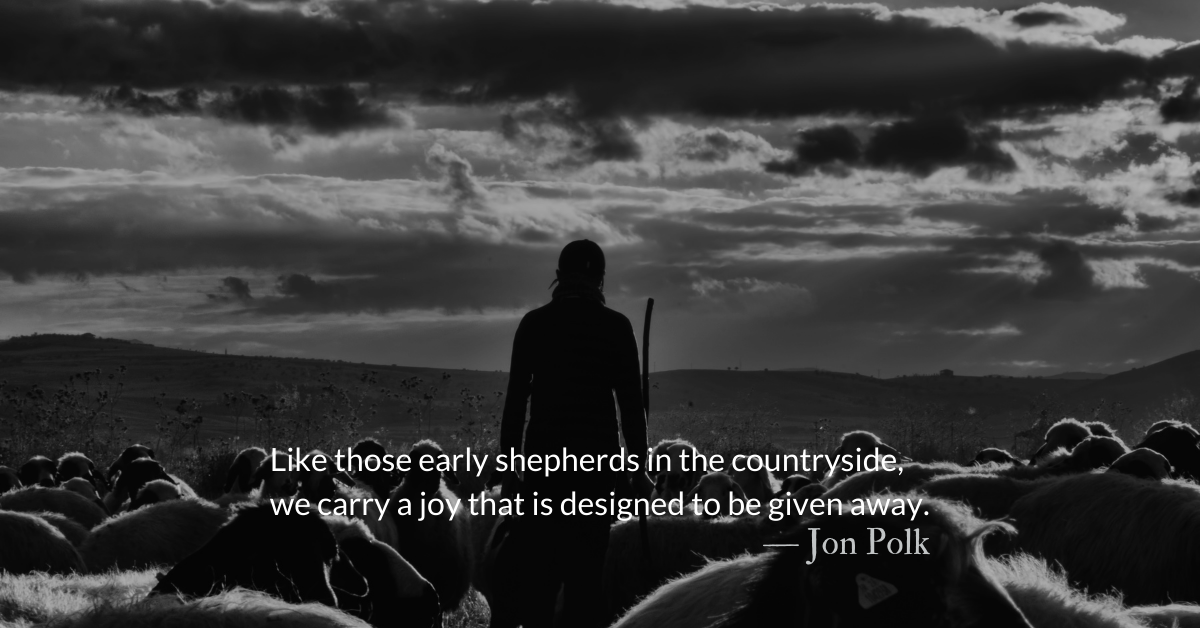
Look for those around you who need a little joy this year. Spend some time this Advent season spreading joy however you can. We can all provide an encouraging word, a helping hand, or a few extra moments of our time. Like those early shepherds in the countryside, we carry a joy that is designed to be given away.

After all, in the words of Linus Van Pelt, “That’s what Christmas is all about, Charlie Brown.”

Listen: Angels We Have Heard on High by Future of Forestry
Listen: Les Anges dans Nos Compagnes by Bruce Cockburn
Read: Lyrics from Hymnary.org

Divine Hours Prayer: The Refrain for the Morning Lessons
On this day the Lord has acted; we will rejoice and be glad in it. — Psalm 118.24

– Divine Hours prayers from The Divine Hours: Prayers for Autumn and Wintertime by Phyllis Tickle

Today’s Readings
Zechariah 1 (Listen – 3:37)
John 4 (Listen – 6:37)

Read more about End of Year Giving and Supporting our work
You can give year-round support for biblical literacy and spiritual rhythms in cities around the world for about the same amount as streaming internet services.

Read more about Do We Know Him? :: Love of Advent
Jesus went out of his way to reach out to those who were considered unreachable, and more than that, unworthy of being reached.

He Raises Us — Love of Advent

Scripture Focus: Zephaniah 2.3
3 Seek the Lord, all you humble of the land, 
you who do what he commands. 
Seek righteousness, seek humility; 
perhaps you will be sheltered 
on the day of the Lord’s anger. 

Luke 24.44-49
44 He said to them, “This is what I told you while I was still with you: Everything must be fulfilled that is written about me in the Law of Moses, the Prophets and the Psalms.” 
45 Then he opened their minds so they could understand the Scriptures. 46 He told them, “This is what is written: The Messiah will suffer and rise from the dead on the third day, 47 and repentance for the forgiveness of sins will be preached in his name to all nations, beginning at Jerusalem. 48 You are witnesses of these things. 49

Reflection: He Raises Us — Love of Advent
By John Tillman

Zephaniah calls tenderly, yet urgently, to those who are faithful in the land to respond to God while there is still time.

Seek righteousness. This is more than seeking our own good or simply doing good for ourselves. Any good that we do that does not also benefit our neighbor deserves not the name of “doing righteousness.

Seek humility. He is already calling to the humble in the land. This shows that humility is a constant seeking and lowering of one’s self and one never truly arrives at the bottom.

Perhaps you will be sheltered. In the family of believers there are many among us who know from experience that we may not always be shielded from all of life’s ailments, sicknesses, and hurts. Our dear Lord’s word that we would have trouble in this world is as equally true as his promise that he has overcome this world. His love is shown as much by his embrace when we are weeping as it is by blessings of laughter and joy.

Trouble is coming to this world. It is, after all, a world of darkness. How could it be otherwise? We made it so.

In our sinfulness, we wrested the world to our whims and wrecked it with our sins. Under Satan’s sway the world we cursed writhes in the evil darkness to which we subjugated it.

But no matter how low we have dragged the heights of God’s creation, he searches these low valleys for us.

No matter how deep in sin we sink our feet, or what bog’s stench hangs on us, or what fell parasites and diseases of the swamp cling to us, he reaches in. He wades deep. He dredges us up.

However low we are, he comes to raise us.
However vile we are, he comes to cleanse us.
However sickened we are, he comes to heal us.
However broken our body, he comes to make us whole.

Seek righteousness! Seek humility!
We may not all be sheltered from calamity, but we will all be raised!

Made like him, like him we rise…” (Christ the Lord is Risen Today — Charles Wesley)

Divine Hours Prayer: The Request for Presence
Show us the light of your countenance, O God, and come to us. — Psalm 67.1

– Divine Hours prayers from The Divine Hours: Prayers for Autumn and Wintertime by Phyllis Tickle


Today’s Readings
Zephaniah 2 (Listen – 2:44)
Luke 24 (Listen – 6:16)

Read more about End of Year Giving and Supporting our work
We need and pray for donors of all amounts. A donation does not have to be exceedingly large to make a large difference.

Read more about His Loving Presence :: Love of Advent
He is always the God who comes to us—not just during Advent.

He Became a Servant — Love of Advent

Scripture Focus: Habakkuk 3.2, 13-19
2 Lord, I have heard of your fame; 
I stand in awe of your deeds, Lord. 
Repeat them in our day, 
in our time make them known; 
in wrath remember mercy. 

13 You came out to deliver your people, 
to save your anointed one. 
You crushed the leader of the land of wickedness, 
you stripped him from head to foot. 
14 With his own spear you pierced his head 

Luke 22.25-27
25 Jesus said to them, “The kings of the Gentiles lord it over them; and those who exercise authority over them call themselves Benefactors. 26 But you are not to be like that. Instead, the greatest among you should be like the youngest, and the one who rules like the one who serves. 27 For who is greater, the one who is at the table or the one who serves? Is it not the one who is at the table? But I am among you as one who serves.

Reflection: He Became a Servant — Love of Advent
By John Tillman

Habakkuk’s psalm longs for the Lord to make himself known as he had in the past. 

The prophet seems to be referencing the Exodus from Egypt, as he depicts God marching out with plagues and pestilence. He recalls God intervening to save Israel from the oncoming armies of Pharaoh. 

Habakkuk trusts that calamity will come on the nation that conquers Judah, but that does not bring him joy. No matter that all seems to be failing around him, his joy will come from God.

What Habakkuk waited for, we have seen in Jesus. God served the enslaved Israelite nation by coming as a mighty warrior, a liberator. Jesus enacted a different kind of Exodus from a different kind of slavery. He attacked sin and death itself, not by becoming a warrior but by becoming a servant.

Jesus also marched out, with his face set like flint toward those he came to save and what he came to do. But instead of bringing with him destruction and plagues, he brought compassion and healing. Instead of girding himself with armor and taking up weaponry, he stripped himself and took up a towel. Instead of slaying the first-born of Egypt, Jesus, the only begotten son of the Father, offered himself to be slain.

And just like Pharoah rushed into the parted sea with his armies, thinking he had won, Satan must have thought the cross a moment of victory. Instead, it was the instrument of his destruction.

Habakkuk wanted God to make himself known, and he has done so in the person of Jesus. Jesus is our perfect and complete picture of what God is like. He is still among us as one who serves and we are to be like him.

May we serve him well by serving others. Worldly leaders will continue to puff themselves up. Kings will continue to abuse their power. Darkness will continue to wage a futile war against light. But as for us, we will rejoice in the Lord and be joyful in God our Savior.

May the Sovereign Lord be your strength, making your feet like those of a deer, to go on the heights. (Habakkuk 3.18-19; Psalm 18.33)

Divine Hours Prayer: The Morning Psalm
I will exalt you, O Lord, because you have lifted me up and have not let my enemies triumph over me.
O Lord my God, I cried out to you, and you restored me to health. — Psalm 30.1-2

– Divine Hours prayers from The Divine Hours: Prayers for Autumn and Wintertime by Phyllis Tickle


Today’s Readings
Habakkuk 3 (Listen – 2:59)
Luke 22 (Listen – 7:58)

Read more about End of Year Giving and Supporting our work
We need and pray for donors of all amounts, and for those who can donate every month as well as those who donate once-a-year.

Read more about Seeking God’s Servant
This “servant song” foreshadows Christ as the Servant whom the Father will raise up for His purposes.