Mourning With Hope — Hope of Advent

Links for today’s readings:

Read: Esther 4 Listen: (2:53)
Read: 1 John 1 Listen: (1:28)

Scripture Focus: Esther 4.16-17

16 “Go, gather together all the Jews who are in Susa, and fast for me. Do not eat or drink for three days, night or day. I and my attendants will fast as you do. When this is done, I will go to the king, even though it is against the law. And if I perish, I perish.”

17 So Mordecai went away and carried out all of Esther’s instructions.

Luke 1.38

38 “I am the Lord’s servant,” Mary answered. “May your word to me be fulfilled.” Then the angel left her.

Reflection: Mourning With Hope — Hope of Advent

By John Tillman

Esther and Mary’s stories are at the center of joyful holidays, but both passed through distress, danger, and mourning.

Mary’s situation may not seem as dangerous as Esther’s, but her life also hung by the thread of a man’s decision to spare her or kill her. Mary’s song of joy expressed a mournful longing for justice. Both women saw life’s danger, wickedness, and unfairness up close. Both surrendered their lives to God’s providence and took action.

Mordecai and Esther found themselves in privileged positions with reasons to celebrate. When Esther heard Mordecai was mourning, she was distressed. She tried to encourage Mordecai by sending clothing and an attendant but he rejected her gifts. Esther didn’t understand Mordecai’s mourning because she didn’t understand the depth of the problem. Once Esther understood Mordecai’s mourning, she joined him in fasting and prayer. She followed that with action.

Mordecai refusing to bow to Haman is inspiring. We recognize standing up for one’s beliefs and refusing to give undue honor to a human as a righteous act of resistance. (Although many of us give undue honor to humans.)

But, like Esther, Mordecai’s mourning distresses us. Many today scorn public mourning as weakness. Even if we don’t scorn mourning, we want Mordecai to move on. Do something. But he is doing something. There is a time to “move on,” but there is also a time to mourn. Mordecai’s mourning is as righteous an act as his refusal to bow.

In a wicked world, mourning declares that we hunger and thirst for righteousness. In a violent world, mourning declares our longing for peace. In a darkening world, mourning declares we are children of light. Even in seemingly hopeless situations, we do not mourn hopelessly as the world does. We mourn with hope. Surrendering to emotion leads to spiraling. Surrender instead to hope in God.

Even in a celebratory season, we may find evil to resist or to mourn. These are righteous acts. Perhaps you have come to your position for such a time as this. Perhaps you, like Esther, can take action despite the risks. Perhaps you, like Mary, can sing of hope in a hopeless land.

Might your own mourning with hope declare to others that light, peace, love, joy, and righteousness are on the horizon?

Might the mourning of others call your attention to something you don’t understand? How might you be stirred to action?

Divine Hours Prayer: The Morning Psalm

Lord, how many adversaries I have! How many there are who rise up against me!
How many there are who say of me, “There is no help for him in his God.”
But you, O Lord, are a shield about me; you are my glory, the one who lifts up my head.
I call aloud upon the Lord, and he answers me from his holy hill;
I lie down and go to sleep; I wake again, because the Lord sustains me. — Psalm 3.1-5

– From The Divine Hours: Prayers for Autumn and Wintertime by Phyllis Tickle.

Read more about Supporting Our Work

Your support is vital to our work and keeps this ministry going. Please consider a year-end or monthly gift to support our ad-free biblical content.

Read The Bible With Us

Advent is a great time to join our Bible reading plan. Find meaning in the Bible with us at a sustainable, two-year pace.

https://mailchi.mp/theparkforum/m-f-daily-email-devotional

Mercy Seat and Manger — Readers’ Choice

Scripture Focus: 2 Chronicles 3.1
1 Then Solomon began to build the temple of the Lord in Jerusalem on Mount Moriah, where the Lord had appeared to his father David. It was on the threshing floor of Araunah the Jebusite, the place provided by David.

Luke 1.34-38
34 “How will this be,” Mary asked the angel, “since I am a virgin?”

35 The angel answered, “The Holy Spirit will come on you, and the power of the Most High will overshadow you. So the holy one to be born will be called the Son of God. 36 Even Elizabeth your relative is going to have a child in her old age, and she who was said to be unable to conceive is in her sixth month. 37 For no word from God will ever fail.”

38 “I am the Lord’s servant,” Mary answered. “May your word to me be fulfilled.” Then the angel left her.

Originally published on December 4, 2023, based on readings from 2 Chronicles 3 and Luke 1.

Readers’ Choice is here: There’s still time to tell us about your favorite, most meaningful posts of the year. If you shared it with someone, or it helped you, let us know via email, direct message, or filling out the linked form.

Advent in September: Several of the choices from readers were from last year, during Advent. We are putting these posts together in this first week of Readers’ Choice. We pray as Summer winds down that the spirit of Christmas has continued in your heart and that these posts will help you look forward to and anticipate the coming seasons.

Readers’ Choice posts are selected by our readers:
Peter — John, thank you for this gift. Your explanation of how God’s temple on Mt. Moriah (and ultimately through Jesus’ own mediation) deepened and enriched my understanding of how God brings life out of our death for us.
Russell, Japan — This is wonderful. So much to meditate on and absorb. Thank you.
Susan — This reminds me of a medieval formulation, concerning Mary’s womb, or rather, the Holy Contents thereof, one runs across in the sayings of mystics: “We found heaven and earth in a little space.”

Reflection: Mercy Seat and Manger — Readers’ Choice
By John Tillman

Temples intend to overlap the mundane and the mystical, allowing humans to interact with gods. The holiest place in the Temple was “the mercy seat,” where human guilt was confronted by God’s righteousness and mercy. The Temple site on Mount Moriah was a place of confrontation and sacrifice long before the Temple was built. 

David purchased Araunah’s threshing floor as a place of sacrifice for his own sin. (1 Chronicles 21) David chose plague as punishment, but God stayed the sword of the death angel on the threshing floor. Then David said, “I, the shepherd, have sinned…These are but sheep…let your hand fall on me…do not let this plague remain on your people.”

Abraham was sent to this mountain to offer Isaac as a sacrifice, but God stayed his knife, providing a ram in Isaac’s place and fulfilling Abraham’s promise to Isaac as they traveled, “God himself will provide the lamb.” (Genesis 22.8)

John the Baptizer calls Jesus “the lamb of God” (John 1.29, 36) but also describes him as coming “to clear his threshing floor…gather the wheat into his barn, but…burn up the chaff with unquenchable fire.” (Luke 3.17)

Threshing separates grain from chaff and produces seed and food from grass that would otherwise fade away. It brings life from death. The place where Araunah threshed wheat was a place where the Lord threshed human hearts. It is a place where the holy confronts the unholy. (Isaiah 6.5) In that holiest place, we find mercy and hope.

John says Jesus “tabernacled” among us. (John 1.14) Jesus is where human space overlaps divine space—a Temple that comes to us. Jesus is our mercy seat, the holy one in whom we hope. The mercy seat and the manger represent God’s throne. In the gold-covered room, we glimpse his glory and worth. In the humble manger, he shows us ours.

David met an angel, made a sacrifice, and prepared a place to welcome God’s presence. Generations later, David’s daughter, Mary, did the same to welcome Jesus.

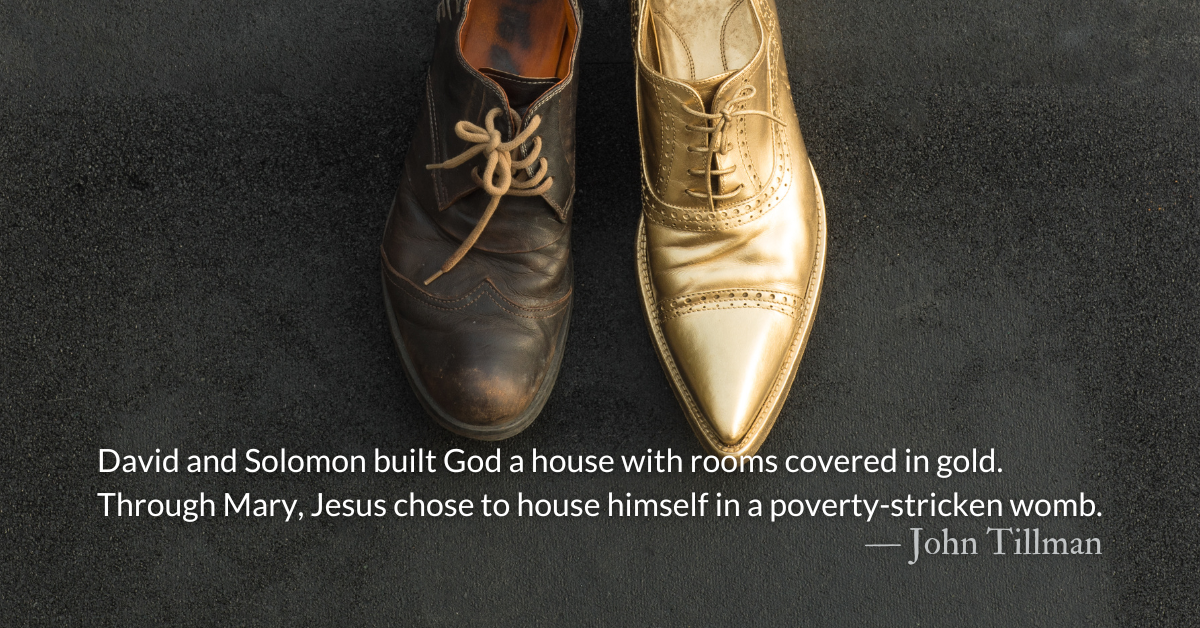
David and Solomon built God a house with rooms covered in gold. Through Mary, Jesus chose to house himself in a poverty-stricken womb.

David, the shepherd, sinned, bringing punishment on his sheep. Jesus, the shepherd, is sinless, taking punishment for his sheep. 

Jesus stays the sword of judgment and knife of sacrifice, providing himself as the lamb.

Jesus threshes life out of death.

From John: The Divine Hours prayers will return in October. This month we will pray one scripture passage or verse each week.

Prayer:
The Word became flesh and made his dwelling among us. We have seen his glory, the glory of the one and only Son, who came from the Father, full of grace and truth. — John 1.14


​Today’s Readings
Jeremiah 30-31 (Listen 7:21)
1 Corinthians 7 (Listen 6:09)

Read more about Becoming Part of the Promise
Rahab asks to be accepted by this powerful God who is not only in the heavens but active upon the Earth.

Readers’ Choice is here!
This month, we are thankful to share your favorite posts from the past year. There’s still time to tell us your faves via email, direct message, or the linked form, so we can repost them.

https://forms.gle/9vyYwVxa1kZZn7AKA

Mary’s Story — Love of Advent

Scripture Focus: Matthew 1.1, 16
1 This is the genealogy of Jesus the Messiah the son of David, the son of Abraham:
16 and Jacob the father of Joseph, the husband of Mary, and Mary was the mother of Jesus who is called the Messiah.

Luke 1.28
28 The angel went to her and said, “Greetings, you who are highly favored! The Lord is with you.”

Reflection: Mary’s Story — Love of Advent
By Erin Newton

These are the matriarchs of Jesus: Tamar, Rahab, Ruth, Bathsheba, and Mary. This is Mary’s story.

Unlike the other matriarchs of Jesus’s lineage, Mary is the focus of a multitude of hymns and prayers. She is the feature of paintings with token blue robes and a golden halo. As the mother of Jesus, she adorns nearly every nativity scene and features prominently in Advent messages.

The angel calls her “highly favored” and Elizabeth heralds her as “blessed among women.” Mary is well-known, famous to be precise. She is the foremost saint in the Catholic church. We know her story well.

Mary is the easiest character to place in the genealogy. Her story doesn’t center around abuse or widowhood. Yet we know she suffered for the task placed upon her. Her husband was not evil like Er, or sickly like Mahlon or Kilion, or murdered like Uriah. But Joseph was tempted to leave her child fatherless.

Her status as an unwed, pregnant young woman was met with skepticism and doubts. She was outcast in some ways—like Ruth, Rahab, Tamar, and Bathsheba. But Joseph stayed by her side, more like a Boaz than a David. No hand was laid upon her body, more loving than Judah or the men of Jericho.

Mary was a Jew. She did not have to struggle with a foreign culture. She could stay among family and provide safe haven for the Messiah inside.

Mary’s greatest asset to the world was her faithfulness. As men had chosen women before for their bodies; Mary was divinely chosen for her faith. Advent paints a rare and shockingly different picture of love.

Her story is unique, being the only divine conception that ever existed. But in some ways, she’s rather typical and expected. Her past is not powerfully redeemed. Her heritage was not amazingly rewritten.

She is well-known and respected. Her presence demands honor and dignity. Her burdens, disadvantages, and crises are seen as a badge of honor for the one who carries God in her womb.

She is the mother of Jesus. Mary, a woman of faith is chosen and honored as one of five women named in Jesus’s family.

In the love of Jesus belong the ordinarily faithful.

God can dramatically transform, and God can dramatically indwell. No matter our story, we belong within the love of Jesus. Advent invites us to a place of belonging.

Divine Hours Prayer: The Request for Presence
Lead me, O Lord, in your righteousness,… make your way straight before me. — Psalm 5.8

– From The Divine Hours: Prayers for Summertime by Phyllis Tickle.

Today’s Readings
2 Chronicles 17  (Listen 2:48)
Psalms 119.121-144 (Listen 15:14)

This Weekend’s Readings
2 Chronicles 18  (Listen 5:51Psalms 119.145-176 (Listen 15:14)
2 Chronicles 19-20  (Listen 8:09Psalms 120-122 (Listen 2:12)

Read more about Pause To Read
On Pause to Read, a podcast by The Park Forum, we read a devotional from the past year and encourage listeners to pause to read the scripture before continuing to listen to the devotional.

Read more about Supporting Our Work
We could not continue, much less expand our work, without our donors. Please consider joining them to support ad-free biblical devotional content to readers and listeners across the world.

Mercy Seat and Manger — Hope of Advent

Scripture Focus: 2 Chronicles 3.1
1 Then Solomon began to build the temple of the Lord in Jerusalem on Mount Moriah, where the Lord had appeared to his father David. It was on the threshing floor of Araunah the Jebusite, the place provided by David.

Luke 1.34-38
34 “How will this be,” Mary asked the angel, “since I am a virgin?”

35 The angel answered, “The Holy Spirit will come on you, and the power of the Most High will overshadow you. So the holy one to be born will be called the Son of God. 36 Even Elizabeth your relative is going to have a child in her old age, and she who was said to be unable to conceive is in her sixth month. 37 For no word from God will ever fail.”

38 “I am the Lord’s servant,” Mary answered. “May your word to me be fulfilled.” Then the angel left her.

Reflection: Mercy Seat and Manger — Hope of Advent
By John Tillman

Temples intend to overlap the mundane and the mystical, allowing humans to interact with gods. The holiest place in the Temple was “the mercy seat,” where human guilt was confronted by God’s righteousness and mercy. The Temple site on Mount Moriah was a place of confrontation and sacrifice long before the Temple was built. 

David purchased Araunah’s threshing floor as a place of sacrifice for his own sin. (1 Chronicles 21) David chose plague as punishment, but God stayed the sword of the death angel on the threshing floor. Then David said, “I, the shepherd, have sinned…These are but sheep…let your hand fall on me…do not let this plague remain on your people.”

Abraham was sent to this mountain to offer Isaac as a sacrifice, but God stayed his knife, providing a ram in Isaac’s place and fulfilling Abraham’s promise to Isaac as they traveled, “God himself will provide the lamb.” (Genesis 22.8)

John the Baptizer calls Jesus “the lamb of God” (John 1.29, 36) but also describes him as coming “to clear his threshing floor…gather the wheat into his barn, but…burn up the chaff with unquenchable fire.” (Luke 3.17)

Threshing separates grain from chaff and produces seed and food from grass that would otherwise fade away. It brings life from death. The place where Araunah threshed wheat was a place where the Lord threshed human hearts. It is a place where the holy confronts the unholy. (Isaiah 6.5) In that holiest place, we find mercy and hope.

John says Jesus “tabernacled” among us. (John 1.14) Jesus is where human space overlaps divine space—a Temple that comes to us. Jesus is our mercy seat, the holy one in whom we hope. The mercy seat and the manger represent God’s throne. In the gold-covered room, we glimpse his glory and worth. In the humble manger, he shows us ours.

David met an angel, made a sacrifice, and prepared a place to welcome God’s presence. Generations later, David’s daughter, Mary, did the same to welcome Jesus.

David and Solomon built God a house with rooms covered in gold. Through Mary, Jesus chose to house himself in a poverty-stricken womb.

David, the shepherd, sinned, bringing punishment on his sheep. Jesus, the shepherd, is sinless, taking punishment for his sheep. 

Jesus stays the sword of judgment and knife of sacrifice, providing himself as the lamb.

Jesus threshes life out of death.


Divine Hours Prayer: The Refrain for the Morning Lessons
This is the Lord’s doing, and it is marvelous in our eyes. — Psalm 118.23

– From The Divine Hours: Prayers for Summertime by Phyllis Tickle.


Today’s Readings
2 Chronicles 3-4   (Listen 5:42)
Psalms 108-109 (Listen 4:28)

Read more about Unto Us, He Comes — Hope of Advent
The movements of the heavens tell a story in which Christ comes in at our darkest point to turn the world back to the light.

Read more about Supporting Our Work
Our ad-free content is not free to produce. Join our donors and help bring biblical devotionals to inboxes across the world.

In the Face of the Impossible

Scripture Focus: Luke 1.18, 34, 37
Zechariah asked the angel, “How can I be sure of this?”
“How will this be,” Mary asked the angel, “since I am a virgin?”
“…no word from God will ever fail.”

Reflection: In the Face of the Impossible
By John Tillman

Luke plunges into visionary tales of the impossible and people who, to one degree or another, expressed doubts, reservations, and fears, and felt themselves unqualified for the task.
Madeleine L’Engle, in her book, Walking on Water marvels at how often God gave glorious visions and impossible tasks to those who were ill equipped.

“We are all asked to do more than we can do. Every hero and heroine of the Bible does more than he would have thought it possible to do, from Gideon, to Esther, to Mary. Jacob, one of my favorite characters, certainly wasn’t qualified. He was a liar and a cheat; and yet he was given the extraordinary vision of angels and archangels ascending and descending a ladder which reached from earth to heaven.

In the first chapter of John’s Gospel, Nathanael is given a glimpse of what Jacob saw, or a promise of it, and he wasn’t qualified, either. He was narrow-minded and unimaginative, and when Philip told him that Jesus of Nazareth was the one they sought, his rather cynical response was, “Can anything good come out of Nazareth?” And yet it was to Nathanael that Jesus promised the vision of angels and archangels ascending and descending upon the son of man.”

God chooses to do the impossible with the unqualified, to frustrate the wise with the foolish, and to overthrow the strong with the weak. He subverts the systems we rely on and reminds us that our competence is an illusion and his grace shown through us comprises all that is good in the world.

We face the impossible, like Zechariah, when the world sees us as cursed and broken.
We face the impossible, like Mary, when the world strives to keep us powerless and vulnerable.
In the face of the impossible we are forced to keep our faith where it always should have been—on God. We are not qualified, but, L’Engle concludes, God will be glorified.

“In a very real sense, not one of us is qualified, but it seems that God continually chooses the most unqualified to do his work, to bear his glory. If we are qualified, we tend to think that we have done the job ourselves. If we are forced to accept our evident lack of qualification, then there’s no danger that we will confuse God’s work with our own, or God’s glory with our own.“

Divine Hours Prayer: The Greeting
Not to us, O Lord, not to us, but to your Name give glory; because of your love and because of your faithfulness. — Psalm 115.1

– From The Divine Hours: Prayers for Springtime by Phyllis Tickle.

Today’s Reading
Exodus 18 (Listen 3:54)
Luke 1.1-38 (Listen 9:26)

Read more about Angelic Visions Require Childlike Faith
Madeleine L’Engle was often perplexed at the tendency of scholarly Christians to hold at arm’s length the angels and miracles of the Bible.

Read The Bible With Us
Our Bible reading plan is immersive with a sustainable, two-year pace. Walk with us through God’s Word and reflect on the beauty revealed by a slower pace.

https://mailchi.mp/theparkforum/m-f-daily-email-devotional