It’s a Trap!

Links for today’s readings:

Sep 2  Read: Jeremiah 27 Listen: (3:52) Read: 1 Corinthians 4 Listen: (3:15)

Scripture Focus: Jeremiah 27:16-17

16 Then I said to the priests and all these people, “This is what the Lord says: Do not listen to the prophets who say, ‘Very soon now the articles from the Lord’s house will be brought back from Babylon.’ They are prophesying lies to you. 17 Do not listen to them. Serve the king of Babylon, and you will live. Why should this city become a ruin?

Reflection: It’s a Trap!

By Erin Newton

In the Star Wars movies, one character is known for the line “It’s a trap!” The phrase is actually repeated by multiple characters. Clearly the plot relies on the element of ruses and tricks. Situations the characters first think are good, often erupt into action-packed scenes of near disaster.

False prophets also deal in tricks and traps. 

Jeremiah warns the people about their judgment by the hand of God through the Babylonians. While their experience was painful, it was tempting to trust those who promised ease and a reversal. I don’t think I blame them. 

In fact, the prophets often began their messages with warnings of judgment and destruction and then followed those statements with promises of restoration. We rely on the conclusion of hope when we read the Bible. Why is Jeremiah warning against those prophecies now? 

If these false prophets had been able to sway the people, they would likely have attempted to act on the promises by rebelling against Babylon. Jeremiah warns that this would be futile.

Disclaimer: A glimmer of hope appears when Jeremiah indicates that restoration will happen when God decides. But the key factor is that God is the determiner of when that happens. Reacting to a false promise of restoration would likely have ruined it all. 

Pain has a way of leading us into temptation. We are tempted to listen to false prophets. We are tempted to listen to people who claim the name of God but speak a different message. 

You often see movies with these types of characters. They are the characters that cannot possibly grasp the danger that lies before them and so they convince themselves that everything is going to be just fine and that restoration is coming “very soon.” The character jumps up and flees the small net of safety and then the monster pounces. 

It is certainly tempting to believe a message that we can control. Blessing is coming very soon? Well let’s just hurry things along! That sounds rather nice. But in the end, it is foolish for us to force things to happen—force blessings, force ease and comfort. 

It’s sometimes hard to distinguish between promises of hardship or promises of coming restoration. I think we are called to be patient in God’s timing, even in pain. We must hold this life of ours loosely, never trying to turn things to our own commands.

Divine Hours Prayer: The Greeting

Your love, O Lord, reaches to the heavens, and your faithfulness to the clouds. — Psalm 36.5

– From The Divine Hours: Prayers for Summertime by Phyllis Tickle.

Readers’ Choice is Coming!

Readers’ Choice is when we ask you to share your favorite Park Forum posts from this year. 

What posts helped you heal?

https://forms.gle/Kj12Ziy4C9gQg8Xm7

Read more: Comfortable Prophecies

It is difficult to judge Jerusalem for falling for these false prophets. Don’t we also feel the pull to grasp onto any far-fetched hope of a return to normalcy?

Unexpected Contents of God’s Cup of Wrath

Links for today’s readings:

Aug 31  Read: Jeremiah 25 Listen: (6:12) Read: 1 Corinthians 2 Listen: (2:26)

Scripture Focus: Jeremiah 25.27

27 “Then tell them, ‘This is what the LORD Almighty, the God of Israel, says: Drink, get drunk and vomit, and fall to rise no more because of the sword I will send among you.

Reflection: Unexpected Contents of God’s Cup of Wrath

By John Tillman

Jeremiah’s prophecy of the cup of God’s wrath is so shocking that it leads to death threats against him. 

The cup of God’s wrath is a common image that echoes all throughout the scriptures. (Isa 51.17; Jer 49.12; Lam 4.21; Eze 23.31; Rev 14.10) Jesus mentions not wanting to drink it if possible. Yet, eventually, he drains it on our behalf. (Mat 26.39)

We might imagine this cup filled with dreaded poison. We’d be wrong. We might imagine the horrific practice, used by ancient Romans, Spanish Inquisition torturers, and South American tribes, of having molten gold poured down one’s throat. This type of horrific torture is human wrath, not divine wrath.

The cup of God’s wrath, as described by Jeremiah, is not filled with poison, molten gold, burning sulfur from the lake of fire, or any fanciful substance of perverse punishment or torture. It is filled with wine. 

No special torturous properties are needed. The contents are our own desires. Victims simply drink and drink and drink, until they vomit and die. The picture painted by Jeremiah is a messy nightmare of people dying in pools of their own vomit. It is still horrific, but a far cry from scenes that might garner high ratings on television programs like Game of Thrones.

God’s wrath does not work the way human wrath does. God punishes us, more often than not, by handing us the bottle of our bad choices and letting us drink up. Jeremiah describes how the cup of God’s wrath would be passed from nation to nation as they each in turn were judged by God for their excesses and sin.

Wine, when representing God’s wrath, is transfigured from a symbol of joy to a symbol of judgment, from a sign of happiness to a sign of horror.

The cup of God’s wrath is also a long time in coming. In this case, Jeremiah has been preaching for twenty-three years before God finally gives up appealing to his people and gives them over to self-destruction.

May we learn to listen to God’s prophets who, like Jeremiah, might not speak in ways we like or appreciate.

May we learn to soften our hearts to God’s appeals so that we, like the “good figs” mentioned in the previous chapter (Jer 24.4-10), will be carried through the judgment God allows rather than being destroyed in it.

Divine Hours Prayer: The Call to Prayer

Let my mouth be full of your praise and your glory all the day long. — Psalm 71.8

– From The Divine Hours: Prayers for Summertime by Phyllis Tickle.

Read more: A Lifetime of Waiting

As we learn to wait on God, the ultimate aim should be to be peacemakers here.

Read more: Style Versus Substance

Often when we first grasp the basics of something, we too quickly think we are experts. 

Solo Sins and Systemic Sins

Links for today’s readings:

Aug 28  Read: Jeremiah 22 Listen: (5:07) Read: 2 Thessalonians 2 Listen: (2:32)

Links for this weekend’s readings:

Aug 29  Read: Jeremiah 23 Listen: (7:13) Read: 2 Thessalonians 3 Listen: (2:16)
Aug 30  Read: Jeremiah 24 Listen: (1:54) Read: 1 Corinthians 1 Listen: (4:03)

Scripture Focus: Jeremiah 22.1-5

1 This is what the Lord says: “Go down to the palace of the king of Judah and proclaim this message there: 2 ‘Hear the word of the Lord to you, king of Judah, you who sit on David’s throne—you, your officials and your people who come through these gates. 3 This is what the Lord says: Do what is just and right. Rescue from the hand of the oppressor the one who has been robbed. Do no wrong or violence to the foreigner, the fatherless or the widow, and do not shed innocent blood in this place. 4 For if you are careful to carry out these commands, then kings who sit on David’s throne will come through the gates of this palace, riding in chariots and on horses, accompanied by their officials and their people. 5 But if you do not obey these commands, declares the Lord, I swear by myself that this palace will become a ruin.’”

Reflection: Solo Sins and Systemic Sins

By John Tillman

God, through Jeremiah, confronted wicked kings for their individual sins and for their sins as heads of state. But the first words of God’s message were about governmental responsibility.

Jeremiah challenged kings to rescue people from crime, protect foreigners from violence, and stop innocent bloodshed. These were political/governmental sins.

Prophets address moral problems that are both spiritual and political. This was especially true in Jeremiah’s day, when state power and religious power were synonymous. Every religious problem was a political problem and every state problem was a religious one.

Oppression, violence, and injustice are not on God’s back burner. They are the fruit that shows whether the tree’s heart is sick or healthy. This is true for individuals and governments.

Some Christians individualize moral commands in scripture to the point that they deny any corporate or community culpability for the moral failings of systems that we individuals manage and create together. “We just need to change hearts,” is their half-truth.

Some Christians make the opposite error. They only acknowledge collective sins of political, economic, or judicial systems and deny that personal choices, lifestyles, or identities can be caused by, or connected to, individual sins that need correction. “Better systems, better people, better choices,” is their half-truth.

If prophets like Jeremiah heard us separating individual and systemic sins, they’d pull out their beards in frustration. What foolishness! We need the whole truth. There’s no such thing as “solo sins.” Every sin is systemic.

What are oppressive systems made from other than the compounded selfish choices of individuals? What individual sins are not influenced by the systems of culture, economics, and power that surround, control, and influence us? It is foolish to deny they are connected.

Think of Cain and Abel and the Good Samaritan…

The hyper-individualist Christian denies being his brother’s keeper and denies being the neighbor of the wounded traveller. The hyper-collectivist Christian blames God’s evaluation of sacrifices for Abel’s death, and rather than help the wounded traveler, lectures us that the robbers are merely symptoms of an unfair economy.

Hear and heed Jeremiah’s challenge to the kings as it was intended. It challenges both individuals and the systems those individuals influence. The gospel is the answer to every human problem, but its effects were never intended to stop with individuals.

If the gospel changes only you, and nothing around you, it isn’t the gospel.

Divine Hours Prayer: The Request for Presence

Lead me, O Lord, in your righteousness,… make your way straight before me. — Psalm 5.8

– From The Divine Hours: Prayers for Summertime by Phyllis Tickle.

Read more: What Makes a King?

True kings are those who know God. Their lives, efforts, causes, where they put their money…reveal who is truly a king after God’s heart.

Read more: The Crux of Repentance

The unmerited favor of Christ is an acquired taste. Most of us are gauche enough to like our grace flavored with a little bit of earning it.

Cursed Birth Day

Links for today’s readings:

Aug 26  Read: Jeremiah 20 Listen: (3:07) Read: 1 Thessalonians 5 Listen: (2:37)

Scripture Focus: Jeremiah 20:14–15

14 Cursed be the day I was born!
May the day my mother bore me not be blessed!
15 Cursed be the man who brought my father the news,who made him very glad, saying,“A child is born to you—a son!”

Reflection: Cursed Birth Day

By Erin Newton

What do Jeremiah, Job, and Frankenstein’s monster all have in common? Answer: They curse the day they were born. 

Jeremiah has been ridiculed and imprisoned for his prophesying. He curses the day that brought him life and the messenger who brought the news. 

Job suffered the deaths of his children and the loss of his wealth and health. He declares: “May the day of my birth perish, and the night that said, ‘A boy is conceived!’ That day—may it turn to darkness” (Job 3.3-4). 

The Creature in Mary Shelley’s gothic novel experiences rejection from his maker and cries out: “Cursed, cursed creator! Why did I live? Why, in that instant, did I not extinguish the spark of existence which you had so wantonly bestowed?”

We know the value of life. We celebrate birthdays. We pray for healings. 

But let’s be honest. Many of us have felt pain deep enough to wish it away. We have grieved to the point that the future seems not worth the trouble. We understand that living is a gift, but pain brings us to the place we want to trade it all in. 

And that’s expected. Despite our desire for ease and comfort—this world often brings the uncomfortable and the painful and the awful events right to our doorstep. 

It is good for us to sit with the uneasiness of this chapter in Jeremiah. It ends rather bleakly. We want to rush to tidy it up, to add a “but then” phrase in there. 

But if we move past the harsh, raw emotions of pain too fast, we lose the transformative moment of what brutal honesty can do for us. Telling God we wish we’d never been born is probably the most honest we will ever be. But it’s scary. Are we allowed to not want this

I think Jeremiah and Job give us permission to say what we are really thinking. Job sits in misery for a while. He bangs on the doors of heaven until God speaks. A fire of passion is stoked by God in the heart of Jeremiah. He cannot contain it even if he wants to give up. 

We are not a creature stitched together from decomposing flesh and rejected by our father. We are like the prophet and the most faithful servant—seen, heard, and tended to by God. Don’t be afraid to be honest. He’s heard all this before and still loves us.

Divine Hours Prayer: The Request for Presence

Gladden the soul of your servant, for to you, O Lord, I lift up my soul. — Psalm 86.4

– From The Divine Hours: Prayers for Summertime by Phyllis Tickle.

Read more: Better Unborn

It is normal to feel ready to give up, regret answering God’s call, and wish we could go where no one can reach us.

Read more: Be Awake Be Light

In Christ, we are “of the light” but live in a world dominated by darkness…How then should we live?

When Truth Provokes Violence

Links for today’s readings:

Aug 25  Read: Jeremiah 19 Listen: (2:58) Read: 1 Thessalonians 4 Listen: (2:24)

Scripture Focus: Jeremiah 19.1-4, 10-15

1 This is what the Lord says: “Go and buy a clay jar from a potter. Take along some of the elders of the people and of the priests 2 and go out to the Valley of Ben Hinnom, near the entrance of the Potsherd Gate. There proclaim the words I tell you, 3 and say, ‘Hear the word of the Lord, you kings of Judah and people of Jerusalem. This is what the Lord Almighty, the God of Israel, says: Listen! I am going to bring a disaster on this place that will make the ears of everyone who hears of it tingle. 4 For they have forsaken me and made this a place of foreign gods; they have burned incense in it to gods that neither they nor their ancestors nor the kings of Judah ever knew, and they have filled this place with the blood of the innocent.

10 “Then break the jar while those who go with you are watching, 11 and say to them, ‘This is what the Lord Almighty says: I will smash this nation and this city just as this potter’s jar is smashed and cannot be repaired. They will bury the dead in Topheth until there is no more room. 12 This is what I will do to this place and to those who live here, declares the Lord. I will make this city like Topheth. 13 The houses in Jerusalem and those of the kings of Judah will be defiled like this place, Topheth—all the houses where they burned incense on the roofs to all the starry hosts and poured out drink offerings to other gods.’ ” 14 Jeremiah then returned from Topheth, where the Lord had sent him to prophesy, and stood in the court of the Lord’s temple and said to all the people, 15 “This is what the Lord Almighty, the God of Israel, says: ‘Listen! I am going to bring on this city and all the villages around it every disaster I pronounced against them, because they were stiff-necked and would not listen to my words.’ ”

Reflection: When Truth Provokes Violence

By John Tillman

Immediately after Jeremiah’s message, a priest, Pashhur, had Jeremiah seized, beaten, and put in stocks (Jer 20.1-2).

Jeremiah suffered seven recorded instances of physical violence, threats, and arrests—more than any other prophet. However, Jeremiah’s message was not unique.

Moses and Joshua warned that if Israel was unfaithful, God would remove them from the land (Deut 4.23-30). God warned Solomon that he would destroy the temple and exile his people for unfaithfulness (2 Chron 6.36-39; 7.19-22). Micah, Amos, Hosea, and Isaiah repeated and amplified these warnings (Mic 3.12; Amos 5.27; Hosea 9.3, 17; Isa 5.13; 39.6). Jeremiah was just telling Jerusalem’s leaders what scripture said would happen.

Despite the fact that Jeremiah’s warnings were “biblical,” his message was unwelcome and unthinkable. To religious leaders, like Pashhur, it was unthinkable that the temple would be destroyed. To political leaders, Jeremiah’s critiques of corruption, cruelty to the poor, idolatry, and wicked alliances were unwelcome.

Rather than repent, they called Jeremiah a liar and traitor. They accused him of allying with the Babylonians and sabotaging soldiers’ and citizens’ morale. They falsely accused him of defecting to the Babylonians (Jer 37.12-14). They labeled his moral critiques as political threats to justify responding with political violence.

Most of our readers live in places with legal freedoms of religious expression and speech. Jeremiah didn’t have that. But such protections are only effective if leaders follow them. Also, some powerful political movements are attacking these rights. Violent attacks against those speaking God’s truth can happen anywhere and at any time, even in places that guarantee freedoms of religion and speech. We need to be ready for moments when speaking unwelcome biblical truths is labeled treasonous, unpatriotic, or criminal. 

It can be tempting to back away from scripture when its teachings against greed, lust, sexual promiscuity, power, and favoritism or its teachings about helping the poor, immigrants, and outcasts are labeled as a political movement instead of a moral imperative. We must be willing to stand faithfully even if Pashhurs of the world slap us verbally or physically. However, “getting slapped” doesn’t mean you are being faithful.

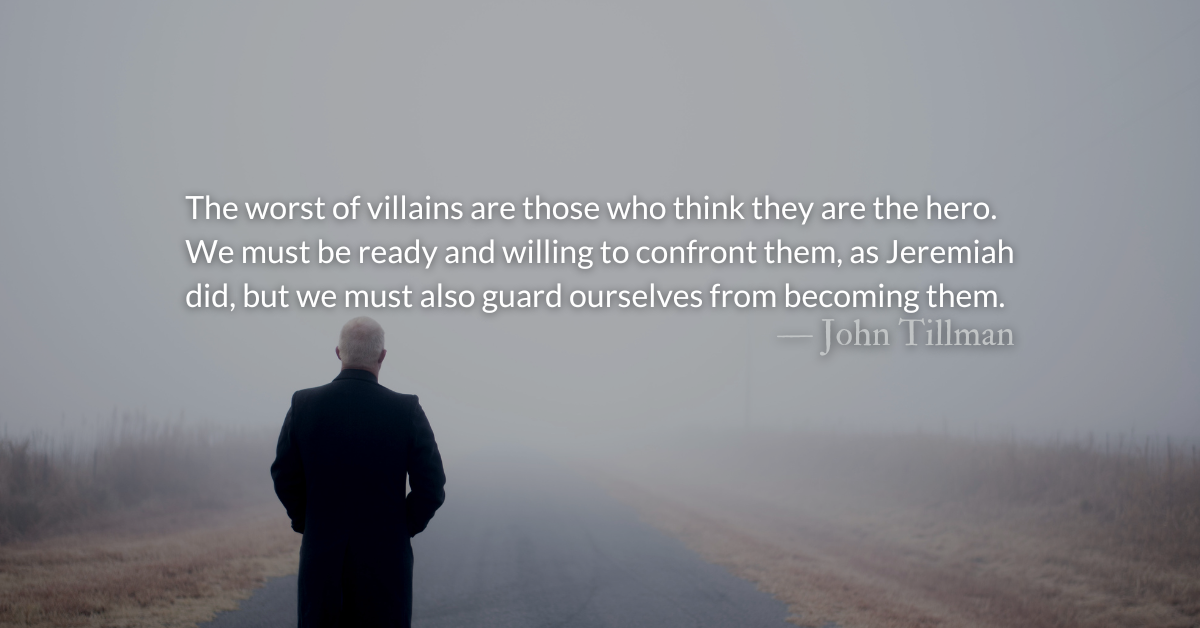
Some Christian “truth-tellers” today are persecution farmers, provoking others to claim persecution. They are Pashhur, pretending to be Jeremiah. They are bullies pretending to be prophets. They don’t weep over the lost. They gloat. Being a cruel bully doesn’t make you a faithful prophet and suffering for doing wrong is not persecution (1 Pet 2:20; 3:17; 4:15-16; Gal 6:7).

Be a Jeremiah not a Pashhur. Don’t seek persecution as validation but be faithful regardless of the consequences.

Divine Hours Prayer: The Morning Psalm

Show me your marvelous loving-kindness, O Savior of those who take refuge at your right hand from those who rise up against them. Keep me as the apple of your eye; hide me under the shadow of your wings, From the wicked who assault me, from my deadly enemies who surround me. — Psalm 17.7-9

– From The Divine Hours: Prayers for Summertime by Phyllis Tickle.

Read more: Stephen, Isaiah, and Confronting God’s People

Stephen and Isaiah stand in a long line of those who were killed for confronting God’s people with hypocrisy. Not pagans. Not enemies. God’s people.

Read more: The Weeping Enduring Prophet

No matter what insults they throw at him or what pit they throw him down into, he holds firm to the truth.

Show Buttons
Hide Buttons
Spur a spiritual rhythm of refreshment right in your inbox
By joining this email list you are giving us permission to send you devotional emails each weekday and to communicate occasionally regarding other aspects of the ministry.
100% Privacy. We don't spam.