Death, the Final Equalizer

Links for today’s readings:

Jun 17  Read: Isaiah 14 Listen: (5:04) Read: Acts 3 Listen: (3:33)

Scripture Focus: Isaiah 14:9-11

9 The realm of the dead below is all astir
    to meet you at your coming;
it rouses the spirits of the departed to greet you—
    all those who were leaders in the world;
it makes them rise from their thrones—
    all those who were kings over the nations.
10 They will all respond,
    they will say to you,
“You also have become weak, as we are;
    you have become like us.”
11 All your pomp has been brought down to the grave,
    along with the noise of your harps;
maggots are spread out beneath you
    and worms cover you.

Reflection: Death, the Final Equalizer

By Erin Newton

“There are dead things, dead faces in the water,” he whispered with horror. “Dead faces!”

Gollum laughed. “The Dead Marshes, yes, yes: that is their names…”

“Can’t we get on and get away?”

“Yes, yes,” said Gollum. “But slowly, very slowly. Very carefully! Or hobbits go down to join the Dead ones and light little candles of their own.” 

This scene from The Lord of the Rings: The Two Towers describes the perilous journey of Frodo and Sam to Mordor. In the movie, Frodo is entranced by the faces and falls into the water, being pulled further and further down. Like the refrain in Isaiah 14, “The realm of the dead is astir to meet you.”

The imagery is potent. The dead are ravenous for their newcomer. 

When people die, as we often hear from well-meaning friends, “They’ve gone to a better place.” And for those we disdain, we proclaim they are “worm food” or we wish them to “rot in Hell.”

The first sentiment speaks of the loved person’s everlasting soul. The second sentiment sounds closer to the prophet’s description of an eager underworld. 

The ancient Near East focused primarily on this earthly life. The taunt in Isaiah strikes at that focus specifically.

The prophet declares to this soon-to-be-fallen king: You’re on borrowed time. You’re definitely going to die.

And the prophet adds: Death has come for your fellow royals already. You are weak, just like them, swallowed up by death.

Instead of cheers of fans or a parade, harps and drums sound a processional to the underworld.

The fallen king’s abode is simply a means of becoming compost—a bed of worms, a blanket of maggots.

Tolkien envisioned the dead as ghostly faces drifting in a dreary marsh. Isaiah describes the dead as lying in beds of decomposition.

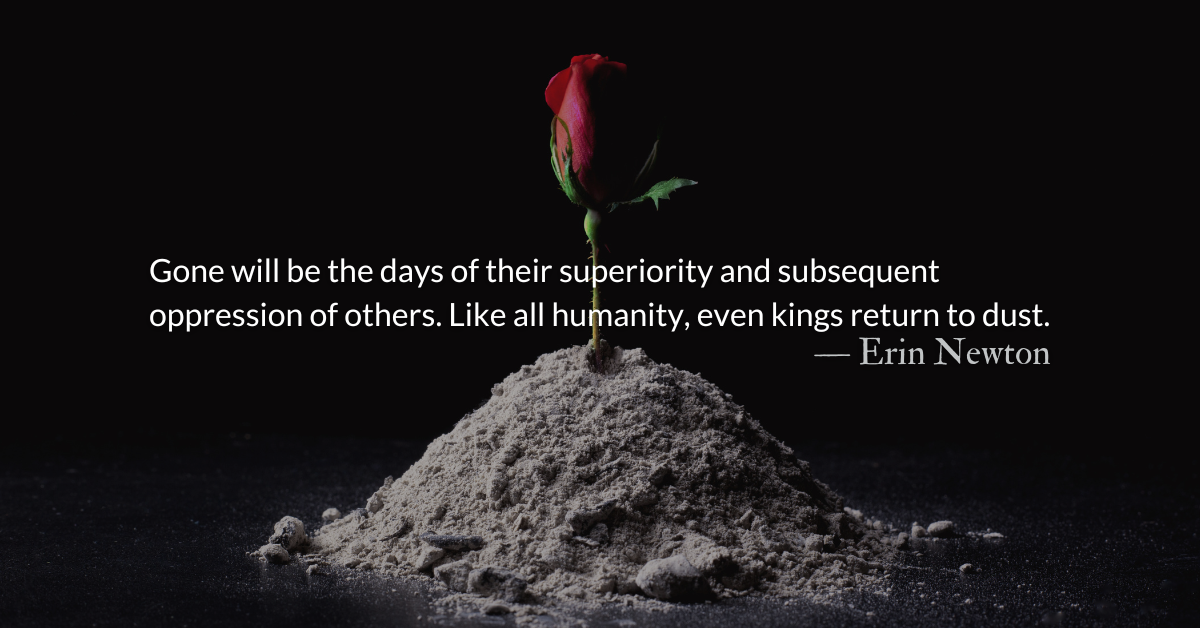
All of this morbid description is a reality check for Israel’s enemy king. Gone will be the days of their superiority and subsequent oppression of others. Like all humanity, even kings return to dust.

In the end (quite literally), we are all equals. There is some comfort in knowing even trillionaires become worm food. But more importantly, we remember that our bodies are not the final word. We are more than our frail cells. We are not bound to be dust for eternity. Perhaps our bodies will become part of God’s good creation once more, but that is not our true end. Hallelujah!

Divine Hours Prayer: The Greeting

In you, O Lord, have I taken refuge; let me never be put to shame; deliver me in your righteousness. — Psalm 31.1

– From The Divine Hours: Prayers for Summertime by Phyllis Tickle.

Read more: Waiting at the Beautiful Gate

Jesus didn’t give us the Holy Spirit for warm, fuzzy feelings in our sanctuaries. The Holy Spirit is given to us to heal

Read more: Taunting Ourselves

Babylon honors the brutal and brutalizes the gentle.
Babylon protects the powerful rather than the weak.


Taunting Ourselves

Scripture Focus: Isaiah 14.3, 26-27
3 On the day the Lord gives you relief from your suffering and turmoil and from the harsh labor forced on you, 4 you will take up this taunt against the king of Babylon: 
How the oppressor has come to an end! 
How his fury has ended! 

26 This is the plan determined for the whole world; 
this is the hand stretched out over all nations. 
27 For the Lord Almighty has purposed, and who can thwart him? 
His hand is stretched out, and who can turn it back? 

Reflection: Taunting Ourselves
By John Tillman

God promises those who suffer under oppression that one day he will turn the tables and they will taunt those who harmed them.

Isaiah taunts specific oppressors such as Babylon, Assyria, and the Philistines. God expands these taunts to include the whole world—any nation taking up the spirit of Babylon. There are still nations of this kind today and some of us may live in them. We should be careful not to take up Isaiah’s taunts too quickly—we may end up taunting ourselves.

Babylon considered itself the ultimate pinnacle of human achievement. They felt they deserved to wield ultimate power because of their ultimate enlightenment. They considered themselves the light of the world and a provider of peace. Babylonian exceptionalism was part of their core belief system.

Babylon’s utopian self-concept was a lie. Their definition of peace was murdering anyone who resisted them. Their definition of achievement was enslaving the smartest people from other nations and re-educating them to serve the empire. Their definition of light was snuffing out the gods of other nations and absorbing them.

In the Bible, Babylon is both a literal kingdom and a figurative representation of all human opposition to God. When God said, “I will wipe out Babylon’s name and survivors, her offspring and descendants,” he wasn’t speaking literally of human offspring. He spoke of nations who would follow the spirit of Babylon, to succeed her, ascend her throne, and continue her prideful destruction of the weak. 

Babylon’s highest value is ultimate autonomy and unrestricted freedom—at least for the powerful. Many pursue ultimate autonomy today as well. The dirty little secret of ultimate autonomy is that it only exists for those willing to take it by force or those privileged enough to have it handed to them.

The spirit of Babylon is not only adopted by nations or people groups. Individuals adopt it too. Has the spirit of Babylon taken over any part of our hearts?

Babylon disdains God’s demands for righteousness and justice.
Babylon rejects God’s definitions of sin and holiness.
Babylon honors the brutal and brutalizes the gentle.
Babylon protects the powerful rather than the weak. 
Babylon uses freedom to harm others.

One day we will taunt Babylon, but first, we must come out from among her. Let us root out Babylon’s influences in our own lives and hearts.

Divine Hours Prayer: The Morning Psalm
Wait upon the Lord and keep his way; he will raise you up to possess the land, and when the wicked are cut off, you will see it.
I have seen the wicked in their arrogance, flourishing like a tree in full leaf.
I went by, and behold, they were not there; I searched for them, but they could not be found.
Mark those who are honest; observe the upright; for there is a future for the peaceable.
Transgressors shall be destroyed, one and all; the future of the wicked is cut off.
But the deliverance of the righteous comes from the Lord; he is their stronghold in time of trouble.
The Lord will help them and rescue them; he will rescue them from the wicked and deliver them, because they seek refuge in him. — Psalm 37.36-42

– From The Divine Hours: Prayers for Summertime by Phyllis Tickle.


​Today’s Readings
Isaiah 14 (Listen 5:04)
Acts 3 (Listen 3:33)

Read more about Waiting at the Beautiful Gate
Jesus didn’t give us the Holy Spirit for warm, fuzzy feelings in our sanctuaries. The Holy Spirit is given to us to heal

Read more about The Fall of a Superpower
Babylon embraced idolatry and morality that was contrary to the law of God…it’s important to realize we share in the same sinful nature

Taunting Ourselves

Scripture Focus: Isaiah 14.3, 26-27
3 On the day the Lord gives you relief from your suffering and turmoil and from the harsh labor forced on you, 4 you will take up this taunt against the king of Babylon: 
How the oppressor has come to an end! 
How his fury has ended! 

26 This is the plan determined for the whole world; 
this is the hand stretched out over all nations. 
27 For the Lord Almighty has purposed, and who can thwart him? 
His hand is stretched out, and who can turn it back? 

Reflection: Taunting Ourselves
By John Tillman

God promises those who suffer under oppression that one day he will turn the tables and they will taunt those who harmed them.

Isaiah’s taunts target specific oppressors such as Babylon, Assyria, and the Philistines. God expands these taunts to include the whole world—any nation who takes up the spirit of Babylon. There are still nations of this kind today and some of us may live in them. We should be careful not to take up Isaiah’s taunts too quickly—we may end up taunting ourselves.

Babylon considered itself the ultimate pinnacle of human achievement. They felt they deserved to wield ultimate power because of their ultimate enlightenment. They considered themselves the light of the world and a provider of peace. Babylonian exceptionalism was part of their core belief system.

Babylon’s utopian self-concept was a lie. Their definition of peace was murdering anyone who resisted them. Their definition of achievement was enslaving the smartest people from other nations and re-educating them to serve the empire. Their definition of light was snuffing out the gods of other nations and absorbing them.

Babylon, in the Bible, is both a literal kingdom and a figurative representation of all human opposition to God. When God says, “I will wipe out Babylon’s name and survivors, her offspring and descendants,” he isn’t speaking literally of human offspring. He is speaking of nations who would follow the spirit of Babylon—those who succeed her, ascend her throne, and continue her prideful destruction of the weak. 

Babylon’s highest value is ultimate autonomy and unrestricted freedom—at least for the very, very powerful. Many pursue ultimate autonomy today as well. The dirty little secret of ultimate autonomy is that it only exists for those willing to take it by force or those privileged enough to have it handed to them.

The spirit of Babylon is not only adopted by nations or people groups. It is often adopted by individuals. Has any part of our heart been taken over by the spirit of Babylon?

Babylon disdains God’s demands for righteousness and justice.
Babylon rejects God’s definitions of sin and holiness.
Babylon honors the brutal and brutalizes the gentle.
Babylon protects the powerful rather than the weak. 
Babylon uses freedom to harm others.

One day we will taunt Babylon, but first we must come out from among her. Let us root out Babylon’s influences in our own lives and hearts.

Divine Hours Prayer: The Refrain for the Morning Lessons
God is a righteous judge; God sits in judgment every day. — Psalm 7.12

Today’s Readings
Isaiah 14 (Listen -5:04)
Matthew 27 (Listen -8:45) 

This Weekend’s Readings
Isaiah 15 (Listen -1:34)Matthew 28 (Listen -2:39)
Isaiah 16 (Listen -2:32)Luke 1,1-38 (Listen -9:26)

Read more about Prepare for the End
Christians, just like the nation of Israel, can become complacent about the coming of judgment.

Read more about The Fall of a Superpower
When we read the oracles against other nations, it is easy to distance ourselves from them.

https://theparkforum.org/843-acres/the-fall-of-a-superpower

Different Kind of Exile

Scripture Focus: 
1 Peter 2.15-17
For it is God’s will that by doing good you should silence the ignorant talk of foolish people. Live as free people, but do not use your freedom as a cover-up for evil; live as God’s slaves. Show proper respect to everyone, love the family of believers, fear God, honor the emperor.

From John: This repost from 2018 cannot be more applicable. Too many of us are ignorantly using our “freedom” to cover up our evil selfish desires in the midst of this COVID-19 response.

Reflection: Different Kind of Exile
By John Tillman

In 1 Peter 2, we see that the scattered exiles from Jerusalem must live in submission to masters, whether harsh or kind. Their lives—their good deeds—are literally the arguments they are to defend themselves with.

In Isaiah, we see a different message to the soon to be exiled. It is a taunt for their enemies to be used in the distant future after the current hearers are long dead and a future generation is restored.

But as Christians go into exile in the rising anti-Christian culture, we don’t seem to be willing to serve our oppressors in love. We want to taunt them now, not later.

As the exiled people of God, Peter tells us to silence the ignorant not by shouting them down, but through service, respect, love, and honor.

Peter encourages his exiles not to allow the oppression and suffering they are going through to be something that crushes their faith. Instead they are to allow the weight of their suffering to press them deeper into the footprints of Jesus Christ who has walked the path of suffering before us.

Living as outcasts in society has nearly always brought healing to the church through suffering. The historical church that suffers, tightens its grasp of the gospel as it loses worldly influence and power. The church that suffers scatters, spreading the gospel to new areas and communicating it in new ways. The church that is oppressed, attacked, sidelined, and shunned, is shunted back onto the narrow path of obedience to Christ.

Peter’s words about living in a pagan society have always been applicable, but they seem especially appropriate to our times. Most people who don’t accept Christianity aren’t concerned with our theology. They are concerned by our actions.

They need to see the argument of our actions line up with our words, and they need to see the integrity with which we suffer.

In this world, we are cast out. In the renewed world we will be brought in. May that day come soon. And may we bring many following behind us.

Divine Hours Prayer: The Refrain for the Morning Lessons
Righteousness shall go before him, and peace shall be a pathway for his feet. — Psalm 85.13

– Divine Hours prayers from The Divine Hours: Prayers for Springtime by Phyllis Tickle

Today’s Readings
Isaiah 14 (Listen – 5:04) 
1 Peter 2 (Listen – 3:48)

This Weekend’s Readings
Isaiah 15 (Listen – 1:34), 1 Peter 3 (Listen – 3:30)
Isaiah 16 (Listen – 2:32), 1 Peter 4 (Listen – 2:50)

Read more about The Mingled Prayers of Exiles
We abandon hope in princes, kings, or human power, taking refuge only in you, Lord. (Psalm 118.1-9)

Read more about In Denial in Exile
The elders of Israel…were continually in denial about their judgment and exile.


Show Buttons
Hide Buttons
Spur a spiritual rhythm of refreshment right in your inbox
By joining this email list you are giving us permission to send you devotional emails each weekday and to communicate occasionally regarding other aspects of the ministry.
100% Privacy. We don't spam.