The Intense Happiness of Grace

2 Corinthians 3.7-8
Now if the ministry of death, carved in letters on stone, came with such glory that the Israelites could not gaze at Moses’ face because of its glory, which was being brought to an end, will not the ministry of the Spirit have even more glory?
The Intense Happiness of Grace
By Martin Luther
Paul undertakes to explain the difference between the righteousness of the Law and the righteousness of faith. The righteousness of the Law is the fulfillment of the Law according to the passage: “The man that does these will live in them.” The righteousness of faith is to believe the Gospel according to the passage: “The righteous will live by faith.”
The Law is a statement of debit, the Gospel a statement of credit. By this distinction Paul explains why [good works], which is the commandment of the Law, cannot justify, because the Law contributes nothing to our justification.
Indeed, works do follow after faith, but faith is not therefore a meritorious work. Faith is a gift.
When we believe in Christ we live by faith. When we believe in the Law we may be active enough but we have no life. The function of the Law is not to give life; the function of the Law is to kill. True, the Law says: “The man that does them shall live in them.” But where is the person who can do “them,” i.e., love God with all his heart, soul, and mind, and his neighbor as himself?
Paul has nothing against those who are justified by faith and therefore are true doers of the Law. He opposes those who think they can fulfill the Law when in reality they can only sin against the Law by trying to obtain righteousness by the Law.
The Law demands that we fear, love, and worship God with a true faith. The law-workers fail to do this.
All evils would have overwhelmed us, as they shall overwhelm the unbelievers forever, if Christ had not become the great transgressor and guilty bearer of all our sins. The sins of the world got Him down for a moment. They came around Him like water. Of Christ, the Old Testament Prophet complained: “Your fierce wrath goes over me; your terrors have cut me off.”
By Christ’s salvation we have been delivered from the terrors of God to a life of eternal felicity.
*Excerpted and language updated from Martin Luther’s A Commentary on Saint Pauls Epistle to the Galatians.

Today’s Reading
2 Samuel 10 (Listen – 3:19)
2 Corinthians 3 (Listen – 2:25)

Hard Hits: Faith and the NFL :: The Weekend Reading List

“I remember, every season, multiple occasions where I’d hit someone so hard that my eyes went cross-eyed, and they wouldn’t come uncrossed for a full series of plays.” — Kyle Turley, former offensive tackle for the Saints, Rams, and Chiefs
The NFL, Malcolm Gladwell says, “is a moral abomination… Can you point to another industry in America which, in the course of doing business, maims a third of its employees?” Gladwell compares the NFL to dogfighting where an owner, “willingly submitted his dog to a contest that culminated in her suffering and destruction. And why? For the entertainment of an audience and the chance of a payday.”
“[Pro] Football is one of the most dehumanizing experiences a person can face.” — Dave Meggyesy, former linebacker, Cardinals (1963-69)
“Dehumanizing sounds so extreme, but when you’re fighting for a football at the bottom of the pile, it is kind of dehumanizing. It’s like a spectacle of violence, for entertainment… It’s make-believe, really. That’s the truth about it.” — Chris Borland, former linebacker for the 49ers
“Part of what makes dogfighting so repulsive is the understanding that violence and injury cannot be removed from the sport,” says Gladwell. “It’s a feature of the sport that dogs almost always get hurt.”
Think Progress notes that chronic traumatic encephalopathy (CTE), a disease which manifests in symptoms similar to Alzheimers, is the smoking gun of the NFL’s methodical destruction of its athletes lives. “Dr. David Geier of The Post and Courier reports that evidence of CTE — which has been linked to depression, suicide, and memory loss — has been found in the brains of 87 out of the 91 dead NFL players who were examined by the Center for the Study of Traumatic Encephalopathy.”
The latest research on traumatic brain injuries shows the greatest damage to an athlete’s brain tissue — and future — comes from the “normal” hits, not the colossal ones. Sub-concussive hits, impacts which do not cause a concussion, occur up to 1,000x per season for an individual linebacker, adding up in the tens of thousands over a career that starts in high school.
This is a story the NFL has worked aggressively to suppress, including forcing Sony Pictures to take “most of the bite” out of an upcoming movie “for legal reasons.”
In the short term, players (even young ones) become addicted to prescription drugs and marijuana to manage their physical pain; and in the long-term they experience degenerative neurological disease at disproportionately high rates.
Many fans expect new technologies like instantaneous impact data and improved helmet design to help athletes stay in the game longer. Yet there are two problems which make this unlikely. First, sub-concussive hits occur in practice, even in the comparatively less violent “shells” practice where players only wear helmets and shoulder pads. More importantly the NFL’s most aggressive investments in technology are not to improve player safety, but to increase fan engagement and revenue.
“We’re focusing on making [local games] a five-to-six-hour, driveway-to-driveway experience.” — Brian Lafemina, SVP Club Business Development, NFL
This year the league is investing in RFID chips which will sit under both shoulder pads of every player in the league, as well as on the officials, yard markers, and pylons. CIO magazine reports that “The NFL plans to use the data generated to power the NFL 2015 app for Xbox One and Windows 10, allowing for things like ‘Next Gen Replay’ that will allow fans to call up stats for each player tied into highlight clips posted on the app.”
Some Christian communities’ obsession with the NFL is a living confession that we are as of-the-world as we are in it. The fallen reality of the game should dramatically reorient our posture toward the NFL. Christian communities could start by discussing how to rightly engage with the NFL — and how much time and energy is appropriate to dedicate to spectator sports in general.
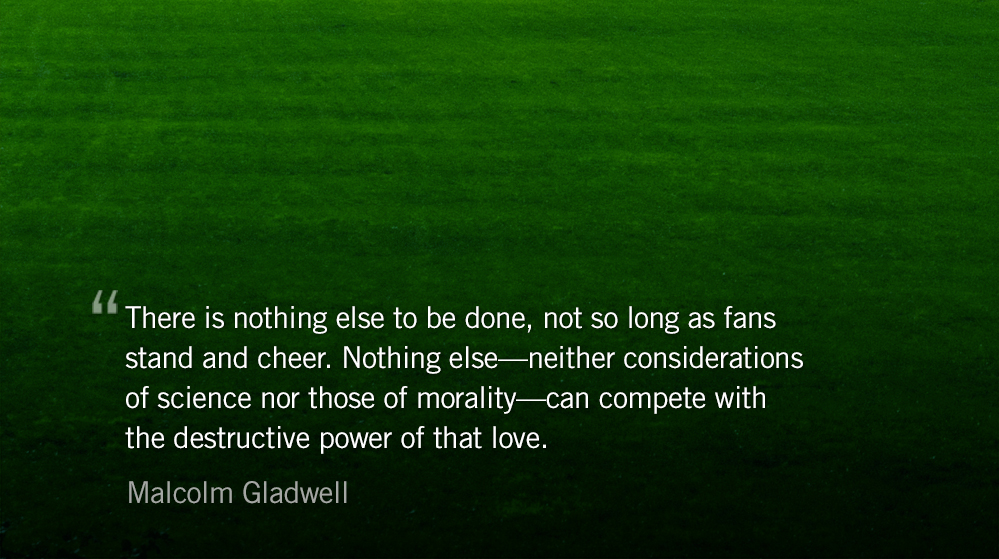
There is nothing else to be done, not so long as fans stand and cheer. We are in love with football players, with their courage and grit, and nothing else—neither considerations of science nor those of morality—can compete with the destructive power of that love. — Malcolm Gladwell
If Christians’ interactions with professional sports are no different than someone outside the church there is simply no testimony to be seen. Faith reorients our understanding of human dignity, fortifies our desires for justice, and releases us from the clutches of media overindulgence. We should lend our voices to reforming sports in every way we can — knowing that our loudest votes for or against the current state of the NFL come through our money and time.

Today’s Reading
2 Samuel 6 (Listen 3:34)
1 Corinthians 16 (Listen 2:54)

This Weekend’s Readings
2 Samuel 7 (Listen 4:26) 2 Corinthians 1 (Listen 3:52)
2 Samuel 8-9 (Listen 4:51) 2 Corinthians 2 (Listen 2:13)


The Weekend Reading List

Ten Questions to Diagnose Your Spiritual Health

Highlighted Text: 2 Cor. 13:5
Full Text: Prov. 1, 2 Cor. 13

Examine yourselves, to see whether you are in the faith. Test yourselves. [1]

How do doctors diagnose physical health? They ask questions, e.g., Have you experienced any breathing difficulties? In his short book, “Ten Questions to Diagnose Your Spiritual Health” [2], Don Whitney suggests doing the same:

  • Do you thirst for God? Jonathan Edwards wrote, “So holy desire, exercised in longings, hungerings, and thirstings after God and holiness, is often mentioned in Scripture as an important part of true religion.” [3]
  • Are you governed increasingly by God’s Word? Thomas Chalmers wrote, “The sum and substance of the preparation needed for a coming eternity is that you believe what the Bible tells you and do what the Bible bids you.” [4]
  • Are you more loving? Martin Luther wrote, “The more a person loves, the closer he approaches the image of God.” [5]
  • Are you more sensitive to God’s presence? A.W. Pink wrote, “If the soul of the believer is in a healthy condition, he will take occasion to frequently come into God’s presence on purpose to have communion with Him.” [6]
  • Do you have a growing concern for the spiritual and temporal needs of others? John Calvin said, “There is nothing in which men resemble God more truly than in doing good to others.” [7]
  • Do you delight in the bride of Christ? Peter Jeffrey wrote, “The closer you are to the Lord, the closer you will be to other believers.” [8]
  • Are the spiritual disciplines increasingly important to you? Peter Jeffrey wrote, “Without a disciplined life, you will stagnate as a Christian.” [9]
  • Do you still grieve over sin? J.C. Ryle wrote, “I am convinced that the first step towards attaining a higher standard of holiness is to realize more fully the amazing sinfulness of sin.” [10]
  • Are you a quick forgiver? James Coulter wrote, “The unforgiving spirit … is the number one killer of spiritual life.” [11]
  • Do you yearn for heaven and to be with Jesus? C.H. Spurgeon said, “You may judge of a man by what he groans after.” [12]

Lord, We long for life in you and, therefore, we must have health and growth. Let us test ourselves, as we seek your face in our quiet times alone with you and in our community. Lift our eyes to Jesus, as we press toward the goal for the prize of the upward call of God in him. Amen.

[Note: Supporting Scripture references for each question are found in the footnotes.]

____________________________________

FAQs

How can I make a tax-deductible donation? Click here.
How can I get these devotionals in my inbox? Click here.
What is the reading plan this blog is based on? Click here.

____________________________________

Footnotes

[1] 2 Cor. 13:5 ESV.  |  [2] Donald S. Whitney. Ten Questions to Diagnose Your Spiritual Health. I love his questions because they focus on the state of the heart toward God (which is the goal) and see Christian obedience and the practice of Christian disciplines (which are the means) as evidence of the state of the heart. Also, in each chapter, he expands on these questions and offers “practical steps” for growing in each of these areas.  |  [3] Do you thirst for God? See, e.g., Ps. 42; Ps. 63; Phil. 3:1-11. (Tons more in the chapter.)  |  [4] Are you governed increasingly by God’s Word? See, e.g., Ps. 119; 1 Ptr. 2:2; 2 Tim. 3:16-17; 2 Thes. 2:10. (Tons more in the chapter.)  |  [5] Are you more loving? See, e.g., Jn. 15:12; Jn 15:17; Rom. 12:10; Rom. 13:8; 1 Cor. 16:14; Gal. 5:14; Eph. 5:2; 1 Thes. 4:9. (Tons more in the chapter.)  |  [6] Are you more sensitive to God’s presence? See, e.g., Gen. 28:16 (when Jacob didn’t recognize God’s presence); Matt. 28:20; Ps. 139:5-12; Matt. 1:23; Acts 11:21; Matt. 18:10; Rev. 21:3. (Tons more in the chapter.) Also, I love this chapter because it talks about times when we go through the desert and how those increase our later senses of His presence.  |  [7] Do you have a growing concern for the spiritual and temporal needs of others? See, e.g., Acts 4:33-34; Gal. 2:10; Jms 2:15-16; Jn. 10:10; Jn. 13:1-17. (Tons more in the chapter.)  |  [8] Do you delight in the bride of Christ? See, e.g., Eph. 5:25-27; 1 Jn. 3:14; Ps. 16:3. (Tons more in the chapter.) (Note: Delighting in “our friends who are in the church” is not the same as delighting “in the church.” In New York, I have found that it is so easy only to spend time with those I already like and am drawn to. Yet the church is filled with all kinds of people. Do I delight in the church? This is the goal; my, how far I have to go!  |  [9] Are the spiritual disciplines increasingly important to you? See, e.g., Heb. 12:14; 1 Tim. 4:7; Mark 1:35. (Tons more in the chapter.) He also asks, “What are the spiritual disciplines?” and “What are the dangers of the spiritual disciplines?” – two important questions.  |  [10] Do you still grieve over sin? See, e.g., 1 Ptr. 1:15; 1 Tim. 1:15; 2 Cor. 7:8-11. (Tons more in the chapter.) He also provides wonderful examples of great saints in more “modern” times (Edwards, etc.).  |  [11] Are you a quick forgiver? See, e.g., Mark 11:25-26; 2 Cor. 5:17. (Tons more in the chapter.)  |  [12] Do you yearn for heaven and to be with Jesus? See, e.g., Rom. 8:22-23; 2 Cor. 5:2. (Tons more in the chapter.)  |  [13] For those who read our 843 Acres in Google Reader, please disregard the accidental version of this post that was published yesterday.

What Happens When We See God

Highlighted Text: Job 42:5
Full Text: Job 42, 2 Cor. 12

Sight | We can read about God and study His Word and yet never be changed. God is just an idea until He comes and speaks into our hearts. Before God spoke to him, Job was quick to remember his own righteousness. When he heard God’s voice, however, he fell in brokenness and confessed, “I had heard of you by the hearing of the ear, but now my eye sees you”[1].

Perspective | Job immediately had two new senses about the Lord – that His sovereignty was absolute: “I know that you can do all things, and that no purpose of yours can be thwarted”[2], and that His wisdom was infinitely superior to human knowledge: “I have uttered what I did not understand, things too wonderful for me, which I did not know” [3]. In light of having these two new senses about God, Job also had a new sense about himself: “I despise myself, and repent in dust and ashes” [4].

Sense | This is what happens when we see God. We don’t have to ask God to show us our sin for what it is; we merely need to ask God to open our eyes to see Him in His magnificent and sovereign holiness. When our eyes behold His glory, we automatically see how utterly different we are from Him [5]. Then what happens to us? Do we become joyless and depressing people? No! We get a brokenhearted joy and a childlike faith that trusts in God. As Jonathan Edwards wrote, “The desires of the saints, however earnest, are humble desires; their hope is a humble hope; and their joy, even when it is unspeakable and full of glory, is a humble, broken-hearted joy, leaving the Christian more poor in spirit, more like a little child, and more disposed to a universal lowliness of behavior” [6].

Prayer | Lord, When we’re not in your presence, it’s easy to think more highly of ourselves than we ought. We praise our own abilities and knowledge instead of your sovereignty and wisdom. Yet, when the reality of your holiness comes bursting forth into our hearts, we see how unworthy we are – apart from Jesus – to live in your mighty love. Therefore, make us broken and changed people, who trust in you with childlike faith. Make our objections to you give way to our worship of you. Give us a sense of your holiness so that we live in confession. Amen.

____________________________________

FAQs

How can I make a tax-deductible donation? Click here.
How can I get these devotionals in my inbox? Click here.
What is the reading plan this blog is based on? Click here.

____________________________________

Footnotes

[1] Job 42:5 ESV  |  [2] Job 42:2 ESV  |  [3] Job 42:3 ESV  |  [4] Job 42:6 ESV  |  [5] Isaiah saw the Lord and proclaimed, “Woe is me! For I am lost; for I am a man of unclean lips, and I dwell in the midst of a people of unclean lips; for my eyes have seen the King, the Lord of hosts!” (Is. 6:6 ESV), and Peter saw Jesus perform a miracle and said, “Depart from me, for I am a sinful man, O Lord” (Lk. 5:8 ESV).  |  [6] Jonathan Edwards. Religious Affections. (portion in italics is taken from 1 Peter 1:8). Elsewhere Jonathan Edwards elaborated on the experience of David Brainerd, “I saw that I had been heaping up my devotions before God, fasting, praying, pretending, and indeed really thinking sometimes, that I was aiming for the glory of God; whereas I never once truly intended it, but only my own happiness. I saw, that as I had never done any thing for God, I had no claim on any thing from him, but perdition, on account of my hypocrisy and mockery. Oh how different did my duties now appear from what they used to do! I used to charge them with sin and imperfection; but this was only on account of the wanderings and vain thoughts attending them, and not because I had no regard to God in them; for this I thought I had. But when I saw evidently that I had regard to nothing but self-interest, then they appeared a vile mockery of God, self-worship, and a continual course of lies; so that I now saw that something worse had attended my duties, than barely a few wanderings; for the whole world was nothing but self-worship, and a horrid abuse of God. I continued, as I remember, in this state of mind, from Friday morning till the Sabbath evening following (July 12, 1739) when I was walking again in the same solitary place, where I was brought to see myself lost and helpless, as before mentioned. Here, in a mournful melancholy state, I was attempting to pray; but found no heart to engage in that or any other duty; my former concern, exercise and religious affections were now gone. I thought the Spirit of God had quite left me; but still was not distressed; yet disconsolate, as if there was nothing in heaven or earth could make me happy. Having been thus endeavoring to pray though, as I thought, very stupid and senseless for near half an hour, then as I was walking in a dark, thick grove, unspeakable glory seemed to open to the view and apprehension of my soul. I do not mean any external brightness, for I saw no such thing; nor do I intend any imagination of a body of light, somewhere in the third heavens, or any thing of that nature; but it was a new inward apprehension or view that I had of God, such as I never had before, nor any thing which had the least resemblance of it. I stood still, wondered, and admired! I knew that I never had seen before any thing comparable to it for excellency and beauty; it was widely different from all the conceptions that ever I had of God, or things divine. I had no particular apprehension of any one person in the Trinity, either the Father, the Son, or the Holy Ghost; but it appeared to be divine glory. My soul rejoiced with joy unspeakable, to see such a God, such a glorious Divine Being; and I was inwardly pleased and satisfied that he should be God over all for ever and ever. My soul was so captivated and delighted with the excellency, loveliness, greatness, and other perfections of God, that I was even swallowed up in him; at least to that degree, that I had no thought (as I remember) at first about my own salvation, and scarce reflected there was such a creature as myself.” See how Brainerd FIRST saw his own sinfulness and wretchedness and THEN saw the unspeakable joy of the Lord – so much that he even forgot about himself! This is the process that God uses to show us who He is and who we are in light of who He is. This is how He makes us brokenhearted in joy and childlike in faith. See Jonathan Edwards. The Life and Diary of David Brainerd.

Why and What Do We Pray for One Another

Highlighted Text: 2 Cor. 11:24-27
Full Text: Job 41, 2 Cor. 11

Prayer-Pleading | Paul frequently asked his fellow believers to pray for him. Sometimes he would simply say, “Brothers, pray for us” [1]. Other times he would passionately plead,“Strive together with me in your prayers to God on my behalf” [2]. And we know why he so desperately needed their prayers. As he testified, “Five times I received at the hands of the Jews the forty lashes less one. Three times I was beaten with rods. Once I was stoned. Three times I was shipwrecked; a night and a day I was adrift at sea; on frequent journeys, in danger from rivers, danger from robbers, danger from my own people, danger from Gentiles, danger in the city, danger in the wilderness, danger at sea, danger from false brothers; in toil and hardship, through many a sleepless night, in hunger and thirst, often without food, in cold and exposure” [3].

Prayer-Needing | Paul was brilliant and intense. He was a great man, a spiritual warrior, and a chosen instrument of God. Yet he needed others to pray for him. Why? First, he knew that he could never accomplish his work apart from the grace of God: “By the grace of God I am what I am, and his grace toward me was not in vain. On the contrary, I worked harder than any of them, though it was not I, but the grace of God that is with me” [4]. Second, he knew that moral growth and ministry success came only by prayer. As he told the Philippians, “It is my prayer that your love may abound more and more, with knowledge and all discernment” [5] (moral growth), and wrote to the Thessalonians, “Pray for us, that the word of the Lord may speed ahead and be honored” [6] (ministry success).

Prayer-Doing | Lord, We long for grace, moral growth and ministry success in our lives. Thus, we know that we must meet with you in prayer. We must boast in our weaknesses apart from you, knowing that we cannot accomplish the most lasting achievements on this earth apart from your might, power, glory and love. Let us not be lazy in praying for one another – that your grace would abound in our lives, that our love may grow in knowledge and depth of insight, and that your word may speed ahead and be honored in our lives – even as we endure hardship for our obedience like Paul did. Amen.

____________________________________

FAQs

How can I make a tax-deductible donation? Click here.
How can I get these devotionals in my inbox? Click here.
What is the reading plan this blog is based on? Click here.

____________________________________

Footnotes

[1] See Col. 4:3; 1 Thess. 5:25; 2 Thess. 3:1.  |  [2] Rom. 15:30 ESV  |  [3] 2 Cor. 11: 24-27 ESV  |  [4] 1 Cor. 15:10 ESV. See also 1 Peter 4:11; Heb. 13:20-21  |  [5] Phil. 1:9 ESV. See also Col. 1:9-10; Lk. 22:40  |  [6] 2 Thess. 3:1. See also Eph. 6:19; Col. 4:3-4