Contemplating the Cross :: A Lenten Reflection

Rejection of God is not limited to irreligion; it is possible to refuse the grace of Christ through religion. Because the heart of Christianity isn’t morality, the nature of temptation isn’t a draw toward immorality.

The irreligious version of this is obvious: the systematic or categorical rejection of God. Life apart from God through religion is more difficult to see. The religious atheist is observant—even outwardly impressive in his adherence. The religious atheist sees his efforts of living like Jesus as sufficient and acceptable to God.

The cross is perplexing to someone earning their acceptance through works. It seems cruel and vulgar—pointless in affecting daily life and practice. To the faithful—who place their trust in the life, death, and resurrection of Christ—the cross, while no less cruel, is also beautiful because on it we see the depth of God’s love.

In the late 19th century Edward Monro composed a five-part hymn, The Story of the Cross. In the fifth to eighth stanzas Monro writes:
Follow to Calvary;
Tread where He trod,
He Who forever was
Son of God.

You who would love Him stand
Gaze at His face:
Tarry awhile on your
Earthly race.

As the swift moments fly
Through the blest week,
Read the great story the
Cross will teach.

Is there no beauty to
You who pass by,
In that lone figure which
Marks that sky?
Monro wrestles with the weight of the cross, “For us Thy blood is shed, us alone.” Yet he is overwhelmed by the grace of God in this sacrifice. The cross is transformative in daily life because on it we see that God’s acceptance is not based on our work, but on his own—that God’s grace has no limits—that God’s love is sufficient where every earthly affection has failed.

In the final three stanzas Monro reflects on the daily impact of Christ’s sacrifice on our behalf:
Yea, let Thy cross be borne
Each day be me;
Mind not how heavy, if
But with Thee.

Lord, if Thou only wilt,
Make us Thine own,
Give no companion, save
Thee alone.

Grant through each day of life
To stand by Thee;
With Thee, when morning breaks
Ever to be.

Today’s Reading
Job 18 (Listen – 1:54)
1 Corinthians 5 (Listen – 1:58)

Wandering Anger :: A Lenten Reflection

“Christians build up little gods, little temples of Baal. We begin to worship them. And we must tear them down, destroy them,” author Madeleine L’Engle told Christianity Today. The interview was conducted late in L’Engle’s career (she passed away in 2007), during a time when her writings were highly controversial.

Readers outside the church complained that she talked about Christ and faith far too often. Her most vocal opponents, however, were inside the Christian community. Part of the frustration, according to one book review, was that she eschewed evangelical language.

One of L’Engle’s poems, Love Letter, begins with the arresting words:
I hate you, God.
Love, Madeleine.

I write my message on water
and at bedtime I tiptoe upstairs
and let it flow under your door.
Her honesty—“When I am angry with you, I know that you are there”—seems to channel David’s in the Imprecatory Psalms. Most beautifully, L”Engle’s thorough examination reaches into the depths of her own heart; “I cannot turn the other cheek. It takes all the strength I have.” In her interview with Christianity Today, L’Engle continues:

The gods we erect are easier to worship than the Creator of the universe. They’re more comprehensible. We don’t like having to depend on that which we cannot control, manipulate, dominate.

Freedom comes on the other side of work. If I want to play a Bach fugue, I must practice scales. If I hope for any transcendent experience in prayer, I have to have just done my ordinary, everyday prayers, which is the same thing as practicing my scales. I have to write every day.

Freedom and discipline, rather than being antithetical, are complementary. Permissiveness, either from others toward you or toward yourself, ends up being restricting and crippling. If you choose to be a writer and a mother, you have to be incredibly disciplined. Otherwise you won’t manage. Discipline does not imprison you.
Idols are destroyed through spiritual discipline, hearts transformed through prayer. None more-so than L’Engle’s in Love Letter. After pouring out her frustration, lament, and confession L’Engle, with her final words, cries out:
Let me hear you roar.
Love,
Madeleine

Today’s Reading
Job 16-17 (Listen – 3:40)
1 Corinthians 4 (Listen – 3:15)

How to Live as a Christian :: A Lenten Reflection

Fasting is as much about dedicating time and energy to activities that refresh the soul as it is about divesting from the facades we have come to rely on in place of the gospel. Discovering how to engage our faith in daily life is best done, as Miroslav Volf writes, when faith is “nourished more on its own intrinsic vision than on the deprecatory stories about others.” Volf, who we read yesterday, continues:

Notice the significance of the new birth for Christian social identity. Christians do not come into their social world from outside seeking either to accommodate to their new home (like second generation immigrants would), shape it in the image of the one they have left behind (like colonizers would), or establish a little haven in the strange new world reminiscent of the old (as resident aliens would). They are not outsiders who either seek to become insiders or maintain strenuously the status of outsiders.

Christians are the insiders who have diverted from their culture by being born again. They are by definition those who are not what they used to be, those who do not live like they used to live. Christian difference is therefore not an insertion of something new into the old from outside, but a bursting out of the new precisely within the proper space of the old.

The question of how to live in a non-Christian environment, then, does not translate simply into the question of whether one adopts or rejects the social practices of the environment. This is the question outsiders ask, who have the luxury of observing a culture from a vantage point that is external to that culture. Christians do not have such a vantage point since they have experienced a new birth as inhabitants of a particular culture. Hence they are in an important sense insiders. As those who are a part of the environment from which they have diverted by having been born again and whose difference is therefore internal to that environment.

Christians ask, “Which beliefs and practices of the culture that is ours must we reject now that our self has been reconstituted by new birth? Which can we retain? What must we reshape to reflect better the values of God’s new creation?”

Today’s Reading
Job 15 (Listen – 3:23)
1 Corinthians 3 (Listen – 3:05)

Soft Difference :: A Lenten Reflection

The Lenten season’s focus on inward sin is meant to be catalytic—a renewal of self, through Christ, for the benefit of the world. Through holiness, the faithful are rooted, nourished, and able to bear fruit. Sin saps the branches—a gospel-centered understanding of sin promotes human flourishing. Forming a distinctly Christian understanding of sin is essential.

Religious identities rooted in their rejection of a particular social environment are inherently violent. Miroslav Volf notes that it is only when faith is “nourished more on its own intrinsic vision than on the deprecatory stories about others” that it is able to live in and not of the world. Volf, a theologian at Yale, continues:
It is Christian identity that creates difference from the social environment, not the other way around. When identity is forged primarily through the negative process of the rejection of the beliefs and practices of others, violence seems unavoidable, especially in situations of conflict.

We should keep in mind, however, that the call to follow the crucified Messiah was, in the long run, much more effective in changing the unjust political, economic, and familial structures than direct exhortations to revolutionize them would ever have been.
The New Testament’s call to meekness, something which Volf calls “soft difference”—becomes the key to winsome and transformative faith.
People who are secure in themselves—more accurately, who are secure in their God—are able to live the soft difference without fear. They have no need either to subordinate or damn others, but can allow others space to be themselves. For people who live the soft difference, mission fundamentally takes the form of witness and invitation. They seek to win others without pressure or manipulation, sometimes even “without a word.”

Soft difference is not simply a missionary method. Rather, the soft difference is the missionary side of following in the footsteps of the crucified Messiah. To be a Christian means to live one’s own identity in the face of others in such a way that one joins inseparably the belief in the truth of one’s own convictions with a respect for the convictions of others. To give up the softness of our difference would be to sacrifice our identity as followers of Jesus Christ.
Today’s Reading
Job 14 (Listen – 2:23)
1 Corinthians 2 (Listen – 2:26)

Hard Hits: Faith and the NFL :: The Weekend Reading List

“I remember, every season, multiple occasions where I’d hit someone so hard that my eyes went cross-eyed, and they wouldn’t come uncrossed for a full series of plays.” — Kyle Turley, former offensive tackle for the Saints, Rams, and Chiefs
The NFL, Malcolm Gladwell says, “is a moral abomination… Can you point to another industry in America which, in the course of doing business, maims a third of its employees?” Gladwell compares the NFL to dogfighting where an owner, “willingly submitted his dog to a contest that culminated in her suffering and destruction. And why? For the entertainment of an audience and the chance of a payday.”
“[Pro] Football is one of the most dehumanizing experiences a person can face.” — Dave Meggyesy, former linebacker, Cardinals (1963-69)
“Dehumanizing sounds so extreme, but when you’re fighting for a football at the bottom of the pile, it is kind of dehumanizing. It’s like a spectacle of violence, for entertainment… It’s make-believe, really. That’s the truth about it.” — Chris Borland, former linebacker for the 49ers
“Part of what makes dogfighting so repulsive is the understanding that violence and injury cannot be removed from the sport,” says Gladwell. “It’s a feature of the sport that dogs almost always get hurt.”
Think Progress notes that chronic traumatic encephalopathy (CTE), a disease which manifests in symptoms similar to Alzheimers, is the smoking gun of the NFL’s methodical destruction of its athletes lives. “Dr. David Geier of The Post and Courier reports that evidence of CTE — which has been linked to depression, suicide, and memory loss — has been found in the brains of 87 out of the 91 dead NFL players who were examined by the Center for the Study of Traumatic Encephalopathy.”
The latest research on traumatic brain injuries shows the greatest damage to an athlete’s brain tissue — and future — comes from the “normal” hits, not the colossal ones. Sub-concussive hits, impacts which do not cause a concussion, occur up to 1,000x per season for an individual linebacker, adding up in the tens of thousands over a career that starts in high school.
This is a story the NFL has worked aggressively to suppress, including forcing Sony Pictures to take “most of the bite” out of an upcoming movie “for legal reasons.”
In the short term, players (even young ones) become addicted to prescription drugs and marijuana to manage their physical pain; and in the long-term they experience degenerative neurological disease at disproportionately high rates.
Many fans expect new technologies like instantaneous impact data and improved helmet design to help athletes stay in the game longer. Yet there are two problems which make this unlikely. First, sub-concussive hits occur in practice, even in the comparatively less violent “shells” practice where players only wear helmets and shoulder pads. More importantly the NFL’s most aggressive investments in technology are not to improve player safety, but to increase fan engagement and revenue.
“We’re focusing on making [local games] a five-to-six-hour, driveway-to-driveway experience.” — Brian Lafemina, SVP Club Business Development, NFL
This year the league is investing in RFID chips which will sit under both shoulder pads of every player in the league, as well as on the officials, yard markers, and pylons. CIO magazine reports that “The NFL plans to use the data generated to power the NFL 2015 app for Xbox One and Windows 10, allowing for things like ‘Next Gen Replay’ that will allow fans to call up stats for each player tied into highlight clips posted on the app.”
Some Christian communities’ obsession with the NFL is a living confession that we are as of-the-world as we are in it. The fallen reality of the game should dramatically reorient our posture toward the NFL. Christian communities could start by discussing how to rightly engage with the NFL — and how much time and energy is appropriate to dedicate to spectator sports in general.
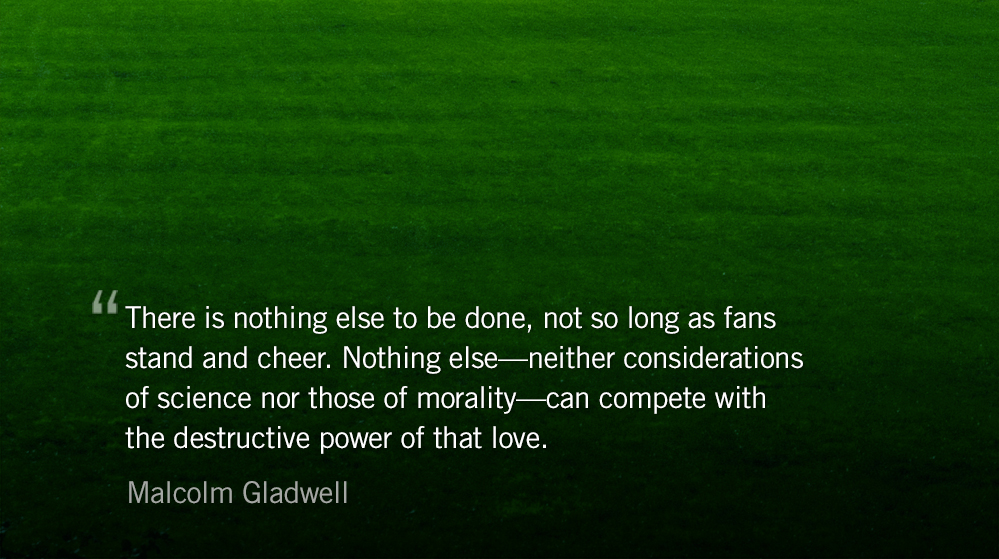
There is nothing else to be done, not so long as fans stand and cheer. We are in love with football players, with their courage and grit, and nothing else—neither considerations of science nor those of morality—can compete with the destructive power of that love. — Malcolm Gladwell
If Christians’ interactions with professional sports are no different than someone outside the church there is simply no testimony to be seen. Faith reorients our understanding of human dignity, fortifies our desires for justice, and releases us from the clutches of media overindulgence. We should lend our voices to reforming sports in every way we can — knowing that our loudest votes for or against the current state of the NFL come through our money and time.

Today’s Reading
2 Samuel 6 (Listen 3:34)
1 Corinthians 16 (Listen 2:54)

This Weekend’s Readings
2 Samuel 7 (Listen 4:26) 2 Corinthians 1 (Listen 3:52)
2 Samuel 8-9 (Listen 4:51) 2 Corinthians 2 (Listen 2:13)


The Weekend Reading List
Show Buttons
Hide Buttons
Spur a spiritual rhythm of refreshment right in your inbox
By joining this email list you are giving us permission to send you devotional emails each weekday and to communicate occasionally regarding other aspects of the ministry.
100% Privacy. We don't spam.