Jesus Concealed and Revealed — Readers’ Choice

Readers’ Choice Month:
In August, The Park Forum looks back on our readers’ selections of our most meaningful and helpful devotionals from the past 12 months. Thank you for your readership. This month is all about hearing from you. Submit a Readers’ Choice post today.

Today’s post was originally published, March 10, 2021, based on readings from Luke 24.
It was selected by reader, Jon Polk from Hong Kong
“The Emmaus Road account is one of my favorite gospel stories. I wonder, “How did they not even recognize Jesus?” And then I’m reminded of all the times in my life when Jesus has been right alongside me and I didn’t recognize or acknowledge him. Keep your eyes open and you will see Jesus all through your day, often in places that you wouldn’t expect him to be.”

Scripture Focus: Luke 24.27
27 And beginning with Moses and all the Prophets, he explained to them what was said in all the Scriptures concerning himself.

Reflection: Jesus Concealed and Revealed — Readers’ Choice
By John Tillman

Disciples don’t always seem to recognize the resurrected Jesus. Do we? 

In younger years, I thought this was part of the miracle of the resurrection, but now I think the explanations are far more likely to be practical than out of the ordinary. 

I used to think that Mary mistaking Jesus for the gardener was a miracle, but with age comes experience and wisdom. After living through intense times of mourning in my life, my own tear-blurred vision has made clear to me that probably Mary’s tears were what obscured Jesus, and not a heavenly veil.

I used to think that Jesus blinded Cleopas and his wife on the road to Emmaus, but with grief comes understanding. After walking away from many funerals and deaths of friends and walking through other deep, emotional losses, I know that physical senses are dulled by grief. After what they experienced, it would have been a miracle if their eyes had risen from trudging the road to see the face of the stranger. Even if they had looked up, the shadows of grief in their minds and the shadows of the setting sun on the path could easily have concealed him from them.

However, I do think Jesus helped them miss him—perhaps only by looking away when they looked at him or by wearing a hood or head covering that partly concealed his face. I also believe he did so for a purpose. He was preparing them for his absence and revealing to them his eternal presence. 

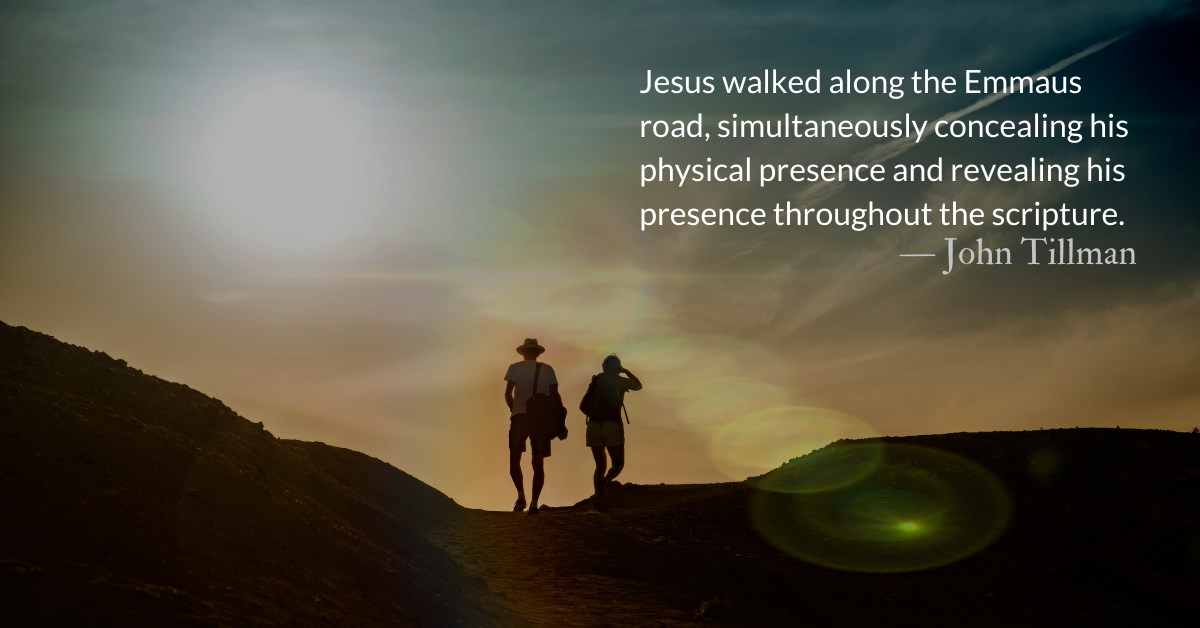
Jesus walked along the Emmaus road simultaneously concealing his physical presence and revealing his presence throughout the scripture. He made himself unrecognizable to them on the road so that he could make himself recognizable to them in the Torah. He hid his face from their eyes but burned his features within their hearts. The couple confessed to each other later, “Were not our hearts burning within us?” 

This same Jesus is with us. He sidles up to us and asks, “What are you discussing? What things weigh you down? What are you grieving?”

As we trudge along a path of grief may we listen to his Spirit. He will reveal to us the joy of his presence. 
His presence with us can make our hearts burn, even when they are weighed down with grief.
His love can make us run back, through the darkness of night, to tell others that light and joy have come.

Divine Hours Prayer: A Reading
Jesus taught us, saying: “The Father loves me, because I lay down my life in order to take it up again. No one takes it from me; I lay it down of my own free will, and as I have power to lay it down, so I have power to take it up again; and this is the command I have received from my Father.” — John 10.17-18

– Divine Hours prayers from The Divine Hours: Prayers for Springtime by Phyllis Tickle


Today’s Readings
1 Samuel 16 (Listen – 3:45)
Romans 14 (Listen – 3:28)

Read More about Readers’ Choice 2021
Have we heard from you yet? Tell us about posts from the past year (September 2020 – July 2021) that have helped you in your faith.
https://forms.gle/ozM13qvW9ouSWhJS7

Read more about In the Face of Grief
The resurrected Christ seems to have a special preference for appearing to the grieving. Why then do we seem to assume that this stopped when he ascended?
Apocalypse, How? — Editor’s Choice

Readers’ Choice Month:
In August, The Park Forum looks back on our readers’ selections of our most meaningful and helpful devotionals from the past 12 months. Thank you for your readership. This month is all about hearing from you. Submit a Readers’ Choice post today.

Today’s post is an “Editor’s Choice” originally published, September 8, 2020, based on readings from Ezekiel 11.
It was selected by John Tillman
“Connecting apocalyptic fiction to the true meaning of apocalypse in scripture has long been something I wanted to write about. For decades, I have enjoyed apocalyptic-style fiction and recognized that it revealed things about our culture. We see this by watching the same “monster” come to us dressed in different fears and sins as our culture changes. For example, early zombie stories had supernatural causes and showed our fear of spiritual forces, now zombie stories are connected to fears of genetic manipulation or other types of technology and the “sins” of society or corporations that pursue them. As a society and as individuals, we never stop needing to have our sins and fears revealed to us so that we may confess them to our God. Rather than our greatest fear, ‘apocalypse’ may be our greatest need.”

Scripture Focus: Ezekiel 11.13
Then I fell facedown and cried out in a loud voice, “Alas, Sovereign LORD! Will you completely destroy the remnant of Israel?” 

Reflection: Apocalypse, How? — Editor’s Choice
By John Tillman

Today, we think of an “apocalypse” as a kind of ending event, involving widespread destruction, suffering, and death. 

Apocalypses come in different flavors from zombies to aliens, from resurrected dinosaurs to natural disasters. Some of our apocalyptic tastes can be quite bizarre. Who would have guessed in 2013 that by 2020 there would be five sequels to Sharknado?

The popularity of “apocalypse” in entertainment has even spawned industries supporting “preppers” who stock up on guns, ammo, food, supplies, or whatever they may need for various kinds of apocalyptic scenarios.

We have apocalypses all wrong.

The Greek word, apocalypsis, does not mean destruction or the end of anything, much less “zombies.” Apocalypsis means unveiling or revealing, and it is the Greek title of the book we call “Revelation.” But the book called Apocalypsis or Revelation isn’t the only apocalyptic part of the Bible. There are many books, poems, writings, and stories that are considered “apocalyptic” in nature. Some “apocalypses” are violent, some are not.

Jesus told his disciples that he would “apocalypse” the father to them, meaning that he would reveal to them God the Father. In fact, Jesus’ entire ministry could be described as one long, loving apocalypse, revealing to us what God is like. “Anyone who has seen me has seen the Father…” (John 14.9)

When we read an “apocalyptic” passage in the Bible, we need to remember that something is being revealed or exposed.

In Ezekiel’s vision, the suffering he witnessed caused him to fall to his knees and cry out, fearing that all would be destroyed. This is often our fear as well, which is revealed in our fictional apocalypses. Name your fear and there’s an apocalypse flavor catering to it. We fear the breakdown of society and human nature? Hollywood gives us zombies. We fear destruction caused by irresponsible science or business? Hollywood gives us Jurassic Park. Our “apocalypses” are revealing after all. They reveal things about us.

Ezekiel did not fully understand the depth of Judah’s sin until he saw the horrifying visions he records. Many times, it takes a moment of horror for us to be forced to confront our own sin. Our sin will be “apocalypsed” to us. But how?

What sin have you glossed over or covered that God might “apocalypse” to you?
What spiritual “prepping” have you done that might aid you?
Are you ready for an apocalypse?

Divine Hours Prayer: A Reading
In the due course John the Baptist appeared; he proclaimed this message in the desert of Judea: “Repent, for the kingdom of Heaven is close at hand. “ — Matthew 3.1-2

– Divine Hours prayers from The Divine Hours: Prayers for Springtime by Phyllis Tickle

Today’s Readings
1 Samuel 12 (Listen – 4:19)
Romans 10 (Listen – 3:21)

This Weekend’s Readings
1 Samuel 13 (Listen – 3:54), Romans 11 (Listen – 5:23)
1 Samuel 14 (Listen – 9:01), Romans 12 (Listen – 2:58)

Read More about Readers’ Choice 2021
Have we heard from you yet? Tell us about posts from the past year (September 2020 – July 2021) that have helped you in your faith.

https://forms.gle/ozM13qvW9ouSWhJS7

Read more about Prepare for the End
Whenever and however “the end” comes, we can be soberly prepared, watchfully vigilant, and unwaveringly hopeful.

The Consequence of Carelessness — Readers’ Choice

Readers’ Choice Month:
In August, The Park Forum looks back on our readers’ selections of our most meaningful and helpful devotionals from the past 12 months. Thank you for your readership. This month is all about hearing from you. Submit a Readers’ Choice post today.

Today’s post was originally published, July 7, 2021, based on readings from Joshua 9 and Psalm 140.
It was selected by reader, John from Singapore.
“Insightful!”

Scripture Focus: Joshua 9:14
14 The Israelites sampled their provisions but did not inquire of the Lord.

Psalm 140:1-3
1 Rescue me, Lord, from evildoers;
    protect me from the violent,
2 who devise evil plans in their hearts
    and stir up war every day.
3 They make their tongues as sharp as a serpent’s;
    the poison of vipers is on their lips.

Reflection: The Consequence of Carelessness — Readers’ Choice
By Erin Newton

There are times when the monotony of life creates an apathy toward caution. Each day is much like the last; one activity looks the same as the next. We grow comfortable in our abilities and go about our day with no need of counsel.

Joshua led the Israelite army against city after city. The mistake of Achan’s sin seemed to have been reversed with the defeat of Ai. However, the pattern of error had already taken root. Some of their enemies formed an alliance, but the Gibeonites chose an alternate method: lie and gain Israel’s protection through deception. With much planning, the ruse was set. The Israelite leaders took a cursory glance and trusted the Gibeonites’ claim. Regrettably, they did not seek God’s counsel. They were blind to the false pretense and propaganda before them. This lapse in judgment bound the Israelites with their enemy. Hastiness produced errors.

Psalm 140 presents a plea for protection, asking God for wisdom to discern evil plans and cunning words. The psalmist likens the words of an enemy to the poisonous, sharp tongue of a viper. The craftiness of the serpent in the Garden strikes again in the Promised Land through the Gibeonites.

Why did the leaders fail to inquire of God? Why do we? Is it apathy, busyness, or pride? Our lives are plagued with rash decisions because we operate at high speed. We are convinced of our abilities and fail to lay our lives before God. Are we neglecting God’s counsel because we do not want to deny ourselves certain things?

C. S. Lewis describes the gentle slope toward evil through his fictional story of demonic correspondence in The Screwtape Letters: “It does not matter how small the sins are provided that their cumulative effect is to edge the man away from the Light and out into the Nothing. Murder is no better than cards if cards do the trick.”

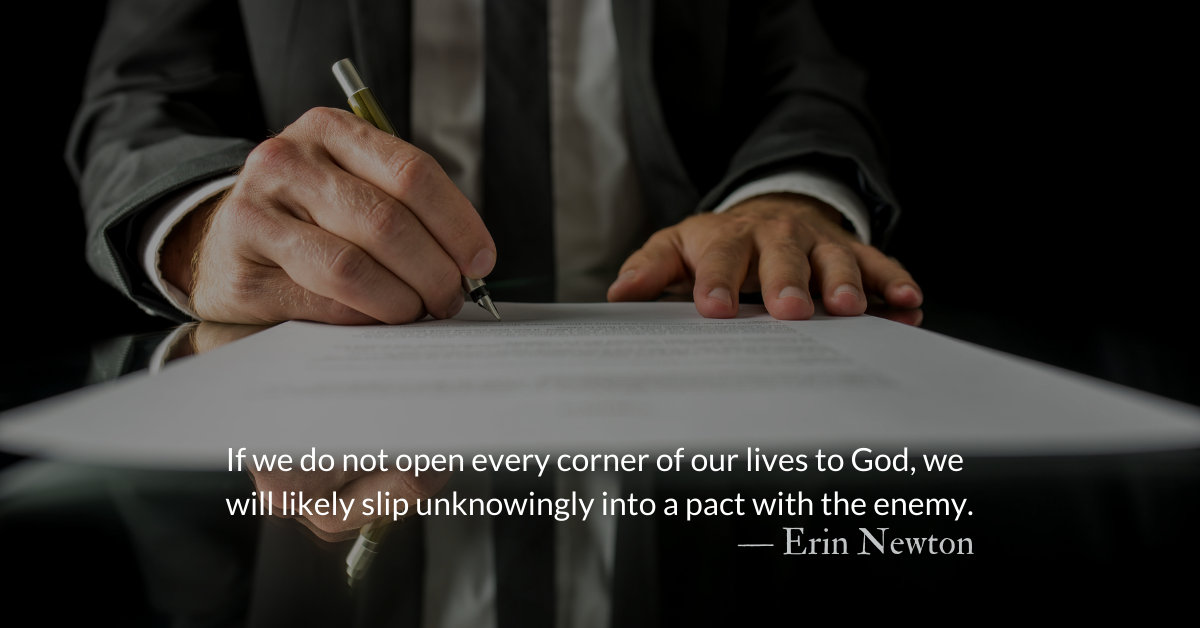
Israel’s tendency toward neglect would be a festering wound resulting in more errors and consequences. If we do not open every corner of our lives to God, we will likely slip unknowingly into a pact with the enemy. We will be duped by anyone with persuasive words. We must remember to seek God’s counsel and see through deception. 

Joshua honored the covenant Israel made in error. Ultimately, the Gibeonites remained part of the Israelite community for centuries. Even though humanity errs, God redeems. 

Divine Hours Prayer: The Request for Presence
Hide not your face from your servant; be swift and answer me… Draw near to me and redeem me… Psalm 69.19-20

– Divine Hours prayers from The Divine Hours: Prayers for Springtime by Phyllis Tickle

Today’s Readings
1 Samuel 11 (Listen – 2:43)
Romans 9 (Listen – 5:15)

Read More about Readers’ Choice 2021
Have we heard from you yet? Tell us about posts from the past year (September 2020 – July 2021) that have helped you in your faith.
https://forms.gle/ozM13qvW9ouSWhJS7

Read more about ​​The Idol of Control
True peace comes from trusting in the wisdom, plan, and counsel of God…we must ensure that we listen first and foremost to God’s wisdom.

Facing a Biblical Disaster — Readers’ Choice

Readers’ Choice Month:
In August, The Park Forum looks back on our readers’ selections of our most meaningful and helpful devotionals from the past 12 months. Thank you for your readership. This month is all about hearing from you. Submit a Readers’ Choice post today.

Today’s post was originally published, October 23, 2020, based on readings from Daniel 8 and Psalm 116.
It was selected by reader, Jerome from Golden
“Thank you for these words and the refreshing breath of the Holy Spirit that they represent. You are spot on; turning our eyes to Jesus instead of on the drama du jour will bring us peace in the storm.”

Scripture Focus: Daniel 8.26-27
26 “The vision of the evenings and mornings that has been given you is true, but seal up the vision, for it concerns the distant future.” 
27 I, Daniel, was worn out. I lay exhausted for several days. Then I got up and went about the king’s business. I was appalled by the vision; it was beyond understanding. 

Psalm 116.8-11
8 For you, LORD, have delivered me from death, 
my eyes from tears, 
my feet from stumbling, 
9 that I may walk before the LORD 
in the land of the living. 
10 I trusted in the LORD when I said, 
“I am greatly afflicted”; 
11 in my alarm I said, 
  “Everyone is a liar.”

Reflection: Facing a Biblical Disaster — Readers’ Choice
By John Tillman

For some people the only use of the word “biblical” they are familiar with is as an adjective to describe the proportions of disasters. 2020 has brought multiple disasters described as being of “biblical proportions.”

Along with physical disasters, this year has brought the exhausting mental and emotional disaster of trying to sort out truth from the storm of misinformation and lies. Every problem we face seems to have competing sets of “facts” that conveniently paint one political side or the other as being the problem.

The unnatural disaster of conspiracy theories getting injected into churches by mainstream and fringe news outlets has caused spiritual and emotional trauma for many. How is it people who claim to know the truth that will set us free, have become unable to agree on basic truths? 
Christians have been filling up on bread with the yeast of conspiracy theories rather than the bread of life, and we are belching up harmful and hateful lies as a result. As Ed Stetzer has said, “Gullibility is not a spiritual gift.”

Too many Christians follow political pundits more closely than Jesus Christ. Their spiritual diet depends more on news programs than Bible passages. They are more concerned with the status and power of their political party, than the health and productivity of the body of Christ, God’s Church. Many Christians would rather change churches (or fire their pastors) than face uncomfortable truths from the Bible that conflict with their political worldview. 

This is the true biblical disaster of 2020.

Many ask, “Are we in the end times?” I don’t know. I do think we are seeing what they are like. Visions of the end, as Daniel can attest, are exhausting and terrifying. Daniel tells us, wisely I think, that visions of the end are “beyond understanding.” Even with Gabriel’s explanation, he still couldn’t understand. 

May we mimic Daniel’s faithfulness through confusion and weariness, his caution in not sharing what he didn’t understand, and his focus on prayer and the scriptures.

Rest and trust in Christ. Your exhaustion and confusion is real and justified.

Lay anguish, rage, and sadness from this crisis-filled year at the feet of Jesus, rather than weaponize it against your brothers and sisters.

Go about our king’s business. Love one another well and share the good news (the gospel) that unites us rather than news that conspires to divide us.

Divine Hours Prayer: The Refrain for the Morning Lessons
Righteousness and justice are the foundations of your throne; love and truth go before your face. — Psalm 89.14

– Divine Hours prayers from The Divine Hours: Prayers for Springtime by Phyllis Tickle

Today’s Readings
1 Samuel 10 (Listen – 4:34)
Romans 8 (Listen – 6:22)

Read More about Readers’ Choice 2021
Have we heard from you yet? Tell us about posts from the past year (September 2020 – July 2021) that have helped you in your faith.

https://forms.gle/ozM13qvW9ouSWhJS7

Read more about Worship and Politics
I have never heard anyone say that a politically tinged sermon which agreed with their politics was “too political.”

It Came Upon The Midnight Clear — Readers’ Choice

Readers’ Choice Month:
In August, The Park Forum looks back on our readers’ selections of our most meaningful and helpful devotionals from the past 12 months. Thank you for your readership. This month is all about hearing from you. Submit a Readers’ Choice post today.

Today’s post was originally published, December 23rd, 2020, based on readings from John 13 and Luke 2.
It was selected by reader, Russell in Saitama, Japan
“I always thought this was a strange Christmas carol, in that it never mentions Jesus or His birth. I’m glad to know that the author was ‘passionately focused on Christ,’ in spite of this omission.”

Scripture Focus: John 13.13-15
13 “You call me ‘Teacher’ and ‘Lord,’ and rightly so, for that is what I am. 14 Now that I, your Lord and Teacher, have washed your feet, you also should wash one another’s feet. 15 I have set you an example that you should do as I have done for you.

Luke 2.13-14
13 Suddenly a great company of the heavenly host appeared with the angel, praising God and saying,
14 “Glory to God in the highest heaven,
    and on earth peace to those on whom his favor rests.”

Reflection: It Came Upon The Midnight Clear — Readers’ Choice 
By Jon Polk

After graduating in 1837 from the Theological School in Cambridge, Massachusetts, Edmund Hamilton Sears settled in as pastor in the country town of Wayland. The church was impressed with his character and preaching and Sears, who never had ambitions for a prominent city congregation, was enamored by the quiet beauty of the little parish.

One can sense parochial tranquility in his most famous hymn.

It came upon the midnight clear,
That glorious song of old…
The world in solemn stillness lay,
To hear the angels sing.

Sears’ family would quickly grow to four children, compelling him to seek out a larger church which could support them. In 1840, he accepted the pastorate of a church in Lancaster, where he would serve for seven years.

The work in Lancaster was difficult and Sears suffered from illness, depression, and an eventual breakdown. Ultimately, his condition deteriorated to the point where he was unable to project his preaching voice loud enough for the congregation to hear.

To facilitate recovery, he returned to Wayland for a year of rest. When healthy, he was invited to return to the Wayland church part-time, which freed him to use his gifts in writing.

In the aftermath of his personal struggles, he wrote “It Came Upon the Midnight Clear,” in 1849. At the time, the U.S. was reeling from the Mexican War and struggling with slavery as the Civil War drew near.

His sadness is palpable in the lyrics.

Yet with the woes of sin and strife
The world has suffered long…
And man, at war with man, hears not
The love-song which they bring…

Sears’ theology was passionately focused on Christ; he preached “The word ‘Jesus’ opens the heart and touches the place of tears.” He maintained that Christ alone had bridged the great divide between God and humanity.

As a result, he believed that we are responsible for implementing God’s peace in the world, consequently he preached for equality of women and men, opposing killing even in war, and against the evils of slavery.

This work towards peace is reflected in the carol’s hopeful ending.

When peace shall over all the earth
Its ancient splendors fling,
And the whole world give back the song
Which now the angels sing.

Following his life struggles, Sears managed to find his own peace and eventually a new purpose as a full-time writer. In his most read work, The Fourth Gospel: The Heart of Christ, he writes, “My consciousness at one time may give me an inward sense of moral ruin and disorder. I may see a creation rise out of this chaos… a peace more sweet than the tranquility of the morning… It comes not from inward beholdings of the Deity, but of what He does…”

Listen:It Came Upon A Midnight Clear by Over the Rhine
Read: Lyrics at Hymnary.org

Divine Hours Prayer: The Refrain for the Morning Lessons
I have made a covenant with my chosen one; I have sworn an oath to David my servant:
“I will establish your line forever, and preserve your throne for all generations.” — Psalm 89.3-4

– Divine Hours prayers from The Divine Hours: Prayers for Springtime by Phyllis Tickle

Today’s Readings
1 Samuel 9 (Listen – 4:42)
Romans 7 (Listen – 4:09)

Read More about Readers’ Choice 2021
Have we heard from you yet? Tell us about posts from the past year (September 2020 – July 2021) that have helped you in your faith.

https://forms.gle/ozM13qvW9ouSWhJS7

Read more about Ennobled by the Incarnation
Jesus comes not to condemn our humanity but to share in it. The incarnation is an ennobling epiphany

Show Buttons
Hide Buttons
Spur a spiritual rhythm of refreshment right in your inbox
By joining this email list you are giving us permission to send you devotional emails each weekday and to communicate occasionally regarding other aspects of the ministry.
100% Privacy. We don't spam.