Finding Meaning in Suffering

2 Thessalonians 1.4

Therefore we ourselves boast about you in the churches of God for your steadfastness and faith in all your persecutions and in the afflictions that you are enduring. 
Over the past few weeks, I’ve found myself in a bunch of conversations in which the unspoken assumption was that the main goal of life is to maximize happiness. — David Brooks

The scripture’s affirmation of suffering as part of life, and even as a spiritual practice, can be alarming at first. “Consider it pure joy when you face trials,” James challenges. Paul, as usual, takes it farther; “it has been granted to you on behalf of Christ not only to believe in him, but also to suffer for him.” This profound acknowledgment of the reality of suffering, and ultimate purpose in it, stands in contrast to what we hear most often.

In an interview on suffering, Timothy Keller explains,
In secular culture the meaning of life is to be free to choose what makes you happy in this life. Suffering destroys that meaning. And so, in the secular view, suffering can have no meaning at all. It can’t be a chapter in your life story — it is just the interruption or even the end of your life story.
While it is possible to suffer without purpose, something David Brooks acknowledges in his exploration of What Suffering Does, the gospel draws us to the way Christ renews even our deepest pains. Keller continues:

On the one hand, God is absolutely sovereign over suffering. It’s never out of his control. It’s always part of his plan. On the other hand, God has come into the world himself and actually suffered with us.

No other religion says that God is both a sovereign and a suffering God. This is the theological foundation for why Christians can be so realistic and yet so hopeful about suffering at the same time.
Because there is meaning in suffering we can refocus our attention toward the outcome. Brooks concludes,
Notice this phenomenon. When people remember the past, they don’t only talk about happiness. It is often the ordeals that seem most significant. People shoot for happiness but feel formed through suffering.

This is, of course, the joy Paul found in his many sufferings. His heart for the first Christians was that they would experience it, too, “We pray this so that the name of our Lord Jesus may be glorified in you, and you in him, according to the grace of our God and the Lord Jesus Christ.”
Today’s Reading
2 Kings 1 (Listen – 3:13)
2 Thessalonians 1 (Listen – 1:52)

N.T. Wright on Political Allegiance

1 Thessalonians 5.3

While people are saying, “There is peace and security,” then sudden destruction will come upon them.

I am not proposing that we give up looking at Paul as a theologian and read him simply as a covert politician… If there is indeed a reference to Caesar and his cult in Romans, Philippians, and elsewhere, it would be a mistake to universalize this and suppose that Paul is covertly opposing Caesar in all sorts of other places as well.

The critique of the powers which Paul has in mind depends precisely on a thoroughgoing and well worked out theology, not least a very high Christology and a strong doctrine of justification. — N.T. Wright

In his paper on Paul and Caesar, N.T. Wright highlights Paul’s confrontation of the Thessalonians when he quotes Roman the propaganda, “peace and security” — Caesar’s promise to all who would worship him. Paul wasn’t critiquing one political view over another, but reorienting the way Christians looked to government in its entirety.

As a member of the ruling global superpower of his day, Paul would have had access to fantastic privileges and faced enormous temptations — he saw both as detrimental to faith. Even the Roman government, the largest superpower at that point in history, was insufficient to deliver humanity’s greatest needs. Wright summarizes Paul’s challenge to the first century church:
Paul had abandoned his Jewish privileges to find Christ, so the Philippians should be prepared, at least, not to take advantage of their belonging to a Roman colony, with the same end in view (finding Christ).
It is impossible for genuine faith not to influence a person’s politics. Paul explains that Christian faith does not result in a doubling down on political ideology as a means toward “peace and security,” but in radical commitment to Christ. Wright concludes:
Paul’s underlying point is that the victory of the true God is not won by the normal means of revolution. Rome could cope with revolutions; she could not cope, as history demonstrated, with a community owing imitative allegiance to the crucified and risen Jesus.

Paul closes his letter the to Thessalonians by pointing them toward the one true source of peace and security; “Now may the God of peace himself sanctify you completely, and may your whole spirit and soul and body be kept blameless at the coming of our Lord Jesus Christ.”

Today’s Reading
1 Kings 22 (Listen – 7:51)
1 Thessalonians 5 (Listen – 2:37)

There’s (Not) An App For That :: The Weekend Reading List

Professional life requires that one live with the tension of using technology and remembering to distrust it. ― Sherry Turkle

U.K. study released yesterday opens with the observation that media consumed on phone, laptop, and television screens, “can now occupy every waking hour of people’s lives.” This is not shocking to most, as the technological requirements of the modern world have us creating and consuming more data than ever before.

We turn to our devices to stay connected with loved ones, keep up with work, and sometimes to hedge ourselves away from boredom. The problem is that our devices let us down. The U.K. study revealed that a teenager engaging in social-networking for one to three hours a day is half as likely to report themselves as happy compared to teens who engage for less than one hour per day. (This isn’t the first study to link social media or TV to depressive behaviors.)
The problem lies not in the devices, but in what technology replaces, according to Sherry Turkle, the author of Alone Together and Reclaiming Conversation: The Power of Talk in a Digital Age.

When we orient our attention toward another person’s projection of themselves through texts, chatting and social media, “It’s as though we’re using them as spare parts to support our fragile sense of self,” Turkle says. “We slip into thinking that always being connected is going to make us feel less alone. But we’re at risk, because actually it’s the opposite that’s true.”

Technology offers the promise of never being alone — a world of friends and followers perpetually streams just taps away. As a result, it’s becoming almost impossible to sit alone. A University of Virginia study reveals most people would rather self-administer electric shocks than sit in silence for 6 minutes. An inability to distinguish the destructive nature of isolation from the value of solitude keeps us from experiencing the fullness of living in God’s image.
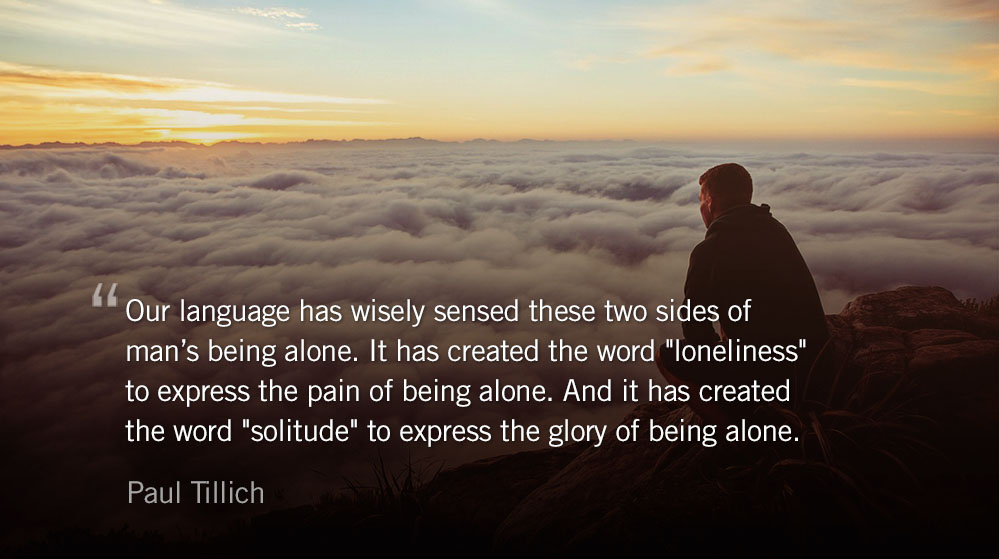
Our language has wisely sensed these two sides of man’s being alone. It has created the word “loneliness” to express the pain of being alone. And it has created the word “solitude” to express the glory of being alone. Although, in daily life, we do not always distinguish these words, we should do so consistently and thus deepen our understanding of our human predicament. — Paul Tillich
The spiritual discipline of solitude will slowly fade from modern practice without intentional assessment of technology’s effects on our daily rhythms. What we hear from the Spirit in silence guides our words, shapes our posture toward the world, and informs our understanding of scripture in ways that cannot be replaced by technology.

Bible study, prayer and church attendance, among the most commonly prescribed activities in Christian circles, generally have little effect for soul transformation, as is obvious to any observer. If all the people doing them were transformed to health and righteousness by it, the world would be vastly changed. Their failure to bring about the change is precisely because the body and soul are so exhausted, fragmented and conflicted that the prescribed activities cannot be appropriately engaged, and by and large degenerate into legalistic and ineffectual rituals. Lengthy solitude and silence, including rest, can make them very powerful.

But we must choose these disciplines. God will, generally speaking, not compete for our attention. If we will not withdraw from the things that obsess and exhaust us into solitude and silence, he will usually leave us to our own devices. — Dallas Willard
Today’s Reading
1 Kings 19 (Listen – 3:53)
1 Thessalonians 2 (Listen – 2:53)

This Weekend’s Readings
1 Kings 20 (Listen – 7:03) 1 Thessalonians 3 (Listen – 1:44)
1 Kings 21 (Listen – 4:19) 1 Thessalonians 4 (Listen – 2:24)

The Weekend Reading List

Beyond Cultural Faith :: Throwback Thursday

1 Thessalonians 1.5

Our gospel came to you not only in word, but also in power and in the Holy Spirit and with full conviction.

By Sophronius of Jerusalem 560-638 C.E.

Let us discern whether our confession is by the power and the grace of the Holy Spirit, or whether we have learned it from others and it is due to the common hope we share with them.

Confessing Jesus as Lord by the power of the Holy Spirit is always accompanied by fervent love, longing to obey the Lord whom we confess and a desire to do his commandments.

Confessing Jesus as Lord as a result of education, customs and sharing the life of a community remains as a seed in the mind, which may stir our minds and inspire us to study and learn even more to create an opportunity for a debate or to have something to say to others. And if this seed reaches the inner life and receives the gift of life from the Spirit of the Lord it becomes the foundation for a new life. In other words it should not be neglected but should be watered to make it grow up. Learning and studying the word of God can capture the heart, increase our love for the Lord and purify our life. This must not be neglected.

Confessing Jesus as Lord by the Holy Spirit appears as a fire, which consumes our suffering or sustains us through it. When one confesses Christ it is not simply a testimony. It is the power of life, which sustains and fortifies the soul. Thus we do not compromise in spite of the severity of our pain, or give up in spite of whatever difficulties we encounter.

The Holy Spirit, the fire of divine love, moves us always in our weakness, desiring to help us and to keep us in the fellowship of Christ and the Father. But if there is no sadness or pain in the heart [but, rather] joy in doubt and a desire to abandon faith, be careful, because your faith has come to you as part of your social upbringing and needs the living water of the Holy Spirit to grow.

Confessing Jesus as Lord by the Holy Spirit remains always a source of hope and a sure sign of eternal life. This can be seen when we refuse money, power, possessions or a higher social status in order to remain disciples of Jesus.


— Abridged and language updated from Letters of Abbot Sophronius to Fr. Zephaniah. Translated from Coptic to English by George Bebawi.


Today’s Reading
1 Kings 18 (Listen – 7:08)
1 Thessalonians 1 (Listen – 1:27)

Cherished Prayers

Colossians 4.3
Pray for us, that God may open to us a door for the word, to declare the mystery of Christ, on account of which I am in prison.

Though primarily associated with flash-points in history, religious intolerance and persecution still run rampant in our world today. Pew Research Center’s most recent study, released last year, opened by stating, “Religious hostilities increased in every major region of the world except the Americas.”

You now live in a position of privilege if you can read scripture without threat to freedom, worship without worry of attack, or be identified as a Christian without threat to life and family.

This privilege shouldn’t bring guilt, nor should it breed fondness of its luxury. The words of martyrs quickly rebuke such self-absorption and idleness. Polycarp, in final prayer before his martyrdom c.156 C.E., said this:

I bless you because you have thought me worthy of this day and hour, worthy to be numbered among the martyrs and to drink out of the cup your Anointed has drunk from, so to rise and live forever, body and soul, in the incorruptibility that is the Holy Spirit’s.

May I be admitted with them in your presence today, a satisfying welcome sacrifice. You have made my life a preparation for this; you showed me that this was to be and now you have brought it about, like the veracious and truthful God that you are. For this and all your blessings I praise you and give you glory, through the eternal high priest, Jesus Christ the heavenly, your dear Child.

He is with you and the Holy Spirit. Through him may glory be given you now and in the ages to come. Amen.
Paul asks for prayer at the end of Colossians because the persecuted cherish the prayers of the church. We can raise awareness of global persecution, and prompt our government to action — but we should not forget the power of our prayers.
Prayer is the most necessary action, the greatest gift, the hardest spiritual labor, as well the simplest cry of a loving heart. The time that you spend in prayer has an eternal impact on the lives of men and women throughout our world. Through prayer our world is changed, closed doors are opened, resistant people are made receptive, leaders are put down and raised up, and the kingdom of our Lord Jesus Christ is extended. — Voice of the Martyr’s prayer guide for persecuted Christians
Today’s Reading
1 Kings 17 (Listen – 3:14)
Colossians 4 (Listen – 2:21)
Show Buttons
Hide Buttons
Spur a spiritual rhythm of refreshment right in your inbox
By joining this email list you are giving us permission to send you devotional emails each weekday and to communicate occasionally regarding other aspects of the ministry.
100% Privacy. We don't spam.