A Broken Rebel’s Prayer

Scripture Focus: Psalm 90
A prayer of Moses the man of God. 
1 Lord, you have been our dwelling place 
throughout all generations. 
2 Before the mountains were born 
or you brought forth the whole world, 
from everlasting to everlasting you are God. 
3 You turn people back to dust, 
saying, “Return to dust, you mortals.” 
4 A thousand years in your sight 
are like a day that has just gone by, 
or like a watch in the night. 
5 Yet you sweep people away in the sleep of death— 
they are like the new grass of the morning: 
6 In the morning it springs up new, 
but by evening it is dry and withered. 
7 We are consumed by your anger 
and terrified by your indignation. 
8 You have set our iniquities before you, 
our secret sins in the light of your presence. 
9 All our days pass away under your wrath; 
we finish our years with a moan. 
10 Our days may come to seventy years, 
or eighty, if our strength endures; 
yet the best of them are but trouble and sorrow, 
for they quickly pass, and we fly away. 
11 If only we knew the power of your anger! 
Your wrath is as great as the fear that is your due. 
12 Teach us to number our days, 
that we may gain a heart of wisdom. 
13 Relent, Lord! How long will it be? 
Have compassion on your servants. 
14 Satisfy us in the morning with your unfailing love, 
that we may sing for joy and be glad all our days. 
15 Make us glad for as many days as you have afflicted us, 
for as many years as we have seen trouble. 
16 May your deeds be shown to your servants, 
your splendor to their children. 
17 May the favor of the Lord our God rest on us; 
establish the work of our hands for us— 
yes, establish the work of our hands.

Reflection: A Broken Rebel’s Prayer
By John Tillman

Psalm 90, the prayer of Moses, is the prayer of a broken rebel, humbled and wise, relying on God.

Moses was a rebel from the beginning. Born illegally, the state condemned him to death from birth. Secreted into the wicked king’s palace as a child, he grew up like a sleeper agent. His family did this for his safety but also must have hoped that their little rebel, like a well-slung stone, might take down the oppressive giant.

Instead, he fails miserably. Commits murder. Gets caught. Flees for his life. Marries foreigners. Has uncircumcised children. He stutters. He hesitates. He hides. Yet, God speaks directly to him and does wonders before his eyes. But, despite the burning bush and the voice of God and all those miracles, Moses still says, “Please send someone else.”

Who better to emulate in prayer than a man this broken, purposeless, ashamed, and fearful? Through prayer, Moses became a different kind of man. He became a man used for God’s purposes, breaking the might of a national superpower. He became a man of humility instead of shame. He became a man who stood his ground in faith rather than fleeing in fear.

A Broken Rebel’s Prayer
Lord, whether in a precariously floating basket, a gleaming palace, or a desert lit by burning bushes, you are the source of our life.

All our strivings are pointless before you.
You are the better dwelling place we long for.
Everything we hope for is in you.
We dwell enslaved to our brokenness, our shame, and our fear.
We return to the dust with you as our only hope.

Lord, you see thousands of years like a day and our lives like a blink of an eye.
Help us live our brief lives wisely, with your righteous wrath and merciful love before our eyes.

Have compassion on us, Lord, weak as we are.
Help us praise you with our faltering voices,
Raise our unworthy hands to see you win what our rebellions never could.

Let us pursue your power for your purposes.
Let us release our shame and stand before you in humility.
Let us stand our ground defending the weak with faith that seas will part and armies will fall without striking a blow against us.

Establish your work through our hands and speak your words through our voices.


Divine Hours Prayer: The Request for Presence
Lord, God of hosts, hear my prayer; hearken, O God of Jacob. — Psalm 84.7


– From The Divine Hours: Prayers for Summertime by Phyllis Tickle.


​Today’s Readings
Malachi 2 (Listen 3:12)
Psalm 90 (Listen 2:03)

Read more about Outward-Focused Rhythms
Instead of focusing mostly on activities that are forms of self-investment, practicing daily rhythms that are rooted in Christ can take us beyond ourselves.

Read more about Offal Leaders
God smeared their faces with offal, but some keep trying to wipe it off and pretend nothing is wrong.

Prophetic Forgery

Scripture Focus: Zechariah 13.4-6
4 “On that day every prophet will be ashamed of their prophetic vision. They will not put on a prophet’s garment of hair in order to deceive. 5 Each will say, ‘I am not a prophet. I am a farmer; the land has been my livelihood since my youth.’ 6 If someone asks, ‘What are these wounds on your body?’ they will answer, ‘The wounds I was given at the house of my friends.’”

Reflection: Prophetic Forgery
By Erin Newton

Zechariah foresees a time when prophets who speak in the name of God—but not in the Spirit of God—would openly admit their fraudulent ways and renounce their forged positions as prophets.

So many times, we see messages about the end of false prophets: “A sword will flash in their cities; it will devour their false prophets and put an end to their plans” (Hosea 11.6). “In vain I punished your people; they did not respond to correction. Your sword has devoured your prophets like a ravenous lion” (Jeremiah 2.30).

Rarely do we see the regeneration of a false prophet. It is easier to wish for their demise than for their redemption.

The false prophets in Zechariah’s vision have changed careers—from a position of power wielded to hurt others to a life-giving position of a farmer who sows seeds that bear real fruit. The self-inflicted wounds from the ecstatic rituals (like what we saw on Mount Carmel in 1 Kings 18.28) are admitted to be the wounds of “friends”—false prophets like themselves.

We have false prophets in our midst today. They speak of God, but the deity is not like the God of the Bible. Self-proclaimed pastors or theologians warp the message of the Bible for their gain—financial, political, or spiritual power, or even some form of self-preservation. True prophets speak the message of God and call out abuses, corruption, and unabashed sin. False prophets deny wrong-doing, cover up sins, and call evil “good.” They are idolaters without realizing it.

We like to think of idols as representing a completely different god than our God. Truth is these false prophets aren’t merely speaking about other gods—they are preaching false words in the forged name of our God. As M. Daniel Carroll R. points out in The Lion Roars, “Israel and Judah were supremely active religious nations, but the quantity of rituals did not qualify the worship as acceptable…. These activities were directed at another god constructed according to the worshipers’ tastes and needs.” Carroll defines false prophecy in the ancient world and points toward the false prophets of our own day.

Prophetic forgery is claiming to speak on God’s behalf when the words sound nothing like the God of the Bible.

The greatest hope we have for the false prophets is that people would see the deceit, name it for what it is, and denounce that behavior once and for all.


Divine Hours Prayer: The Greeting
You are the Lord, most high over all the earth; you are exalted far above all gods. — Psalm 97.9


– From The Divine Hours: Prayers for Summertime by Phyllis Tickle.


​Today’s Readings

Zechariah 13.2-9 (Listen 1:40)
Luke 22 (Listen 7:58)

​This Weekend’s Readings
Zechariah 14 (Listen 3:52), Luke 23 (Listen 6:39)
Malachi 1 (Listen 2:47), Luke 24 (Listen 6:16)

Read more about What is a False Prophet?
When every religious leader claims to be speaking truth…what will be the litmus test for all these words?

Read more about Tortured Prophets Department
Many who speak out against abuses in the church…of power and sexual abuse, found the track “Cassandra,” from Taylor Swift’s new album, devastatingly relatable

Our Immovable Rock

Scripture Focus: Zechariah 12.3
3 On that day, when all the nations of the earth are gathered against her, I will make Jerusalem an immovable rock for all the nations. All who try to move it will injure themselves.

Luke 21.5-11
5 Some of his disciples were remarking about how the temple was adorned with beautiful stones and with gifts dedicated to God. But Jesus said, 6 “As for what you see here, the time will come when not one stone will be left on another; every one of them will be thrown down.” 
7 “Teacher,” they asked, “when will these things happen? And what will be the sign that they are about to take place?” 
8 He replied: “Watch out that you are not deceived. For many will come in my name, claiming, ‘I am he,’ and, ‘The time is near.’ Do not follow them. 9 When you hear of wars and uprisings, do not be frightened. These things must happen first, but the end will not come right away.” 
10 Then he said to them: “Nation will rise against nation, and kingdom against kingdom. 11 There will be great earthquakes, famines and pestilences in various places, and fearful events and great signs from heaven. 

Reflection: Our Immovable Rock
By John Tillman

Zechariah spoke to those who had gone through exile and captivity. They knew what it meant for armies to gather, the city to fall, and the walls to be destroyed and burned. They heard their parents’ tales and tasted the fear and uncertainty. God’s words reassured these people that, in the future, no gathering of armies will be able to overcome Jerusalem, the shelter of his people.

Jesus spoke to his disciples, suffering under Roman occupation and puppet kings like Herod. Herod was “king”, but all were forced to say “Caesar is Lord.” They longed for liberation.

The Temple Zechariah knew was renovated and expanded by Herod. The disciples were impressed with the stonework in Herod’s expansion. If they had read Zechariah’s words at that moment, they would probably have thought that they were living in the time of their fulfillment. We know they expected Jesus to become king. We can easily imagine that they hoped to see Jerusalem become the immovable rock that Rome and every other enemy would break themselves against.

But instead of speaking of armies breaking against Jerusalem, Jesus spoke of Jerusalem being broken. Even the Temple’s impressive stones would be cast down, not one of them left on another.

Eschatological anxiety has waxed and waned in my lifetime. It’s easy for us to go to extremes on this issue. Some panic that the end is near and then, when it seems delayed, lose faith. Some throw their hands up in cynical doubt that the day will ever come. Some seek to bring the day to pass by taking the reins of power into their own hands. They long to build whatever kingdom they can using hastily baptized political power.

Christ told his followers to not be easily taken in by messianic movements. He warned them against fear and reactionary haste and encouraged patience.

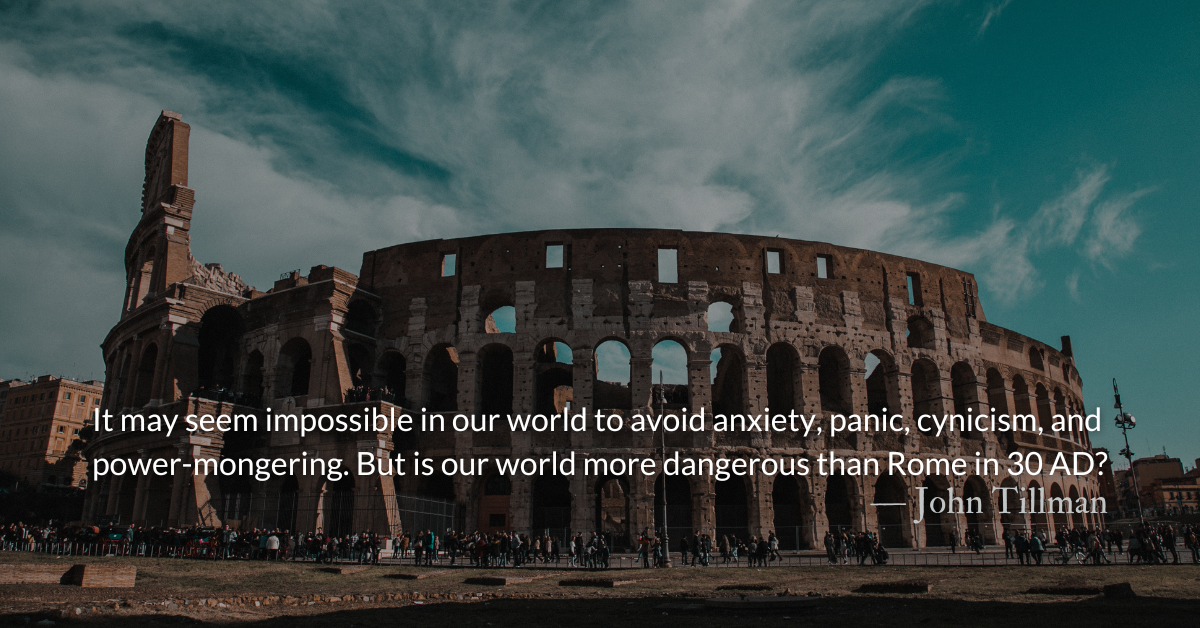
It may seem impossible in our world to avoid anxiety, panic, cynicism, and power-mongering. But is our world more dangerous than Rome in 30 AD?

“Do” is easier than “Don’t.” Instead of thinking, “Don’t be anxious,” concentrate on resting in Jesus. Resist panic by resting in hope. Wrestle in prayer rather than for power. What Christ will establish will not depend on our power or wisdom but on his.

Remember that our immovable rock is not an institution, movement, country, or leader. Jesus is our immovable rock.

Divine Hours Prayer: The Greeting
The Lord lives! Blessed is my Rock! Exalted is the God of my salvation! — Psalm 18.46


– From The Divine Hours: Prayers for Summertime by Phyllis Tickle.

​Today’s Readings
Zechariah 12-13.1 (Listen 2:30)
Luke 21 (Listen 4:18)

Read more about Fasting Uncovers Our Hearts
If all we get from fasting is a measurable, earthly ROI, we will be unlikely to reap a spiritual benefit.

Read The Bible With Us
Our two-year Bible reading plan encourages moments of reflection at a sustainable pace. It’s never too late to join.

https://mailchi.mp/theparkforum/m-f-daily-email-devotional

God’s Performance Artists

Scripture Focus: Zechariah 11.4-5, 7-8
4 This is what the Lord my God says: “Shepherd the flock marked for slaughter. 5 Their buyers slaughter them and go unpunished. Those who sell them say, ‘Praise the Lord, I am rich!’ Their own shepherds do not spare them

7 So I shepherded the flock marked for slaughter, particularly the oppressed of the flock. Then I took two staffs and called one Favor and the other Union, and I shepherded the flock. 8 In one month I got rid of the three shepherds. The flock detested me, and I grew weary of them.

Reflection: God’s Performance Artists
By John Tillman

When Christians think of God as an artist, we often think of pretty sunsets. But God’s artistic portfolio reveals edgier, darker, and grittier work beyond sunsets or rainbows. God often directed his prophets in shocking forms of performance art.

Few people understand performance art, which, like any art form, can be shocking, disgusting, or absurd. In 2014, Shia LaBeouf participated in performance art called “I Am Sorry.” LaBeouf attended events wearing a paper bag over his head that read, “I am not famous anymore.” Then, he wore the bag in the gallery while visitors sat across from him. Most verbally abused him.

“I Am Sorry” was mild compared to God’s performance art exhibits.
Isaiah prophesied naked.
Jeremiah wore an oxen’s yoke.
Ezekiel ate food cooked over feces.
Hosea married a prostitute.

Zechariah’s performance art was taking over a herd of sheep marked for slaughter. These sheep were neglected and ill-treated by former shepherds. Zechariah paid special attention to the oppressed of the flock, yet even with his tender treatment, they detested him. Zechariah turned them over to a far worse shepherd than the ones before.

God explains this as a condemnation of the shepherds and the flock. God sent a good shepherd to replace the bad, but the flock rejected him. They paid Zechariah thirty pieces of silver as an insult. It was the same price paid for the death of a servant gored by a bull.

Zechariah’s performance art previewed Jesus’ ministry. Jesus was the good shepherd sent to the abused flock. He directed his attention to the outcasts, abused, and oppressed. Israel rejected him and sold his life for thirty pieces of silver. (Matthew 27.9-10) We can trust this good shepherd.

Not all art we encounter is holy in meaning or execution. But art expresses part of the image of God in us. Understanding anyone’s art helps us better understand God’s art, which reveals God’s heart.

God is an artistically expressive creator, a verbally gifted communicator, and a passionate storyteller. Like most great artists, God puts his blood, sweat, and tears into his work. We communicate with God through art inspired by and interpreted by his Holy Spirit.

God’s art, including the Bible, is complex and multifaceted but not inscrutable or absurd. Even at its darkest, there is hope. Even at its most confusing, we can trust the heart of Jesus, the ultimate artist and good shepherd.

Divine Hours Prayer: A Reading
On the last day, the great day of the festival, Jesus stood and cried out: “Let anyone who is thirsty come to me! Let anyone who believes in me come and drink! As scripture says, ‘From his heart shall flow streams of living water.’” He was speaking of the Spirit which those who believed in him were to receive; for there was no Spirit as yet because Jesus had not yet been glorified. — John 7.37-39

– From The Divine Hours: Prayers for Summertime by Phyllis Tickle.

​Today’s Readings
Zechariah 11 (Listen 2:40)
Luke 20 (Listen 5:07)

Read more about Supporting Our Work
Please consider becoming a donor. Support ad-free content that brings biblical devotionals to inboxes across the world.

Read The Bible With Us
It’s never too late to join our Bible reading plan. Immerse in the Bible with us at a sustainable, two-year pace.
https://mailchi.mp/theparkforum/m-f-daily-email-devotional

Until I Come Back

Scripture Focus: Luke 19.11-13
11 While they were listening to this, he went on to tell them a parable, because he was near Jerusalem and the people thought that the kingdom of God was going to appear at once. 12 He said: “A man of noble birth went to a distant country to have himself appointed king and then to return. 13 So he called ten of his servants and gave them ten minas. ‘Put this money to work,’ he said, ‘until I come back.’

Reflection: Until I Come Back
By John Tillman

It bothers me when interpreters contend that there is only one possible message or lesson from a given passage. It’s prideful and often plainly false. For example, Paul used a regulation about animal husbandry to teach that pastors deserve payment for their work. (1 Corinthians 9.9-11; 1 Timothy 5.17-18) If the passage only has one lesson to teach, which is it? Animal ethics? Or ministerial ethics? Of course, it’s both and even more than that. God’s word is living and active. (Hebrews 4.12) Guided by the Holy Spirit, ministers bring out of it things both old and new. (Matthew 13.51-52

However, context and the author’s intent are two of the main tools of good interpretation, and they often give us what I would call the primary or first-order interpretation.

Luke consistently included the context of Jesus’ parables. Knowing the situation, event, debate, or question Jesus was responding to helps us understand the intent of the story, which in turn helps us interpret the story’s primary meaning.

Minas and talents (Bags of gold from a similar parable in Matthew 25.14-30) are both financial terms for a certain amount of money, measured by weight. The minas parable in Luke is tightly focused on the immediate situation. Jesus was about to enter Jerusalem. Jesus’ followers thought the kingdom was about to start right then by taking control of the city. They pictured an insurrection and an overthrow led by a powerful king.

The talents parable is part of a trilogy of parables on spiritual neglect. The parables of the virgins, the talents, and the sheep and goats illustrate what it will be like when the Kingdom of God comes.

The minas story mentions taking control of cities and making Jesus king, but not at the expected time. There was work to do first. The talents parable and its partner parables warn Christ’s followers that we have been given opportunities to know him, resources to cultivate for him, and needy people to serve for him. How we respond reveals whether we are part of his kingdom or not.

Jesus desires to call you “friend.” How have you responded? Are you keeping him at a distance by neglecting your “mina” or your “lamp?” What have you been given to steward and cultivate? Are you burying it or planting it so it can grow?

Use well what Christ gives you until he comes back, remembering that knowing him is the greatest gift.


Divine Hours Prayer: A Reading

Jesus taught us, saying: “Beware of false prophets who come to you disguised as sheep but underneath are ravenous wolves. You will be able to tell them by their fruits. Can people pick grapes from thorns, or figs from thistles? In the same way, a sound tree produces good fruit but a rotten tree bad fruit. A sound tree cannot bear bad fruit, nor a rotten tree bear good fruit. Any tree that does not produce good fruit is cut down and thrown on the fire. I repeat, you will be able to tell them by their fruits.” — Matthew 7.15-20

– From The Divine Hours: Prayers for Summertime by Phyllis Tickle.


​Today’s Readings
Zechariah 10 (Listen 2:11)
Luke 19 (Listen 5:29)

Read more about God Forbid
God forbid that we would make decisions based on politics rather than truth

Apply or tell a student!
One spot left! (and overflow available) #StudentWritersMonth orientation begins this weekend! #FreeCoaching, seminars by special guests, published work, and a scholarship/stipend.

Show Buttons
Hide Buttons
Spur a spiritual rhythm of refreshment right in your inbox
By joining this email list you are giving us permission to send you devotional emails each weekday and to communicate occasionally regarding other aspects of the ministry.
100% Privacy. We don't spam.