Public, Prayerful, Persistent Protest

Scripture Focus: Daniel 6.10-11
10 Now when Daniel learned that the decree had been published, he went home to his upstairs room where the windows opened toward Jerusalem. Three times a day he got down on his knees and prayed, giving thanks to his God, just as he had done before. 11 Then these men went as a group and found Daniel praying and asking God for help.

Psalm 112.7-8
They will have no fear of bad news;
their hearts are steadfast, trusting in the Lord.
8 Their hearts are secure, they will have no fear;
in the end they will look in triumph on their foes.

Reflection: Public, Prayerful, Persistent Protest
By John Tillman

Daniel’s daily prayer probably concerned his reading of Jeremiah’s prophecies about the return from exile. (Daniel 9.1-3)

Daniel’s prayer was not just any kind of prayer. Daniel prayed for God to forgive the sin of the people and return them to their homeland. This was a subversive prayer for the oppressed to be freed by the government Daniel served. 

Regardless of the topic of Daniel’s prayer, when a law was passed forbidding it, Daniel’s public prayer became a protest against injustice. 

Those who wish to regulate protests often say to protesters, “Not here. Not now. Not like this.” They may have told Daniel to pray at a different time or place. They may have told Daniel to pray in private, keeping his religion to himself. They may have told Daniel to pray silently, so as not to offend anyone. But Daniel did not allow anyone to dictate the timing and method of his prayerful protest for justice.

Daniel prayed in defiance of an unjust law. He was guilty before the law of the land, but blameless before God. He also remained blameless and unassailable in the righteousness of all his other dealings. He broke no other law in the course of his protest. 

Finally, Daniel faced the consequences of his protest without protest. He did not demand or expect to be spared. He trusted in God for justice, not in humans. 

We too, are exiles living in an unjust world. The corrupt followers of the corrupt systems around us are prepared to penalize us for resisting. In a corrupt system, incorruptibility is a crime.

When we protest injustice, no matter what is, we can follow Daniel’s model of publicly, prayerfully, and persistently protesting unjust laws in a just and righteous way. Daniel’s protest softened the heart of a king and changed the leadership of an entire nation. What might ours change today?

Pray this prayer for those living in and protesting injustice in a corrupt world: (Based on Psalm 112 and the proclamation of Darius in Daniel 6.)

Oh, God whose kingdom will not be destroyed
Rescue and save! 
As in heaven, work your will on the earth. 
From ravenous lions, save us, your servants.

Make the darkness light for the upright, 
The gracious, compassionate, and righteous
who conduct their affairs with justice. 
May hearts be steadfast
May the wicked be vexed, 
May justice longed for roll like rivers over them.

Divine Hours Prayer: The Morning Psalm
Your righteousness, O God, reaches to the heavens, you have done great things; who is like you, O God?
You have showed me great troubles and adversities, but you will restore my life and bring me up again from the deep places of the earth,
You strengthen me more and more; you enfold and comfort me.
Therefore I will praise you upon the lyre for your faithfulness, O my God; I will sing to you with the harp, O holy One of Israel.
My lips will sing with joy when I play to you, and so will my soul, which you have redeemed.
My tongue will proclaim your righteousness all day long,for they are ashamed and disgraced who sought to do me harm.  — Psalm 71.19-24

– Divine Hours prayers from The Divine Hours: Prayers for Autumn and Wintertime by Phyllis Tickle

Today’s Readings
Daniel 6  (Listen – 5:18)
Psalm 112-113 (Listen – 1:49)

Read more about A Generational Lament
Prayers of lament and complaint are a healthy and fulfilling spiritual practice that can be entered into by individuals and communities.

Read more about Peter’s Unfinished Work
As evidenced by both the murder of George Floyd and some of the broken and tragic responses to it, the church has much work left to do.
Weighed and Found Wanting

Scripture Focus: Daniel 5.17, 25-28
17 Then Daniel answered the king, “You may keep your gifts for yourself and give your rewards to someone else. Nevertheless, I will read the writing for the king and tell him what it means. 

25 “This is the inscription that was written: 

MENE, MENE, TEKEL, PARSIN 

26 “Here is what these words mean: 
Mene: God has numbered the days of your reign and brought it to an end. 
27 Tekel: You have been weighed on the scales and found wanting. 
28 Peres: Your kingdom is divided and given to the Medes and Persians.” 

Psalm 110.5
The Lord is at your right hand; he will crush kings on the day of his wrath.

Psalm 111.10
The fear of the Lord is the beginning of wisdom; all who follow his precepts have good understanding. To him belongs eternal praise.

Reflection: Weighed and Found Wanting
By John Tillman

The terms written on Belshazzar’s wall come from counting and weighing money made of precious metals and are filled with double meanings. Mene means “mina” and sounds like the word for “measured.” Tekel means shekels, a unit of weight measurement, and was also a play on the word numbered. Parsin means half-shekels, implying a kingdom divided, and sounded like Persian, which is who would take over the kingdom.

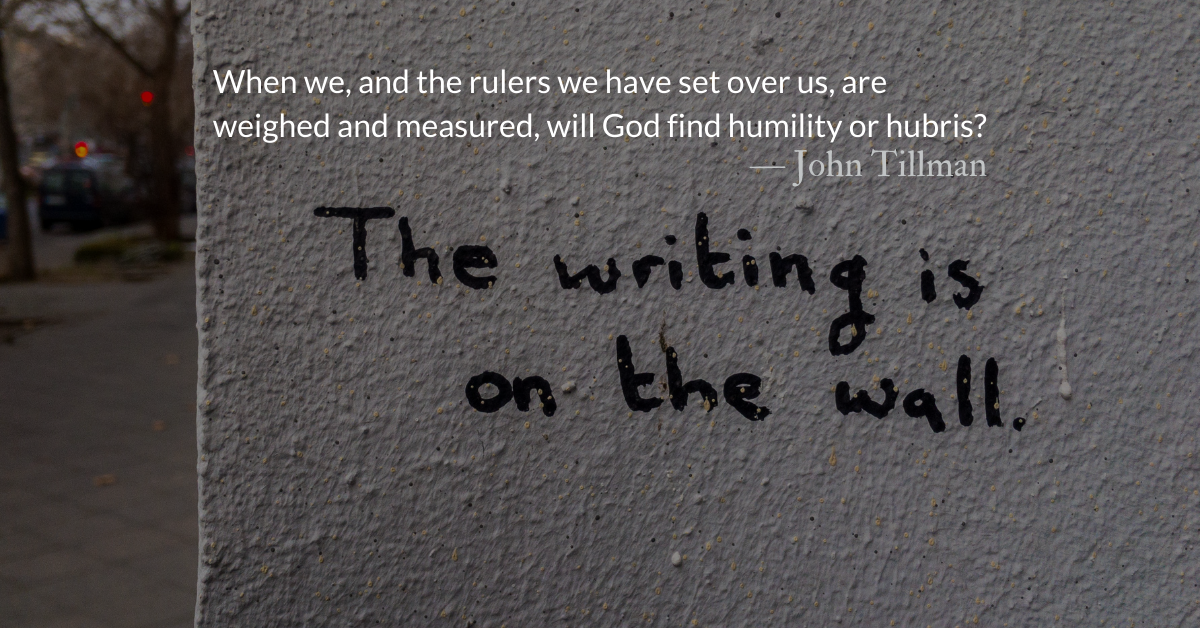
“Writing on the wall,” has become a worldwide idiom that shows up in countless cultural references. Many don’t know that it comes from the Bible. But there is more to the meaning of the phrase than an ominous warning. The writing on the wall is all about pride and gold.

The gold items Belshazzar was drinking from had an interesting history.

After humbling Egypt, God caused Egyptians to look favorably on the slaves as they left. God told the Israelites to ask for items of gold and jewelry, “so they plundered the Egyptians.” (Exodus 11.1-3; 12.31-36)

Later, the people gave of this gold to make implements of worship designed by God. (Exodus 35.20-29) A generation prior to the exile, Hezekiah showed off these golden items in the temple to visiting Babylonian officials, which seems to have sparked Babylon’s interest in conquering the land. (2 Kings 20.12-18)

So, Belshazzar held in his hand golden cups designed by God, made from gold taken by God by humbling Egypt at the height of its power. Belshazzar stood atop the empire of his father, called the “king of kings,” who at the height of his power suffered humiliation and exile because of his pride. 

Belshazzar held God’s cup but did not honor the God who held his own life in his hands. (Daniel 5.23) Belshazzar “knew all this” but still chose to defy the God of Israel. Belshazzar did not measure up. He was found wanting. 

Belshazzar should have known better and so should we. We also hold in our hands wealth and power that we think we gained for ourselves but which came from God. 

We, like Belshazzar, “know all this,” but do we learn from the sins of our fathers before us? Do we continue in them or deny them?
We are responsible for what we know and what we do about it.
When we, and the rulers we have set over us, are weighed and measured, will God find humility or hubris? Kindness or callousness? Generosity or greed?

Divine Hours Prayer: The Request for Presence
Show your goodness, O Lord, to those who are good and to those who are true of heart. — Psalm 125.4

– Divine Hours prayers from The Divine Hours: Prayers for Autumn and Wintertime by Phyllis Tickle

Today’s Readings
Daniel 5  (Listen – 5:47)
Psalm 110-111 (Listen – 1:57)

Read more about Humbling Nebuchadnezzar
Humility will save you and your nation. Pride will destroy you and your nation. If only kings had ears to hear.

https://theparkforum.org/843-acres/humbling-nebuchadnezzar/

Read more about Hearing the Groans of the Prisoners
He hears the cries of all those oppressed by their rulers. He judges all rulers and leaders who conduct themselves with pride and irresponsibility.

Humbling Nebuchadnezzar

Scripture Focus: Daniel 4.28-32
28 All this happened to King Nebuchadnezzar. 29 Twelve months later, as the king was walking on the roof of the royal palace of Babylon, 30 he said, “Is not this the great Babylon I have built as the royal residence, by my mighty power and for the glory of my majesty?” 

31 Even as the words were on his lips, a voice came from heaven, “This is what is decreed for you, King Nebuchadnezzar: Your royal authority has been taken from you. 32 You will be driven away from people and will live with the wild animals; you will eat grass like the ox. Seven times will pass by for you until you acknowledge that the Most High is sovereign over all kingdoms on earth and gives them to anyone he wishes.”

Reflection: Humbling Nebuchadnezzar
By John Tillman

Babylon is more than a historical empire. Babylon is the proto-typical symbol for all empires in rebellion against God. 

At the tower of Babel we first see the idea of Babylon. It is like the rebellion of the Garden of Eden written on a nationwide scale. “We will raise ourselves up to Heaven. We will not be scattered or conquered.” (Genesis 11.4) “We will be like God.” (Genesis 3.4-7) 

Throughout the cannon, writers reference Babel and Babylon when discussing spiritual or political forces that oppose God. For example, John refers to Rome as Babylon quite clearly, but John is not only writing about Rome in his own time. He uses Babylon as a stand-in so that we will recognize that he is writing about Rome and all future incarnations of power that will take up the mantle of Babylon in opposition to God.

In this same way, Nebuchadnezzar is more than a historical emperor. He is the proto-typical emperor of all kingdoms aligned against the people of God. This is part of the meaning of the dream of the statue which brings Daniel to great prominence. Daniel calls Nebuchadnezzar the “king of kings.” (Daniel 2.37)

When Nebuchadnezzar is humbled it is not just a warning for one king, but a warning to all future kings, emperors, and heads of nations. Humility will save you and your nation. Pride will destroy you and your nation. If only kings had ears to hear.

Despite surrounding themselves with the best and brightest, leaders often have a hard time learning. Nebuchadnezzar has multiple opportunities but the lessons don’t stick. Many leaders, like Nebuchadnezzar, will say the right things, but can’t bring themselves to do the right things.

Nebuchadnezzar commands that all people worship the God of Shadrach, Meshach, and Abednego and the God of Daniel, but he consistently returns to his prideful, arrogant way of life. This is why he is ultimately humbled.

Scripture and history are unclear on whether or not Nebuchadnezzar truly repented or just gave lip service to God’s greatness until he got the reins of government back in his hands. It is also unclear in our own day if our leaders’ words of faith or repentance can be trusted. 

Daniel prayed Nebuchadnezzar would humble himself and avoid humiliating tragedy, yet suffering and humiliation did come to the unrepentant emperor.
We pray unrepentant emperors of our day would avoid the humbling discipline of God by humbling themselves before him.

Divine Hours Prayer: The Call to Prayer
Let my mouth be full of your praise and your glory all the day long.
Do not cast me off in my old age, forsake me not when my strength fails. — Psalm 71.8-9

– Divine Hours prayers from The Divine Hours: Prayers for Autumn and Wintertime by Phyllis Tickle

Today’s Readings
Daniel 4  (Listen – 7:27)
Psalm 108-109 (Listen – 4:28)

Read more about Stories of Faith :: A Guided Prayer
Nebuchadnezzar’s response is that of an ego-driven, violent, positional leader projecting his own needs onto God. When we place our hope in human government, this is what we can expect.

Read more about The Thriving Tree
Jesus, the king planted by God upon Zion, is the tree that will thrive, bringing all the birds to his shade.

An Undefiled Heart

Scripture Focus: Daniel 1.8
…he asked the chief official for permission not to defile himself this way.

Reflection: An Undefiled Heart
By John Tillman

Pastors and teachers regularly turn to Daniel as an example of how to live undefiled in a culture that is radically opposed to faith.

Defilement, however, was a way of life for exiles. It was defiling to be a slave as every exile was. It was defiling to live among foreigners as every exile was forced to do. It was defiling to eat with foreigners as Daniel and his friends did. It was defiling to sleep with or marry foreigners as Esther did.

Consider that the story in today’s reading, about Daniel’s struggle to eat a diet of vegetables and water instead of the “rich food” from the king’s table, happens in the same country where Ezekiel begs God not to force him to defile himself by eating food cooked over human feces.

For Daniel and his friends, God gifts them with strength, health, and intelligence far beyond the other candidates, and this event is the beginning of their rise to prominence and power. For Ezekiel, God relents and allows him to cook his food over animal feces instead. It’s no wonder we teach about Daniel’s story more often.

I’ve never heard of a church doing an “Ezekiel fast” but “Daniel fasts” have enjoyed massive popularity. Some even suggest that this is how Christians should eat year round. It is clear that we’d all prefer Daniel’s kind of struggle to Ezekiel’s.

In a way, being personally defiled through their experience was a part of the exiles’ punishment from God and a path to their repentance and healing.

Our outer circumstances may not be in our control as exiles. We may be forced to serve evil governments as Daniel and his friends were. We may be sexually exploited as Esther was. We may be forced to swallow unclean things as Ezekiel was.

In all circumstances, we must seek God’s guidance as we attempt to live in way that is pleasing to him. And at times, like Daniel, we must beg for permission from governments and employers to follow our consciences. That the government may not relent, and we may be forced to eat what is given is a part of being an exile.

As we live as exiles we must seek God to determine, as Daniel did, where the lines may be drawn for us and how we can best adapt to keep our hearts pure, even when everything we touch or interact with in our culture is defiled.

Divine Hours Prayer: The Greeting
O Lord, I cry to you for help; in the morning my prayer comes before you. — Psalm 88.14

– Divine Hours prayers from The Divine Hours: Prayers for Autumn and Wintertime by Phyllis Tickle

Today’s Readings
Daniel 1  (Listen – 3:22)
Psalm 105 (Listen – 4:02)

This Weekend’s Readings
Daniel 2  (Listen – 8:45), Psalm 106 (Listen – 4:52)
Daniel 3  (Listen – 5:56), Psalm 107 (Listen – 4:12)

Read More about In Denial about Greed and Power
We still don’t fully admit or understand the destructive nature of the sins of greed and power.

Read More about The Idol of Immorality, Impurity, and Greed
Paul reveals to us that what is truly at the root of sexual immorality, is exactly the same thing that is at the root of greed—selfishness.

Christ our Temple, River, and City

Scripture Focus: Ezekiel 48.35
“And the name of the city from that time on will be: the Lord is there.”

Reflection: Christ our Temple, River, and City
By John Tillman

Ezekiel spends a huge amount of his text describing the terrors, the corruption, and injustice of the city of Jerusalem and its Temple. Then, in his final chapters, he gives us a vision of a new temple, a river, and a city to come.

This temple and city Ezekiel describes bear little resemblance to the temple he knew or the temples to come in the future. In just one example, in chapter 47, Ezekiel describes a river that flows from the restored Temple. The river grows deeper and wider, until it can no longer be crossed. When this river meets the Salt Sea, the Dead Sea, it makes it alive again, bringing back to life not only the aquatic life, but the entire ecological system.

If Ezekiel’s visions sound familiar, it may be because, in Revelation, John’s visions of God’s city and the river flowing from it are remarkably similar.

Just because God’s city and temple have only been seen by visionaries and prophets, doesn’t mean they aren’t real or accessible to us today. John and Ezekiel may not intend to show us a physical temple or city that we will ever see on earth, but rather something else entirely.

Perhaps the temple of Ezekiel has never been seen on Earth because it is not a temple built by human hands. Perhaps the temple Ezekiel sees is the same one Christ told the Pharisees could be destroyed and rebuilt in three days.

Christ himself is our temple.
He is the gate, the doorway, through which we enter to worship. He is our priest, he is the offerer of the only sacrifice capable of covering our sin and our only mediator before God.

Christ is our river
, flowing as the Holy Spirit into our lives, into our cities, into our dead, dry, and poisoned environments. His river-like spirit brings life to what is dead and healing to what is sickened by the waste products of our sins’ industrious and destructive revolution.

Christ is our city.
He is our refuge and rest—our strong tower and protected place—our park of peace in the midst of a frantic and fracturing world.

We say, “amen” to these visions.

May we regularly enter the peace of this city, be nourished by this river, and be made righteous in this temple.
May the temple, the city, and the river of these visions come.
May we dwell in the city called, “The Lord is there.

Divine Hours Prayer: The Request for Presence
Gladden the soul of your servant, for to you, O Lord, I lift up my soul. — Psalm 86.4

– Divine Hours prayers from The Divine Hours: Prayers for Autumn and Wintertime by Phyllis Tickle


Today’s Readings
Ezekiel 48  (Listen – 6:15)
Psalm 104 (Listen – 3:37)

Read More about Last Priest Standing
We can rest in the security of knowing that our eternal priest, Jesus the Christ, is forever working for the salvation of those who seek him and he is alive to intercede before God on our behalf.

Read More about Hope Among the Traumatized
This river of living water from the Temple changes the entire environment, bringing life even to the Dead Sea.

https://theparkforum.org/843-acres/hope-among-the-traumatized/

Show Buttons
Hide Buttons
Spur a spiritual rhythm of refreshment right in your inbox
By joining this email list you are giving us permission to send you devotional emails each weekday and to communicate occasionally regarding other aspects of the ministry.
100% Privacy. We don't spam.