Our Hope Amidst Violence — Worldwide Prayer

Scripture Focus: Psalm 69.16-21
16 Answer me, Lord, out of the goodness of your love; 
in your great mercy turn to me. 
17 Do not hide your face from your servant; 
answer me quickly, for I am in trouble. 
18 Come near and rescue me; 
deliver me because of my foes. 
19 You know how I am scorned, disgraced and shamed; 
all my enemies are before you. 
20 Scorn has broken my heart 
and has left me helpless; 
I looked for sympathy, but there was none, 
for comforters, but I found none. 
21 They put gall in my food 
and gave me vinegar for my thirst. 

Reflection: Our Hope Amidst Violence — Worldwide Prayer
By John Tillman

In 1995, with Aparthied still close in the rear view mirror, the Rugby World Cup was hosted and won by South Africa. In 2009, the story was turned into a film starring Morgan Freeman and Matt Damon. Sports metaphors and movies are inspiring, but the struggle in South Africa was just beginning. 1998 saw bombings in South Africa and attacks scattered over the entire continent. The times were tense, violent, unpredictable. 

From that time and place, comes this prayer. It was written by South African Christians and published in a book of prayers prepared for a worship conference in Berlin in 1998. Like many of the prayers we read in the psalms, this prayer is familiar with violence and suffering. This prayer’s response is inspiring for us today.

These problems still exist in one way or another, popping up in one country, then another. We still see abuse, rape as a weapon of war, and mass killings motivated by tribal conflicts or religious radicalization. Often the chief victims of these events are women. We also still see state-sanctioned terrorist attacks and state-approved assassinations. We still see disproportionate responses to violence both by police forces around the world and by governments.

Today’s psalm, referenced by gospel authors, (Matthew 27.34, 48; Mark 15.23, 36; Luke 23.36; John 19.28-30), reminds us that Jesus entered violence and scorn on our behalf. May the church follow Christ’s footsteps as he moves to help those affected by violence.

His eye is on the sparrows. Is ours?

Join this prayer today for all people across the world experiencing oppression, violence, and exile. Whether people suffer because of their religious beliefs or any other reason, we pray on their behalf.

A Prayer of Hope from South Africa
Oh, God,
You can do anything, anywhere, any time.
All knowing, all seeing God,
There is nothing hidden from you.
You see the women of Africa:
Who are refugees,
Fleeing their war-torn countries
With babies on their backs and luggage on their heads.
Some who are victims of human rights violations, abuse, infected with AIDS.
We put our hope in you, oh God.
For you hear even our unmentioned prayers
You watch not only the sparrow, but you see us too.
And your hands guide us all the way.
Above all, you offer us the gift of eternal life.
We praise your holy name.

*Prayer from Hallowed be Thy Name, L. A. (Tony) Cupit, ed., Hallowed be Your Name: A collection of prayers from around the world

Divine Hours Prayer: the Request for Presence
Protect me, O God, for I take refuge in you; I have said to the Lord, “You are my Lord, my good above all others.” — Psalm 16.1

– Divine Hours prayers from The Divine Hours: Prayers for Springtime by Phyllis Tickle

Today’s Readings
Numbers 26 (Listen – 7:47)
Psalm 69 (Listen – 4:04)

Read more about Reflecting the Unity of Christ
Prayers for unity and peace coming from brothers and sisters in places where violence is common, are especially to be emulated and repeated…

Read more about Blossoming of Joy in Adversity
We find examples of joy under persecution and difficulty in Jesus, Peter, John, Paul, and many others in scripture.

The Prophet of Profit

Scripture Focus: Numbers 22.32-33
32 The angel of the Lord asked him, “Why have you beaten your donkey these three times? I have come here to oppose you because your path is a reckless one before me. 33 The donkey saw me and turned away from me these three times. If it had not turned away, I would certainly have killed you by now, but I would have spared it.” 

Numbers 23.16, 27
5 The Lord put a word in Balaam’s mouth and said, “Go back to Balak and give him this word.” 

27 Then Balak said to Balaam, “Come, let me take you to another place. Perhaps it will please God to let you curse them for me from there.”

Jude 1.11-13
11 Woe to them! They have taken the way of Cain; they have rushed for profit into Balaam’s error; they have been destroyed in Korah’s rebellion. 
12 These people are blemishes at your love feasts, eating with you without the slightest qualm—shepherds who feed only themselves. They are clouds without rain, blown along by the wind; autumn trees, without fruit and uprooted—twice dead. 13 They are wild waves of the sea, foaming up their shame; wandering stars, for whom blackest darkness has been reserved forever.

From John: In the early 2000s, some friends collaborating on children’s curriculum with a major Christian publisher were told that they couldn’t write about Balaam’s donkey because, “donkeys don’t talk.” I’m happy that later on, I joined my friends in writing about her in our own, independent curriculum. I love the story of Balaam’s donkey so much. This repost from 2019 reminds us that the best and most likeable character in Balaam’s story is the donkey.

Reflection: The Prophet of Profit
By John Tillman

The most relatable and likeable character in Balaam’s story is the donkey. Even the deadly angel who warned Balaam against colluding with Balak liked the donkey better than the man. The angel explained that if he had killed Balaam he would have been careful to spare the donkey’s life.  (Numbers 22.33)

Balaam may seem a minor, unpopular character but he has an impressive string of mentions throughout scripture which make clear he was unfaithful and deceptive. Despite this, he seemed to enjoy a relationship with God that sounds strangely similar to that of other prophets in scripture whose ethical principles were far higher.  Balaam made multiple prophecies about Israel that are not only true, but are often beautiful. For example:

“No misfortune is seen in Jacob,
   no misery observed in Israel.
The Lord their God is with them;
   the shout of the King is among them.”

Despite his seemingly close relationship with God and his ability to hear God speak, scripture is clear that Balaam showed the Lord little loyalty, reverence, or love. He continued attempting to do what Balak wanted. When God prevented him from doing it, he tried again. And again.

Modern believers have many advantages over prophets and priests in ancient times. We do not need to rely on divination, or strange practices to hear God. God’s Word is available to us in almost any language we could want and we have incredible opportunities for deep study and understanding of the Bible. Not only that, as Christians we have the indwelling power of the Holy Spirit who Christ promised would teach us the Scriptures and what they mean.

Despite all our advantages, we can sometimes still fall into the error of Balaam, thinking that God and the Word of the Lord can be used in a utilitarian way, whether that is to curse others or to bless ourselves.

In our culture, as in Balaam’s, curses are more valuable, clickable, and profitable content than blessings. Despite our cultural and personal tendencies to desire to bless ourselves, may we seek God for the joy of his presence, rather than the marketability of his miracles. May our proclamation of God’s Word be a blessing to those who hear it and never a curse.

Divine Hours Prayer: The Refrain for the Morning Lessons
Righteousness shall go before him, and peace shall be a pathway for his feet. — Psalm 58.13

– Divine Hours prayers from The Divine Hours: Prayers for Springtime by Phyllis Tickle

Today’s Readings
Numbers 23 (Listen – 4:01)
Psalm 64-65 (Listen – 2:39)

This Weekend’s Readings
Numbers 24 (Listen – 3:37), Psalm 66-67 (Listen – 2:42)
Numbers 25 (Listen – 2:20), Psalm 68 (Listen – 4:26)

Read more about Unworthy Prophets
There will always be prophets like Balaam. These prophets…tickle the ears of the powerful in exchange for assurances of influence and power.

https://theparkforum.org/843-acres/unworthy-prophets

Read more about Balaams and Balaks
Although God speaks through Balaam, there is no relationship of love or trust—no expectation of good faith.

Unworthy Prophets

Scripture Focus: Number 22.6
6 Now come and put a curse on these people, because they are too powerful for me. Perhaps then I will be able to defeat them and drive them out of the land. For I know that whoever you bless is blessed, and whoever you curse is cursed.”

Psalm 62.4
4 Surely they intend to topple me
    from my lofty place;
    they take delight in lies.
With their mouths they bless,
    but in their hearts they curse.

Reflection: Unworthy Prophets
By John Tillman

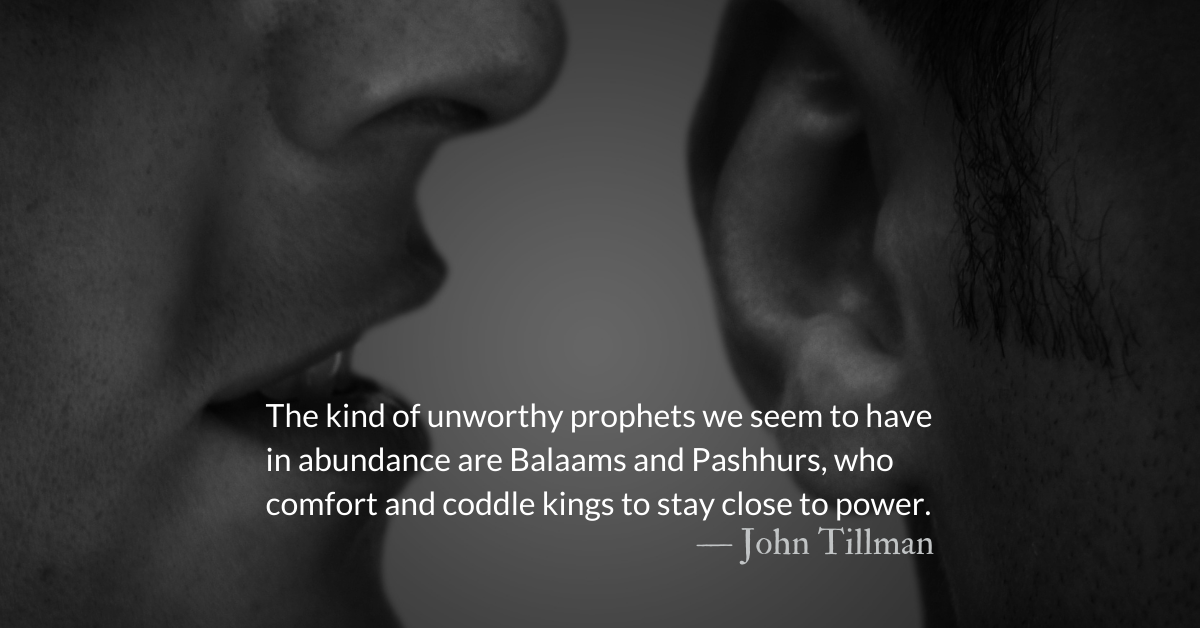
The prophets we have needed in recent times are those like Nathan, Daniel, and Jeremiah, who would not shirk their duty to speak the truth in order to stay in the good graces of kings. The kind of unworthy prophets we seem to have in abundance are Balaams and Pashhurs, (Jeremiah 19.14-20.6) who comfort and coddle kings to stay close to power.

Balaam was not concerned with the king’s morals. Balaam’s prophecies were for sale. Balaam intended to cash in by putting words in God’s mouth, but God put his words in Balaam’s mouth instead. (Numbers 23.16)

Balaam said what God commanded. This could be because he was overwhelmed by supernatural visions or because he obeyed out of fear of the angel who threatened him. Scripture does not tell us. Although God spoke through Balaam, there was no relationship of love or trust—no expectation of good faith.

We must remember that there will always be political leaders like Balak. They want prophets of God to identify with them, stand with them, and give blessing to their policies in exchange for favors. 

We must also remember that there will always be prophets like Balaam. These prophets claim to speak for God but, instead, tickle the ears of the powerful in exchange for assurances of influence and power. These modern Balaams do their best to put words in God’s mouth that are pleasing to the powerful.

Along their desert sojourn, the Israelites faced being hated by Balaks and cursed by Balaams. In our political realms, we will more likely be wooed by Balaks, and have our ears tickled by the Balaams doing their bidding.

As God’s people, we may feel powerless against the Balaams or the Balaks of the world. We can be assured that God is more than able to deal with them according to their sins. This world, ruled by Balaks and preached to by Balaams is not our home. It is the land of our sojourn.

May we keep serving our God and following him through this desert. As Balaam could not deny the beauty of the tents of Israel (Numbers 24.5), may the conspiring prophets and rulers of our culture not be able to deny the beauty of the love of God that works among us.

May a better class of prophets speak the truth to power and to God’s people.

Divine Hours Prayer: The Refrain for the Morning Lessons
My eyes are upon the faithful in the land, that they may dwell with me. — Psalm 101.6

– Divine Hours prayers from The Divine Hours: Prayers for Springtime by Phyllis Tickle

Today’s Readings
Numbers 22 (Listen – 5:55)
Psalm 62-63 (Listen – 2:44)

Read more about Balaam’s Success
Balaam’s strategy of people-pleasing pandering to powerful politicians is still alive today. So are his methods of deceit and temptation.

Read more about The Losers Who Write History
Not one of those glowingly positive, king-praising prophets’ writings are in our Bible. Instead we have the writings of the losers.

The Antivenom for Sin

Scripture Focus: Numbers 21.7-9
7 The people came to Moses and said, “We sinned when we spoke against the Lord and against you. Pray that the Lord will take the snakes away from us.” So Moses prayed for the people. 
8 The Lord said to Moses, “Make a snake and put it up on a pole; anyone who is bitten can look at it and live.” 9 So Moses made a bronze snake and put it up on a pole. Then when anyone was bitten by a snake and looked at the bronze snake, they lived.

Psalm 60.1-5
1 You have rejected us, God, and burst upon us; 
you have been angry—now restore us! 
2 You have shaken the land and torn it open; 
mend its fractures, for it is quaking. 
3 You have shown your people desperate times; 
you have given us wine that makes us stagger. 
4 But for those who fear you, you have raised a banner 
to be unfurled against the bow. 
5 Save us and help us with your right hand, 
that those you love may be delivered.

Reflection: The Antivenom for Sin 
By John Tillman

With sin, as with serpents, it isn’t the size that kills you—it is the venom.

Venom is a specific kind of poison. Poison can be transmitted by touch or ingestion, like the poison on the skin of a poisonous frog or in a poisonous plant. Venom is a poison inflicted through a wounding attack, such as a bite or sting. 

Venoms can cause necrosis, killing the tissue it is injected into. Many cause vomiting, hemorrhaging, seizures, heart failure, and other deadly symptoms. Many venoms also cause blindness, paralysis, or disorientation, making victims easier to kill by other means.

Through the serpent in the Garden of Eden, humanity was stung by sin. Its venom necrotizes our spirit, disorients us, blinds us, and makes us easy victims to be toyed with or killed by our adversary, the devil. (1 Peter 5.8)

Contrary to popular belief, venom cannot be sucked out of a wound. In most cases, the surrounding tissue is flooded with venom and it is nearly instantly carried through the bloodstream. Antivenom must be taken. In some cases antivenom must begin to be administered within minutes of being bitten or the victim may not survive. 

We cannot save ourselves from the venom of sin. It inevitably will cause our death and many other harms in our lives. The venom that pained and even killed some of the Israelites was a direct consequence of sin and a realistic representation of how the venom of sin infects our bodies and communities.

When the Israelites looked to the sign of the serpent, they were looking in faith at God’s promise of an antivenom for sin. Every heel struck by a serpent in the Israelite camp was healed not by looking at the serpent but by the bruised heel of the one promised to Eve in the garden. (Genesis 3.15; Isaiah 53.4-5)

Jesus was struck by sin, stung with its venom, and raised up as a sign of God’s provision. Sin wounds us. He is the balm. Sin injects venom that necrotizes our souls. Jesus injects us with the antivenom of his indestructible life.

No matter what we have done, or what sin we are struck by, Jesus is lifted up for us to look to for salvation. (John 3.14-18) There is no sting of sin too grievous for him to heal.

Jesus is the only antivenom for sin and we are commanded to lift him up so that the world can be freed from the sting of sin and death. (1 Corinthians 15.54-57; Isaiah 25.7-8; Hosea 13.14)

Divine Hours Prayer: The Call to Prayer
Taste and see that the Lord is good; happy are they who trust in him! — Psalm 34.8
– Divine Hours prayers from The Divine Hours: Prayers for Springtime by Phyllis Tickle

Today’s Readings
Numbers 21 (Listen – 5:03)
Psalm 60-61 (Listen – 2:27)

Read more about The Cup
Christ’s death and resurrection is the assurance and archetype for our own hope: the greatest evil turned for the greatest good.

Read more about Quotations from the Desert
Christ…locked eyes with the serpent upon whose head his heel would soon step down with infinite crushing weight.

Complaints and Responses

Scripture Focus: Numbers 20.10-13
10 He and Aaron gathered the assembly together in front of the rock and Moses said to them, “Listen, you rebels, must we bring you water out of this rock?” 11 Then Moses raised his arm and struck the rock twice with his staff. Water gushed out, and the community and their livestock drank. 
12 But the Lord said to Moses and Aaron, “Because you did not trust in me enough to honor me as holy in the sight of the Israelites, you will not bring this community into the land I give them.”
13 These were the waters of Meribah, where the Israelites quarreled with the Lord and where he was proved holy among them.

Reflection: Complaints and Responses

By John Tillman

Complaint is not always sinful but leaders too often treat it that way. 

The Israelites often complain. Sometimes their complaints are unjustified or overdramatic, but other times they concern legitimate needs. Sometimes God calls their complaining or grumbling sinful, but other times no condemnation is specified. 

In today’s passage, we see unhealthy complaining and unhealthy responses by leaders. Only Moses’ response, however, is condemned by God. Also, despite Moses disobeying his instructions, God still miraculously answered the people’s complaint. No one is a hero in this passage except God.

Healthy complaints come from reality falling short of what was promised. Israel’s promise from God, through Moses, was a land flowing with “milk and honey.” Not even having water was a natural point of complaint. 

Both times Israel complained about lack of water the confrontation got heated and personal. Both times they went beyond complaining to accuse Moses of plotting to kill them. Moses complained to the Lord in Exodus 17 that the people were ready to stone him. (Exodus 17.1-7) In today’s passage, he called them “rebels.” (Numbers 20.8-12) Moses took these personal attacks to heart, growing angry rather than compassionate toward the people’s legitimate needs.

God didn’t condemn the people or Moses for their complaining. He simply supplied their lack. At Rephidim, The Lord stood beside Moses as he struck a rock to bring forth water. At Meribah, God instructed Moses to speak to the rock to bring forth water. It is a tender and god-like act to speak things into being, but Moses rejects this plan, opting for a show of force. 

Moses speaks to the people instead of to the rock. Instead of speaking words of life, bringing life-giving water, he speaks harsh, brash, and prideful words. He defends his honor instead of honoring God. He proclaims his power, his ability, and his “righteousness” instead of demonstrating trust in God.

God says to Moses, “You didn’t trust me. You didn’t honor me. But I will still be faithful to the people and supply what they complain for. I will still be faithful to my promise and bring them into the land.” (Numbers 20.12)

For followers and leaders, complaining legitimately and responding honorably are difficult. When the reality of our world does not match the promises of God, complaint can be a spiritual practice rather than a sin. When we complain, instead of calling into question God’s holiness, we can point to God’s holiness as a reason for him to act.

Divine Hours Prayer: The Greeting

To you I lift up my eyes, to you enthroned in the heavens.
As the eyes of servants look to the hand of their masters, and the eyes of a maid to the hand of her mistress,
So our eyes look to the Lord our God, until he shows us his mercy. — Psalm 123.1-3

– Divine Hours prayers from The Divine Hours: Prayers for Springtime by Phyllis Tickle

Today’s Readings
Numbers 20 (Listen – 4:15)
Psalm 58-59 (Listen – 3:32)

Read more about Complaining in Prayer
Have you ever wondered if it was appropriate to express your thoughts, feelings, and darkest emotions to God?

Read more about Complaint to Commission
Complaining can turn into unspiritual grumbling but it can also initiate lament in our lives and communities.

Show Buttons
Hide Buttons
Spur a spiritual rhythm of refreshment right in your inbox
By joining this email list you are giving us permission to send you devotional emails each weekday and to communicate occasionally regarding other aspects of the ministry.
100% Privacy. We don't spam.