

Links for today’s readings:
Feb 26 Read: Proverbs 17 Listen: (2:58) Read: Mark 7 Listen: (4:28)
Scripture Focus: Mark 7.8-19
8 You have let go of the commands of God and are holding on to human traditions.” 9 And he continued, “You have a fine way of setting aside the commands of God in order to observe your own traditions! 10 For Moses said, ‘Honor your father and mother,’ and, ‘Anyone who curses their father or mother is to be put to death.’ 11 But you say that if anyone declares that what might have been used to help their father or mother is Corban (that is, devoted to God)—12 then you no longer let them do anything for their father or mother. 13 Thus you nullify the word of God by your tradition that you have handed down. And you do many things like that.” 14 Again Jesus called the crowd to him and said, “Listen to me, everyone, and understand this. 15 Nothing outside a person can defile them by going into them. Rather, it is what comes out of a person that defiles them.”
17 After he had left the crowd and entered the house, his disciples asked him about this parable. 18 “Are you so dull?” he asked. “Don’t you see that nothing that enters a person from the outside can defile them? 19 For it doesn’t go into their heart but into their stomach, and then out of the body.” (In saying this, Jesus declared all foods clean.)
Reflection: Untwisting Scripture
By John Tillman
Some Christians spend a lot of time finger-pointing.
Accusations of “twisting scripture to accommodate culture” are common. Some are accused of accommodating today’s culture and others of accommodating past cultures.
Jesus often had similar arguments with religious leaders. In Mark 7, the leaders accused the disciples of violating purity laws by not ceremonially washing before eating. Jesus quoted Isaiah, calling their traditions “human rules.” (Isaiah 29.13)
Then Jesus accused them of twisting scripture. They used commands about “Corban,” or dedicating things to God (Leviticus 27.16-24), to dodge responsibilities to family from other commands. (Exodus 20.12; Deuteronomy 5.16) They used Leviticus to negate Exodus and Deuteronomy.
Finally, Jesus returned to the issue of purity, shockingly declaring that eating cannot defile a person but speaking can, because words come from the heart. The narrator (probably Peter speaking through Mark) tells us this means all foods are “clean.” (A claim that would remain controversial through much of the New Testament. Acts 11.1-18)
Did Jesus do a “whataboutism?” Did he lecture leaders for nullifying God’s commands while nullifying purity laws? Did Jesus say some commands in scripture are “human rules?”
“No” to all of those. Jesus didn’t switch topics to “what about” the religious leaders. He exposed the actual topic underneath their objection that had implications far beyond ceremonial washing. Jesus diagnosed their dysfunctional theology and prescribed a cure.
When Jesus said “human rules” and “your traditions,” he wasn’t downgrading some scripture and elevating others. He condemned their human interpretations of how to live according to those laws. (Matthew 5.21-48) When Jesus declared all food clean it was because he was making all people clean in himself. (Acts 10.15; John 15.3)
God’s commands are perfect. Human theological interpretations and practices can be filled with errors. We shouldn’t confuse the two. But if the religious leaders (the elite theologians of their day) were so badly mistaken, what hope do we have?
We definitely need less finger-pointing and more humility. If you interpret scripture so that it never contradicts your culture, your friends, or your political party, something is wrong. Scripture critiques every culture and all traditions, past, present, and future. Only slippery slopes have no friction.
Like Jesus, drill down to the real issues, not the culture war surface-level skirmishes. Untwist scripture from trends and traditions. When in doubt, make sure what comes out of you (actions and words) is loving and pure.
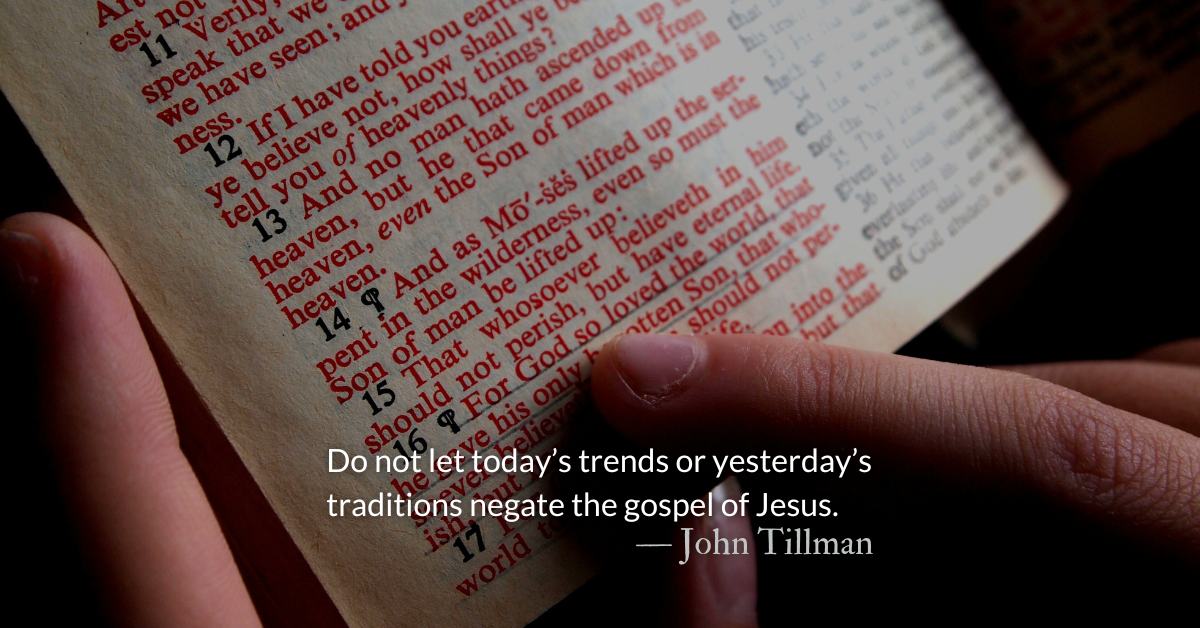
Do not let today’s trends or yesterday’s traditions negate the gospel of Jesus.
Divine Hours Prayer: The Greeting
My heart is firmly fixed, O God, my heart is fixed; I will sing and make melody. — Psalm 57.7
– From The Divine Hours: Prayers for Springtime by Phyllis Tickle.
Current cultural sexual ethics are old, but in every age, God carved out for himself people to be different—to return to Eden, little by little.
Read The Bible With Us
Reading the Bible can and should change your life. It’s never too late to join our Bible reading plan at a sustainable, two-year pace. What will you find?
One Reply to “Untwisting Scripture”
Comments are closed.