

Links for today’s readings:
Jan 6 Read: Job 6 Listen: (2:56) Read: John 6 Listen: (8:27)
Scripture Focus: Job 6.14-21
14 “Anyone who withholds kindness from a friend
forsakes the fear of the Almighty.
15 But my brothers are as undependable as intermittent streams,
as the streams that overflow
16 when darkened by thawing ice
and swollen with melting snow,
17 but that stop flowing in the dry season,
and in the heat vanish from their channels.
18 Caravans turn aside from their routes;
they go off into the wasteland and perish.
19 The caravans of Tema look for water,
the traveling merchants of Sheba look in hope.
20 They are distressed, because they had been confident;
they arrive there, only to be disappointed.
21 Now you too have proved to be of no help;
you see something dreadful and are afraid.
Reflection: Constant Streams
By John Tillman
Job needed comfort. He needed the refreshment of kindness. Instead, Job’s wife told him to “curse God and die.” (Job 2.9) Job’s friends subtly (and not so subtly) blamed him for some secret sin, some fatal flaw bringing God’s judgment. Job compared them to inconstant streams.
In the ancient Near East and the American Southwest, wadis carve their way across the desert. Wadis vary in size. Some are like a ditch. Many are like small canyons. In the rainy season, water and snowmelt rush down from the heights and surrounding mountains, filling the wadis and bringing life to the desert. But in the dry season, when water is most needed, the wadis are dry.
A wadi isn’t a person. And a wadi being dry in the dry season is not a surprise. It’s not a choice. When Job needed it most, in his driest season, all his resources ran out. But they should have been reliable. Can you relate?
You might feel that you are waiting by a dry stream now. But something else is true about wadis. Rain far, far away in the hills can cause them to suddenly fill up with water. We are at the very beginning of Job and there are many long chapters of debate, arguing, and angst ahead of us. But at the end, Job is refreshed by others. Rain is on the way.
God uses Job’s friends to restore him. (Job 42.10-11) Scripture describes a scene not unlike the end of It’s a Wonderful Life. Every relative and person Job knew came to him with a financial gift. Job was “the richest man in town” once again.
There are two lessons for us here. First, like Job, we may need to wait for God’s answer, but we should not doubt that it is coming. However dry our streams are, even when friends dry up, remember that God makes streams in the desert. (Isaiah 43.19-21; 44.3-4; Psalm 65.9; 74.15; 78.16)
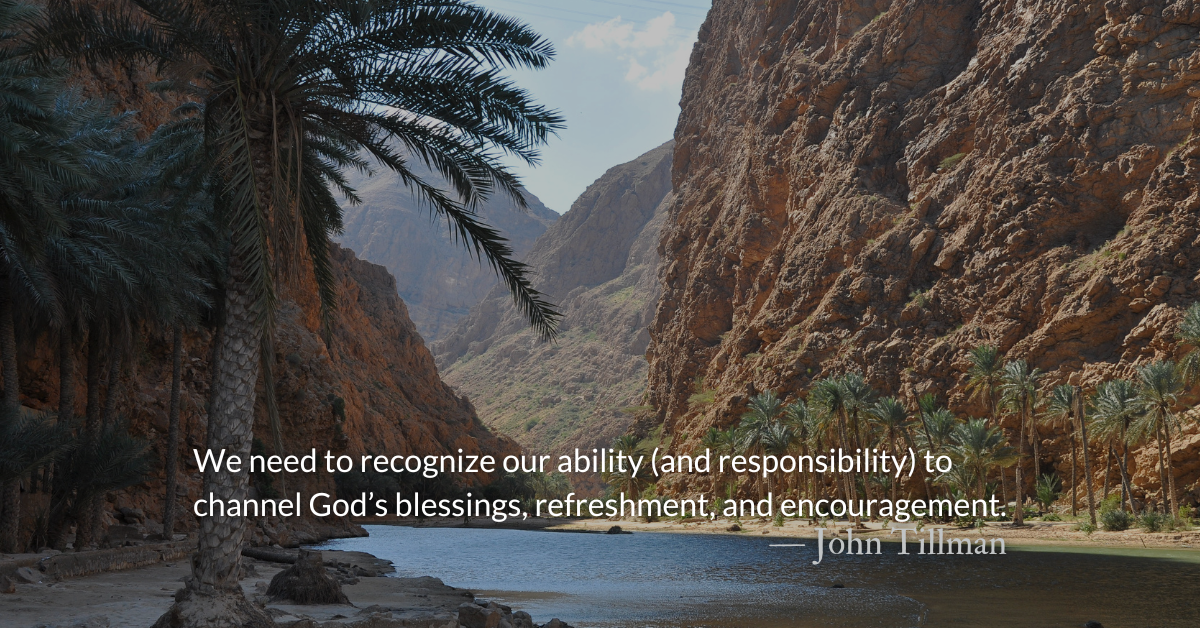
Second, as friends, we need to recognize our ability (and responsibility) to channel God’s blessings, refreshment, and encouragement. Eliphaz dreaded Job’s fate. (Job 6.21) His fear dried up his encouragement. He blamed Job to shield himself. When our friends struggle, instead of fearing their fate or protecting ourselves by subtly blaming them, lean into how much God loves them.
Don’t be an inconstant stream. Open up and let God’s love be made tangible in us. Let constant streams of God’s love flow to and through us.
Divine Hours Prayer: The Refrain for the Morning Lessons
When the Lord restores the fortunes of his people, Jacob will rejoice and Israel be glad. — Psalm 14.7
– From The Divine Hours: Prayers for Autumn and Wintertime by Phyllis Tickle.
Read more: Manna or the Man?
What are our motives for pursuing Jesus? Do we want the man or just the manna?
Read The Bible With Us
Reading the Bible has never been easier, yet Biblical illiteracy is growing. Join our Bible reading plan. Find meaning in the Bible at a sustainable, two-year pace.