Most Excellent Salvation

Links for today’s readings:

Apr 3  Read: Hosea 2 Listen: (3:48) Read: Matthew 7 Listen: (3:31)

Links for this weekend’s readings:

Apr 4  Read: Hosea 3-4 Listen: (3:53) Read: Matthew 8 Listen: (4:09)
Apr 5  Read: Hosea 5-6 Listen: (3:44) Read: Matthew 9 Listen: (4:56)

Scripture Focus: Matthew 7.13-27

The Narrow and Wide Gates

13 “Enter through the narrow gate. For wide is the gate and broad is the road that leads to destruction, and many enter through it. 14 But small is the gate and narrow the road that leads to life, and only a few find it. 

True and False Prophets

15 “Watch out for false prophets. They come to you in sheep’s clothing, but inwardly they are ferocious wolves. 16 By their fruit you will recognize them. Do people pick grapes from thornbushes, or figs from thistles? 17 Likewise, every good tree bears good fruit, but a bad tree bears bad fruit. 18 A good tree cannot bear bad fruit, and a bad tree cannot bear good fruit. 19 Every tree that does not bear good fruit is cut down and thrown into the fire. 20 Thus, by their fruit you will recognize them. 

True and False Disciples

21 “Not everyone who says to me, ‘Lord, Lord,’ will enter the kingdom of heaven, but only the one who does the will of my Father who is in heaven. 22 Many will say to me on that day, ‘Lord, Lord, did we not prophesy in your name and in your name drive out demons and in your name perform many miracles?’ 23 Then I will tell them plainly, ‘I never knew you. Away from me, you evildoers!’ 

The Wise and Foolish Builders

24 “Therefore everyone who hears these words of mine and puts them into practice is like a wise man who built his house on the rock. 25 The rain came down, the streams rose, and the winds blew and beat against that house; yet it did not fall, because it had its foundation on the rock. 26 But everyone who hears these words of mine and does not put them into practice is like a foolish man who built his house on sand. 27 The rain came down, the streams rose, and the winds blew and beat against that house, and it fell with a great crash.”

Reflection: Most Excellent Salvation

By John Tillman

Bill and Ted’s epic proverb, “Be excellent to each other,” is less fluffy than it sounds.

If Jesus were born near the San Fernando valley north of Los Angeles instead of the Elah Valley west of Bethlehem, he might have said it. The similarity is no accident. “Be excellent to each other” is an intentional distillation of Jesus’ teachings filtered through Western (and 90s surfer) culture. It pretends so hard to be deep it actually achieves it. Living out “be excellent to each other” would be similarly challenging as “Love your neighbor.” (Mark 12.28-34)

Some falsely perceive Jesus’ teachings as nice and easy, fluffy and feel-good platitudes like Bill and Ted’s. However, even Jesus’ most popular and celebrated teachings, the Sermon on the Mount, contain harsh (as Bill and Ted would describe them) parables. The parables of the narrow gate, false prophets, false disciples, and foolish builders, arranged in a row, share the same message: salvation is hard.

The road is narrow. Few find it. False, ferocious, and fruitless prophets will deceive many. People can do works in Jesus’ name, yet at the judgment, Jesus will call their work evil and deny knowing them. People can build impressive lives on the wrong foundation, yet when the storm of judgment comes, everything crashes down into a sandy mess.

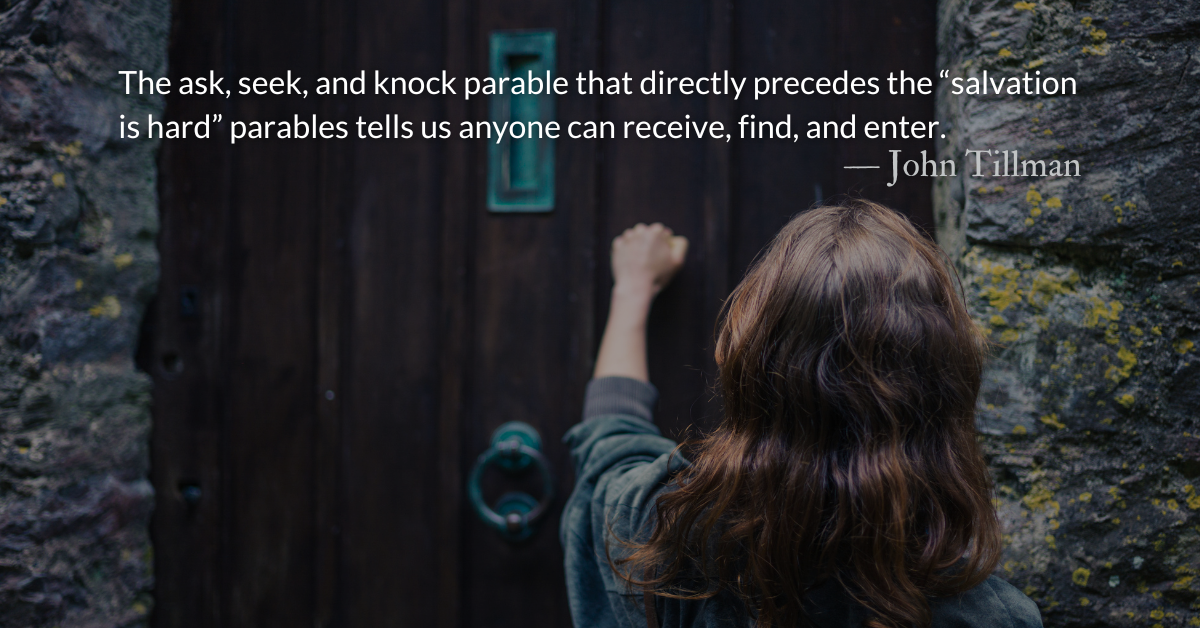
Other parables make salvation seem easy. The ask, seek, and knock parable that directly precedes the “salvation is hard” parables tells us anyone can receive, find, and enter. (Matthew 7.7-8) Jesus says he is the way to be followed, the truth to be found, and the gate we can enter. (John 10.9) We can walk in his way. We can spot false prophets by their fruit. We can build on the right foundation and even a shabby, shotgun shack can stand the storm.

If up to us, salvation is not only hard, but impossible. However, all things are possible with God. (Luke 18.27) If through Jesus, salvation is not only possible but inevitable once we accept his well-meant offer. He knocks on the door of our hearts. Once we open to him he leads us to the gate and narrow path of sanctification. This path is hard, yet he will complete his work within us (Philippians 1.6) to fulfill his purpose. (Philippians 2.13)

The complete process of salvation is both hard and easy, yet when we live through and for Jesus, it is most excellent. (1 Corinthians 12.31)

Divine Hours Prayer: The Call to Prayer

I cry out to you, O Lord; I say, “You are my refuge, my portion in the land of the living.” — Psalm 142.5

– From The Divine Hours: Prayers for Springtime by Phyllis Tickle.

Read more: Our Good Friday—Guided Prayer

Dr. Shadrach Meshach Lockridge’s poetic description of Good Friday…“It’s Friday, but Sunday’s Coming” sits with us in the tension of seeming disaster…

Read more: Looking Back at Good Friday

May the love we were shown on Good Friday be carried by us not just on Fridays, but on every day.

Heavy Loads Lifted

Links for today’s readings:

Apr 2  Read: Hosea 1 Listen: (2:08) Read: Matthew 6 Listen: (4:35)

Scripture Focus: Matthew 6.24-34

24 “No one can serve two masters. Either you will hate the one and love the other, or you will be devoted to the one and despise the other. You cannot serve both God and money. 25 “Therefore I tell you, do not worry about your life, what you will eat or drink; or about your body, what you will wear. Is not life more than food, and the body more than clothes? 26 Look at the birds of the air; they do not sow or reap or store away in barns, and yet your heavenly Father feeds them. Are you not much more valuable than they? 27 Can any one of you by worrying add a single hour to your life? 

28 “And why do you worry about clothes? See how the flowers of the field grow. They do not labor or spin. 29 Yet I tell you that not even Solomon in all his splendor was dressed like one of these. 30 If that is how God clothes the grass of the field, which is here today and tomorrow is thrown into the fire, will he not much more clothe you—you of little faith? 31 So do not worry, saying, ‘What shall we eat?’ or ‘What shall we drink?’ or ‘What shall we wear?’ 32 For the pagans run after all these things, and your heavenly Father knows that you need them. 33 But seek first his kingdom and his righteousness, and all these things will be given to you as well. 34 Therefore do not worry about tomorrow, for tomorrow will worry about itself. Each day has enough trouble of its own.

Reflection: Heavy Loads Lifted

By John Tillman

Christ’s moral teachings are the most popular thing about him.

The Sermon on the Mount is recognized worldwide as an aspirational description of a beautiful way to live. Even non-Christians recognize the Sermon on the Mount as the most astute moral teachings ever produced in the history of the world.

It may be a beautiful way to live, but isn’t it impossible? Rich Mullins confronts this humorously in the bridge of his song, “Hard.

“Well His eye’s on the sparrow

And the lilies of the field I’ve heard

And He will watch over you and He will watch over me

So we can dress like flowers and eat like birds.”

It is hard to be like Jesus describes in these teachings. 

Jesus generally commended the Pharisees’ moral teaching. “Do what they say…Don’t do what they do.” He critiqued the Pharisees for tying up “heavy loads” of moral requirements but not lifting them themselves or helping people live them out. (Matthew 23.4)

Aren’t Jesus’ hard moral teachings “heavy loads”?

Who can dress like a flower?

Eat like a bird?

Continually turn the other cheek? 

Go the extra mile? 

Give unrestrainedly to the needy? 

Surrender our security for another’s shelter and safety?

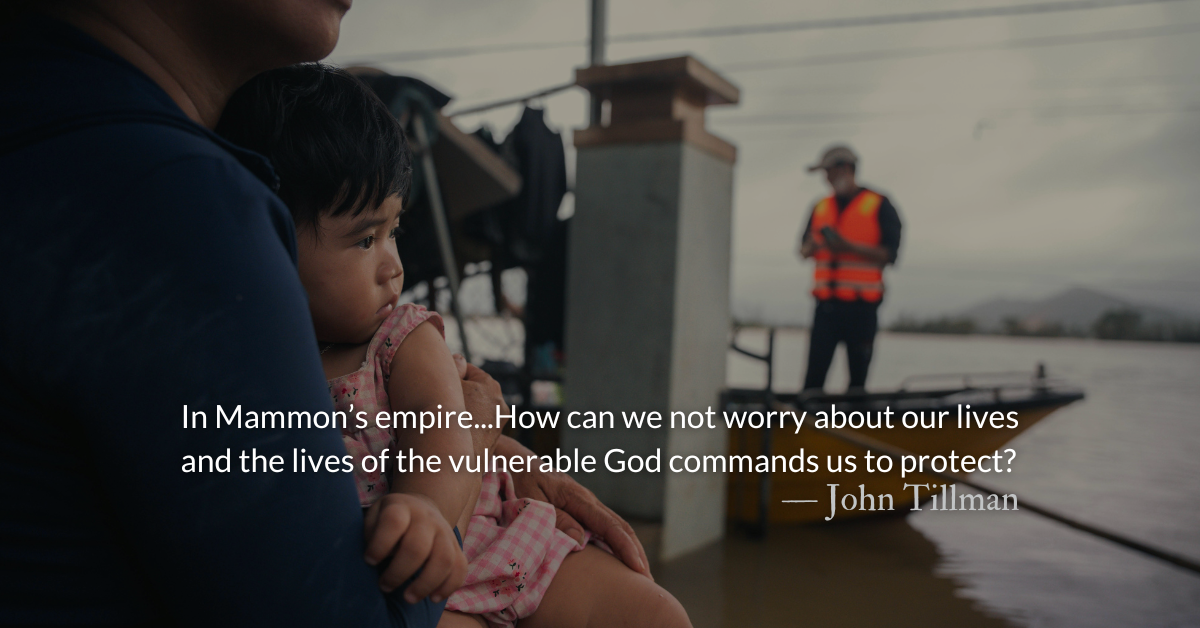
In Mammon’s empire, how can we survive without accumulating wealth? In a world that denigrates the poor, how can we be unconcerned with clothing, food, and shelter? In a world where governments fight for the right to end the lives of the defenseless in the womb, the defenseless in war zones, and the defenseless in borderland river crossings, how can we not worry about our lives and the lives of the vulnerable God commands us to protect?

Who can carry this load? Who can “be perfect” as our Heavenly Father is perfect? (Matthew 5.48; 19.21) Not us. Only Jesus.

Jesus tied this load for his own back. He carried it perfectly. He carries it for us. The teaching of the Sermon on the Mount glimpses the Kingdom of Heaven. One day, we will arrive.

It is too simplistic to say, “We don’t have to do it. Jesus did it.” However, we can say, “Jesus did it for me, and he is doing it within me now.” Together with the same power that raised Christ from the dead, strain toward heavenly living today. (Ephesians 1.19-21; Philippians 3:12-14) Don’t walk away discouraged or sad. “With God, all things are possible.” (Matthew 19.21-26) Heavy loads can be lifted.

Divine Hours Prayer: The Request for Presence

Make me understand the way of your commandments, that I may meditate on your marvelous works. — Psalm 119.27

– From The Divine Hours: Prayers for Springtime by Phyllis Tickle.

Read more: The Shema and the Lord’s Prayer

In the Shema and The Lord’s Prayer, we are expected to engage in concrete actions once we stop praying.

Read more: The Naked Emotion of God

Hosea shows us a God unashamed of shame, nakedly confessing his love for the unlovable.

Let’s Talk about Sex

Links for today’s readings:

Apr 1  Read: Song of Songs 8 Listen: (2:23) Read: Matthew 5 Listen: (6:03)

Scripture Focus: Song of Solomon 8:4

4 Daughters of Jerusalem, I charge you:
    Do not arouse or awaken love
    until it so desires.

Reflection: Let’s Talk about Sex

By Erin Newton

Song of Solomon repeats the plea to “refrain from arousing or awakening love until it so desires” in 2:7, 3:5, and 8:4. But what does this phrase mean? 

Admittedly, this phrase had left scholars with more questions than answers. Early church fathers saw the intimate relationship as an allegory for God and the Church. Others and later interpreters read the poetry as a typical human love poem.

Still more troublesome is our culture’s relationship with sex. Everything is over-sexualized from clothing to cologne ads to music to Halloween costumes. Our imago Dei is good and lovely, yet the exploitation of our bodies crosses many moral lines.

Setting aside an allegorical reading of the book, let’s talk about sex.

Some have read the phrase to refer to abstinence from sex altogether. Since the phrase is repeated twice before chapter 8, the two have already been intimate so that cannot be the meaning here.

Sheila Gregoire, author and founder of Bare Marriage, speaks regularly about Christians’ (mis)understanding about sex. In her blog post about this phrase, she notes that for many Christian women who grew up in the 90s-00s, “we’re taught that we are responsible both for our own purity and for his.” It was this verse that was used to support not arousing him until it was time

The problem with this concept was that the onus fell on women. “Boys can’t stop” was the mantra. Failure to refrain meant the female in the relationship was the cause of both of their failures to follow this scriptural admonition. This is untrue.

Shame that often followed has added to many Christian couples’ struggles in bed. 

What can we learn from this phrase? Sexual desire is good and inevitable, but don’t underestimate its power (for both men and women). There is wisdom in timing. The better “purity teaching” would highlight how waiting is meant to benefit couples, protecting from heartache, unplanned pregnancies, or abandonment.

For many Christians, the admonition might be far too late to heed. There is so much more to this topic, more than we can fit in our short reflections here at The Park Forum. But I think Sheila concludes it well:

“Please know, even if love was awakened too early, you can still re-awaken it. I think that’s what God loves to do—restore that which was broken. All of creation is broken, but Jesus is always working towards wholeness.”

Divine Hours Prayer: The Request for Presence

Send out your light and your truth, that they may lead me, and bring me to your holy hill and to your dwelling;

That I may go to the altar of God, to the God of my joy and gladness; and on the harp I will give thanks to you, O God my God. — Psalm 43.3-4

– From The Divine Hours: Prayers for Springtime by Phyllis Tickle.

Read more: Jesus Is as Serious as Leviticus

A victim may grant forgiveness as part of their act of worship. Those who do harm must make restitution as part of theirs.

Read more: Love Stronger Than Death

Human love can be twisted, becoming sinful jealousy that destroys what it can no longer possess…leads to rape, domestic violence, abuse, and often murder.