Zealous Correction and Healing — Hope of Advent

Scripture Focus: 2 Chronicles 7.11-16
11 When Solomon had finished the temple of the Lord and the royal palace, and had succeeded in carrying out all he had in mind to do in the temple of the Lord and in his own palace, 12 the Lord appeared to him at night and said: 
“I have heard your prayer and have chosen this place for myself as a temple for sacrifices. 
13 “When I shut up the heavens so that there is no rain, or command locusts to devour the land or send a plague among my people, 14 if my people, who are called by my name, will humble themselves and pray and seek my face and turn from their wicked ways, then I will hear from heaven, and I will forgive their sin and will heal their land. 15 Now my eyes will be open and my ears attentive to the prayers offered in this place. 16 I have chosen and consecrated this temple so that my Name may be there forever. My eyes and my heart will always be there. 

Luke 2.45-49
45 When they did not find him, they went back to Jerusalem to look for him. 46 After three days they found him in the temple courts, sitting among the teachers, listening to them and asking them questions. 47 Everyone who heard him was amazed at his understanding and his answers. 48 When his parents saw him, they were astonished. His mother said to him, “Son, why have you treated us like this? Your father and I have been anxiously searching for you.” 
49 “Why were you searching for me?” he asked. “Didn’t you know I had to be in my Father’s house?”

Reflection: Zealous Correction and Healing — Hope of Advent
By John Tillman

God promised Solomon that his eyes, ears, and heart would always be in the Temple and attentive to those who sought him there. But, God warned that if they turned away and abandoned him, he would reject Solomon’s Temple, destroy it, and exile his people away from the Temple and his presence. The slide into idolatry began quickly. Soon, Solomon built other temples for false gods and joined in worshiping there.

By the time Jesus visited Jerusalem, Solomon’s Temple had been destroyed and burnt with fire. Jesus entered a rebuilt version. However, Jesus’ eyes, ears, and heart still longed to be there, engaging in his father’s business.

One of the humorous mysteries of the incarnation is imagining adults teaching young Jesus about the world he created and the scriptures he inspired. Imagine him, who filled the hearts of psalmists until they burst with poetry, learning to sing words he shaped. Imagine him, who spoke through Isaiah and other prophets about the minute details of his life, ministry, and death, sitting in Nazareth’s Hebrew school listening to a teacher interpret Isaiah’s words without realizing they are about him. Imagine Jesus, who “knew what was in each person” (John 2.24-25), learning ethics from a pharisee who will “devour widows’ houses and for a show make lengthy prayers.” (Mark 12.40)

For Jesus, God’s house was the Temple, flawed as it was. Like today, corruption in religious circles was rampant, and religious leaders were more concerned about political power than truth or justice. Jesus showed us an example of maintaining zeal for God’s house in his life, but that zeal didn’t mean warm, fuzzy nostalgia or not rocking the boat. Every time Jesus came to the Temple, there was something to confront. In the Temple, Jesus deconstructed hypocrisy, repaired the foundations of faith, healed broken bodies, mended broken hearts, and corrected crooked teaching. Don’t we hope for that today?

For us, God’s house is the church, flawed as it is. Advent tells us Jesus is coming. To our churches. To our cities. To us. His eyes, ears, and heart are in his church today. What might Jesus see, hear, and feel in our churches? Will he long to stay? Will he find us doing his father’s business?

Thank God, Jesus is zealous for imperfect people and places! May his Advent bring zealous correction for our errors and healing for our weaknesses.


Divine Hours Prayer: The Refrain for the Morning Lessons
Blessed is he who comes in the name of the lord; we bless you from the house of the Lord. — Psalm 118.26 

– From The Divine Hours: Prayers for Summertime by Phyllis Tickle.


Today’s Readings
2 Chronicles 7  (Listen 4:07)
Psalms 114-115 (Listen 2:18)

Read more about Better Temples
Jesus’ life stands, like the Temple, as a miraculous work of God. He is the promised one who fulfills all of God’s promises.

Read more about Supporting Our Work
Please consider becoming a donor. Your support is needed for us to continue our work.
Exclusive Claims, Inclusive Hope — Hope of Advent

Scripture Focus: 2 Chronicles 6.18-21
​​18 “But will God really dwell on earth with humans? The heavens, even the highest heavens, cannot contain you. How much less this temple I have built! 19 Yet, Lord my God, give attention to your servant’s prayer and his plea for mercy. Hear the cry and the prayer that your servant is praying in your presence. 20 May your eyes be open toward this temple day and night, this place of which you said you would put your Name there. May you hear the prayer your servant prays toward this place. 21 Hear the supplications of your servant and of your people Israel when they pray toward this place. Hear from heaven, your dwelling place; and when you hear, forgive.

Luke 2.28-38
28 Simeon took him in his arms and praised God, saying: 
29 “Sovereign Lord, as you have promised, 
you may now dismiss your servant in peace. 
30 For my eyes have seen your salvation, 
31 which you have prepared in the sight of all nations: 
32 a light for revelation to the Gentiles, 
and the glory of your people Israel.” 

36 There was also a prophet, Anna, the daughter of Penuel, of the tribe of Asher. She was very old; she had lived with her husband seven years after her marriage, 37 and then was a widow until she was eighty-four. She never left the temple but worshiped night and day, fasting and praying. 38 Coming up to them at that very moment, she gave thanks to God and spoke about the child to all who were looking forward to the redemption of Jerusalem.

Reflection: Exclusive Claims, Inclusive Hope — Hope of Advent
By John Tillman

It was a common belief in the ancient world that gods were territorial.

When Assyria conquered the northern kingdom of Israel they exiled much of the population and imported captured peoples from other regions to take their place. When animal attacks became a problem, the Assyrians reasoned that the imported non-Israelites were not properly worshiping “the god of that country,” so they sent back an Israelite priest to train the foreigners in worshiping Yahweh. (2 Kings 17.26-28)

Jews did not worship Yahweh as a regional god. Yahweh was God in Israel, Judah, Egypt, Assyria, Babylon, and everywhere else. Yet, they still struggled to comprehend God’s presence. Solomon marveled that God’s presence would enter the Temple when even the highest heavens failed to contain him. Solomon pondered how this everywhere-god could “dwell on earth with humans.”

God’s enormity does not limit his intimacy, and Solomon’s Temple is not the smallest or humblest place God will enter.

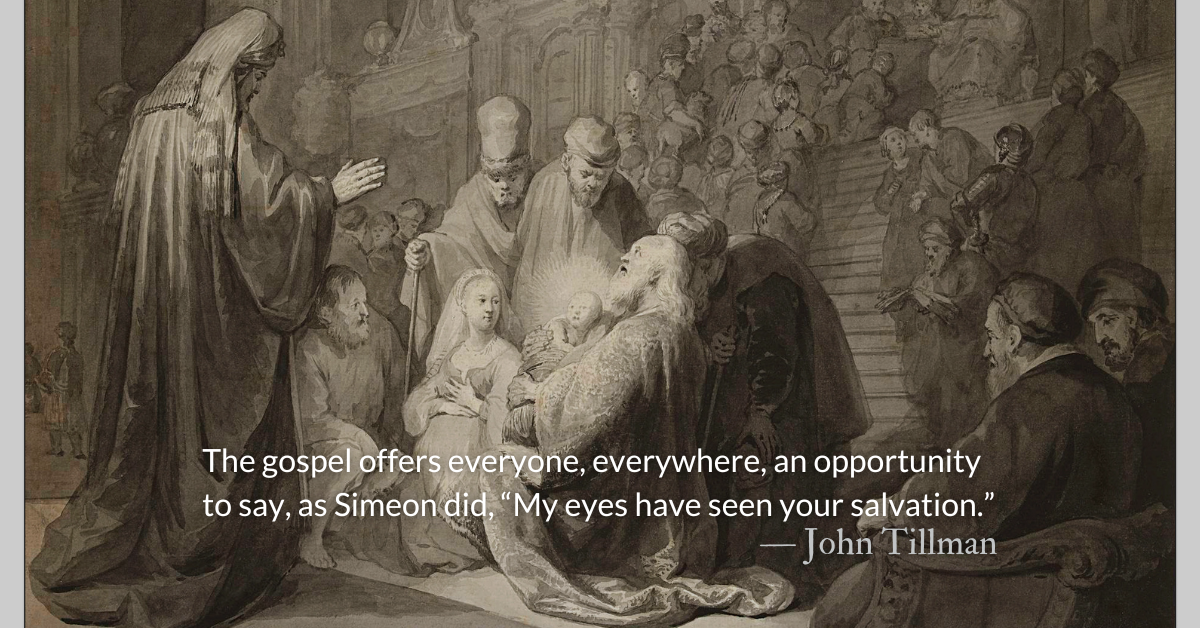
Centuries later, standing in a reconstructed Temple, Simeon held in his arms the same presence that filled Solomon’s Temple. The prophetess Anna, who never left God’s presence in the Temple, recognized it in Jesus and proclaimed about him to Jerusalem.

How astounded Solomon would be at Simeon standing in the Temple holding Jesus in his arms! How astounded we should still be!

Yahweh is God, and Jesus is Lord everywhere, at all times, all at once. This exclusive claim was odd to some and offensive to others. “Who is the Lord that I should obey him?” (Exodus 5.2) “Bow down before this statue I have made!” (Daniel 3.15) “Great is Artemis of the Ephesians!” (Acts 19.34)

Exclusive claims are no less odd or insulting today. Christians face versions of these same objections now. “Why should I obey God?” “You must assent to and support my belief!” “My belief is greater than yours!”

God’s exclusivity is not a bragging point or an insult. Our hope is exclusively in God yet inclusively welcomes all people. Jesus is the light of the world, not the light of our region, race, or nation. His existence is exclusive—He is the only God. His invitation is inclusive—He will be anyone’s God.

The gospel offers everyone, everywhere, an opportunity to say, as Simeon did, “My eyes have seen your salvation.” God is their God, too. Jesus loves them, too. He longs for them and desires to come closer to them than Solomon, Simeon, or Anna could imagine.


Divine Hours Prayer: The Refrain for the Morning Lessons
With my whole heart I seek you; let me not stray from your commandments. — Psalm 119.10

– From The Divine Hours: Prayers for Summertime by Phyllis Tickle.


Today’s Readings
2 Chronicles 6.11-42  (Listen 7:17)
Psalms 112-113 (Listen 1:49)

Read more about He Stoops to Raise
The equally interesting, intimate glory of God is how infinitely small he is willing to shrink in order to meet us, save us, and lift us up.

Read more about Supporting Our Work
Will you help support ad-free content that brings biblical devotionals to inboxes across the world? Join our donors with a one-time or recurring donation.

Unexpectedly Tangible Presence — Hope of Advent

Scripture Focus: 2 Chronicles 5.13
13 The trumpeters and musicians joined in unison to give praise and thanks to the Lord. Accompanied by trumpets, cymbals and other instruments, the singers raised their voices in praise to the Lord and sang: 

“He is good; 
his love endures forever.” 

Then the temple of the Lord was filled with the cloud, 14 and the priests could not perform their service because of the cloud, for the glory of the Lord filled the temple of God.

Luke 2.6-11
6 While they were there, the time came for the baby to be born, 7 and she gave birth to her firstborn, a son. She wrapped him in cloths and placed him in a manger, because there was no guest room available for them. 
8 And there were shepherds living out in the fields nearby, keeping watch over their flocks at night. 9 An angel of the Lord appeared to them, and the glory of the Lord shone around them, and they were terrified. 10 But the angel said to them, “Do not be afraid. I bring you good news that will cause great joy for all the people. 11 Today in the town of David a Savior has been born to you; he is the Messiah, the Lord.

Reflection: Unexpectedly Tangible Presence — Hope of Advent
By John Tillman

David remembered God’s faithfulness. God had inspired him as he slept under the stars as a shepherd, protected him from wicked leaders as a fugitive in his own country, and gone with him into foreign lands as an exile. Now David’s throne was in a palace, and God’s throne, the mercy seat of the Ark of the Covenant, was in a centuries-old tent. David thought God’s presence should be housed more grandly. Solomon made sure of it, following David’s preparations. 

When the days were completed for the Ark to be delivered, Solomon brought forth the presence of the Lord to take up residence in the Temple.

Every priest, no matter their job description, was consecrated. Countless sacrifices were made in worship. The entire nation gathered. Under the spreading wings of cherubim, the Ark was set in place. Choirs of singers and bands of musicians made music of praise and thanks. 

Then, the unexpectedly tangible presence of God, a cloud that filled the Temple, prevented the performance of the priests’ duties. God took over the space as his own. Then, Solomon prayed a priestly prayer over the Temple and kingdom.

When the days were completed for Jesus to be delivered, different preparations had been made. No consecrated priests were there to minister, but Mary, full of the Holy Spirit, prophesied and gave him life. No choir of Levites in fine linen celebrated him, but shepherds, sleeping on the ground, were inspired to seek him by music from the heavens. No dignitaries from his nation visited or brought sacrifices, but foreigners came from afar to worship, bringing sacrificial gifts. No king prayed to or worshiped him, but Herod’s killers pursued him, and Jesus became a fugitive and an exile, leaving behind comfort and familiarity.

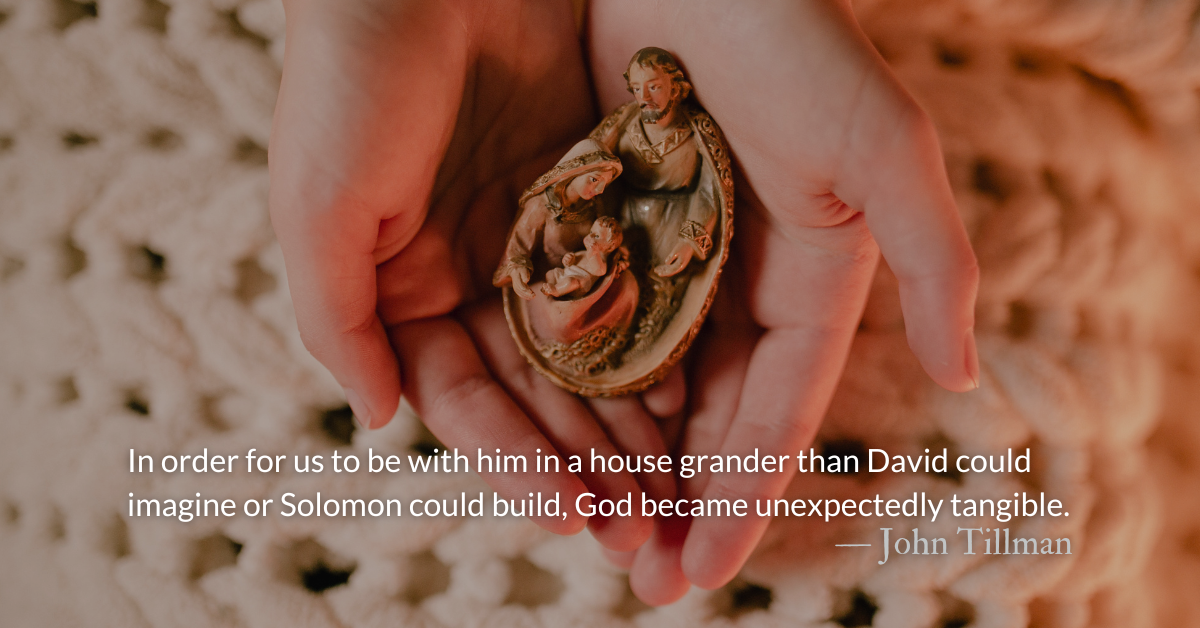
In order for us to be with him in a house grander than David could imagine or Solomon could build, God became unexpectedly tangible. Rather than a non-corporeal cloud, he became a poor, unhoused, itinerant carpenter and died as a slandered, tortured rebel.

Jesus, with no place to lay his head, is the same God who inspired David’s songs in the night. Jesus, whose parents could not afford to sacrifice a lamb, is the Lamb of God. Jesus, hung on a cross with a crown of thorns, is the same God enthroned on the mercy seat of the Ark of the Covenant.

Come, thou unexpectedly tangible Jesus.


Divine Hours Prayer: The Request for Presence
Show us the light of your countenance, O God, and come to us. — Psalm 67.1

– From The Divine Hours: Prayers for Summertime by Phyllis Tickle.


Today’s Readings
2 Chronicles 5-6.11 (Listen 9:47)
Psalms 110-111 (Listen 1:57)

Read more about O Come, O Come, Emmanuel — Carols of Advent Hope
Our true hope…Messiah King soothes doubts, heals afflictions, wipes sorrowful tears, and rescues us from captivity to sin.

Read more about Supporting Our Work
Approximately half of our funding comes from monthly and half from once-a-year donors. Please consider joining one of these groups and supporting our work.

Mercy Seat and Manger — Hope of Advent

Scripture Focus: 2 Chronicles 3.1
1 Then Solomon began to build the temple of the Lord in Jerusalem on Mount Moriah, where the Lord had appeared to his father David. It was on the threshing floor of Araunah the Jebusite, the place provided by David.

Luke 1.34-38
34 “How will this be,” Mary asked the angel, “since I am a virgin?”

35 The angel answered, “The Holy Spirit will come on you, and the power of the Most High will overshadow you. So the holy one to be born will be called the Son of God. 36 Even Elizabeth your relative is going to have a child in her old age, and she who was said to be unable to conceive is in her sixth month. 37 For no word from God will ever fail.”

38 “I am the Lord’s servant,” Mary answered. “May your word to me be fulfilled.” Then the angel left her.

Reflection: Mercy Seat and Manger — Hope of Advent
By John Tillman

Temples intend to overlap the mundane and the mystical, allowing humans to interact with gods. The holiest place in the Temple was “the mercy seat,” where human guilt was confronted by God’s righteousness and mercy. The Temple site on Mount Moriah was a place of confrontation and sacrifice long before the Temple was built. 

David purchased Araunah’s threshing floor as a place of sacrifice for his own sin. (1 Chronicles 21) David chose plague as punishment, but God stayed the sword of the death angel on the threshing floor. Then David said, “I, the shepherd, have sinned…These are but sheep…let your hand fall on me…do not let this plague remain on your people.”

Abraham was sent to this mountain to offer Isaac as a sacrifice, but God stayed his knife, providing a ram in Isaac’s place and fulfilling Abraham’s promise to Isaac as they traveled, “God himself will provide the lamb.” (Genesis 22.8)

John the Baptizer calls Jesus “the lamb of God” (John 1.29, 36) but also describes him as coming “to clear his threshing floor…gather the wheat into his barn, but…burn up the chaff with unquenchable fire.” (Luke 3.17)

Threshing separates grain from chaff and produces seed and food from grass that would otherwise fade away. It brings life from death. The place where Araunah threshed wheat was a place where the Lord threshed human hearts. It is a place where the holy confronts the unholy. (Isaiah 6.5) In that holiest place, we find mercy and hope.

John says Jesus “tabernacled” among us. (John 1.14) Jesus is where human space overlaps divine space—a Temple that comes to us. Jesus is our mercy seat, the holy one in whom we hope. The mercy seat and the manger represent God’s throne. In the gold-covered room, we glimpse his glory and worth. In the humble manger, he shows us ours.

David met an angel, made a sacrifice, and prepared a place to welcome God’s presence. Generations later, David’s daughter, Mary, did the same to welcome Jesus.

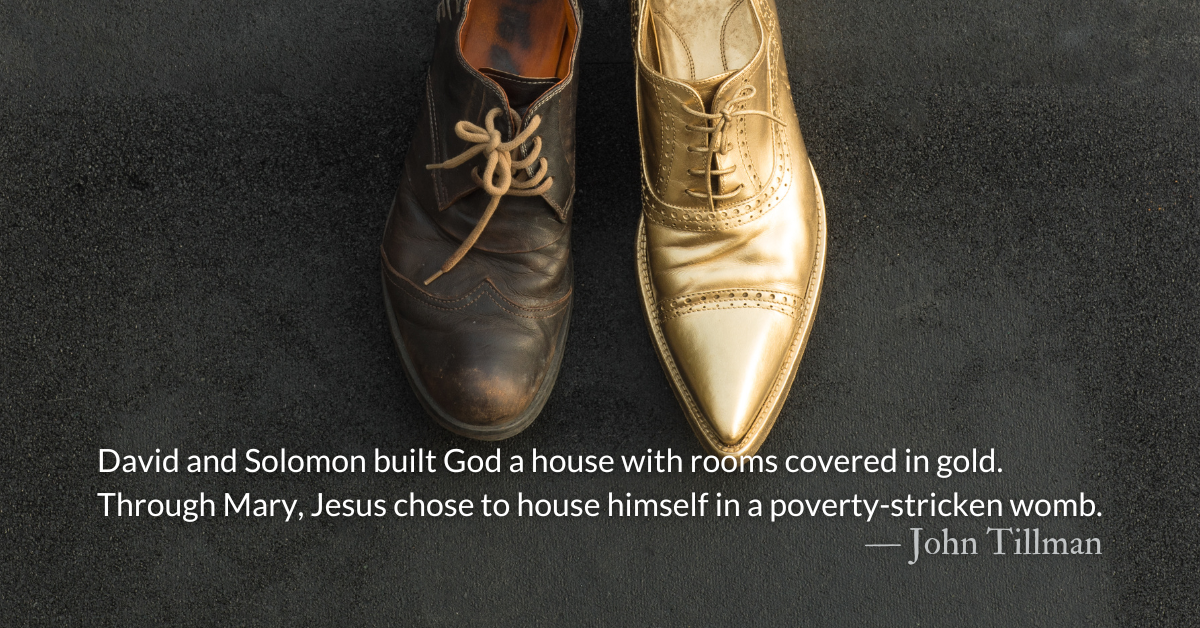
David and Solomon built God a house with rooms covered in gold. Through Mary, Jesus chose to house himself in a poverty-stricken womb.

David, the shepherd, sinned, bringing punishment on his sheep. Jesus, the shepherd, is sinless, taking punishment for his sheep. 

Jesus stays the sword of judgment and knife of sacrifice, providing himself as the lamb.

Jesus threshes life out of death.


Divine Hours Prayer: The Refrain for the Morning Lessons
This is the Lord’s doing, and it is marvelous in our eyes. — Psalm 118.23

– From The Divine Hours: Prayers for Summertime by Phyllis Tickle.


Today’s Readings
2 Chronicles 3-4   (Listen 5:42)
Psalms 108-109 (Listen 4:28)

Read more about Unto Us, He Comes — Hope of Advent
The movements of the heavens tell a story in which Christ comes in at our darkest point to turn the world back to the light.

Read more about Supporting Our Work
Our ad-free content is not free to produce. Join our donors and help bring biblical devotionals to inboxes across the world.

From Darkness to Light

Scripture Focus: Psalm 105.23-28
23 Then Israel entered Egypt; 
Jacob resided as a foreigner in the land of Ham. 
24 The Lord made his people very fruitful; 
he made them too numerous for their foes, 
25 whose hearts he turned to hate his people, 
to conspire against his servants. 
26 He sent Moses his servant, 
and Aaron, whom he had chosen. 
27 They performed his signs among them, 
his wonders in the land of Ham. 
28 He sent darkness and made the land dark— 
for had they not rebelled against his words? 

“Do you feel the shadows deepen? We do.” — “Is He Worthy” Andrew Peterson

Reflection: From Darkness to Light
By John Tillman

Psalm 105 tells Israel’s story of moving from light to darkness to light. Joseph goes from favored son to slave and prisoner, then rises to the bright pinnacle of power. Politics turns against Joseph’s immigrant family, and they are cast again into the pit of slavery. Into this darkness, prophets come to work wonders. They bring light to God’s people and darkness to their oppressors in both literal and spiritual ways.

Our planet cycles from light to darkness to light. In Autumn, when the United States “falls back” to Standard Time from Daylight Savings Time, social media floods with complaints. People bemoan how the early evening darkness affects their moods, children, pets, and time to do things after work. I try not to tell people they shouldn’t complain. But I do often point out that complaining about “falling back” is complaining about the world as it really is. 

In the Northern Hemisphere, days slowly shorten following the summer solstice. Night has been creeping up on us most of the summer. Daylight Savings Time pretends to hold the darkness at bay with its gently deceptive trick of the clock. Falling back rips the bandaid off. DST’s deceptively late sunsets disappear. The growing darkness is suddenly more obvious.

In literal and spiritual ways, the world is darkening. Gently deceptive mantras such as “People are basically good” and “One’s environment causes evil, not one’s choices” try to put a bandaid on the darkness. We need the bandaid ripped off to recognize our need for illumination. 

If people are basically good, why is teaching ethics hard? Isn’t “the environment” that causes evil in one person made from another’s evil choices? Evil is real. Darkness comes. We don’t have to live in denial about the darkness, but we also don’t have to despair. 

Sunday is the first Sunday of Advent. Advent tells our story of going through darkness to light. As Advent starts, the darkness is deepening, but we smile, knowing dawn is approaching.

Advent is an anticipation of light entering darkness. God brought light and hope to Israel through Moses, Aaron, and other prophets. They burned imperfectly and briefly, like birthday candles down a well. They were only signs and examples of the one to come.

Jesus plunges himself into our well of darkness, bringing light that is perfect and unextinguishable. May the first dark well he illuminates be our hearts.

Music: “Is He Worthy” Andrew Peterson

Divine Hours Prayer: The Refrain for the Morning Lessons
Our sins are stronger than we are, but you will blot them out. — Psalm 65.3

– From The Divine Hours: Prayers for Summertime by Phyllis Tickle.


Today’s Readings
1 Chronicles 29  (Listen 5:50)
Psalms 105 (Listen 4:02)

This Weekend’s Readings
2 Chronicles 1  (Listen 2:47), Psalms 106 (Listen 4:52)
2 Chronicles 2   (Listen 3:41),  Psalms 107 (Listen 4:12)

Read more about Renamed by God — Hope of Advent
We don’t have to continue in life with the haunting names that fit our histories. New names bring us new hope.

Read more about God In the Dark — Hope of Advent
The first picture of God…On the very first page of scripture…God hovers over dark, chaotic waters…enters creation’s darkness and sparks light and life.