From Privilege to Prisoner to Priest

Scripture Focus: Ephesians 4:1-2
As a prisoner for the Lord, then, I urge you to live a life worthy of the calling you have received. Be completely humble and gentle; be patient, bearing with one another in love.

From John: Our friend and fellow writer, Jon Polk, no longer lives on the other side of the world. We are sad for their time there to end but joyful they will be near to us. As we welcome Jon back to Texas from Hong Kong, we share today his excellent reflection from a few years ago, considering today’s reading in light of events of Saint Francis’s life.

Reflection: From Privilege to Prisoner to Priest
By Jon Polk

St. Francis of Assisi is generally known for his peaceful disposition and love for animals and nature. The Prayer of St. Francis (authorship uncertain, but often attributed to Francis) begins…

Lord, make me an instrument of Thy peace;
Where there is hatred, let me sow love;
Where there is injury, pardon;
Where there is doubt, faith;
Where there is despair, hope;
Where there is darkness, light;
Where there is sadness, joy.

However, this devoted follower of Christ, widely regarded for his vow of poverty, did not begin life in a humble way. Francis was born in Italy around 1181 to a wealthy cloth merchant and his beautiful French wife. By age 14, Francis, spoiled by luxury, dropped out of school and gained a reputation as a rebellious teen, known for drinking, partying, and vanity.

His privileged upbringing afforded him training in archery and horsemanship and when war broke out in 1202, he joined the cavalry. Having no combat experience, Francis was easily captured by opposing forces and imprisoned for a year before ransom was negotiated.

But during his time as a prisoner of war, Francis began to receive visions from God and arrived home a changed man. He turned his heart towards God and spent time in prayer, seeking direction.

Eventually, he felt the call of Christ to serve the Church and to live a life of extreme poverty—fully devoted to Christianity. He is considered by many to be one of the purest examples of living the Christian life, other than Jesus himself.

Certainly, Francis embodies Paul’s encouragement to the Ephesians to “live a life worthy of the calling you have received” and to “be completely humble and gentle.”

Francis’ deep dedication and gratitude to God is seen expressed in these excerpts from a song he composed, Canticle of the Sun. May these words guide our worship and service to Christ.

Most High, all powerful, good Lord,
Yours are the praises, the glory, the honor,
and all blessing.
To You alone, Most High, do they belong,
and no man is worthy to mention Your name.
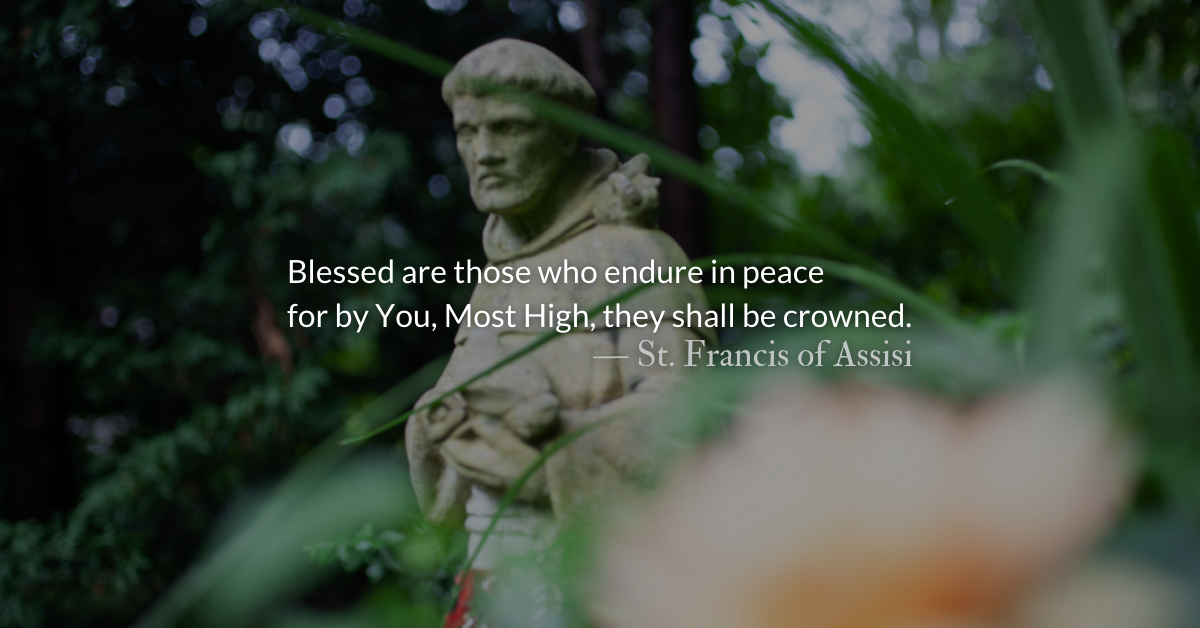
Blessed are those who endure in peace
for by You, Most High, they shall be crowned.
Woe to those who die in mortal sin.
Blessed are those whom death will
find in Your most holy will,
for the second death shall do them no harm.
Praise and bless my Lord,
and give Him thanks
and serve Him with great humility.

Divine Hours Prayer: The Greeting
Let the words of my mouth and the meditation of my heart be acceptable in your sight, O Lord, my strength and my redeemer. — Psalm 19.14

– From The Divine Hours: Prayers for Summertime by Phyllis Tickle.

Today’s Readings
Joshua 12-13 (Listen 8:18)
Ephesians 4 (Listen  3:58)

Read more about Choosing and Being Worthy Overseers
We may be shaped more by secular political media than by Christian voices or our local church…are we choosing our “overseers” wisely?

Read more about Anger Industrial Complex
Anger can form grooves, patterns, in our lives that affect our identity, transforming us into people of anger, rather than people of God.
Ask and Keep Asking

Scripture Focus: Ephesians 1.17-21
17 I keep asking that the God of our Lord Jesus Christ, the glorious Father, may give you the Spirit of wisdom and revelation, so that you may know him better. 18 I pray that the eyes of your heart may be enlightened in order that you may know the hope to which he has called you, the riches of his glorious inheritance in his holy people, 19 and his incomparably great power for us who believe. That power is the same as the mighty strength 20 he exerted when he raised Christ from the dead and seated him at his right hand in the heavenly realms, 21 far above all rule and authority, power and dominion, and every name that is invoked, not only in the present age but also in the one to come.

Reflection: Ask and Keep Asking
By John Tillman

Writing Ephesians, Paul is “an old man” (Philemon 9). He is in chains. Execution and death lie ahead. Yet, in many of his letters from this time, Paul sounds enduringly hopeful.

Paul’s eyes are not set on his current circumstances or on the current state of the church. They are set on the heavenly realm. He speaks little of earthly sufferings, focusing attention on spiritual blessings.

By the sovereignty of Rome, Paul was predestined for trial, suffering, and, eventually, execution. But by the sovereignty of God, Paul was predestined to adoption to sonship through Jesus, to redemption and forgiveness, and to bringing Gentiles into the family of God. By the Holy Spirit’s prompting, Paul’s speaking, and the Ephesians’ hearing, they believed and were included in Christ as heirs to his promises.

There are different types of sovereignty at work in our lives. We live under the sovereignty of governments and employers. There are penalties and benefits predestined by their laws and policies. When we work according to our employment policies, we receive promised wages. Whether we believe in paying our taxes or not, if we don’t pay them, we are predestined for trouble.

By God’s sovereignty, not only the Ephesians but we are included in Christ by hearing and believing the gospel of salvation. (Ephesians 1.13) Like them, we who believe are marked, sealed, and predestined for the glory that is to come.

And like the Ephesians, we also have farther to go. Paul thanked God for their faith but prayed that through the Holy Spirit they would know God better.

Pray this prayer based on Paul’s:
Lord, help us to ask and keep asking that through the Holy Spirit you would grant us greater wisdom, greater enlightenment, greater hope, and greater power.
In this world that seeks to do us harm, these are our daily bread. We cannot survive without them.
Whatever the world has destined for us, Lord, work out everything in conformity with the purpose of your will.
Your Holy Spirit guarantees that we are your possession. We do not belong to the world.
Through whatever suffering, whether loss of life or comfort, let no harsh treatment make our speech harsh or our hearts hard.
Let your resurrection power not only resurrect our bodies should we die, but resurrect our compassion, our love, our goodness, our humility, and our generosity while we live.

Divine Hours Prayer: The Refrain for the Morning Lessons
Help me, O Lord my God; save me for your mercy’s sake. — Psalm 109.25

– From The Divine Hours: Prayers for Summertime by Phyllis Tickle.

Today’s Readings
Joshua 9 (Listen 3:46)
Ephesians 1 (Listen  3:10)

Today’s Readings
Joshua 10 (Listen 7:23Ephesians 2 (Listen  3:04)
Joshua 11 (Listen 3:52Ephesians 3 (Listen  2:41)

Read more about The Consequence of Carelessness
There are times when the monotony of life creates an apathy toward caution.

Read The Bible With Us
There is joy to be found in the scriptures. Read the Bible with us at a sustainable, two-year pace.

https://mailchi.mp/theparkforum/m-f-daily-email-devotional

Speak to Philemon

Scripture Focus: Philemon 8-11
8 Therefore, although in Christ I could be bold and order you to do what you ought to do, 9 yet I prefer to appeal to you on the basis of love. It is as none other than Paul—an old man and now also a prisoner of Christ Jesus— 10 that I appeal to you for my son Onesimus, who became my son while I was in chains. 11 Formerly he was useless to you, but now he has become useful both to you and to me.

Reflection: Speak to Philemon
By John Tillman

Our aversion to slavery is historically atypical. Excepting the last 200 years or so, the prevailing thought of the world’s elite philosophers and rulers was that slavery was not just acceptable, but a moral good.

Slavery aligned well with most religious and political systems. Slavery supported the despotic theology and ideology of authoritarianism and social stratification. Gods and emperors were on top, then the wealthy and powerful, then ordinary men, then women, then slaves at the bottom.

Even if we transported ourselves and our belief that slavery is evil back in time to Paul’s day, what could we do? If we went to the market, slaves would be sold there. If we bought property, it would be built and maintained by slaves. Slavery touched every part of life. It was woven into political and financial systems. Slavery was unavoidable. Yet, we find Paul and others resisting and subverting the practice. 

Slavery is not culturally acceptable anymore, but many ideologies that enslave both bodies and minds are. We live among cultural assumptions that shape our media, our economy, our schools, and our politics. Many are wicked, unjust, and unavoidable.

How do we live within unjust systems and during an unjust time? 

Paul’s letters, especially Philemon, show us one way. Paul never led a slave revolt and his words have been twisted to support slavery, but his careful, thoughtful logic and loving, inclusive actions eroded the philosophical foundations of slavery.

Despite the fact that many Christians, past and present, defend slavery, the idea that slavery is evil comes exclusively from Christian theology. Local slave rebellions or individual rulers partially freeing some slaves occurred in ancient history. But nowhere in any culture does a consistent cry arise to abolish slavery for all people everywhere, except among the followers of Jesus. However, it is not to our glory that abolitionism arose from Christianity. It is to our shame that it took so long.

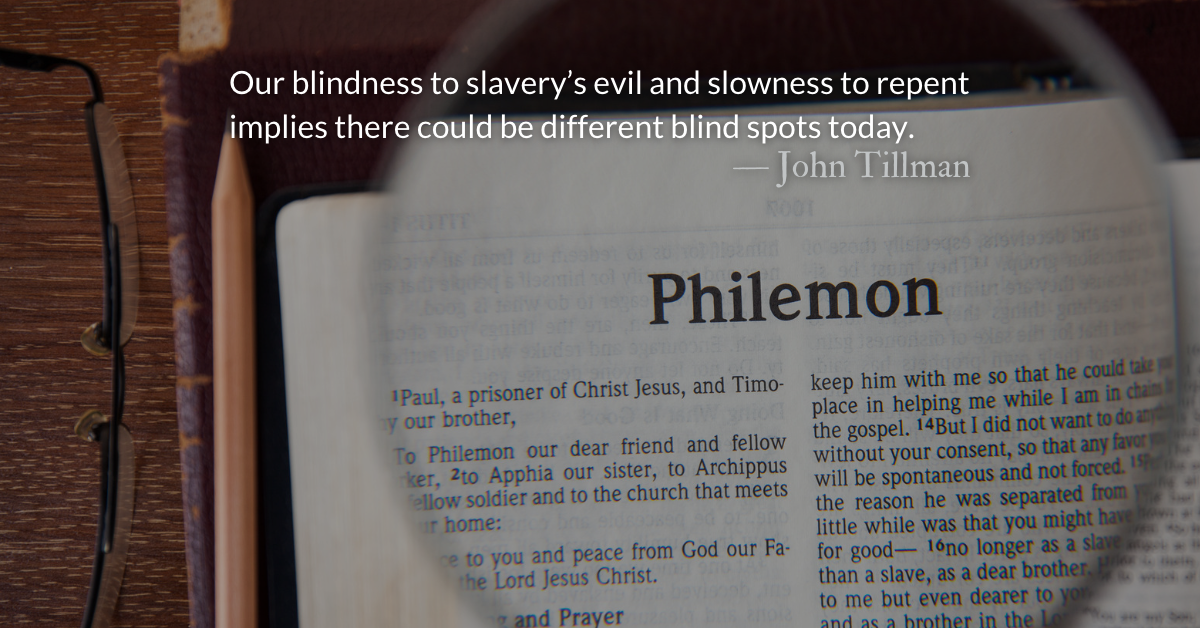
Somehow, through all the pressure of cultural ideology, Paul pushed back against slavery. But it took us too long to see it. Our blindness to slavery’s evil and slowness to repent implies there could be different blind spots today. What is culture telling us today that we accept without question? Speak to your “Philemon.” How can you, gently and with love, erode the philosophical foundations of oppressive ideologies? How can you, in love, set people free through the gospel?

Divine Hours Prayer: The Small Verse
My soul thirsts for the strong, living God and all that is within me cries out to him.

– From The Divine Hours: Prayers for Summertime by Phyllis Tickle.

Today’s Readings
Joshua 8 (Listen 5:55)
Philemon (Listen  2:52)

Read more about Philemon’s Speck and Our Log
Our existence is supported by the labor of people who directly or indirectly serve us, just as Onesimus served Philemon.

Read more about Slavery, Racism, and a Lone Christian Voice
In the late fourth century a lone Christian voice spoke out against the oppressive institution of slavery in a way that none had before.

Trouble and Hope

Scripture Focus: Joshua 7.25-26
25 Joshua said, “Why have you brought this trouble on us? The Lord will bring trouble on you today.”

Then all Israel stoned him, and after they had stoned the rest, they burned them. 26 Over Achan they heaped up a large pile of rocks, which remains to this day. Then the Lord turned from his fierce anger. Therefore that place has been called the Valley of Achor ever since.

Hosea 2.14-15
14 “Therefore I am now going to allure her;
    I will lead her into the wilderness
    and speak tenderly to her.
15 There I will give her back her vineyards,
    and will make the Valley of Achor a door of hope.
There she will respond as in the days of her youth,
    as in the day she came up out of Egypt.

Reflection: Trouble and Hope
By Erin Newton

The memorial stones marking Achan’s death were called “The Valley of Achor” or fully translated, “The Valley of Trouble.” The name was fitting. Trouble came to Israel through Achan. One man’s sin caused the downfall of the community.

Joshua describes Achan’s sin as coveting and stealing. After Jericho, he took items destined to be devoted to God. Implied sins include pride and deceit. It was pride that led Achan to assume authority over what belonged to God. It was deceitfulness that caused Achan to avoid confessing until the very end.

Now just a pile of stones, thrown by the betrayed community and commanded by the betrayed God, Achan’s memorial would serve as a warning to Israel. The justice of God was not something to be overlooked. The warnings about disobedience were important.

God as a wrathful, vengeful deity is a typical assumption when reading the Old Testament. Some people reduce the testaments to the opposing picture of God: wrath in the Old, mercy in the New. This conclusion, however, neglects the fuller picture of God from Genesis to Malachi.

In Joshua, one sinful man is led into the wilderness as punishment. In Hosea, God leads the sinful people into the wilderness as a pathway of hope. The Valley of Achor reveals a more comprehensive view of God’s character: justice and mercy. Two sides of the same God.

Faced with this complex tension of two opposing characteristics, we tend to downplay one for the sake of the other. Our minds struggle to grasp how God can be completely just and completely merciful. It is a dichotomy we will never fully grasp.

How does trouble turn into hope? How does the punishment of disobedience become a beacon of mercy in the wilderness?

Justice and mercy converged on the cross. Like the punishment heaped upon Achan, the weight of our guilt was cast upon the body of Christ. But this monument of justice suddenly becomes a crimson beacon of hope. The justice required after the first Adam is covered by the mercy of the second Adam.

Whereby one man’s sin caused the downfall of humanity, the one Son of God caused the redemption of all creation.

We are not so different from Achan. Our sin would have us trudge into the wilderness to endure justice. But we are also like Israel, we are lured into the wilderness with a promise of restoration and mercy.

Divine Hours Prayer: The Morning Psalm
Seven times a day do I praise you, because of your righteous judgments.
Great peace have they who love your law: for them there is no stumbling block. — Psalm 119.165

– From The Divine Hours: Prayers for Summertime by Phyllis Tickle.

Today’s Readings
Joshua 7 (Listen 4:58)
Colossians 4 (Listen  2:21)

Read more about Distrust of God and Fraud
It is the unbelief and contempt of heaven, which make men risk it for the poor commodities of this world.

Read The Bible With Us
Join our Bible reading plan. Immerse in the Bible at a sustainable, two-year pace.

https://mailchi.mp/theparkforum/m-f-daily-email-devotional

From Survival to Cultivation

Scripture Focus: Joshua 5.10-12
10 On the evening of the fourteenth day of the month, while camped at Gilgal on the plains of Jericho, the Israelites celebrated the Passover. 11 The day after the Passover, that very day, they ate some of the produce of the land: unleavened bread and roasted grain. 12 The manna stopped the day after they ate this food from the land; there was no longer any manna for the Israelites, but that year they ate the produce of Canaan. 

Reflection: From Survival to Cultivation
By John Tillman

Migrants carry their world through the world. Everything precious to their lives and future is strapped to them in a backpack or a duffel bag. They often carry large amounts of cash or precious items to use for bribes and to survive on the way. I barely trust plastic grocery bags to make it from the store to my car, but migrants travel thousands of miles carrying water, food, and necessities in these bags.

After the first Passover, Israel left Egypt with considerably more than backpacks, duffle bags, and plastic grocery sacks. They had flocks and herds and wealth. Their encampment was carefully organized with strict cleanliness and purity rules. They built the Tabernacle, a magnificent mobile garden of Eden that moved around the desert with them like a mirage.

But no matter how organized or clean a migrant camp is, it is still a migrant camp. There is no planting or harvesting. There is no cultivation. There is only surviving.

At their first Passover in the promised land the people ate food from the land. They tasted the fruit of the promise. They had previously been sustained by manna, the miraculous provision of Heaven. Now they would rely on a different miracle—cultivation. They began the process of going from survival mode to cultivation mode.

Cultivation is just as miraculous as manna. We plant and water, but it is still the Lord who makes things grow. The one in whom we trust is the same one who provided manna in the wilderness.

Cultivation has a different responsibility. Manna could not be saved or shared. They gathered only for themselves. In survival mode, nothing lasts until tomorrow.

Shifting from survival to cultivation, we both save and share. Cultivation creates bounty and resources intended to bless the community and invest in the future.

There is no shame in being migrants. The Lord sustains them—often through us. (Deuteronomy 10.18-19; 24.14, 17; 27.19) But God’s calling and promise are to cultivation. (Micah 4.4) It is through cultivation of faith that we have plenty to share with those in survival mode.

Are you in survival mode or cultivation mode? 

Do you pray only in crisis? Or do you plant prayers, allowing them to grow roots and sprout?
Do you forge scriptures into weapons to fight others? Or do you form scripture into a plowshare, dragging its blades through the soil of your heart, casting out stones and weeds?

Divine Hours Prayer: The Refrain for the Morning Lessons
“Because the needy are oppressed, and the poor cry out in misery, I will rise up,” says the Lord, “And give them the help they long for.” — Psalm 12.5


– From The Divine Hours: Prayers for Summertime by Phyllis Tickle.

Today’s Readings
Joshua 5-6.5 (Listen 7:25
Colossians 2 (Listen  3:27)

Tuesday’s Readings
Joshua 6.6-6.27 (Listen 4:47), Colossians 3 (Listen  3:09)

Read more about Jericho’s Wall
God isn’t interested in destroying people we call our enemies

Read more about Over Jordan
When we cross over the Jordan with Christ, the land has no enemies to be defeated.