Forward-Looking Remembering :: Readers’ Choice

Selected by reader, Lauren Nichols from Fort Wayne, IN
I have often read of the folly of living in the past, or looking back mournfully as if we could turn back time. This post is an excellent reminder of the value of remembering God’s past faithfulness as a way to be encouraged to trust Him for the future.

Originally published, February 1, 2018 based on readings from Esther 9 and Romans 4.

Mordecai recorded these events, and he sent letters to all the Jews throughout the provinces of King Xerxes, near and far, to have them celebrate annually… the time when the Jews got relief from their enemies, and… when their sorrow was turned into joy and their mourning into a day of celebration. He wrote them to observe the days as days of feasting and joy and giving presents of food to one another and gifts to the poor. — Esther 9:20-22

Reflection: Forward-Looking Remembering :: Readers’ Choice
By Jon Polk

A visit to the National Mall in Washington, D.C. is a testament to the significant power of memory. In the heart of the United States’ capital are numerous monuments dedicated to the memory of great historical figures – Lincoln, Washington, King and others – and significant human sorrows – World War II, the Vietnam War, the Holocaust. Standing in front of the impressive white marble statue of the great American president Abraham Lincoln, one cannot help but be overwhelmed with a sense of history that goes far beyond the memory of personal life experiences.

Many of us have our own memorials in a prominent place in our home: the refrigerator door. There on that sleek magnetic surface, the faces of family and friends stare back at us from treasured moments that have come and gone. There, kindergarten artwork is treated like a rare, priceless Van Gogh. There we find notes and cards that remind us of the ones we love.

At the conclusion of the story of Esther, her uncle Mordecai instructs the Jews to annually celebrate by remembering the attempted genocide and their escape from it. This inaugurates the Jewish Festival of Purim, a memorial of the time when sorrow turned to joy and mourning to celebration.

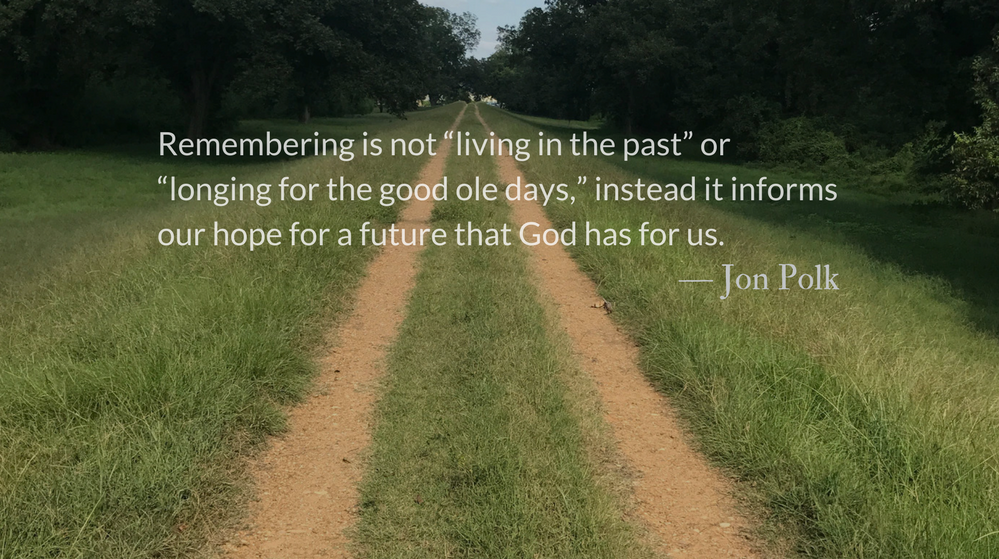
Remembering is not “living in the past” or “longing for the good ole days,” instead it informs our hope for a future that God has for us. At Purim, the Jews were to look back to the story of Esther and their deliverance in order to look forward to find a hope for their future. This remembering caused them to not only feast and celebrate, but also to give gifts to the poor. Memory of God’s favor on us should compel us to share that same grace with others.

It is often noted that Esther is the one book in the Bible where God is not specifically mentioned. Reading the story with the benefit of hindsight reveals that God was indeed present and working behind the scenes.

We would be wise to regularly recall God’s intervention and provision in our own lives, giving thanks and praise for how God has delivered us and cared for us, especially in those times when we may have not been able to immediately recognize his presence.

What spiritual memories are we hanging on the refrigerator doors of our hearts that we look to regularly for hope and to say, “Thanks be to God”?

Prayer: The Refrain for the Morning Lessons
Our days are like the grass; we flourish like a flower of the field. — Psalm 116.14-4

– Prayer from The Divine Hours: Prayers for Springtime by Phyllis Tickle.

Prayers from The Divine Hours available online and in print.

Today’s Readings
Jeremiah 30-31 (Listen – 11:21)
Mark 16 (Listen – 2:34)

This Weekend’s Readings
Jeremiah 32 (Listen – 7:32) Psalm 1-2 (Listen – 2:05)
Jeremiah 33 (Listen – 4:46)Psalm 3-4 (Listen – 1:56)

Additional Reading
Read More about Finishing Well
For a faith focused on the ideals of selflessness and sacrifice, it seems odd that biblical writers draw parallels with sports events focused on individual winners.

Read More about Going Where the Gospel Goes
“Who was I to think that I could stand in God’s way?” — Apostle Peter

Readers’ Choice
We still have room for you to suggest your favorite posts of the year. Submit a Readers Choice post.
Tell us about a post and what it meant to you.

Support our Work
Over 4,000 people every week read an email devotional from The Park Forum. Support our work with a monthly or a one time donation.

Resurrecting Goodness :: Readers’ Choice

Selected by reader, Matt Tullos from Alexandria, LA
I loved the grit of this meditation and scripture. Great insight into the humanity and intimacy of our connection with Jesus. It was a reminder to me that he is incarnate in the present. Our connection isn’t hidden in the future. It’s now. I love the concept of a God with dirty hands restoring everything to himself.

Originally posted April 23, 2018, based on readings from Ecclesiastes 10 and Titus 2.

In everything set them an example by doing what is good. In your teaching show integrity, seriousness and soundness of speech that cannot be condemned, so that those who oppose you may be ashamed because they have nothing bad to say about us. — Titus 2.7-8

Reflection: Resurrecting Goodness :: Readers’ Choice
By John Tillman

It would be easy to misread the second chapter of Paul’s letter to Titus as a legalistic list of behaviors to enforce—complete with injunctions against addictions and stealing and including commendations of moral purity and of showing respect for masters and for husbands.

But these actions are not requirements of the gospel as much as they are results of it. They are differentiators—showing the evidence of God at work among the Christian community.

Nearly every religion promises transcendent joy and peace in the hereafter. Christianity describes a God willing to get his hands dirty fixing things in the here and now.

Our God is not a distant observer, merely passing judgement. He is a present participant, showing the dignity of work by engaging in it himself. He works on us as Paul says, he, “gave himself for us to redeem us from all wickedness and to purify for himself a people that are his very own, eager to do what is good.”

Even Christ’s resurrection wasn’t about his cosmic survival, it was about us. Christ didn’t stick around after his resurrection to “prove” he was alive. If he cared about incontrovertible proof, Christ would simply have leapt off of the top of the Temple as he was tempted to do at the beginning of his ministry.

Christ invested time between his resurrection and his ascension preparing his followers for the coming of the Holy Spirit and getting them ready to do the work the Holy Spirit would prompt them to do.

It is a uniquely Christian claim that God is invested in our present, not just our future. His Holy Spirit is our present down payment on the future eternity we will one day inherit. And right now, in each moment, the Holy Spirit inhabits us giving us the connection, the power, and the ability to resurrect goodness into the world.

During the season of Easter, we transition from a Christ who walked around in a body like ours, doing good in the ancient world of the past, to a Christ whose Spirit walks around in our bodies prompting us to do good in our world right now.

When we engage in the gospel that Paul describes to Titus, the natural result will be a connection to the Spirit that makes us “eager” to do good.

May we connect with the Spirit of Christ and resurrect goodness of speech, goodness in teaching, and goodness in action for those in our communities.

Prayer: The Greeting
O Lord, what are we that you should care for us? Mere mortals that you should think of us?
We are like a puff of wind; our days are like a passing shadow. — Psalm 144.3-4

– Prayer from The Divine Hours: Prayers for Springtime by Phyllis Tickle.

Prayers from The Divine Hours available online and in print.

Today’s Readings
Jeremiah 29 (Listen – 5:44)
Mark 15 (Listen – 5:16)

Additional Reading
Read More about Present Glory
Thus God’s glory among men is his goodness, his mercy, his justice, his truth.

Read More about Rhythms of Grace and Discipline
Spiritual disciplines, practiced well, are not contradictory to grace, but extensions of it.

Readers’ Choice
We still have room for you to suggest your favorite posts of the year. Submit a Readers Choice post.
Tell us about a post and what it meant to you.

Support our Work
Over 4,000 people every week read an email devotional from The Park Forum. Support our work with a monthly or a one time donation.

When We Fast From The Feast :: Readers’ Choice

Selected by reader, Steve Bostrum from Helena, Montana.
“Christian, or you who will someday follow Jesus, we are astonished that a holy God loves sinners like us. But, he does. And when similarly astonished people get together, a unique culture forms—a Gospel culture. This column calls us from the seductions and pressures of contemporary culture—ones we often wolf down—back to a way of living that actually connects us with God and each other. Tasting that the LORD is good.”

Originally posted March 23, 2018, based on readings from Proverbs 10-12 and Ephesians 3-5.

You were taught, with regard to your former way of life, to put off your old self, which is being corrupted by its deceitful desires; to be made new in the attitude of your minds; and to put on the new self, created to be like God in true righteousness and holiness. — Ephesians 4.22-24

At the time of the banquet he sent his servant to tell those who had been invited, “Come, for everything is now ready.” But they all alike began to make excuses.— Luke 14.17-18

Reflection: When We Fast From The Feast :: Readers’ Choice
By John Tillman

We already know how to fast. We have simply been fasting from the wrong things.

Our culture has steadily, for decades, been encouraging us to abstain from spiritual disciplines in favor of activities that we are led to believe are more profitable.

Our culture tells us that rather than read scripture in the mornings, we must pound through more emails. Productivity trumps biblical literacy.

We are told rather than praying at noon, we should skip lunch to work at our desk or take lunch with a valuable business contact. Productivity and self-promotion trumps prayerfulness and relational spirituality.

Rather than living simply and giving extravagantly, we reverse the equation, making our giving a simple percentage that satisfies a legalistic requirement or gains a tax benefit. Moral satisfaction trumps active compassion.

Rather than draw away from the world to worship in community with other believers, we draw away from others to worship with our headphones in—shutting the world out via podcast or streaming music and worship services.

When we have had just enough of God to make us feel more emotionally healthy and morally superior, we wish to move on to productivity, profit, and success. (All with the implied blessing of God of course.)

Many of us, when Christ has enabled us to overcome one or two sins that were an obvious nuisance, are inclined to feel (though we do not put it into words) that we are now good enough. He has done all we wanted him to do, and we should be obliged if he would now leave us alone. — C.S. Lewis

We’ve pushed our chairs back from the banquet table of God’s Word and placed our hand over our glass to prevent being refilled with the wine of his Holy Spirit.

God invites us to the feast of the kingdom. But many are fasting from God’s feast in order to binge on the benefits we can wring from the world.

May we return to the table and to the fellowship of believers with gusto, pushing aside distractions and false supplements that aren’t real spiritual food. As the voice of Christ cries through the prophet, Isaiah, “Why spend money on what is not bread?

Spiritual disciplines of daily Bible reading, prayer, and meditation are not the spices and subtle flavorings of life—they are the main course. Everything else is sprinkles of garnish.

Prayer: A Reading
When Jesus spoke to the people again, he said: “I am the light of the world; anyone who follows me will not be walking in the dark; but will have the light of life.” — John 8.12

– Prayer from The Divine Hours: Prayers for Springtime by Phyllis Tickle.

Prayers from The Divine Hours available online and in print.

Today’s Readings
Jeremiah 28 (Listen – 3:05)
Mark 14 (Listen – 8:37)

Additional Reading
Read More about Fasting to Benefit Others
When Jesus was critiqued regarding fasting and feasting, he responded by saying, “wisdom is proved right by her deeds.”

Read More about Fasting for All
Fasting may be the most important spiritual discipline for the church to focus on in the next decade.

Readers’ Choice
We still have room for you to suggest your favorite posts of the year. Submit a Readers Choice post.
Tell us about a post and what it meant to you.

Support our Work
Over 4,000 people every week read an email devotional from The Park Forum. Support our work with a monthly or a one time donation.