What Child is This? — Carols of Advent Joy

Scripture Focus: Psalm 123:1
1 I lift up my eyes to you,
    to you who sit enthroned in heaven.

Luke 2:15-18
15 When the angels had left them and gone into heaven, the shepherds said to one another, “Let’s go to Bethlehem and see this thing that has happened, which the Lord has told us about.”

16 So they hurried off and found Mary and Joseph, and the baby, who was lying in the manger. 17 When they had seen him, they spread the word concerning what had been told them about this child, 18 and all who heard it were amazed at what the shepherds said to them.

Reflection: What Child is This? — Carols of Advent Joy
By Jon Polk

The melody of Greensleeves is instantly recognizable, but few know the lyrics of the original song by that title. Most associate the tune with the beloved Christmas carol, What Child is This?

The son of a surgeon from Bristol, England, William Chatterton Dix spent most of his life as a manager of the Maritime Insurance Company in Glasgow, Scotland. 

In 1865, at the age of 29, Dix suffered from an unexpected, severe illness that nearly took his life. The sickness left him confined to bed for months suffering from serious depression. During his recovery, he experienced a profound spiritual revival. Reading the Bible constantly, he channeled his renewed faith into writing poetry and hymns for the church.

Dix’s most well-known hymn is the carol, What Child is This?, written during that period of illness and depression. The song wrestles with the mystery of the Incarnation and paints a classic portrait of the Nativity.

What Child is this who, laid to rest,
On Mary’s lap is sleeping?
Whom angels greet with anthems sweet,
While shepherds watch are keeping?

The questions presume to be those of the shepherds as they consider the true nature of the baby the angels celebrate. They wonder about the humble circumstances surrounding his birth.

Why lies He in such mean estate,
Where ox and ass are feeding?

Dix based the song on a poem he had written earlier, titled The Manger Throne, in which he describes the excitement over the birth of this King born in a lowly estate.

Never fell melodies half so sweet
          As those which are filling the skies,
And never a palace shone half so fair
          As the manger bed where our Saviour lies

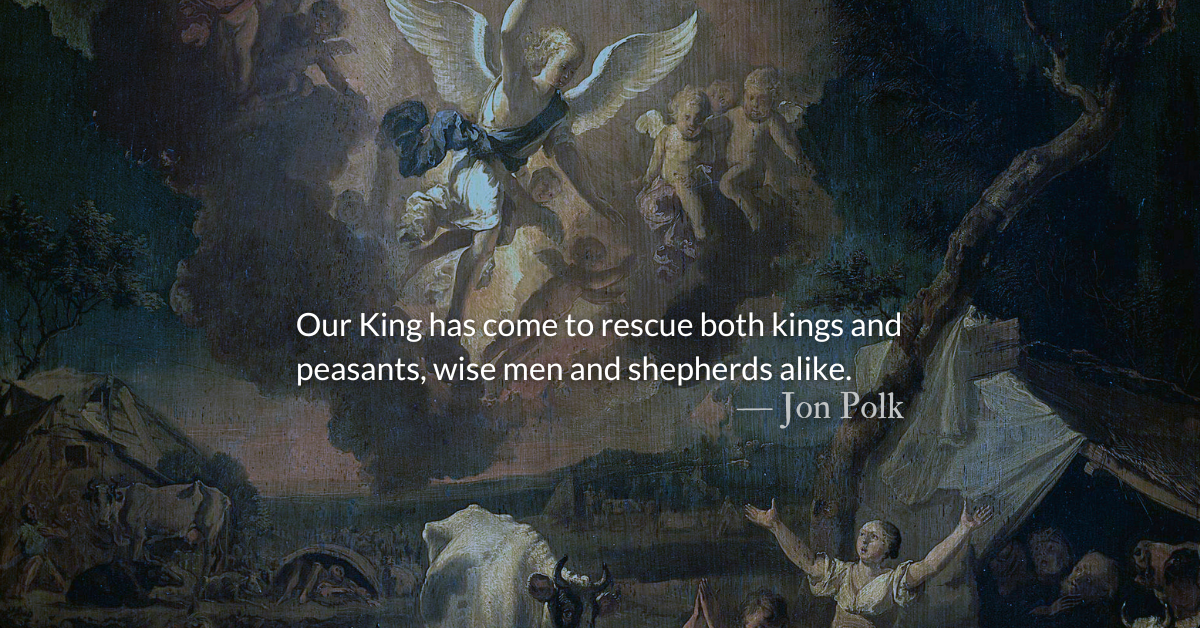
With a symbolic nod to the story of the Magi, the questions of the shepherds are answered, and we are reminded that our King has come to rescue both kings and peasants, wise men and shepherds alike.

So bring Him incense, gold, and myrrh,
Come peasant, king to own Him;
The King of kings salvation brings,
Let loving hearts enthrone Him.

This King, born in a Manger Throne, has come to bring us life, the humble station of his birth reflecting the humiliation of his own death on our behalf.

Nails, spear shall pierce Him through,
The cross be borne for me, for you;

The King of the Universe, born in a filthy cattle trough, worshiped by dirty shepherds. A stark contrast which portends our own transformations when we follow him, much like the spiritual awakening of a humble Anglican businessman inspired him to dedicate his creative talents to hymns which remind the church to continually reflect upon the question, what child is this?

Listen: What Child is This? by Russ Taff
Read:
Lyrics from Hymnary.org

– From The Divine Hours: Prayers for Summertime by Phyllis Tickle.

Today’s Readings
2 Chronicles 21  (Listen 3:25) 
Psalms 123-125 (Listen 1:52)

Read more about Pause To Read
On Pause to Read, a podcast by The Park Forum, we read a devotional from the past year and encourage listeners to pause to read the scripture before continuing to listen to the devotional.

Read more about Supporting Our Work
Continuing and expanding our work requires support from our donors. Consider becoming a donor with an end-of-year one-time gift or as a monthly donor.
Bathsheba’s Story — Love of Advent

Scripture Focus: Matthew 1.1, 6
1 This is the genealogy of Jesus the Messiah the son of David, the son of Abraham:

6 and Jesse the father of King David.
David was the father of Solomon, whose mother had been Uriah’s wife…

Psalm 51.1
1 Have mercy on me, O God,
    according to your unfailing love;
according to your great compassion
    blot out my transgressions.

Reflection: Bathsheba’s Story — Love of Advent
By Erin Newton

These are the matriarchs of Jesus: Tamar, Rahab, Ruth, Bathsheba, and Mary. This is Bathsheba’s story.

Every year on social media, a new debate arises surrounding the culpability of Bathsheba. Some wish to see her as a willing participant in adultery but Matthew’s gospel refers to Bathsheba as Uriah’s wife highlighting the tragedy of what happened to her. When Nathan confronts David about his sin, he compares Bathsheba to an innocent lamb stolen from another man’s flock.

Eyes gazed upon Bathsheba as eyes had fallen upon Tamar and Rahab. She was taken, forcibly widowed, and consecutively mourned the death of her child. Bathsheba’s story begins with sorrow.

Sorrow is a common thread among the stories of these women. For a group of matriarchs of the long-awaited Messiah, you’d expect stories filled with joy and praise. But for many of these women, the stories are full of hardship, grief, and pain. Bathsheba lived with the grief of Uriah’s death. She also mourned the death of her baby.

Bathsheba is not alone in her sorrow. When David recognizes his guilt, he calls upon the love of God for forgiveness. Only divine compassion could heal a heart that took a woman and arranged for her husband’s death.

It has been over three thousand years since Bathsheba lived and her story continues to create havoc and debate. She becomes the scapegoat for anyone looking to blame a victim for her own abuse. She is labeled as a co-conspirator or a seductress—as if readers forget that she was the little ewe lamb of Nathan’s story.

Whether one sees her as a manipulative adulterer or an innocent sexual abuse victim, Bathsheba’s place as an ancestor of Jesus is often diminished or ignored. However, her placement in the genealogy is a coincidence.

God does not sit by aloof to the events of our lives. God redeems our pain.

Bathsheba was a woman of sorrow and of pain. She endured the abuse of power and buried her husband and child. She is misunderstood and misrepresented. But she is a matriarch of Jesus. 

Bathsheba is chosen and honored as one of five women named in Jesus’s family. She is not defined by her sorrow or her once naked body. She does not have to be defined by misrepresentations or skeptical debates.

In the love of Jesus belong the slandered, the misunderstood, and the innocent.

Divine Hours Prayer: The Refrain for the Morning Lessons
Let integrity and uprightness preserve me, for my hope has been in you. — Psalm 25.20

– From The Divine Hours: Prayers for Summertime by Phyllis Tickle.

Today’s Readings
2 Chronicles 16  (Listen 2:51)
Psalms 119.97-120 (Listen 15:14)

Read more about Ancient #MeToo Story
The bold voice of Nathan was needed to bring the king to a place of repentance. Bathsheba deserved an advocate.

Read more about Supporting Our Work
Approximately half our funding comes as end-of-year gifts. Whether once a year or monthly, please consider becoming a donor to support our ad-free biblical devotionals.

Hymn of Hope — Hope of Advent

Scripture Focus: Psalm 116.1-2
1 I love the Lord, for he heard my voice;
he heard my cry for mercy.
2 Because he turned his ear to me,
I will call on him as long as I live.

Reflection: Hymn of Hope — Hope of Advent
By John Tillman

Advent isn’t shy about acknowledging pain and darkness. Advent happens as the world gets darker specifically to remind us that it is into the darkest dark that Jesus came and from the darkest dark that Jesus ignites the light of salvation. Psalm 116 is a lament that never loses sight of salvation’s light and cycles continually back to thankfulness and praise.

Hymn writer Isaac Watts wrote a hymn based on Psalm 116 in 1719. The hymn was later adopted and adapted by African-American churches and the gospel tradition. In 1990, gospel music artist Richard Smallwood wrote new music to the adapted text based on versions he experienced. The work was featured on the soundtrack of the Whitney Houston Christmas film The Preacher’s Wife. The opening phrase closely follows the psalm and Watts’s interpretation.

“I love the the Lord
He heard my cry
And pitied every groan
Long as I live
And troubles rise
I hasten to his throne”
 — I Love the Lord, sung by Whitney Houston on The Preacher’s Wife soundtrack

The psalmist agrees with Watts that troubles rise. The psalmist was “greatly afflicted” and alarmed, saying, “Everyone is a liar,” still, they trusted in the Lord. (Psalm 116.10-11). Death features repeatedly in Psalm 116. The psalmist has been delivered from death to the land of the living. In the end, despite darkness and trouble, the psalmist hastened to the temple courts to give an offering of thanks, praise, and obedience.

Thanksgiving and love are connected to lament. One often leads to another. When we love the Lord, rising troubles lead us to raise laments to God. When we lament, we reflect not only on the suffering of the moment but the salvation of the past. When we remember how good God has been to us and his promises for the future, we respond in hope with thanksgiving.

In this season and every season, no matter what your troubles are, the Lord pities every groan. His Holy Spirit groans with ours when we have no words. (Romans 8.26) Our hope is not only that we can hasten to his temple and throne of mercy but that Jesus hastens to us in response. His Advent brings his presence, compassion, and care.

Reminding ourselves of what Jesus has done and that he hastens to us, we can say, as the psalmist does, “Return to your rest, my soul, for the Lord has been good to you.” (Psalm 116.7)

Divine Hours Prayer: The Refrain for the Morning Lessons
For god, who commanded the light to shine out of darkness, hath shined in our hearts, to give the light of the knowledge of the glory of God in the face of Jesus Christ. — 2 Corinthians 4.6

– From The Divine Hours: Prayers for Summertime by Phyllis Tickle.

Today’s Readings
2 Chronicles 8 (Listen 3:02)
Psalms 116 (Listen 1:34)

Today’s Readings
2 Chronicles 9 (Listen 5:07) Psalms 117-118 (Listen 2:52)
2 Chronicles 10 (Listen 3:01) Psalms 119.1-24 (Listen 1:34)

Read more about What to Expect when Suffering
Don’t be surprised or ashamed of the emotions that come in times of struggle and pain.

Read more about Supporting Our Work
We are thankful for our donors who support ad-free content that brings biblical devotionals to inboxes across the world. Please consider joining them.

From Darkness to Light

Scripture Focus: Psalm 105.23-28
23 Then Israel entered Egypt; 
Jacob resided as a foreigner in the land of Ham. 
24 The Lord made his people very fruitful; 
he made them too numerous for their foes, 
25 whose hearts he turned to hate his people, 
to conspire against his servants. 
26 He sent Moses his servant, 
and Aaron, whom he had chosen. 
27 They performed his signs among them, 
his wonders in the land of Ham. 
28 He sent darkness and made the land dark— 
for had they not rebelled against his words? 

“Do you feel the shadows deepen? We do.” — “Is He Worthy” Andrew Peterson

Reflection: From Darkness to Light
By John Tillman

Psalm 105 tells Israel’s story of moving from light to darkness to light. Joseph goes from favored son to slave and prisoner, then rises to the bright pinnacle of power. Politics turns against Joseph’s immigrant family, and they are cast again into the pit of slavery. Into this darkness, prophets come to work wonders. They bring light to God’s people and darkness to their oppressors in both literal and spiritual ways.

Our planet cycles from light to darkness to light. In Autumn, when the United States “falls back” to Standard Time from Daylight Savings Time, social media floods with complaints. People bemoan how the early evening darkness affects their moods, children, pets, and time to do things after work. I try not to tell people they shouldn’t complain. But I do often point out that complaining about “falling back” is complaining about the world as it really is. 

In the Northern Hemisphere, days slowly shorten following the summer solstice. Night has been creeping up on us most of the summer. Daylight Savings Time pretends to hold the darkness at bay with its gently deceptive trick of the clock. Falling back rips the bandaid off. DST’s deceptively late sunsets disappear. The growing darkness is suddenly more obvious.

In literal and spiritual ways, the world is darkening. Gently deceptive mantras such as “People are basically good” and “One’s environment causes evil, not one’s choices” try to put a bandaid on the darkness. We need the bandaid ripped off to recognize our need for illumination. 

If people are basically good, why is teaching ethics hard? Isn’t “the environment” that causes evil in one person made from another’s evil choices? Evil is real. Darkness comes. We don’t have to live in denial about the darkness, but we also don’t have to despair. 

Sunday is the first Sunday of Advent. Advent tells our story of going through darkness to light. As Advent starts, the darkness is deepening, but we smile, knowing dawn is approaching.

Advent is an anticipation of light entering darkness. God brought light and hope to Israel through Moses, Aaron, and other prophets. They burned imperfectly and briefly, like birthday candles down a well. They were only signs and examples of the one to come.

Jesus plunges himself into our well of darkness, bringing light that is perfect and unextinguishable. May the first dark well he illuminates be our hearts.

Music: “Is He Worthy” Andrew Peterson

Divine Hours Prayer: The Refrain for the Morning Lessons
Our sins are stronger than we are, but you will blot them out. — Psalm 65.3

– From The Divine Hours: Prayers for Summertime by Phyllis Tickle.


Today’s Readings
1 Chronicles 29  (Listen 5:50)
Psalms 105 (Listen 4:02)

This Weekend’s Readings
2 Chronicles 1  (Listen 2:47), Psalms 106 (Listen 4:52)
2 Chronicles 2   (Listen 3:41),  Psalms 107 (Listen 4:12)

Read more about Renamed by God — Hope of Advent
We don’t have to continue in life with the haunting names that fit our histories. New names bring us new hope.

Read more about God In the Dark — Hope of Advent
The first picture of God…On the very first page of scripture…God hovers over dark, chaotic waters…enters creation’s darkness and sparks light and life.

Recentering on Christ

Scripture Focus: Psalm 104.1
1 Praise the Lord, my soul.
Lord my God, you are very great;
    you are clothed with splendor and majesty.

Reflection: Recentering on Christ
By John Tillman

The psalms are more than instructions and more than inspiration. They are not dry diaries or droning histories, but the living, breathing faith of those interacting with the Holy Spirit. 

Their artistry allows us to enter the prayer room and experience both sides of a holy conversation between human artists and the creator of all. Their art is most practical for those who are seeking God in a world connected by technology. Work, news, and ephemera, now know no boundaries and pop into our hand-held devices unbidden.  

Jonathan Edwards, when in difficulty at work, made use of the scripture, of intercession, and of community to recenter himself on Christ. He describes the experience in the following journal entry:

“In the morning my desires seemed to rise, and ascend up freely to God. Was busy most of the day in translating prayers into the language of the Delaware Indians; met with great difficulty… But though I was much discouraged with the extreme difficulty of that work, God supported me; and especially in the evening gave me sweet refreshment.

In prayer my soul was enlarged, and my faith drawn into sensible exercise; was enabled to cry to God for [them]; and though the work of their conversion appeared impossible with man, yet with God I saw all things were possible.

My faith was much strengthened, by observing the wonderful assistance God afforded his servants Nehemiah and Ezra, in reforming his people, and re-establishing his ancient church.

I was much assisted in prayer for dear Christian friends, and for others that I apprehended to be Christ-less… [I] was enabled to be instant in prayer for them; and hoped that God would bow the heavens and come down for their salvation. It seemed to me there could be no impediment sufficient to obstruct that glorious work, seeing the living God, as I strongly hoped, was engaged for it.

I continued in a solemn frame, lifting up my heart to God for assistance and grace, that I might be more mortified to this present world, that my whole soul might be taken up continually in concern for the advancement of Christ’s kingdom. Continued in this frame until I dropped asleep.”


Divine Hours Prayer: The Request for Presence
Teach me your way, O Lord, and I will walk in your truth; knit my heart to you that I may fear your Name. — Psalm 86.11

– From The Divine Hours: Prayers for Summertime by Phyllis Tickle.


Today’s Readings
1 Chronicles 28  (Listen 4:45)
Psalms 104 (Listen 3:37)

Read more about Supporting Our Work
Please consider becoming a donor. Support ad-free content that brings biblical devotionals to inboxes across the world.

#Giving #SupportOurWork

Read The Bible With Us

It’s never too late to join our Bible reading plan. Immerse in the Bible with us at a sustainable, two-year pace.

https://mailchi.mp/theparkforum/m-f-daily-email-devotional

Show Buttons
Hide Buttons
Spur a spiritual rhythm of refreshment right in your inbox
By joining this email list you are giving us permission to send you devotional emails each weekday and to communicate occasionally regarding other aspects of the ministry.
100% Privacy. We don't spam.