Hello, Darkness, My Only Friend?

Links for today’s readings:

May 7  Read: Micah 7 Listen: (3:36) Read: Psalms 88 Listen: (1:58)

Scripture Focus: Psalm 88.18

18 You have taken from me friend and neighbor— 
darkness is my closest friend.

Reflection: Hello, Darkness, My Only Friend?

By John Tillman

Many psalms of lament have a “turn.” They pivot toward hope, toward praise, or hint at a coming salvation. Not Psalm 88.

Psalm 88’s only glimmer of light is in verse one, and it descends into darkness from there. The poet holds a gloomy course, turning neither to the right nor to the left. The poem’s last word is “utter darkness.”

Resist the urge to “fix” Psalm 88. Stop looking for the bright side. Don’t manufacture what isn’t there. The psalmist doesn’t need cheering up. We shouldn’t sing, with insensitivity, “songs to a heavy heart.” (Proverbs 25.20) This darkness has lessons. Like its author, we need to sit in it for a while.

One reason to sit in this darkness is that there will be a time that darkness covers you. We need to learn endurance in the dark. We need to learn to pray in the dark. We need to toughen our faith against times of testing.

Study the psalmist’s cries in the dark as a model. Cry out, based on God’s identity as “the God who saves.” (v. 1) Cry out expecting God to hear. (v. 2) Cry out consistently and persistently. (v. 9) Cry out honestly. Hold no grievance back. (v.6-9, 10-12, 14-17)

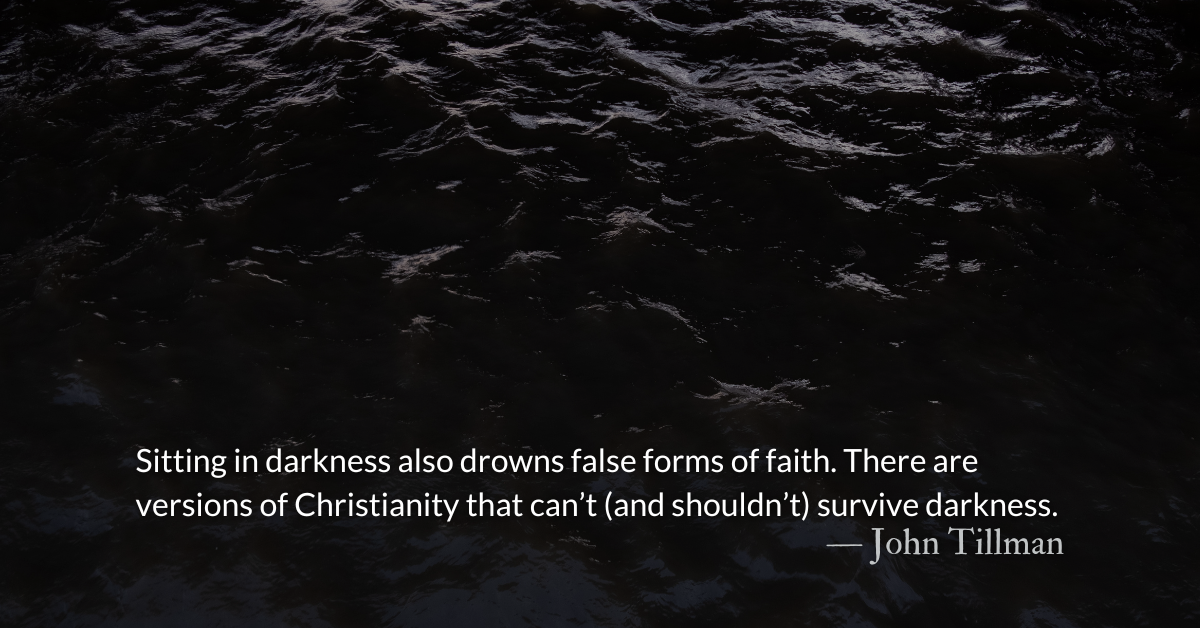
Sitting in darkness also drowns false forms of faith. There are versions of Christianity that can’t (and shouldn’t) survive darkness.

There is a version of Christianity that thinks the faithful shouldn’t suffer. There is a version of Christianity that markets miracles, victory, success, and “winning.” There is a version of Christianity that manufactures grievances and claims persecution in a culture war when all they’ve ever faced is the consequences of their prideful actions (1 Peter 2.20; 3.17; 4.15-17). Psalm 88’s darkness lands like a sledgehammer, shattering these trite, toxic, and worthless forms of faith. Leave the shattered pieces where they lie.

Even when causes of dark times are evil or intended for evil, God can use darkness for good (Genesis 50.20). Darkness can be a teacher to us, strengthening our faith and disciplines. Darkness can be a surgeon to us, cutting out cancers of trite, cheap, and toxically positive Christianity. In these ways, darkness, even that intended for evil, can be an unexpected and unintentional friend. (Psalm 88.18)

Don’t rush through darkness without learning from it but never forget that we don’t belong there. One way or another, in this life or the next, God will rescue us, bringing us into the light.

Divine Hours Prayer: A Reading

Jesus taught us, saying: “Can you not buy two sparrows for a penny? And yet not one falls to the ground without your Father knowing. Why, every hair on your head has been counted. So there is no need to be afraid; you are worth more than many sparrows.” — Matthew 10:29–31

– From The Divine Hours: Prayers for Springtime by Phyllis Tickle

Read more: Equally Skilled Hands

In most individuals, one hand is more skilled than the other…Micah says both hands of his nation and their leaders are equally skilled at wickedness.

Read more: Admit the Dark

In order to hope in the light, we first have to notice and confess that we live in the dark.
Meditation in Spiritual Rhythm :: Readers’ Choice

Selected by reader, Jennifer K, Brooklyn, NY
“Meditation is not new to Christianity, but it has often been forgotten on the shelf,” what a beautiful statement to read as a Christian and daily meditator. Prayer and meditation go hand in hand with my spiritual practice, truly a spiritual rhythm. Thank you for this edition that speaks volumes to my soul!

Scripture Focus: Psalm 88.1-2
Lord, you are the God who saves me;
day and night I cry out to you.
May my prayer come before you;
turn your ear to my cry.

Reflection: Meditation in Spiritual Rhythm :: Readers’ Choice
Originally published October 4th, 2018
By John Tillman

As Thomas Merton poetically wrote about humanity, “He is the saddest animal. He drives a big red car called anxiety.”

Meditation is a breathing apparatus to help us survive in a poisonous atmosphere polluted by anxiety and fear.

Meditation is not new age, but old. However, in the modern age, it has often been forgotten on the shelf as many Christians and Christian leaders followed our culture into frenetic clamor instead of leading our culture from a place of peace and rest.

Today we look back a few hundred years or so, to a collection of thoughts on meditation that were not considered radical or strange in their time, but simply a prudent, practical, and effective Christian discipline.

George Müller (1805-1898)
Now what is food for the inner man? Not prayer, but the Word of God; and here again, not the simple reading of the Word of God, so that it only passes through our minds, just as water passes through a pipe, but considering what we read, pondering over it and applying it to our hearts.

This exercise of the soul can be most effectively performed after the inner man has been nourished by meditation on the Word of God, where we find our Father speaking to us, to encourage us, to comfort us, to instruct us, to humble us, to reprove us. We may therefore profitably meditate with God’s blessing though we are ever so weak spiritually; nay, the weaker we are the more we need meditation for the strengthening of our inner man.

Richard Baxter (1615-1691)
Nor should we imagine it will be as well to take up with prayer alone, and lay aside meditation; for they are distinct duties, and must both of them be performed. We need the one as well as the other, and therefore we shall wrong ourselves by neglecting either. Besides, the mixture of them, like music, will be more engaging; as the one serves to put life into the other. And our speaking to ourselves in meditation, should go before our speaking to God in prayer.

William Bridge (1600-1670)
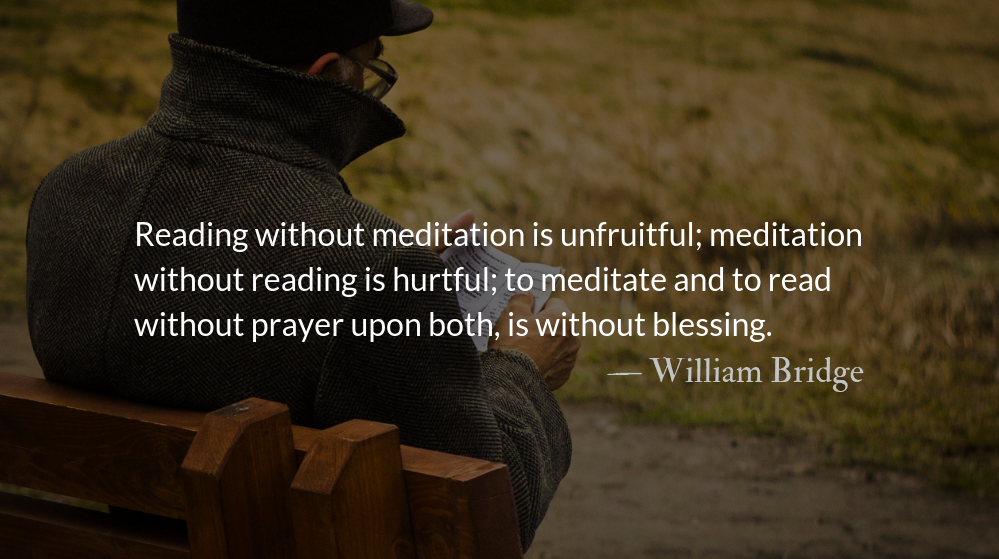
Begin with reading or hearing. Go on with meditation; end in prayer…Reading without meditation is unfruitful; meditation without reading is hurtful; to meditate and to read without prayer upon both, is without blessing.

From these writings and ones like them, we draw a pattern, a spiritual rhythm, that we want to promote for all our readers: Read, reflect, pray…repeat.

Divine Hours Prayer: The Call to Prayer
Let the Name of the Lord be blessed, from this time forth for evermore.
From the rising of the sun to its going down let the Name of the Lord be praised. — Psalm 113.2-3

– From The Divine Hours: Prayers for Summertime by Phyllis Tickle.

Today’s Readings
Judges 19 (Listen – 4:52) 
Acts 23 (Listen – 5:15)

Thank You!
Thank you to our donors who support our readers by making it possible to continue The Park Forum devotionals. This year, The Park Forum audiences opened 200,000 free, and ad-free, devotional content. Follow this link to join our donors with a one-time or a monthly gift.

Submit a Readers’ Choice
Let our community hear about your faith. What post refreshed your relationship with God?

Read more about The Practice of Meditation :: Tea
Christian meditation does not seek emptiness, but fullness. We do not seek unconscious, impersonal revelation, but personal revelation from a conscious and communicative God.

Show Buttons
Hide Buttons
Spur a spiritual rhythm of refreshment right in your inbox
By joining this email list you are giving us permission to send you devotional emails each weekday and to communicate occasionally regarding other aspects of the ministry.
100% Privacy. We don't spam.