Hope Born on the Cross

Scripture: Galatians 5.5-6
For through the Spirit we eagerly await by faith the righteousness for which we hope…The only thing that counts is faith expressing itself through love.

Scripture: Luke 23.42
Then he said, “Jesus, remember me when you come into your kingdom.”

Reflection: Hope Born on the Cross
By Matt Tullos

Hope: When we look toward the constructs of eternity and find our true selves apart from our feeble flesh.

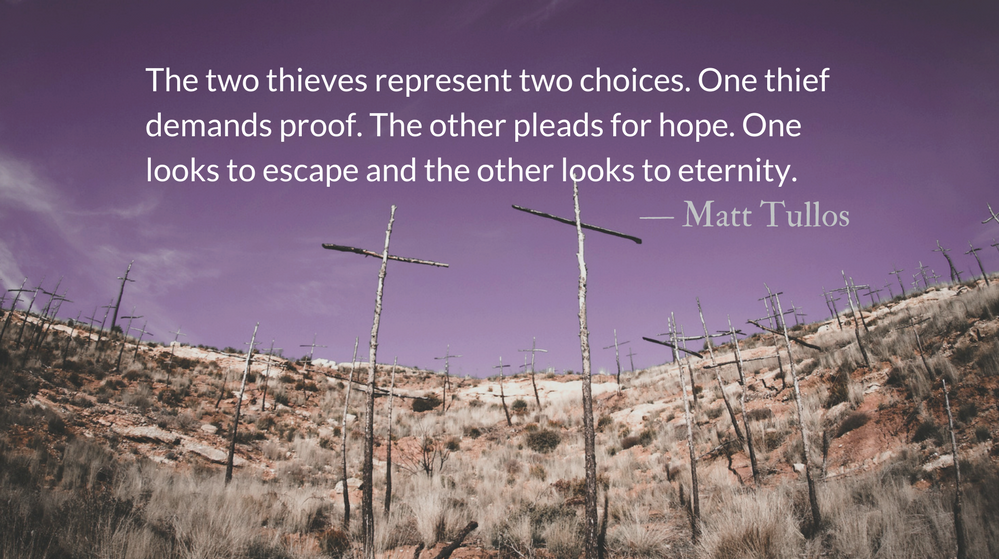
The two thieves represent two choices. One thief demands proof. The other pleads for hope. One looks to escape and the other looks to eternity. These choices stand as constant reminders that the cross of Christ demands a response.

Hope is personal. Very personal. Whether through worship, adversity, desperation or pain, we collide into the reality that our only hope is Jesus.

We can’t hope eternally in friends. Friends will fail us.

We can’t hope in institutions. Institutions over the course of eternity will evaporate like the ephemeral mist of the morning dew.

We can’t hope in hidden treasures. All treasures, short of grace, are water through our fingers.

We can’t hope in flowery platitudes because there will be a day when they will all wilt upon the parched, unforgiving soil of our brokenness.

Our hope is in the One who suffers next to us and says, “Today, you will be with me in paradise.” This glimpse of the cross reflects the absolute power of grace to snatch anyone from the jaws of destruction.

Was there anything the thief could do? Absolutely nothing. He couldn’t start a small group, feed the poor, go to the synagogue or study the scriptures. He found himself at the end of his life and the only thing he could do was to confess his sin and cry out to Jesus.

Hope is the word which God has written on the brow of every man.
— Victor Hugo

Hope was born on the cross.
Because hope was born we don’t have to be ashamed because he bore our shame.
Because hope was born we don’t have to constantly obsess about whether we could be good enough because He is our righteousness.
Because hope was born we are free.
Because hope was born we have purpose.
Because hope was born we are going to be okay.
And that’s worth celebrating!

Celebrate this scene of the darkest day! Grace rules even when we have no more time. Grace ruled the day then and now.

Have you ever felt like God has forgotten you?
What do you hope God will restore in your family, your heart, your church or your life?
Where is your hope waning?

*From a series Matt Tullos wrote called 39 Words. A few of these posts are available in audio form via Soundcloud. — John

On March 19, churches around the world celebrate the life of Saint Joseph, descendant of King David and earthly father of Christ our Lord. We honor and wish by Christ’s grace to emulate him for his obedience, constancy, and protection of the Holy Family.

Prayer: The Morning Psalm
Your love, O Lord, forever will I sing; from age to age my mouth will proclaim your faithfulness. For I am persuaded that your love is established forever… — Psalm 89.1-2

– Prayer from The Divine Hours: Prayers for Springtime by Phyllis Tickle.

Full prayer available online and in print.

Today’s Readings
Proverbs 6 (Listen – 3:22)
Galatians 5 (Listen – 3:22)

Surrender

Scripture: Galatians 2.20
I have been crucified with Christ and I no longer live, but Christ lives in me. The life I now live in the body, I live by faith in the Son of God, who loved me and gave himself for me.

Reflection: Surrender
By Matt Tullos

Surrender: The releasing of every solution, tool, and self-saving strategy.

Jesus walked to the cross in total surrender.

He explained it this way: “No one is taking it from me; I lay it down of my own free will. I have the authority to lay it down, and I have the authority to take it back again. This is what my Father has commanded me.”
John 10:18 (HCSB)

There has always been a controversy around who killed Jesus. But Jesus was clear. He gave up His life as an offering. As we remember the brutal account of Jesus’ death, He invites us to see the cross as an embraced undertaking.

We are His prize and He snatched us away from the enemy through the brutality of an unthinkable surrender. He loved us enough to engage himself in a 33 year passage toward an unspeakable end.

In this act we see how real love works and He is inviting us to enter this story, to live, die, and live again. When we live like Jesus, life is ever before us as an opportunity to surrender everything. What does that look like for you? Only Jesus knows and He will reveal it to you soon enough.

Arise – go! Sell all you possess. Give it directly, personally to the poor. Take up My cross (their cross) and follow Me, going to the poor, being poor, being one with them, one with Me.
Little – be always little! Be simple, poor, childlike.
Preach the Gospel with your life – without compromise! Listen to the Spirit. He will lead you…
Do little things exceedingly well for love of Me.
Love… love… love, never counting the cost
Go into the marketplace and stay with Me. Pray, fast. Pray always, fast.
Be hidden. Be a light to your neighbor’s feet. Go without fear into the depth of men’s hearts. I shall be with you. Pray always.
I will be your rest.
— Catherine Doherty’s Little Mandate

The image of the cross is an image of absolute surrender.

When we enter into the story of Christ we see a point in time when we cannot use our hands to control anything. Our will, determination, ambition, and skill are nailed to the holy cross of Christ. While the world’s system teaches us how to control others and change ourselves, the cross has no such purpose. On the cross, our hands are not busy. They are surrendered.

The cross compels us to die to that old foe that the world calls “a self-made man.” Everything that feeds our own power, pride, ego, and self-determination has to go. It simply must. God is not improved by our efforts. He is glorified by our surrender.

When absolute and complete surrender takes hold of you, you will experience the bliss of satisfaction in Him. Whatever you have or don’t have… it wholly means nothing when you have given it all to Him. You live. You breathe. You worship. You give.
This is enough.

Survey the state of your heart. What things inside stand as barriers between you and God’s complete possession of all that you are?

*From a series Matt Tullos wrote called 39 Words. A few of these posts (including today’s) are available in audio form via Soundcloud. — John

Prayer: The Request for Presence
Send out your light and your truth, that they may lead me, and bring me to your holy hill and to your dwelling. — Psalm 43.3

– Prayer from The Divine Hours: Prayers for Springtime by Phyllis Tickle.

Full prayer available online and in print.

Today’s Readings
Proverbs 3 (Listen – 3:05)
Galatians 2 (Listen – 3:44)

This Weekend’s Readings
Proverbs 4 (Listen – 2:37) Galatians 3 (Listen – 4:39)
Proverbs 5 (Listen – 2:08) Galatians 4 (Listen – 4:13)

What Slavery We Choose :: Throwback Thursday

Scripture: Galatians 1.10
Am I now trying to win the approval of human beings, or of God? Or am I trying to please people? If I were still trying to please people, I would not be a servant of Christ.

Reflection: What Slavery We Choose :: Throwback Thursday
By Richard Baxter (1615-1691)

Consider what slavery you choose, when you make yourselves the servants of every person, whose censures you fear, and whose approbation you are ambitious of. “You were bought at a price; do not become slaves of human beings.” Do not needlessly enthral yourselves.

What a task have people-pleasers! They have as many masters as beholders! No wonder it takes them from the service of God. For the “friendship of the world is enmity to God” and “anyone who chooses to be a friend of the world becomes an enemy of God.” (James 4.4)

They cannot serve two masters, God and the world. You know people will condemn you, if you be true to God. If, therefore, you must have the favor of people, you must take it alone without God’s favor.

A people-pleaser cannot be true to God because he is a servant to the enemies of his service to God. The wind of a person’s mouth will drive him about as the chaff—from any duty, and to any sin.

How servile a person is a people-pleaser! How many masters he has, and how mean ones! It perverts the course of your hearts and lives, and turns all from God to this unprofitable way.

Remember what a pitiful reward you seek. Jesus said, concerning hypocrites and people-pleasers, “they have their reward.” O miserable reward! The thought and breath of mortal people! Instead of God—instead of Heaven—this is their reward!

Their happiness will be to lie in hell, and remember that they were well spoken of on earth—that once they were counted religious, learned, wise, or honorable, and to remember that they preferred this reward before everlasting happiness with Christ!

If this is not gain, your labor is all lost, which you lay out in hunting for applause. If this is enough to spend your time for, and to neglect your God for, and to lose your souls for, rejoice then in the hypocrite’s reward.

*Abridged and language updated from Directions against Idolizing Man.

Prayer: The Request for Presence
Send out your light and your truth, that they may lead me, and bring me to your holy hill and to your dwelling. — Psalm 43.3

– Prayer from The Divine Hours: Prayers for Springtime by Phyllis Tickle.

Full prayer available online and in print.

Today’s Readings
Proverbs 2 (Listen – 1:53)
Galatians 1 (Listen – 3:05)

Praying for Political Leaders

First of all, then, I urge that supplications, prayers, intercessions, and thanksgivings be made for all people, for kings and all who are in high positions. — 1 Timothy 2.1–2

“You don’t actually need a regression analysis to see that hate, not love, is driving the changes in American politics,” writes Ezra Klein. The (well documented) deep divides between political parties in the U.S. have grown at alarming rates.

When people are caught in a system dominated by hate there is an opportunity for Christians to participate in redemption. The preponderance of brokenness in our world today, both foreign and domestic, should drive us to prayer with extraordinary vigor. Yet we are often reticent to get involved in politics.

N.T. Wright, commenting on why the New Testament needs a command to spur Christians toward praying for political leaders and those under their rule, explains:

For many Christians today, particularly those who (like me) have grown up in the Western world and have never known war or major civil disturbance in our own country, this often seems quite remote…. Yes, we’d like our politicians to use our tax money more effectively, we grumble about some of their policies, but what they do doesn’t drive us to our knees to pray for them, to beseech God to guide them and lead them to create a better world for us all to live in.

Many Christians who are reasonably content with their country are tempted to think that praying for kings and governments is a rather boring, conformist thing to do. It looks like propping up the status quo.

Far from seeing prayer as the easy way out, Scripture challenges us to hold it as the most complex, efficacious, and important thing to which we can give ourselves.

Where we know victims by name we can bring them before God. Where we know of great needs, pain, or injustice without knowing any of the victims or leaders serving them, by name, we can repent. Wright concludes:

In the New Testament, the call to prayer is also the call to think: to think clearly about God and the world, and God’s project for the whole human race. Don’t rest content with the simplistic agendas of the world that suggest you should either idolize your present political system or be working to overthrow it. Try praying for your rulers instead, and watch not only what God will do in your society but also how your own attitudes will grow, change and mature.

Today’s Reading
Proverbs 31 (Listen – 2:50)
1 Timothy 2 (Listen – 1:38)

Grace for the Future

But I received mercy for this reason, that in me, as the foremost, Jesus Christ might display his perfect patience as an example to those who were to believe in him for eternal life. — 1 Timothy 1.16

The grace of God, Søren Kierkegaard explains, “is applied in such a way that one sinks deeper and deeper so as to require continually more and more grace.” This progression from sin to grace, to more grace, is the message of 1 Timothy 1.

Yesterday we read, “Christ Jesus came into the world to save sinners, of whom I am the foremost.” Today our minds focus on, “mercy for this reason,” and “perfect patience.” Kierkegaard explains:

Consider a person who is conscious of his guilt and offense. For a long time he goes about in quiet despair and remorsefully broods over it. Then he learns to flee to grace, and he is forgiven everything; everything is infinitely forgiven.

But, the moment he shuts the door of grace, as it were, and goes out full of holy resolve to begin a new life, alas, blissfully stirred by the thought that now all is forgiven and he will never get into that situation again, that very same minute, that very same second, he is on the way to new guilt—in the form of “the best he can do.”

In that same moment he must return again and knock on the door of grace. He must say: Oh, infinite grace, have mercy on me for being here again so soon and having to plead for grace. Now I understand that in order to have peace and rest, in order not to perish in hopeless despair, in order to be able to breathe, and in order to be able to exist at all, I need grace not only for the past but grace for the future.

God’s grace isn’t the light switch that activates independence, but the very power that lights the house. His grace is made perfect in weakness—his mercy shines brightest in the dark. Christians have seen what lies on the inside, and instead of becoming lost in despair, we find our rest in future grace. Kierkegaard concludes:

The difference between an unbeliever and a Christian is not that the latter is without sin. The difference is how he regards his sin and how he is kept in the striving…. The Christian has a Savior…. Bold confidence is not necessarily irresponsibility, but a trusting in grace.

Today’s Reading
Proverbs 30 (Listen – 3:51)
1 Timothy 1 (Listen – 2:59)