Authority Check

What has this year in the scriptures meant to you? Would you mind telling us?

  • How has your prayer life changed?
  • What passages surprised you with new meaning or relevance?
  • What passages did you read for the first time, or did you see a new detail you never noticed?
  • What passages came into your inbox at just the time in the year when you needed them?

We’d love to know how God spoke to you through the scriptures this year. Drop a note to info@theparkforum.org and put “2025 Scripture Reflection” in the subject line.

Links for today’s readings:

Jan 2  Read: Job 2 Listen: (2:11) Read: John 2 Listen: (3:02)
Jan 3  Read: Job 3 Listen: (2:32) Read: John 3 Listen: (4:41)
Jan 4  Read: Job 4 Listen: (2:06) Read: John 4 Listen: (6:37)

Scripture Focus: John 2.16-22

16 To those who sold doves he said, “Get these out of here! Stop turning my Father’s house into a market!” 17 His disciples remembered that it is written: “Zeal for your house will consume me.”  18 The Jews then responded to him, “What sign can you show us to prove your authority to do all this?” 19 Jesus answered them, “Destroy this temple, and I will raise it again in three days.” 20 They replied, “It has taken forty-six years to build this temple, and you are going to raise it in three days?” 21 But the temple he had spoken of was his body. 22 After he was raised from the dead, his disciples recalled what he had said. Then they believed the scripture and the words that Jesus had spoken.

Reflection: Authority Check

By John Tillman

When you abuse authority, and someone starts setting things right, it feels like they are attacking your authority. This feeling is a lie. You betrayed the authority’s giver by your abuse, and your authority lost validity.

When you give authority for something to be done in your name, and someone does it in a way that misrepresents you, anger is justified. Their actions told a lie about you, slandering your name in public.

In the accounts of Jesus cleansing the temple, the religious leaders have abused their authority. Jesus is the authority-giver and the one setting things right. This is what fuels the “zeal” Jesus displayed.

The religious leaders had authority to protect the sanctity of the temple courts and keep temple worship practices uncorrupted. Yet, in slipped commerce. In slipped goods. In slipped greed. In slipped corrupt banking practices, inflated exchange rates, and merciless price gouging. This probably happened as most corruption does, little by little, with lots of self-justifying logic.

But Jesus was not only angry about what slipped in. He was angry about who got pushed out. The noisy, messy commerce took up space designated for prayer. Instead of prayers to God, there was haggling about animals. Instead of souls seeking forgiveness before God, harried shoppers searched for the best animal they could afford.

This corruption also took up space for outcasts and foreigners. The very purpose of the Abrahamic blessing was for his family to bless all the nations. (Genesis 26.4) God said to the nations through Isaiah, “Turn to me and be saved, all you ends of the earth; for I am God, and there is no other.” (Isaiah 45.22) But if nations turned up, they’d probably be turned off. The court designated for them was a filthy, noisy, corrupt market.

The state of the temple court told lies about God. Prayers for a price! God blesses those who can afford it! There’s no room for your kind to pray here; move along!

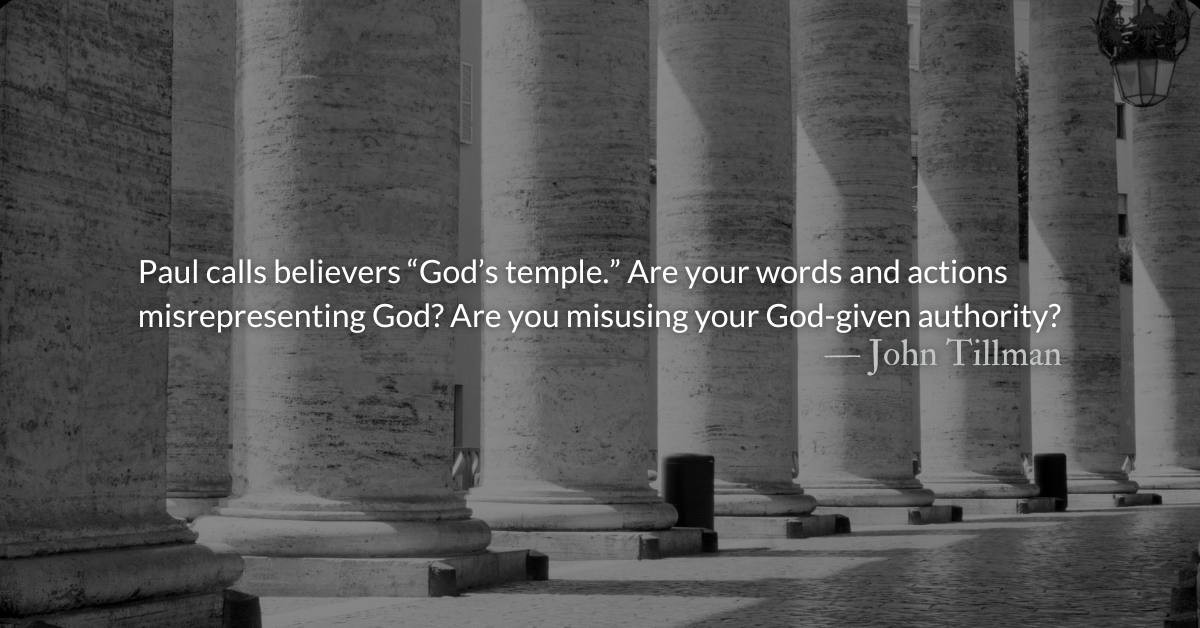
What is the state of your temple court? I’m not primarily talking about your church, unless you are a leader and have authority there. Paul calls believers “God’s temple.” (1 Corinthians 3.16-17) Are your words and actions misrepresenting God? Are you misusing your God-given authority?

At this time of renewal, run an authority check and let zeal for God’s temple consume you. May godly zeal fuel a renovation of your representation of God’s “temple.”

Divine Hours Prayer: A Reading

“Every year his parents used to go to Jerusalem for the feast of Passover. When he was twelve years old, they went up to the feast as usual. When the days of the feast were over and they set off home, the boy Jesus stayed behind in Jerusalem without his parents knowing it. They assumed he was somewhere in the party, and it was only after a day’s journey that they went to look for him among their relations and acquaintances. When they failed to find him they went back to Jerusalem looking for him everywhere. It happened that, three days later, they found him at the Temple, sitting among the teachers, listening to them, and asking them questions; and all those who heard him were astounded at his intelligence and his replies. They were overcome when they saw him, and his mother said to him, ‘My child, why have you done this to us? See how worried your father and I have been, looking for you.’ He replied, ‘Why were you looking for me? Did you not know that I must be in my Father’s house?’ But they did not understand what he meant. He went down with them then and came to Nazareth and lived under their authority. His mother stored up all these things in her heart. And Jesus increased in wisdom, in stature, and in favor with God and with people. — Luke 2.41-52

– From The Divine Hours: Prayers for Autumn and Wintertime by Phyllis Tickle.

Read more: From Your Nothing…Something Beautiful

How has your past year gone? Are you, like the wedding host, staring down scarcity? Are you hovering over deep waters of disappointment?

Read The Bible With Us

We are restarting our two-year journey through the scriptures. Won’t you ask someone to join in this adventure?


https://mailchi.mp/theparkforum/m-f-daily-email-devotional

From Your Nothing…Something Beautiful

Scripture Focus: John 2.6-11
6 Nearby stood six stone water jars, the kind used by the Jews for ceremonial washing, each holding from twenty to thirty gallons. 

7 Jesus said to the servants, “Fill the jars with water”; so they filled them to the brim. 

8 Then he told them, “Now draw some out and take it to the master of the banquet.” 

They did so, 9 and the master of the banquet tasted the water that had been turned into wine. He did not realize where it had come from, though the servants who had drawn the water knew. Then he called the bridegroom aside 10 and said, “Everyone brings out the choice wine first and then the cheaper wine after the guests have had too much to drink; but you have saved the best till now.” 

11 What Jesus did here in Cana of Galilee was the first of the signs through which he revealed his glory; and his disciples believed in him. 

Genesis 1.1-2
1 In the beginning God created the heavens and the earth. 2 Now the earth was formless and empty, darkness was over the surface of the deep, and the Spirit of God was hovering over the waters. 

Reflection: From Your Nothing…Something Beautiful
By John Tillman

I recently came across a video by Dr. Darrell Johnson. In it, Dr. Johnson explains why turning the water into wine is, in his opinion, the most miraculous thing done by Jesus that is surpassed only by his resurrection.

What about feeding the 5,000? What about raising Lazarus? Well, as Dr. Johnson explains, when he fed the 5,000 he only multiplied what was there and when he raised the dead he only reanimated what was there. In the miracle of the water into wine, he demonstrated that he can create something from nothing.

I have, in the past, wondered why John, who only chose seven miraculous signs to testify to Jesus’ divinity, would spend one of his seven choices on the wine at the wedding. I thought perhaps John wanted to start small. But Dr. Johnson has made me reconsider that. 

John opened his gospel with a poetic description of Jesus, the Word, as a participant in the creation of the world—that “through him, all things were made.” (John 1.1-3) In Genesis, the “nothing” from which God created the world was “formless and empty” water. The Spirit of God hovered over this empty and formless deep sea and John testifies that Jesus was there.

The biblical authors, including John, didn’t have a concept of “nothing” that was formed, as ours has been, by space travel. To them, the vacuum of space was the open ocean, and “nothing” meant the formless, useless, shapeless, chaos of the deep waters.

Perhaps John remembered and related this story specifically because it places Jesus once again hovering over deep pools of “nothing” and turning them into something.

How has your past year gone? Are you, like the wedding host, staring down scarcity? Are you hovering over deep waters of disappointment? When you look for meaning or achievements, do you see only formless, useless, shapeless, chaos, like the shifting waves of the deep ocean?

Give your scarcity, your vacuum, your chaotic, shapeless, formless fears and failures of the past to Jesus. Sense him hovering over them with you. From your nothing, Jesus can make something beautiful.

The water became the finest wine that brought joy to the heart. What will your “nothing” become? What it will be can only be known by following him. Join us in following him. And bring someone with you.

Divine Hours Prayer:
Proclaim with me the greatness of the Lord; let us exalt his name together. — Psalm 34.3

Today’s Readings
Genesis 2 (Listen 3:42
John 2 (Listen 3:02)

Read more about Supporting Our Work
Please consider becoming a one-time or monthly donor! Support ad-free content that brings biblical devotionals to inboxes across the world.

Read more about Reading The Bible With Us
Immerse in the Bible at a sustainable, two-year pace, with time for reflection and growth from each day’s passage.
https://mailchi.mp/theparkforum/m-f-daily-email-devotional

Where is the Love?

Scripture Focus: John 2.15
So he made a whip out of cords, and drove all from the temple courts, both sheep and cattle; he scattered the coins of the money-changers and overturned their tables.

From John: In preparing/rewriting this repost from 2019, I was reminded that there are tables that need to be kicked over, not just in our individual lives but in our society, in our culture, and in our churches. May we let Jesus do so.

“There’s a love that’s still turning over tables
And a love making blinded eyes see
There’s a healing that’s waiting in the water
That’s still making saints out of rebels
My God is still making good trouble”

Music: “Good Trouble” written by Leigh Nash, Ruby Amanfu and Matt Maher


Reflection: Where is the Love?
By John Tillman

John’s account of the cleansing of the Temple is the most violent, showing Jesus making a weapon and wielding it. It’s probably why we don’t read it as often. It’s unsettling to see Jesus this way.

Jesus, the tender shepherd, whip in hand, panics the flocks and scatters them in chaos. Jesus the gentle carpenter, builder of tables and furniture, is kicking them over.

The detail of making the whip is important. Because Jesus takes the time to make a weapon we know he isn’t losing his temper or acting in rage. It is premeditated. He chose this fight and prepared for it.

In my acting work, I have often used a script analysis technique from Michael Shurtleff’s book Audition, in which one looks for the love in every scene. Even scenes of violence and tumult are better understood once you find the love and understand what the characters are fighting for.

The testimony of the disciples tells us there is zeal, passion, love. But it is still hard for us to find amidst the chaos. Where is the love in this scene? Who does Jesus love? Who or what is he fighting for?

We find a clue when Jesus answers the religious authorities’ challenge by predicting his own death and resurrection. How does his death and resurrection relate to the love in the scene? For whom is he dying and how is it connected to the Temple cleansing?

The Temple represented God’s connection, his relationship, with the people of Israel. If Jesus was fighting for you to be able to reach him, what obstacle would he have to kick over? What have you placed in the way?

In this same chapter, John tells us that Jesus knows people. He knows we are as untrustworthy as the religious leaders in this scene, yet, he sacrifices for us. He knows we will mess up the Temple, our relationship with him, again and again, but he will just keep coming back to fight for us. Why? Because of His passion. Because of His zeal. Because of His love for us.

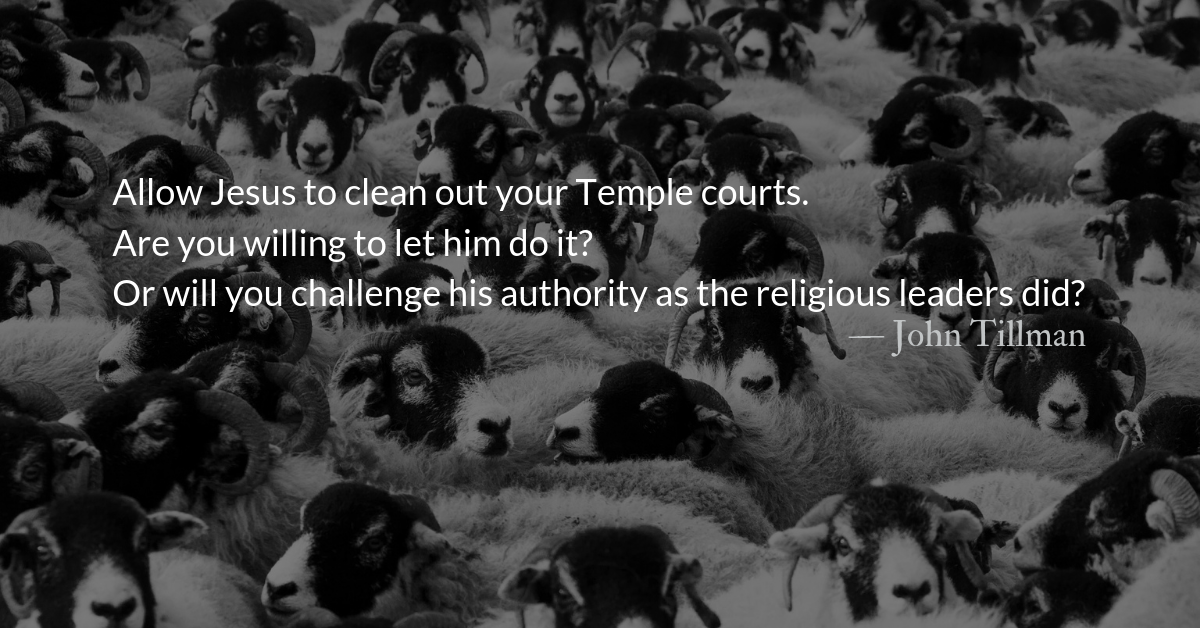
During this Lenten season, allow Jesus to clean out your Temple courts. Ask Jesus what needs to change so that you can better connect with God. Are you willing to let him do it? Or will you challenge his authority as the religious leaders did?

Thank Jesus for caring enough about you to keep kicking over your tables and cleaning up your mess.

Divine Hours Prayer: The Small Verse
Today if you shall hear his voice, harden not your heart.

– Divine Hours prayers from The Divine Hours: Prayers for Springtime by Phyllis Tickle

Today’s Readings
Exodus 23 (Listen – 4:44)
John 2 (Listen – 3:02)

This Weekend’s Readings
Exodus 24 (Listen – 2:48), John 3 (Listen – 4:41)
Exodus 25 (Listen – 4:20), John 4 (Listen – 6:37)

Read more about Setting a New Standard
Many scholars believe that Jesus cleansed the temple of buyers and sellers repeatedly—every time he visited Jerusalem.

Read more about Christ Our Temple, River, and City
Perhaps the temple Ezekiel sees is the same one Christ told the Pharisees could be destroyed and rebuilt in three days…Christ himself is our temple.

Where is the Love?

John 2.15
So he made a whip out of cords, and drove all from the temple courts, both sheep and cattle; he scattered the coins of the money changers and overturned their tables.

Reflection: Where is the Love?
By John Tillman

John’s account of the cleansing of the Temple is the most violent, showing Jesus making a weapon and wielding it. It’s probably why we don’t read it as often. It’s unsettling to see Jesus this way.

Jesus, the tender shepherd, whip in hand, panics the flocks and scatters them in chaos. Jesus the gentle carpenter, builder of tables and furniture, is kicking them over.

The detail of making the whip is important. Because Jesus takes the time to make a weapon we know he isn’t losing his temper or acting in rage. It is premeditated. He chose this fight and prepared for it.

In my acting work I have often used a script analysis technique from Michael Shurtleff’s book Audition, in which one looks for the love in every scene. Even scenes of violence and tumult are better understood once you find the love and understand what the characters are fighting for.

The testimony of the disciples tells us there is zeal, passion, love. But it is still hard for us to find amidst the chaos.

Where is the love in this scene? Who does Jesus love? Who or what is he fighting for?

We find a clue when Jesus answers the religious authorities’ challenge by predicting his own death and resurrection. How does his death and resurrection relate to the love in the scene?

For whom is he dying and how is it connected to the Temple cleansing?

The Temple represented God’s connection, his relationship, with the people of Israel. If Jesus was fighting for you to be able to reach him, what obstacle would he have to kick over? What have you placed in the way?

In this same chapter, John tells us that Jesus knows people. He knows we are as untrustworthy as the religious leaders in this scene, yet, he sacrifices for us. He knows we will mess up the Temple, our relationship with him, again and again, but he will just keep coming back to fight for us. Why? Because of His passion. Because of His zeal. Because of His love for us.

During this Lenten season, allow Jesus to clean out your Temple courts. Ask Jesus what needs to change so that you can better connect with God. Are you willing to let him do it? Or will you challenge his authority as the religious leaders did?

Thank Jesus for caring enough about you to keep kicking over your tables and cleaning up your mess.

Prayer: The Morning Psalm
Hear, O my people, and I will admonish you: O Israel, if you would but listen to me! — Psalm 81.8

Today’s Readings
Exodus 23 (Listen – 4:44)
John 2 (Listen – 3:02)

Thank You!
Thank you for reading and a huge thank you to those who donate to our ministry, keeping The Park Forum ad-free and enabling us to continue to produce fresh content. Every year our donors help us produce over 100,000 words of free devotionals. Follow this link to support our readers.

Read more about Setting a New Standard
Many scholars believe that Jesus cleansed the temple of buyers and sellers repeatedly—every time he visited Jerusalem.

Read more about Christ: Temple, River, and City
Perhaps the temple Ezekiel sees is the same one Christ told the Pharisees could be destroyed and rebuilt in three days…Christ himself is our temple.